

A positive brand reputation starts by defining clear values, delivering consistent customer experiences, and validating credibility through transparent communication, verified reviews, and compliant business practices. Early actions shape long-term perception, influencing trust, visibility, and conversion rates across all digital and offline touchpoints.
What defines a positive brand reputation from the start?
A positive brand reputation is defined by consistency, transparency, and trust signals such as verified reviews, accurate business information, and ethical operations established within the first 30–90 days of launch. These factors influence how customers, platforms, and search engines evaluate credibility.
A brand reputation forms through observable actions, not claims. Three foundational elements establish early trust: consistent messaging, verified presence, and customer validation. For example, businesses that maintain identical brand details across five platforms Google Business Profile, LinkedIn, website, directories, and social media improve trust recognition signals.
Search engines assess entity consistency. If a business name, address, and services match across listings, algorithms assign higher reliability scores. This increases visibility in local and branded search results.
Customer perception also forms rapidly. Studies show users form trust judgments within 7 seconds of interacting with a brand page. Clear messaging, professional design, and accurate information directly influence that judgment.
A positive reputation also requires operational integrity. Businesses that publish clear policies refund terms, service guarantees, and response times reduce uncertainty and increase engagement rates.
Why is reputation management important from day one?
Reputation management from day one controls how information about a business appears, ranks, and spreads, preventing negative or misleading content from shaping early perception. Early intervention improves search visibility, customer trust, and long-term brand authority.
Digital reputation forms before a business scales. Even one unaddressed negative review or inaccurate listing can dominate search results for low-authority domains. Early-stage businesses are more vulnerable because they have fewer content assets to balance perception.
Search engines prioritise relevance and engagement. If negative or incomplete information receives interaction, it gains visibility. This creates a feedback loop where perception worsens over time.
Reputation management also supports conversion. Data from BrightLocal shows that 87% of users read online reviews before engaging with a business. A business with fewer than 10 reviews sees significantly lower trust compared to one with 50+ verified reviews.
Businesses that implement structured Reputation Management for business processes early can monitor mentions, respond to feedback, and correct inaccuracies before they scale into larger issues. This approach stabilises brand perception during growth phases.
For a structured approach, businesses can explore professional solutions such as Reputation Management for Business, which focus on monitoring, correcting, and strengthening digital presence.
How can businesses establish trust in the first 30 days?
Businesses establish trust in the first 30 days by verifying business identity, publishing accurate information across platforms, collecting initial customer reviews, and maintaining fast response times under 24 hours for all inquiries and feedback.
The first 30 days define baseline credibility. During this period, businesses must complete verification across key platforms. Verification methods include domain authentication, business registration checks, and address confirmation.
Accurate data distribution is critical. A business must publish identical details across at least five platforms. These include Google, Bing, Yelp, Trustpilot, and industry-specific directories. Inconsistencies reduce trust signals and affect search rankings.
Customer feedback collection begins immediately. Businesses that secure 10–15 authentic reviews within the first month establish a foundational trust layer. These reviews must be diverse, covering service quality, communication, and delivery outcomes.
Response behaviour also matters. Businesses that respond to 100% of customer interactions within 24 hours demonstrate reliability. This includes both positive and negative feedback. Response consistency signals accountability.
Trust also increases when businesses provide proof elements. Examples include certifications, partnerships, and compliance badges. These elements validate operational legitimacy.
What role does consistency play in brand reputation?
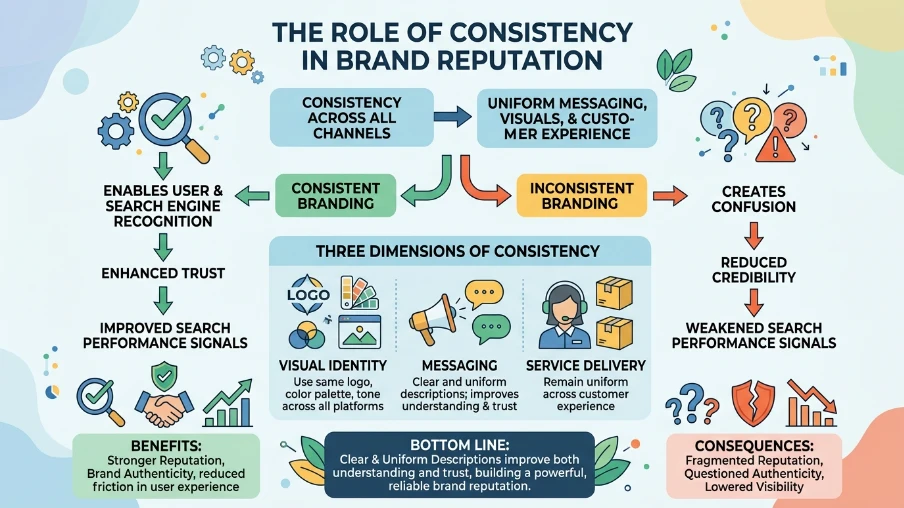
Consistency ensures that messaging, visuals, and customer experience remain uniform across all channels, enabling users and search engines to recognise and trust the brand. Inconsistent branding creates confusion, reducing credibility and weakening search performance signals.
Consistency operates across three dimensions: visual identity, messaging, and service delivery. A business must use the same logo, colour palette, and tone across all platforms. This improves recognition and reduces friction in user experience.
Messaging consistency ensures clarity. If a business describes its services differently across platforms, users may question authenticity. Clear and uniform descriptions improve both understanding and trust.
Service consistency directly impacts reviews. Businesses that deliver predictable outcomes generate stable feedback patterns. This stability influences average ratings and review sentiment.
Search engines also rely on consistency. Entity recognition systems compare structured data across sources. When data aligns, algorithms assign higher confidence scores, improving ranking stability.
Inconsistent signals lead to fragmented perception. For example, if a business lists different operating hours across platforms, users may encounter service gaps, leading to negative reviews.
How do reviews and feedback shape early reputation?
Reviews and feedback shape early reputation by providing third-party validation, influencing purchase decisions, and affecting search rankings. A business with 20 verified reviews and a rating above 4.2 establishes stronger trust compared to one with limited or unmanaged feedback.
Reviews function as social proof. Customers rely on peer experiences to evaluate reliability. Verified reviews carry higher weight because they confirm authenticity.
Feedback also influences algorithmic visibility. Platforms like Google prioritise businesses with frequent, high-quality reviews. Review velocity, sentiment, and response rate all contribute to ranking factors.
Negative feedback plays a role when managed correctly. Businesses that respond professionally to criticism demonstrate accountability. This can improve perception more than having only positive reviews.
Structured review strategies improve outcomes. Businesses must request feedback at defined points, such as after service completion or product delivery. Timing increases response rates.
For a deeper understanding of trust-building components, refer to The Building Blocks of a Trusted Business Reputation, which explains how reviews, consistency, and validation interact.
What strategies improve brand credibility quickly?
Brand credibility improves quickly through verified business listings, transparent communication, consistent content publishing, and active engagement with customer feedback. These strategies create measurable trust signals within 60–90 days of operation.
Credibility requires visible proof. Businesses must validate their presence through official channels. This includes registering with government databases, verifying domains, and securing SSL certificates.
Content publishing builds authority. Businesses that publish 8–12 high-quality articles within the first three months establish topical relevance. These articles must address customer questions and industry-specific topics.
Engagement strengthens credibility. Businesses that interact with users on platforms such as Google and social media create active trust signals. Engagement includes answering questions, responding to comments, and addressing concerns.
Transparency also increases credibility. Businesses that disclose pricing structures, service processes, and timelines reduce uncertainty. Clear information improves user confidence and reduces bounce rates.
Businesses implementing Reputation Management for business strategies can track these metrics and optimise actions based on performance data.
Explore our Reputation Management for business guides,
Why Online Reputation Is Critical for Restaurants and Hotels
What Corporate Reputation Success Stories Teach Businesses
How can businesses protect their reputation proactively?
Businesses protect their reputation proactively by monitoring digital mentions, correcting inaccurate information, and implementing structured response protocols for feedback. Early detection and action prevent negative content from gaining visibility and influence.
Reputation risks emerge from multiple sources. These include incorrect listings, negative reviews, and third-party content. Monitoring tools track mentions across search engines, directories, and social platforms.
Correction processes must be systematic. Businesses must identify inaccuracies, verify correct information, and update listings across all platforms. This ensures consistency and reduces misinformation.
Response protocols define how businesses handle feedback. A structured approach includes acknowledging the issue, providing a solution, and documenting the resolution. This improves customer satisfaction and public perception.
Proactive reputation management also involves content control. Businesses must publish authoritative content that ranks for branded keywords. This ensures that accurate information appears prominently in search results.
For decision-focused insights on long-term strategies, review Reputation Management Services That Build Long-Term Brand Trust, which outlines scalable approaches to maintaining credibility.
Building a positive brand reputation from day one requires structured, consistent, and verifiable actions. Businesses that establish accurate listings, collect authentic reviews, and maintain transparent communication create strong trust signals within the first 90 days. These signals influence both customer perception and search engine evaluation.
Clear My Name delivers structured Reputation Management for business solutions that focus on monitoring, correcting, and strengthening brand perception across digital channels. By implementing data-driven processes and maintaining consistency, businesses achieve stable and credible reputations that support long-term growth.
Frequently Asked Questions
What is reputation management for business and how does it work?
Reputation Management for business involves monitoring, analysing, and improving how a company appears across search engines, review platforms, and social media. Clear My Name applies structured processes such as review management, content optimisation, and data correction to maintain accurate and trustworthy brand visibility.
How long does it take to see results from reputation management for business?
Measurable improvements typically appear within 30 to 90 days, depending on the volume of existing content and issues. Clear My Name focuses on early actions like correcting listings, generating verified reviews, and optimising branded search results to accelerate visibility and trust signals.
Why is online reputation important for small businesses?
Online reputation directly influences customer decisions, as over 80% of users review ratings before choosing a business. Reputation Management for businesses ensures accurate information, positive feedback visibility, and consistent branding, which strengthens trust and improves local search rankings.
Can negative reviews be removed or managed effectively?
Negative reviews cannot always be removed, but they can be addressed through verified dispute processes and professional responses. Clear My Name uses reputation management strategies to respond, suppress harmful content through positive signals, and improve overall rating balance.
What platforms are included in reputation management for business?
Reputation Management for business covers key platforms such as Google Business Profile, Trustpilot, Yelp, and social media channels. Clear My Name ensures consistent business data, monitors mentions, and manages customer feedback across these platforms to maintain credibility.