

Discretion and reputation win retained executive search mandates because organisations evaluate confidentiality, credibility, and professional trust before awarding exclusive recruitment partnerships. Search visibility, entity credibility, and reputation signals collectively influence how executive search firms are assessed within digital search ecosystems.
Reputation management strategies differ based on how they strengthen digital trust, authority signals, and search ranking influence. Online reputation control methods are evaluated through their effectiveness in improving entity credibility, managing sentiment distribution, and maintaining long-term search visibility without compromising confidentiality.
Why Do Discretion and Reputation Matter More Than Visibility Alone?
Discretion and reputation provide stronger competitive advantages than visibility alone because executive search mandates involve confidential leadership appointments rather than high-volume recruitment. Visibility increases awareness, while discretion protects commercially sensitive information and preserves trust between clients, candidates, and recruitment consultants. Search engines evaluate publicly available information, but organisations also assess whether a recruitment firm demonstrates consistent professionalism across every digital touchpoint. Reputation signals therefore extend beyond rankings to include authority, consistency, and credibility. Executive search firms compete by demonstrating reliable judgement rather than generating maximum online exposure.
Search visibility remains important because it determines how organisations first encounter executive search firms. However, search ranking influence produces stronger outcomes when supported by trusted content, authoritative publications, and consistent digital profiles. Excessive promotional content contributes less to entity credibility than expert insights, industry commentary, and verified professional achievements. This comparison demonstrates that visibility introduces credibility, while reputation sustains confidence throughout the retained recruitment process.
How Does Confidentiality Compare With Public Brand Exposure?
Confidentiality operates by limiting unnecessary information disclosure during executive recruitment, whereas public brand exposure focuses on expanding market awareness. Executive search firms routinely manage succession planning, leadership restructuring, and commercially sensitive appointments that require restricted communication. Search ecosystems reward authoritative public information, but confidential recruitment depends upon limiting operational disclosure rather than maximising content publication. These approaches therefore serve complementary rather than competing objectives. Reputation management evaluates how organisations balance discoverability with discretion.
Public exposure strengthens digital authority through thought leadership, executive insights, research publications, and industry analysis. Confidentiality protects client interests by restricting sensitive recruitment activity from public visibility. Comparing these approaches demonstrates that organisations benefit from maintaining strong authority signals while carefully controlling operational information. Search engines interpret published expertise positively, while confidential recruitment safeguards strategic business relationships outside public search environments.
Dive Deeper With Our Expert Guides:
How Do Recruitment Agencies Monitor Their Online Reputation? 7 Tools Compared
What Damages a Recruitment Agency’s Reputation? 9 Triggers Ranked
How Do These Approaches Influence Search Perception?
Search perception develops through the interaction between authoritative visibility and controlled confidentiality. Executive search firms therefore require balanced reputation management rather than prioritising only one strategy.
- Strengthen expert publications that demonstrate executive recruitment expertise through recognised industry analysis.
- Maintain confidential recruitment practices that protect commercially sensitive appointments.
- Develop authoritative leadership content that improves search ranking influence.
- Protect organisational credibility by ensuring sensitive information remains outside public search results.
- Balance visibility with discretion to reinforce sustainable entity credibility.
This integrated approach improves both search perception and professional trust without creating conflicting reputation signals.
Which Reputation Signals Influence Retained Executive Search Decisions?
Retained executive search decisions are influenced by reputation signals that demonstrate authority, consistency, and long-term credibility. Search engines organise these signals through content indexing, semantic relationships, and authority evaluation rather than isolated ranking metrics. Organisations evaluating executive search firms often review leadership articles, industry commentary, conference participation, media interviews, executive biographies, and organisational achievements. These information sources collectively strengthen entity credibility across search ecosystems. Reputation signals therefore provide accessible evidence supporting professional competence before direct engagement begins.
Not all reputation signals contribute equally to search perception. High-authority editorial publications generally provide stronger credibility than repetitive promotional content because search algorithms prioritise trusted sources. Consistent professional profiles reinforce entity relationships by connecting expertise with recognised organisations and industry knowledge. Search ranking influence therefore develops through accumulated authority rather than isolated optimisation. Comparing reputation signals demonstrates that credibility depends upon information quality, consistency, and contextual relevance rather than publication volume alone.
How Does Thought Leadership Compare With Corporate Reputation?
Thought leadership strengthens individual authority by demonstrating recognised expertise within executive recruitment, while corporate reputation reflects the broader credibility of an organisation. Both approaches contribute to search perception, yet they operate through different mechanisms. Thought leadership develops through professional articles, conference presentations, research publications, and expert commentary. Corporate reputation develops through organisational consistency, client recognition, industry standing, and sustained authority across digital channels. Search engines evaluate both entity types independently while also analysing relationships between them.
Executive search firms benefit when organisational reputation and individual expertise reinforce one another. Strong executive consultants enhance organisational credibility through recognised subject expertise, while established firms strengthen consultant authority through institutional trust. Comparing these approaches demonstrates that balanced reputation management produces broader search visibility than relying exclusively on organisational branding or personal visibility. Sustainable authority therefore emerges through complementary reputation signals rather than isolated reputation assets.
Which Reputation Management Strategies Produce Long-Term Trust?
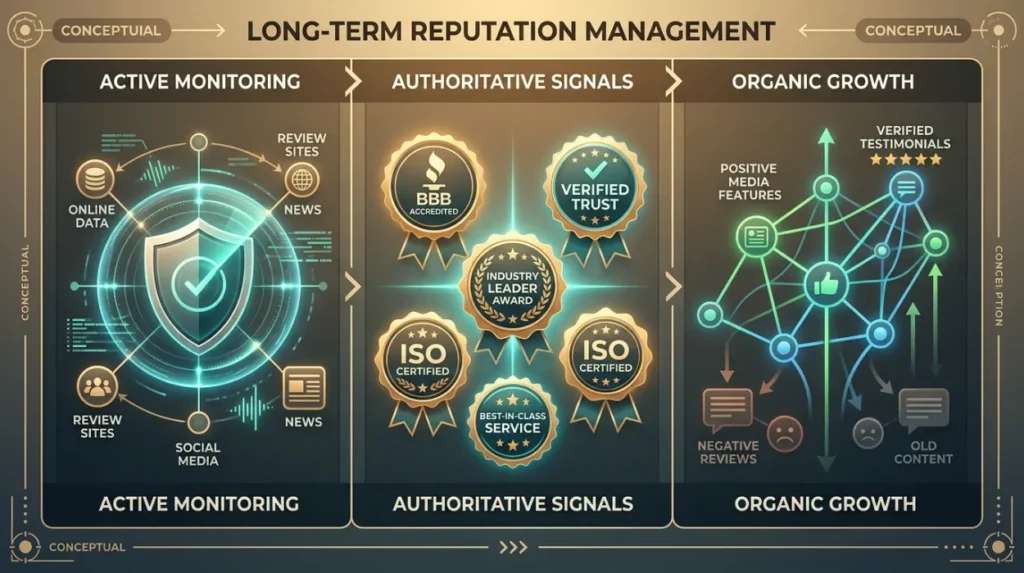
Long-term trust develops through reputation management strategies that consistently strengthen authority, credibility, and information quality across search ecosystems. Short-term optimisation frequently improves temporary visibility, but sustainable reputation depends upon structured information development over extended periods. Search engines continuously evaluate semantic relationships between organisations, leadership expertise, publications, and trusted digital sources. Consistent improvement across these areas reinforces search ranking influence while stabilising entity credibility. Long-term trust therefore operates through cumulative authority rather than isolated optimisation campaigns.
Comparing strategic approaches demonstrates clear differences in sustainability. Reactive reputation management focuses on responding to isolated reputation issues after they become visible, while proactive reputation management builds authoritative digital assets before risks emerge. Proactive strategies strengthen search visibility through expert content, trusted citations, profile consistency, and semantic authority. Reactive approaches remain valuable for resolving immediate reputation concerns but contribute less to long-term search perception. Organisations evaluating executive search partners therefore often interpret sustained authority as evidence of professional reliability.
How Do Proactive and Reactive Reputation Management Approaches Compare?
Proactive reputation management strengthens digital credibility before reputation risks emerge, whereas reactive reputation management responds after negative information, inaccurate content, or declining search perception becomes visible. Both approaches operate within search ecosystems, but they differ significantly in timing, sustainability, and long-term search ranking influence. Search engines continually reassess reputation signals, making consistent optimisation more effective than isolated corrective actions. Proactive strategies develop authoritative digital assets that improve entity credibility over time. Reactive strategies reduce immediate risks but depend upon existing search visibility conditions.
Search perception improves when proactive reputation management establishes trusted content, consistent entity relationships, and authoritative publications before reputation issues occur. Reactive methods frequently involve analysing sentiment distribution, correcting inaccurate information, or strengthening positive content after negative signals appear. Comparing these approaches demonstrates that proactive management creates stronger long-term authority while reactive management provides targeted reputation recovery. Sustainable reputation therefore depends upon combining preventative planning with effective response mechanisms. This balanced strategy strengthens credibility without relying exclusively on corrective action.
Which Factors Make Reputation Management Scalable for Executive Search Firms?
Scalable reputation management depends upon structured processes that improve authority signals consistently across multiple consultants, offices, and digital platforms. Executive search firms require reputation frameworks that maintain professional consistency while supporting organisational growth. Search engines evaluate scalability through content quality, profile accuracy, semantic consistency, and trusted authority rather than publication volume alone. Consistent reputation signals strengthen entity credibility regardless of organisational expansion. Reputation management therefore operates most effectively when strategic processes remain repeatable across all digital assets.
Scalability also depends upon maintaining uniform standards for professional biographies, executive insights, organisational messaging, and authoritative content. Fragmented information weakens entity perception because search engines identify inconsistencies across digital sources. Structured governance improves information quality while reducing reputation risks associated with organisational growth. Comparing scalable and fragmented approaches demonstrates that long-term reputation depends upon operational consistency rather than isolated optimisation efforts. Executive search firms therefore benefit from repeatable reputation management frameworks that reinforce trust throughout expansion.
Which Evaluation Framework Supports Sustainable Reputation Growth?
A structured evaluation framework enables organisations to compare reputation management approaches using measurable search ecosystem indicators.
- Evaluate authority signals by analysing recognised publications, professional profiles, and trusted industry references.
- Measure sentiment distribution across reviews, editorial content, and publicly indexed information.
- Compare search ranking influence before and after reputation improvement initiatives.
- Assess entity credibility through information consistency across authoritative digital sources.
- Review long-term visibility trends to determine whether reputation improvements remain sustainable.
Each evaluation stage contributes objective evidence supporting informed reputation management decisions.
How Do Search Engines Interpret Trust During Executive Recruitment?
Search engines interpret trust through interconnected reputation signals rather than isolated webpages or individual rankings. Authority develops when executive search firms consistently publish reliable information across respected sources while maintaining accurate organisational profiles and recognised industry expertise. Search algorithms compare information quality, contextual relevance, semantic relationships, and source credibility before strengthening entity perception. Trust therefore emerges through cumulative evidence rather than promotional messaging. Executive recruitment benefits from these structured evaluations because they improve confidence in publicly available professional information.
Digital trust also depends upon information stability across time. Consistent executive profiles, verified organisational information, and authoritative thought leadership strengthen semantic relationships recognised by search engines. Contradictory information, outdated profiles, or inconsistent messaging weaken entity credibility because algorithms detect reduced information reliability. Comparing trusted and inconsistent digital ecosystems demonstrates why reputation management extends beyond visibility alone. Trust becomes measurable through sustained authority, search visibility, and reputation signal consistency.
Which Approach Provides the Strongest Long-Term Competitive Advantage?
A balanced reputation management strategy provides the strongest long-term competitive advantage because it integrates authority development, search visibility optimisation, confidentiality, and consistent reputation governance. Visibility alone increases discoverability, while discretion protects sensitive executive recruitment activities. Together, these approaches strengthen entity credibility without compromising confidential client relationships. Search ecosystems reward organisations that consistently publish authoritative information while maintaining reliable digital identities. Sustainable reputation therefore depends upon strategic balance rather than prioritising one reputation factor at the expense of another.
Executive search firms operate within competitive markets where digital credibility influences initial professional evaluation. Search ranking influence strengthens when authoritative publications, consistent profiles, and trusted reputation signals reinforce organisational expertise. Long-term reputation management therefore supports stronger search perception by combining proactive authority building with disciplined confidentiality practices. Organisations comparing executive search partners frequently interpret this balance as evidence of professionalism, reliability, and strategic capability. Additional evaluation of How Do Executive Search Firms Protect Partner Reputations Online? further explains how reputation management strategies strengthen confidential executive recruitment while maintaining digital trust.
Discretion and reputation represent complementary components of retained executive search rather than competing priorities. Confidentiality protects sensitive recruitment activity, while reputation strengthens digital credibility through authoritative content, trusted information, and consistent entity relationships. Search engines interpret these interconnected signals to evaluate professional authority, search ranking influence, and long-term trust. Comparing reputation management approaches demonstrates that sustainable credibility depends upon balanced strategies combining proactive authority development with effective confidentiality practices.
Executive search firms strengthen competitive positioning by maintaining consistent reputation signals, improving entity credibility, and developing authoritative digital assets that support informed decision-making. Long-term reputation management therefore delivers greater sustainability than isolated optimisation because search ecosystems continuously reassess authority, information quality, and semantic relationships. Understanding these comparative approaches provides a stronger foundation for evaluating executive recruitment credibility within modern digital search environments.
How does discretion help executive search firms win retained search mandates?
Discretion protects confidential hiring information throughout the executive recruitment process, reducing reputational and commercial risks. Strong confidentiality practices reinforce trust, which is a key reputation signal when organisations evaluate retained executive search firms.
Why is online reputation important for retained executive search firms?
Online reputation influences how clients assess credibility, expertise, and professional reliability before making contact. Strong reputation signals, authoritative content, and consistent search visibility help executive search firms establish trust within competitive markets.
How do search engines evaluate the reputation of executive search firms?
Search engines assess reputation using content quality, entity credibility, authority signals, content indexing, and information consistency across trusted sources. These factors influence search visibility and shape how executive search firms are perceived in search results.
What is the difference between proactive and reactive reputation management for recruiters?
Proactive reputation management strengthens authority through expert content, profile optimisation, and consistent reputation signals before issues arise. Reactive reputation management focuses on addressing negative content or reputation risks after they affect search perception. Clear My Name provides Reputation Management for Recruiters that supports long-term digital credibility through structured reputation strategies.
Can reputation management improve trust in executive search services?
Reputation management improves trust by strengthening positive reputation signals, increasing authoritative content, and supporting consistent digital visibility. A well-managed online presence enables organisations to evaluate executive search firms using accurate, credible, and relevant information.