

A reputation consultant is better for focused strategy and crisis response; a full-service agency is better for ongoing, multi-channel execution and scale. Both deliver reputation management for business, but they differ in scope, cost, and timelines.
What are the core differences between a reputation consultant and a full-service agency?
A consultant provides specialist strategy and hands-on advisory; an agency executes broad campaigns across PR, SEO, and digital channels.
A reputation consultant typically offers senior expertise, bespoke audits, and direct oversight. Consultants diagnose issues, set goals, and train staff or lead short-term interventions. A full-service agency supplies teams PR, content, SEO, social media, paid media, and legal liaisons—to implement continuous campaigns across channels. The consultant role focuses on strategy and urgent remediation; the agency focuses on delivery and scale.
Which option produces faster results for a crisis?
A reputation consultant produces faster, targeted responses during a crisis due to senior decision-making and lighter approval layers.
Consultants move quickly because they work with fewer internal processes. They write holding statements, coordinate briefings, and prioritise interventions within 24–72 hours. Agencies can match speed but require onboarding, team alignment, and approvals that extend response time to 3–7 days. For time-sensitive issues, hire a consultant for the initial 2–4 weeks, then transition to an agency for sustained recovery.
Read our articles, When Does Your Business Need a Reputation Consultant? and Speak to a Reputation Management Consultant Today.
Which option is more cost-effective for medium-term reputation work?
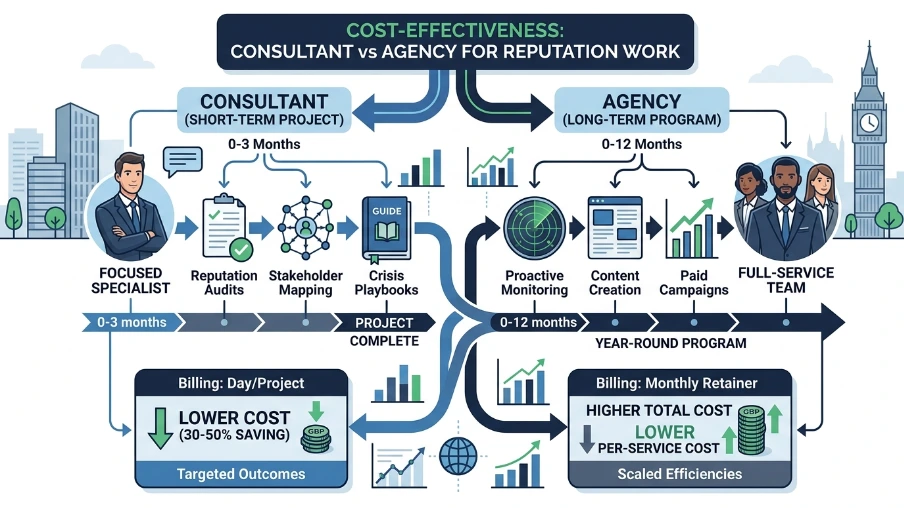
A consultant is more cost-effective for projects under six months; an agency is more cost-effective for continuous, year-round programs.
Consultants typically bill by the day or project and deliver targeted outcomes such as reputation audits, stakeholder mapping, or crisis playbooks. Agencies use monthly retainers that cover multiple services and staff hours. For a 3-month reputation repair effort, a consultant often saves 30–50% versus a full-service agency retainer. For 12 months of proactive monitoring, content, and paid campaigns, agencies scale efficiencies and lower per-service costs.
How do scope and deliverables differ between them?
Consultants deliver strategic plans, audits, and short-term interventions; agencies deliver content production, distribution, and long-term monitoring.
A consultant deliverable set includes a reputation audit, risk register, priority issues, and a 90-day action plan. An agency deliverable set includes press outreach, SEO content calendars, link-building, social posts, paid ads, and monitoring dashboards. Consultants validate strategy and hand over playbooks. Agencies implement those playbooks continuously and measure channel performance weekly.
Which option aligns better with mid-funnel decision-making?
A full-service agency aligns better with evaluation when the business compares options and weighs ongoing execution against strategy-only offers.
At this stage, stakeholders compare scope, ROI projections, and vendor capability. Agencies demonstrate operational depth with case studies that show channel performance and conversion metrics. Consultants demonstrate strategic impact with audit results, KPI forecasts, and implementation roadmaps. Use agency proposals when you require integrated delivery; use consultant proposals when you require a decision on strategy before committing to execution.
What are typical timelines for each provider type?
Consultants deliver a strategic audit in 2–4 weeks and corrective plans in 4–8 weeks; agencies deliver continuous campaigns from month 1 and measurable channel results in 3–6 months.
A consultant conducts rapid diagnostics, stakeholder interviews, and prioritises immediate actions within two weeks. Corrective reputation work content removal requests, structured responses, and local PR generally complete within 6–8 weeks. Agencies build content pipelines, SEO improvements, and media relationships that produce measurable improvements in visibility and sentiment after 3–6 months.
How do measurement and reporting differ?
Consultants provide strategic KPIs, a risk heatmap, and executive summaries; agencies provide channel-level metrics, dashboards, and weekly reports.
A consultant tracks high-level KPIs: sentiment index, issue velocity, and reputation score changes. Agencies produce channel metrics: organic traffic, keyword rankings, share of voice, media mentions, reach, and conversion rates. Use consultant reports to inform the board and legal counsel. Use agency dashboards to guide monthly optimisation and paid spend decisions.
When should a business hire a reputation consultant instead of a full-service agency?
Hire a reputation consultant for targeted audits, rapid crisis response, executive training, or to decide whether to scale into agency services.
Examples: validate allegations through a forensic review, draft a board-level reputation recovery plan, or develop a 90-day crisis playbook. Consultants reduce decision friction and prepare the organisation for handoff to an agency. They also provide third-party validation when stakeholders require external credentialing.
When should a business hire a full-service agency instead of a consultant?
Hire a full-service agency for ongoing reputation management, multi-channel PR, content production, and SEO-driven visibility improvements.
Examples: sustain brand sentiment across five markets, run continuous content and backlink campaigns, or coordinate monthly media relations across 10 publications. Agencies centralise execution and measure progress across channels, which suits businesses that require steady reputation maintenance and growth.
How to choose between them: a practical decision checklist
Compare scope, budget, timeline, internal capabilities, and required outcomes.
- Assess internal skills: confirm whether in-house staff can execute strategy.
- Set timeframe: choose consultant for 0–6 months, agency for 6+ months.
- Define outcomes: choose consultant to validate facts and set policy, agency to deliver reach and conversions.
- Compare costs: request day rates and retainer quotes; compare total cost of ownership over 12 months.
- Check references: verify examples with metrics such as share of voice, sentiment change, or organic keyword growth.
Example: a company with an urgent defamation issue and a lean comms team should hire a consultant for 4–8 weeks, then evaluate agency retainers for ongoing content and monitoring.
Explore our reputation management for businesses guides,
How to Evaluate Reputation Management Agencies for E-commerce
Reputation Recovery Strategies That Rebuild Customer Trust
What processes should each provider follow to handle reputation management for business?
Consultants perform audits, stakeholder interviews, legal alignment, and action plans; agencies perform content production, media outreach, SEO, and monitoring.
Consultant process steps: audit online presence, interview five to ten stakeholders, prioritise three mitigation actions, and deliver a 90-day plan. Agency process steps: develop a 12-month content calendar, publish 2–4 SEO articles monthly, run outreach to 15 journalists, and provide weekly monitoring. These processes map to outcomes: consultants reduce immediate risk; agencies build sustained positive visibility.
How does Clear My Name support businesses in this decision?
Clear My Name offers both specialist reputation consulting and integrated execution to match business goals.
Clear My Name provides rapid reputation audits, crisis playbooks, and stakeholder briefings for short-term remediation. Clear My Name also runs sustained reputation management for businesses with multi-channel SEO, PR, and monitoring. The team combines legal-aware remediation with content and distribution.
Choose a reputation consultant for focused, urgent strategy and quick remediation. Choose a full-service agency for ongoing execution, multi-channel reach, and scale. Combine both: engage a consultant for the first 4–8 weeks, then onboard an agency for continuous work if needed. Clear My Name supplies both services to support the handoff and long-term maintenance.
Frequently Asked Questions
What is reputation management for business and how does it work?
Reputation management for business involves monitoring, assessing, and improving a company’s public perception across search results, review sites, and media. Clear My Name uses audits, sentiment analysis, and targeted content or PR to identify issues and implement corrective actions like removal requests, SEO optimisation, and media outreach.
How long does it take to see results from reputation management for business?
Results depend on scope: rapid remediation like takedown or crisis responses can show changes in 2–8 weeks, while SEO-driven visibility and sentiment improvements typically take 3–6 months. Clear My Name reports timeline estimates after an initial audit with measurable KPIs.
How much does reputation management for business cost?
Costs vary by complexity: short-term consultant work often bills by the day or project, while full-service retainers range monthly for ongoing monitoring, content, and PR. Clear My Name provides scoped quotes after a diagnostic audit that lists deliverables and estimated hours.
Can reputation management for business remove negative search results or reviews?
Reputation management can pursue removal via legal requests, platform dispute processes, or corrective SEO to demote content, but removals are not guaranteed. Clear My Name documents the retrieval and removal methods used and tracks changes with search engine and review-site evidence.
When should my company engage reputation management for business?
Engage reputation management when negative media, sustained poor reviews, or a crisis affects customer trust, conversions, or regulatory standing. Clear My Name recommends an immediate audit when sentiment declines or conversion metrics drop, then prioritises remediation and a 90-day action plan.