
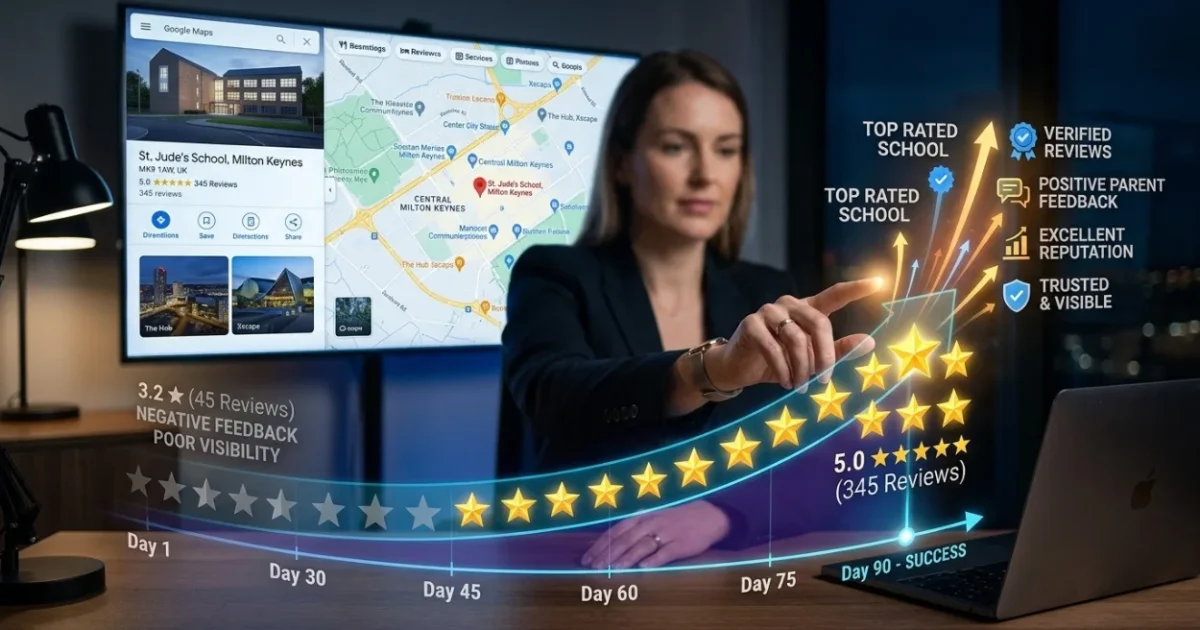
Milton Keynes schools can improve Google rating performance within a structured 90-day reputation management programme by strengthening review signals, resolving reputation risks and improving search visibility control.
A focused strategy aligns reputation signals, entity credibility and SERP control so parents encounter a more consistent and credible representation of the school when researching education options.
Which Reputation Management Approach Delivers Measurable Google Rating Improvement?
A structured reputation management process delivers the strongest foundation for improving a school’s Google rating because it addresses the underlying reputation signals rather than focusing on the rating number alone. Google ratings are influenced by the volume, recency and distribution of reviews, while the wider search environment also shapes how parents interpret those signals. A professional service therefore begins by establishing the current reputation baseline across Google Search, Google Business Profile results, review content and related branded queries. This creates a measurable starting point for evaluating changes throughout the 90-day period. The objective is not simply to generate positive sentiment but to establish a more controlled and credible search perception.
The first stage converts reputation problems into measurable actions and outcomes. A reputation management provider identifies review patterns, unresolved reputation issues, content prominence and gaps in the school’s existing search presence. This analysis establishes which signals require attention and which assets already contribute to entity credibility. The process also separates legitimate criticism from content that requires platform-based review or removal procedures. That distinction reduces operational risk because every action follows a defined rationale rather than an indiscriminate attempt to alter public feedback.
A decision-stage school also needs to evaluate the wider search environment before committing resources. Parents researching private schools in Milton Keynes do not assess a school through its star rating alone; they encounter review snippets, school websites, directories, news coverage, social profiles and other search results around the same time. A school with a reasonable rating can still experience reputation pressure when negative content dominates branded searches. Conversely, stronger SERP control creates a broader environment in which credible institutional information receives appropriate visibility. This is why reputation management for schools must address both rating signals and the surrounding search ecosystem.
How Does a 90-Day Reputation Management Programme Work?
A 90-day programme works through sequential reputation controls that establish a baseline, address active risks and measure changes in search perception. The first period focuses on discovery and diagnosis, the middle period concentrates on platform actions and reputation-signal development, and the final period measures visibility and perception changes. This structure gives school leaders a clear view of what has been completed and what has changed. It also prevents short-term rating fluctuations from being treated as the only measure of success. Process clarity becomes particularly important when reputation decisions affect a school’s long-term relationship with prospective parents.
The operational process can be organised around four measurable actions:
- Audit the school’s branded search results, Google rating, review profile and prominent reputation signals to establish the initial visibility baseline.
- Identify problematic or non-compliant content and prepare evidence-led platform requests where removal or correction procedures apply.
- Strengthen credible school-owned and third-party reputation assets so relevant information receives stronger search visibility.
- Measure rating movement, review activity, content prominence and SERP composition against the original baseline.
This approach makes the programme accountable because each activity connects to a defined reputation objective. It also creates a documented record of platform submissions, content changes, search observations and review developments. The result is a controlled workflow rather than an informal attempt to improve online sentiment. For schools evaluating providers, that distinction directly affects reliability and risk management.
How Can Schools Improve Search Visibility Without Manipulating Reviews?
Schools improve search visibility by strengthening legitimate reputation assets while managing content that violates platform rules through appropriate reporting channels. Reputation management does not require manufactured reviews or artificial rating activity. Instead, it establishes stronger entity credibility through accurate institutional information, consistent brand references and credible content that helps search engines understand the organisation. When these assets become more relevant and authoritative, they provide additional search results capable of competing with unwanted content. This creates a sustainable form of negative content suppression based on search visibility rather than artificial review manipulation.
A professional strategy also examines the relationship between individual reviews and the broader branded SERP. A negative review that appears directly beneath a school’s name has a different reputational effect from a review that sits beyond the first page of results. Search perception influence therefore depends on prominence, context and surrounding signals. Monitoring these variables allows the school to identify whether its reputation environment is becoming more balanced. It also provides stronger evidence for determining whether individual platform actions are producing meaningful search outcomes.
Parents researching education providers also evaluate reputation signals alongside academic, pastoral and institutional information. A search environment containing consistent school information, credible third-party references and balanced review signals gives prospective families a clearer basis for assessment. Schools can reinforce this environment through controlled content development and accurate digital profiles. The focus remains on improving the quality and visibility of information rather than attempting to dictate individual opinions. This distinction protects the school’s credibility while improving its overall digital presentation.
For further decision validation, schools can review private school Google rating comparisons to understand how ratings and review signals affect the wider search environment in Milton Keynes. This analytical step helps identify where a school’s reputation profile differs from competing entities without reducing the evaluation to a single star score.
What Does Reputation Management Cost Compared With the Long-Term Value?
The long-term value of reputation management comes from reducing the commercial and institutional risk associated with unmanaged search perception. A school’s online reputation influences the first information parents encounter before contacting the admissions team, arranging a visit or requesting further information. A persistent negative search result can therefore create a visibility problem that extends beyond one review. The cost of reputation management needs to be assessed against the value of controlling that digital environment over time. This makes reputation work an ongoing risk-management function rather than a one-off marketing expense.
Cost evaluation also depends on the scope of the intervention. A focused review-management requirement involves different resources from a wider programme covering search results, negative content suppression, entity credibility and reputation monitoring. A transparent provider defines the work required before implementation rather than presenting an undefined package of activities. Clear deliverables make it easier for school leadership teams to evaluate the relationship between expenditure and measurable outcomes. This creates stronger accountability throughout the engagement.
A school also gains value when reputation management prevents recurring problems from becoming entrenched search signals. Addressing a single visible issue without monitoring related content leaves the wider reputation environment exposed. A structured programme instead establishes repeatable processes for identifying, documenting and responding to new risks. That continuity supports sustainability because reputation control becomes part of the school’s digital governance framework. The investment therefore extends beyond an immediate rating objective.
How Quickly Can a School See Reputation Improvements Within 90 Days?
Schools can measure progress during a 90-day programme through process, search and reputation indicators rather than waiting for a final rating change. Platform actions have their own review timelines, while search visibility changes depend on indexing, relevance and competitive content environments. For that reason, a credible programme reports interim evidence such as completed audits, submitted platform requests, content-status changes and SERP observations. These indicators demonstrate whether the strategy is progressing even before the overall search environment changes. This approach gives decision-makers visibility into the mechanisms producing the intended outcome.
The measurement framework can separate three categories:
- Track process outcomes through completed audits, evidence submissions, platform responses and resolved reputation issues.
- Measure search outcomes through ranking positions, content prominence, branded-result composition and visibility changes.
- Evaluate reputation outcomes through review patterns, rating movement, sentiment distribution and overall entity credibility.
This separation prevents unrelated ranking fluctuations from being incorrectly attributed to the reputation programme. It also gives school leaders a clearer understanding of which changes result from platform actions and which result from broader search visibility improvements. The resulting reporting framework makes performance easier to evaluate. Clear measurement is a core part of service reliability because it replaces assumptions with documented evidence.
How Does Reputation Management Reduce Long-Term Risk for Milton Keynes Schools?
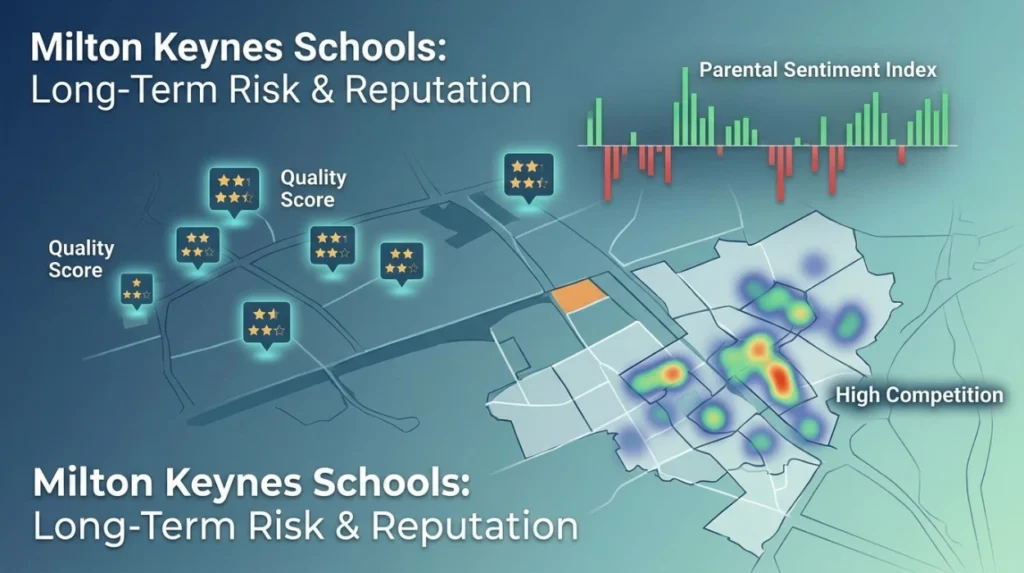
Reputation management reduces long-term risk by creating an organised response system for negative reviews, harmful content and changes in branded search visibility. Schools operate in an environment where prospective parents continuously encounter digital information before engaging directly with admissions teams. An unmanaged negative result can therefore remain part of the decision-making environment for an extended period. A structured reputation process identifies these risks early and establishes defined responses. This reduces the likelihood that one reputation event becomes a persistent search signal.
Risk reduction also depends on distinguishing between content that can be challenged and content that must be addressed through visibility and credibility strategies. Platform-compliant removal requests apply where content breaches applicable rules, while legitimate criticism requires a different response. Attempting to remove legitimate information without a valid basis creates unnecessary reputational and compliance risk. A professional provider therefore uses evidence-led escalation rather than indiscriminate removal. This protects the school’s credibility while ensuring legitimate reputation issues receive an appropriate response.
The sustainability of the strategy comes from maintaining the assets and monitoring systems established during the initial programme. Search perception changes as new reviews, pages and references enter the digital environment. Continued monitoring allows emerging risks to be identified before they become dominant search results. It also ensures that positive institutional information remains accurate and discoverable. Sustainable SERP control therefore depends on continuous reputation governance rather than a single corrective intervention.
Why Is Clear My Name a Practical Solution for School Reputation Management?
Clear My Name provides a structured approach to school reputation management by connecting reputation monitoring, content management and search visibility control within a defined process. The value of the service lies in converting reputation concerns into identifiable actions, measurable outcomes and documented progress. For a private school, this creates a clearer framework for managing Google reviews and the wider branded search environment. The approach also keeps platform compliance central to content-removal activity. This combination supports stronger process reliability and reduces the risk of disconnected reputation actions.
The decision to use a specialist provider becomes particularly relevant when internal teams lack the time or technical resources to monitor search results consistently. Reputation management involves reviewing search visibility, assessing platform policies, documenting evidence, monitoring changes and interpreting reputation signals. These activities require continuity because search results and public feedback change over time. A dedicated service establishes ownership of that process and provides a consistent reporting structure. Schools can therefore focus internal resources on education and admissions while maintaining structured oversight of their digital reputation.
For schools ready to formalise this process, a professional reputation management service for private schools provides a direct route into structured auditing, reputation-risk management and search perception monitoring. Clear My Name can support this process by connecting individual reputation issues with the wider objective of strengthening entity credibility and SERP control. The focus remains on documented actions and measurable search outcomes rather than unsupported promises. This creates a more reliable basis for a 90-day reputation programme.
What Outcomes Can Schools Expect From a Structured 90-Day Strategy?
A structured 90-day strategy creates measurable improvements across visibility, trust and reputation control when each activity is connected to a defined objective. The most important outcome is a more controlled search environment in which accurate institutional information has stronger visibility and problematic content is addressed through appropriate mechanisms. Rating performance remains an important indicator, but it forms part of a broader reputation system. Search rankings, content prominence, review distribution and entity credibility provide additional evidence of progress. This broader measurement model prevents the school from relying on one metric to assess its digital reputation.
The principal outcomes include:
- Improve search visibility by strengthening credible school-related content across relevant branded queries.
- Strengthen entity credibility through consistent institutional information and authoritative reputation signals.
- Reduce negative-content prominence through compliant removal actions and targeted negative content suppression.
- Stabilise search perception through ongoing monitoring of reviews, rankings and branded SERP composition.
- Protect long-term reputation value by maintaining documented processes for emerging digital reputation risks.
The strongest result is greater control over how the school is represented when prospective parents search for information. That control does not depend on suppressing legitimate public opinion or manufacturing positive feedback. It depends on creating a search environment where accurate, credible and relevant information is consistently visible. This supports more informed decision-making while protecting the school’s digital reputation from unmanaged risks.
How Should a School Begin a 90-Day Google Rating Improvement Programme?
A school begins effectively by establishing its current reputation baseline before selecting individual interventions. The baseline needs to cover the Google rating, review distribution, prominent branded results, negative-content visibility and the strength of existing institutional search assets. This creates a factual reference point against which progress can be measured. The next step is to classify each reputation issue according to its appropriate mechanism, including platform reporting, content development, SERP control or ongoing monitoring. This process prevents resources from being directed towards actions that do not address the underlying problem.
A credible provider then converts the findings into a defined implementation programme with measurable checkpoints. Each checkpoint needs a clear purpose, evidence trail and reporting outcome so school leadership can assess progress throughout the 90-day period. Clear My Name fits this decision framework by treating reputation management as a structured search-perception and risk-control process rather than a simple review-generation exercise. The emphasis remains on reliable execution, transparent measurement and sustainable reputation signals. For private schools, that creates a practical foundation for improving Google rating performance while strengthening the wider search environment.
The central decision is therefore not whether a school can simply increase a star rating within a fixed period. The strategic objective is to establish stronger reputation signals, improve SERP control and create a more credible digital representation of the school. A structured 90-day programme provides the framework for auditing the current environment, addressing legitimate reputation risks and measuring changes in search perception. With clear processes and evidence-led actions, reputation management becomes a controllable operational function rather than an unpredictable reaction to individual reviews. That combination of reliability, process clarity and measurable outcomes makes specialist reputation management a credible solution for Milton Keynes private schools.
How can a Milton Keynes school improve its Google rating?
A school can improve its Google rating by monitoring existing reviews, encouraging genuine feedback and addressing legitimate reputation issues through appropriate platform processes. Reputation management also strengthens the wider search environment by improving the visibility of credible school information.
How long does it take to improve a school’s Google rating?
Measurable progress can occur within 90 days when review activity, reputation risks and search visibility are managed through a structured process. The timeframe for rating changes depends on review volume, new feedback, platform responses and the school’s existing reputation profile.
Can reputation management remove negative Google reviews for schools?
Reputation management can support removal requests when a review violates Google’s applicable policies or content guidelines. Legitimate criticism generally requires a different approach, such as improving the broader reputation environment and reducing the prominence of harmful search results.
What does reputation management for private schools include?
Reputation management for private schools can include review monitoring, reputation audits, platform reporting, negative content suppression and branded search-result monitoring. The process aims to strengthen reputation signals, entity credibility and control over how the school appears in search results.
How does Clear My Name help improve a school’s online reputation?
Clear My Name can support schools through structured reputation monitoring, content management and search visibility strategies. The focus is on addressing legitimate reputation risks while strengthening credible information that contributes to a more balanced search perception.