
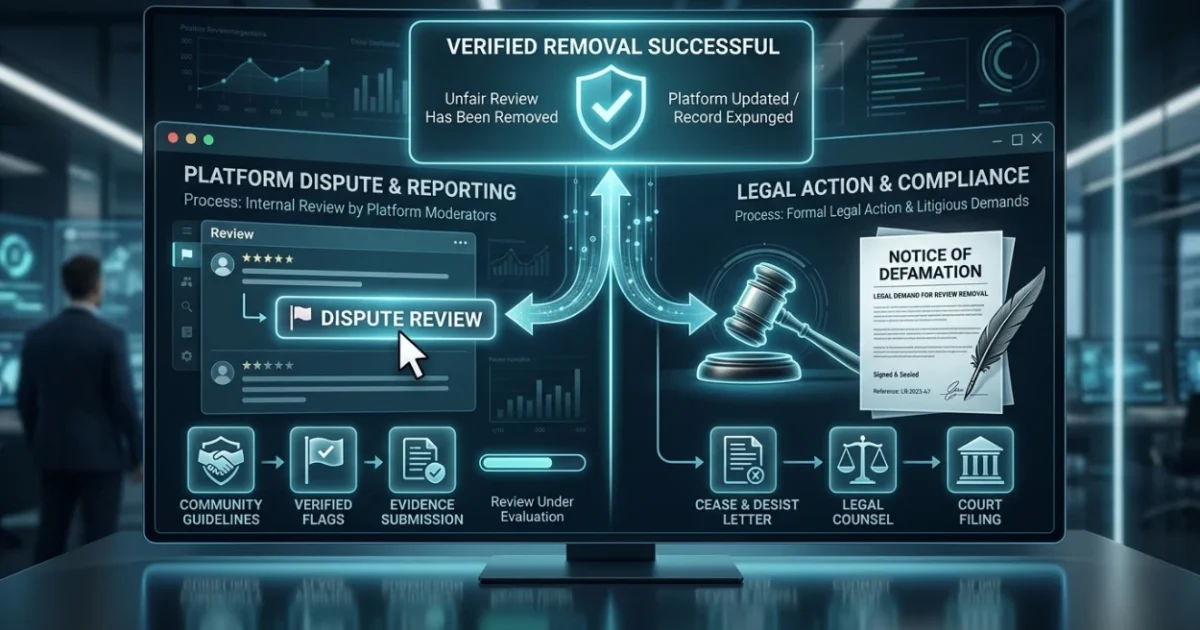
Recruiters can address unfair Trustpilot reviews through platform reporting, evidence-led disputes and, where appropriate, legal routes. A structured reputation management process strengthens SERP control, reduces damaging review visibility and protects the trust signals employers use when assessing recruitment agencies.
Which approach gives recruiters the strongest route for removing an unfair Trustpilot review?
A platform-first, evidence-led process gives recruiters the clearest route for challenging an unfair Trustpilot review. Trustpilot applies review guidelines governing relevance, authenticity, personal experiences and prohibited content, so removal depends on demonstrating a specific policy issue rather than simply showing that a review is negative. A recruiter needs to identify the exact problem, preserve supporting evidence and submit a focused report through the appropriate platform process. This creates a documented record of the dispute and separates legitimate criticism from content that breaches platform rules. When removal is unavailable, reputation management shifts towards reducing the review’s prominence and strengthening the wider search ecosystem around the recruiter.
The distinction between an unfair review and an unfavourable review is critical. A review that accurately reflects a genuine customer or candidate experience is not automatically removable because it damages commercial reputation. A stronger case exists where evidence indicates impersonation, fabricated experience, promotional content, irrelevant material, personal data exposure or another breach of Trustpilot’s rules. This makes evidence quality central to the process, because unsupported assertions provide little basis for platform action. Recruiters also need to avoid retaliatory responses that create additional reputational risk. A controlled process protects both the agency’s entity credibility and its ability to demonstrate responsible review management.
How does Trustpilot’s platform route work for disputed recruiter reviews?
Trustpilot reporting works by connecting the disputed review to a specific guideline concern and supporting that concern with relevant evidence. The process starts with identifying the review, recording its publication details and determining which element creates the dispute. Evidence then needs to demonstrate why the content falls outside the platform’s permitted review framework. Screenshots, customer records, recruitment correspondence and other relevant documentation can establish the factual context without exposing unnecessary personal information. The objective is not simply to request deletion but to present a verifiable policy-based case.
A disciplined reporting process also improves risk control when the review remains live. Every action can be recorded, including the original review, reporting reason, evidence submitted, platform response and subsequent developments. This creates an audit trail that supports further platform engagement and informs wider reputation management decisions. If the platform rejects a report, the evidence can still help determine whether another reporting route exists. The same information also informs negative content suppression strategies when removal does not occur. Process clarity therefore remains valuable regardless of the initial platform outcome.
What evidence makes a Trustpilot review dispute stronger?
A stronger dispute connects the review to an identifiable factual or policy problem rather than relying on general claims that the content is unfair. Relevant evidence establishes whether the reviewer had a genuine interaction with the recruitment business, whether the statements describe a real experience and whether the content contains prohibited material. Recruiters also need to distinguish factual inaccuracies from subjective dissatisfaction because these issues receive different treatment. Maintaining contemporaneous records makes that distinction easier to establish. Evidence-led handling reduces the risk of submitting an unsupported complaint that fails to address the platform’s criteria.
When does legal action become relevant to unfair Trustpilot reviews?
Legal routes become relevant when a review creates a substantive legal issue beyond ordinary negative feedback. In the UK, potentially defamatory statements require careful assessment of the specific words used, their publication, the factual context and the applicable legal tests. A recruiter needs qualified legal advice before making allegations of defamation or sending formal legal correspondence. The purpose of legal escalation is to address a defined legal issue, not simply to pressure a platform into removing criticism. This distinction reduces the risk of escalating a legitimate complaint into a wider dispute.
Legal considerations also extend to privacy and personal-data exposure. A Trustpilot review containing unnecessary personal information about employees, candidates or other identifiable individuals creates a separate risk from a review that simply expresses dissatisfaction. Documentation needs to establish what information has been published, why it creates a problem and which legal or platform mechanism addresses it. A reputation management process can organise this evidence while legal advisers determine the appropriate legal response. Keeping these functions separate creates clearer accountability and reduces avoidable errors.
Should recruiters use reputation management when Trustpilot refuses removal?
Yes, reputation management becomes particularly valuable when legitimate platform removal routes have been exhausted. The objective then changes from deletion to controlling how damaging content appears within the broader search ecosystem. Search perception is shaped by the combination of review pages, branded results, company information, positive third-party references and other reputation signals. A single Trustpilot page can therefore represent only one component of an agency’s overall SERP environment. Strategic content development and digital asset optimisation help strengthen relevant pages while reducing the relative visibility of damaging material.
A professional reputation management for recruiters strategy connects review monitoring with search perception influence. It assesses which pages rank for the agency name, which review terms trigger negative results and which assets provide credible alternative information. The process then strengthens relevant digital properties through technically sound optimisation, useful content and consistent entity information. This does not require manipulating Trustpilot’s rating or suppressing legitimate criticism through deceptive methods. Instead, it improves the information environment that employers and candidates encounter when researching the recruiter.
How does negative review suppression protect a recruitment agency’s search visibility?
Negative content suppression focuses on reducing the prominence of damaging pages through stronger, relevant and authoritative search assets. Search engines evaluate relevance, authority and other signals when determining which pages appear for branded and reputation-related queries. A recruiter cannot directly command search engines to remove an independently hosted review page simply because it is unfavourable. The practical alternative involves building a stronger search ecosystem around legitimate first-party and third-party information. Over time, this can alter the composition of branded search results and improve SERP control.
What outcomes can recruiters measure from reputation management?
- Track branded-query rankings to identify changes in the position and visibility of damaging review pages.
- Monitor review-related search terms to measure whether negative queries continue triggering the same content.
- Strengthen authoritative digital assets to increase their relevance for recruiter and agency-name searches.
- Audit entity consistency across important profiles to reduce conflicting business information.
- Measure sentiment patterns across reviews and search results to identify changes in public perception.
These measurements create a more reliable basis for evaluating reputation work than focusing exclusively on a Trustpilot star rating. A successful process demonstrates movement across visibility, content prominence and entity credibility rather than relying on a single metric. Recruiters also gain clearer evidence about which search queries create the greatest commercial exposure. That information allows resources to be directed towards the reputation issues most closely connected to employer and candidate decision-making. Measurement therefore converts reputation management from reactive review handling into an ongoing search visibility discipline.
How quickly can recruiters expect results from Trustpilot reputation management?

Platform disputes can produce an outcome according to the platform’s review and reporting process, while search visibility work operates according to search-engine indexing and ranking cycles. These are different mechanisms and require separate expectations. A review dispute therefore needs an immediate evidence and reporting phase, whereas SERP improvement requires sustained optimisation and content development. Treating both as one process creates unrealistic expectations about speed. Treating them as connected workstreams provides clearer control over immediate risk and longer-term visibility.
The first priority is usually containment. Recruiters need to document the damaging content, assess the potential policy or legal issue and prevent further reputational deterioration through poorly considered responses. The next stage involves strengthening relevant search assets and monitoring branded queries. Progress can then be assessed through ranking positions, indexed pages, review trends and the visibility of negative results. This staged approach provides measurable checkpoints rather than relying on a promise of instant removal. It also creates a sustainable framework for managing future reputation incidents.
Is the cost of reputation management justified compared with the long-term risk of an unfair review?
The commercial value of reputation management relates to the visibility and decision-making impact of reputation signals rather than the review itself. Employers researching a recruitment agency can encounter Trustpilot results alongside company pages, industry profiles, news coverage and other search assets. If damaging content consistently occupies prominent positions, it becomes part of the information environment surrounding the agency’s entity. The resulting exposure can affect trust formation before a prospective client speaks with the recruiter. Addressing the wider search environment therefore protects a business asset that extends beyond one review platform.
Cost evaluation also needs to account for sustainability. A one-off response that removes or challenges a single review does not establish a complete reputation control system. An effective programme incorporates monitoring, evidence management, search analysis, content optimisation and review-response governance. This creates repeatable processes for future incidents rather than restarting from zero whenever a new negative result appears. The long-term value lies in establishing a controlled reputation infrastructure that continues operating after the original review dispute has ended.
Dive Deeper With Our Expert Guides:
What Does Multilingual Reputation Management Cost for Recruitment Firms?
How Do International Recruiters Remove Scam Allegations From Google Results?
How does Clear My Name reduce risk when recruiters face damaging Trustpilot content?
Clear My Name approaches recruiter reputation management through structured assessment, evidence gathering and search visibility control. The process begins by identifying the content affecting the recruitment agency’s search perception and distinguishing platform issues from broader SERP problems. Where a review presents a potential policy issue, the evidence can be organised around the relevant reporting route. Where removal is unavailable, the strategy can shift towards negative content suppression and strengthening credible search assets. This separation of removal, legal considerations and search optimisation provides a clearer risk-management framework.
A robust process also avoids making removal the only measure of success. Trust restoration depends on the broader information environment that employers encounter when researching a recruiter. Clear My Name can therefore focus on visibility, entity credibility and the prominence of trustworthy information alongside review-related issues. The result is a measurable strategy built around search results and reputation signals rather than an unsupported promise that every negative review disappears. For recruitment businesses where employer confidence directly affects commercial opportunities, that distinction provides stronger long-term reputation control.
What should recruiters check before choosing a reputation management service?
Recruiters need to examine the process, evidence standards, reporting methods and measurement framework before engaging a reputation management provider. A credible service explains which content qualifies for platform reporting, which issues require legal advice and which problems require search visibility management. It also defines the metrics used to evaluate progress, including rankings, content visibility and branded-query exposure. This level of transparency reduces the risk of paying for vague reputation promises without measurable deliverables. Clear communication about limitations is equally important because no legitimate service controls an independent platform or search engine.
Recruiters can also validate whether the service uses sustainable methods. The strategy needs to rely on legitimate content, accurate business information, policy-compliant reporting and search optimisation rather than fabricated reviews or deceptive tactics. Sustainable reputation management strengthens the underlying digital entity instead of creating additional compliance exposure. This matters because short-term manipulation can create a second reputation problem while attempting to solve the first. A transparent methodology therefore provides stronger risk reduction and greater continuity.
For businesses evaluating the commercial consequences of recruitment services, understanding sales recruitment agency fees and the wider recruitment model provides useful context before assessing reputation-related exposure. The next layer is understanding how Trustpilot scores for sales recruiters contribute to the signals employers encounter during supplier research. Together, these stages connect commercial evaluation with the search perception factors that influence initial trust.
Why does process clarity matter when repairing a recruiter’s online reputation?
Process clarity converts an unpredictable reputation problem into a sequence of controlled decisions. The recruiter first identifies the damaging content, then classifies the issue as a platform, legal or search visibility matter. Evidence is gathered before action is taken, and every action is documented for accountability. Search performance is then monitored against defined metrics rather than judged through subjective impressions. This structure reduces operational risk and provides a clear explanation of what has happened at each stage.
The long-term objective is a stable search environment in which legitimate, authoritative information represents the recruitment agency accurately. That requires continuous monitoring because reviews, search rankings and third-party content change over time. A reputation management programme therefore functions as an ongoing control system rather than a one-time deletion request. Clear My Name provides a structured route for recruiters that need review disputes, search visibility and reputation signals managed within one coherent process. For a recruitment business, that combination delivers clearer risk control, measurable visibility management and a more stable basis for employer trust.
When an unfair Trustpilot review creates commercial exposure, the most reliable response combines evidence-led platform action, appropriate legal assessment and sustained SERP control. Removal remains one route, not the entire strategy. A complete reputation management process protects search visibility, strengthens entity credibility and reduces the risk that one disputed review becomes the dominant representation of a recruitment agency online.
Can recruiters remove unfair Trustpilot reviews?
Recruiters can report Trustpilot reviews that breach the platform’s guidelines, such as reviews containing prohibited content, irrelevant material or evidence of an inauthentic experience. Removal depends on Trustpilot’s review process and the evidence provided.
How do I report a false Trustpilot review?
A recruiter can use Trustpilot’s reporting process and identify the specific guideline issue affecting the review. Supporting evidence that demonstrates the factual or policy problem helps create a clearer basis for the dispute.
Can a solicitor help remove a defamatory Trustpilot review?
A solicitor can assess whether a Trustpilot review raises a potential defamation or other legal issue under UK law. Legal correspondence can form part of the response where the specific content and circumstances justify escalation.
What happens if Trustpilot refuses to remove a negative review?
If Trustpilot does not remove the review, reputation management can focus on reducing its search visibility and strengthening credible content around the recruitment agency. This approach supports negative content suppression and improves overall SERP control without attempting to manipulate the review itself.
Can Clear My Name help recruiters manage unfair Trustpilot reviews?
Clear My Name provides reputation management for recruiters that can address review disputes, search visibility and damaging online content. The process focuses on evidence-led action, reputation signals and improving the wider search environment surrounding a recruitment agency.