

Manufacturing recruitment in the UK connects employers with candidates for production, engineering, quality, maintenance and operational roles based on skills, experience and workforce requirements. Reputation management is the structured process of monitoring, analysing and influencing how an organisation or professional entity is represented and interpreted across online information systems.
What does manufacturing recruitment involve in the UK?
Manufacturing recruitment refers to the process of identifying, evaluating and placing candidates into roles across the UK’s manufacturing sector. Employers typically recruit for positions covering production operations, engineering, maintenance, quality assurance, supply chain, logistics and technical management. Recruitment activity therefore depends on the relationship between job requirements, candidate qualifications, industry experience and employer expectations. Within search ecosystems, the same recruitment process also produces digital information about employers, recruiters and professional entities. Job advertisements, company pages, professional profiles, reviews and industry references contribute to the digital footprint associated with a recruitment organisation.
The recruitment process normally begins with an employer defining a vacancy and establishing the competencies required for successful performance. A recruiter then evaluates candidate information against factors such as technical qualifications, previous employment, sector experience and role-specific skills. Candidate sourcing can involve recruitment databases, professional networks, job platforms and search engines. Each stage creates information that contributes to how a recruitment entity is understood online. Reputation signals therefore exist alongside operational recruitment activity rather than functioning as a completely separate information system.
How does online reputation influence manufacturing recruitment?
Online reputation influences manufacturing recruitment by shaping the information environment in which employers and candidates evaluate recruitment entities. Online reputation refers to the collection of perceptions, references, reviews, published content and other information associated with an entity across digital platforms. Search engines organise this information into indexed results, while users interpret the resulting content according to relevance, authority and perceived credibility. A recruitment organisation with a consistent digital footprint presents a clearer entity representation than one surrounded by fragmented or contradictory information. Reputation therefore forms part of the broader search perception surrounding a recruitment entity.
Manufacturing recruitment involves professional relationships between recruiters, employers and candidates, making credibility an important information signal. Employers assess whether a recruiter appears knowledgeable about technical roles, employment requirements and sector-specific recruitment processes. Candidates also evaluate whether available information presents a consistent representation of the organisation. Search visibility determines which information receives attention during these evaluations. Consequently, reputation signals influence perception through the interaction between indexed content, search rankings and user interpretation.
How do search engines evaluate reputation signals?
Search engines evaluate reputation through signals derived from content, entities, references, links, reviews and contextual relationships across indexed information. A reputation signal is an identifiable piece of information that contributes to the perceived authority, relevance or credibility of an entity. Search systems analyse content relationships rather than relying on one isolated statement to establish an entity’s overall representation. Consistency between an organisation’s name, activities, expertise and associated information helps establish clearer entity relationships. Contradictory or poorly supported information creates a less coherent search representation.
SERP evaluation also depends on relevance to the query being performed. When a user searches for a manufacturing recruiter, the search engine evaluates available pages according to their relationship with recruitment, manufacturing, employment and the specific entity involved. Content indexing makes these pages available for retrieval, while ranking systems determine their position within the results. The resulting SERP therefore represents an algorithmic selection of available information rather than a complete record of an organisation. Reputation analysis requires examining this information ecosystem as a connected structure.
How does content affect the reputation of manufacturing recruiters?
Content affects recruiter reputation by defining the information available for search engines and users to interpret. Content refers to published material such as recruitment pages, job descriptions, professional profiles, company information, articles, reviews and external references. Each indexed page provides contextual information about an entity and contributes to its digital footprint. Search engines use textual relationships, topical relevance and entity associations to understand what a page represents. The quality and consistency of this information influence how clearly the recruiter is represented within search results.
A strong content structure establishes direct relationships between the recruiter, manufacturing recruitment and relevant professional expertise. A page describing engineering recruitment, for example, provides contextual information connecting the entity with engineering roles and manufacturing employment. Another page discussing production recruitment establishes a separate but related topical association. These relationships create a broader semantic representation of the recruitment entity. Content therefore functions as an information layer through which search engines interpret professional relevance and authority.
How do reviews and sentiment affect recruiter reputation?

Reviews provide reputation signals by recording user-generated evaluations of an organisation, service or professional interaction. Review signals consist of factors such as rating patterns, written feedback, review frequency, topic relevance and sentiment. Sentiment interpretation identifies whether language associated with an entity expresses positive, negative or neutral evaluations. Search engines and users can interpret these signals differently, so a review does not automatically determine an entity’s overall reputation. The wider collection of information provides the context required for meaningful reputation analysis.
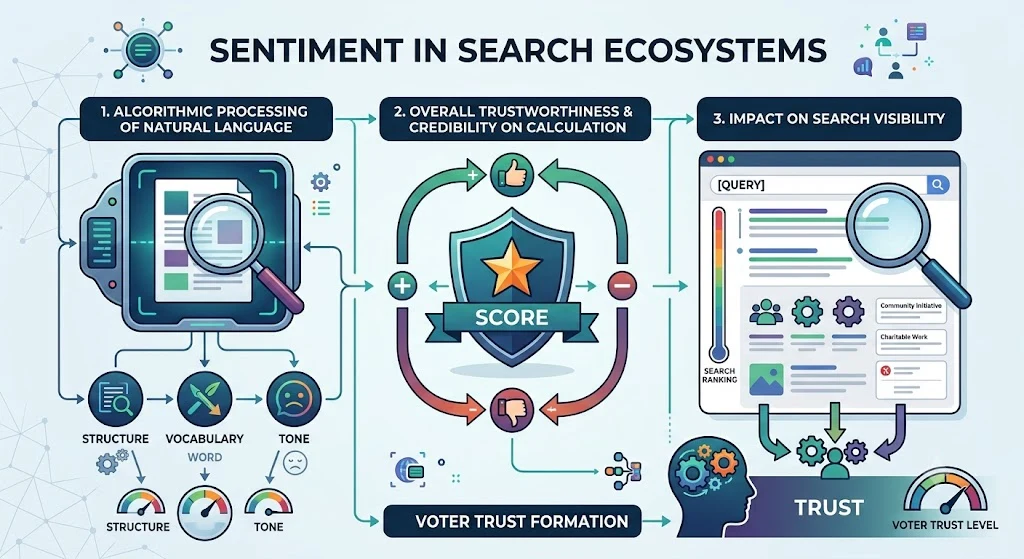
Sentiment also requires semantic interpretation rather than simple counting. A review containing positive language about communication but criticism of response times presents multiple reputation attributes within one document. Search systems process the textual context surrounding these attributes, while users interpret the information according to their own priorities. Consistent themes across independent reviews provide stronger contextual evidence than an isolated statement. Reputation analysis therefore examines patterns, topics and relationships rather than treating individual ratings as complete representations of an entity.
How do authority and trust signals develop online?
Authority and trust signals develop through consistent evidence connecting an entity with relevant expertise, accurate information and credible external references. Authority refers to the strength of an entity’s recognised expertise within a defined topical area. Trust relates to the reliability and consistency of information associated with that entity. Within search ecosystems, these concepts are represented through content quality, contextual relevance, references, professional information and broader entity relationships. Search visibility increases the exposure of these signals but does not independently establish their validity.
For manufacturing recruiters, topical authority relates closely to demonstrated understanding of recruitment categories and industry requirements. Content covering production roles, engineering recruitment, quality control, technical positions and manufacturing workforce requirements establishes relevant semantic associations. Professional information that remains consistent across indexed sources strengthens entity clarity. External references provide additional context by connecting the recruiter with related organisations, publications or professional subjects. These signals collectively contribute to the information environment in which credibility is evaluated.
How does a digital footprint shape recruiter perception?
A digital footprint is the collection of publicly available information associated with an individual or organisation across online platforms. It includes indexed webpages, professional profiles, reviews, directories, publications, social content and other searchable references. The footprint determines the information available when users conduct branded or non-branded searches. Search engines organise these sources into SERPs according to relevance and ranking signals. Users then construct an impression of the entity from the information that appears within the visible search environment.
A fragmented digital footprint creates disconnected information relationships between an entity and its professional activities. Differences in names, job descriptions, company information or professional claims can create ambiguity during entity interpretation. A consistent footprint establishes stronger relationships between the organisation, its services, expertise and industry context. This distinction is particularly relevant to recruitment because employers frequently investigate professional information before establishing business relationships. Search perception therefore depends partly on the coherence of the available digital footprint.
Dive Deeper With Our Expert Guides:
How Do Marketing Recruitment Agencies Source Candidates in 2026?
Best Marketing Recruitment Agencies UK: 2026 Guide for Employers
How does entity perception affect employer trust in recruiters?
Entity perception refers to how a search ecosystem represents and contextualises a particular organisation, person or professional entity. In recruitment, entity perception develops from the relationship between an organisation’s published information, external references, reviews and professional associations. Employers interpret these signals when assessing whether a recruiter appears relevant to their workforce requirements. Search results therefore act as an information interface between the recruiter and the employer. The information presented within that interface influences the initial understanding of the entity.
This relationship becomes more significant when recruitment involves specialist manufacturing roles. Employers seeking technical candidates need information that establishes relevant sector knowledge and professional credibility. A recruiter associated consistently with manufacturing, engineering, production or technical recruitment creates a clearer semantic identity. Conversely, unrelated or contradictory information weakens the clarity of the entity representation. Search perception consequently depends on both the quantity and contextual quality of indexed information.
How does reputation management relate to manufacturing recruitment?
Reputation management is the structured monitoring, analysis and management of information that influences how an entity is represented online. In manufacturing recruitment, reputation management relates to the accuracy, consistency and credibility of information associated with recruiters, recruitment professionals and organisations. It does not replace recruitment operations; instead, it examines the information environment surrounding those operations. This distinction separates reputation analysis from direct candidate sourcing or vacancy management.
A structured reputation approach evaluates indexed content, review signals, entity relationships, authority indicators and search visibility. It also considers whether information accurately represents the entity’s professional history and activities. For sensitive reputation issues, factual accuracy and legal boundaries remain essential because attempts to manipulate information without considering search quality create additional risk. How Does Reputation Decide Which Manufacturing Recruiters Employers Trust? This question connects recruitment activity with the wider mechanisms through which employers evaluate online credibility.
How does accurate information support reputation in recruitment?
Accurate information supports reputation by providing search engines and users with reliable evidence about an entity’s professional identity. Accuracy refers to the consistency of factual claims with verifiable information about an organisation, its activities and its professional relationships. Search ecosystems depend on indexed information to construct entity representations, making factual reliability an important component of digital credibility. Incorrect information can create conflicting associations that affect how an entity is interpreted. Accurate content instead establishes clearer semantic relationships between the recruiter and relevant professional topics.
Accuracy also applies to professional history, business relationships and previous conduct when these subjects appear in searchable information. A politician’s past business dealings, for example, require careful factual treatment because public figures receive heightened scrutiny from voters, journalists and other information-seeking audiences. The same principle applies to professional entities operating within recruitment. Reputation analysis therefore prioritises evidence, context and factual consistency rather than attempting to manufacture a preferred perception.
How will manufacturing recruitment demand affect online reputation?
Manufacturing recruitment demand affects online reputation because increased recruitment activity generates more searchable information about employers, recruiters, vacancies and professional expertise. Growing demand for technical and operational roles produces additional job pages, recruitment content, professional discussions and candidate interactions. Each source contributes to the wider digital footprint surrounding manufacturing recruitment. Search engines process this information according to relevance, quality and contextual relationships. The expansion of recruitment activity therefore expands the information ecosystem in which recruiter reputation develops.
The relationship between recruitment demand and reputation remains informational rather than purely promotional. A recruiter operating across engineering, production, maintenance or quality roles accumulates topical associations through published and referenced information. Consistent information strengthens the clarity of these associations, while inaccurate or contradictory information introduces ambiguity. Reputation consequently develops through the continuous interaction between professional activity and its online representation.
What are the key principles of reputation in manufacturing recruitment?
Reputation in manufacturing recruitment is best understood as an information system involving content, entities, search visibility, reviews and trust signals. The key principles are:
- Maintain accuracy — Ensure published professional information corresponds with verifiable facts so search engines and users receive consistent entity signals.
- Establish relevance — Connect recruitment content with specific manufacturing disciplines, roles and workforce requirements so topical relationships remain clear.
- Strengthen consistency — Align names, professional descriptions and organisational information across indexed sources to reduce entity ambiguity.
- Evaluate sentiment — Analyse review language and recurring themes to understand how users describe professional interactions and recruitment experiences.
- Monitor search visibility — Examine SERP results and indexed content to understand which reputation signals users encounter during relevant searches.
Manufacturing recruitment in the UK operates through the interaction of employer requirements, candidate qualifications, specialist roles and recruitment processes. Its online reputation develops through a parallel information system involving digital footprints, indexed content, reviews, authority signals and entity perception. Search engines organise these signals into SERPs, while employers and candidates interpret the resulting information when evaluating professional credibility. Accurate, relevant and consistent information therefore provides the foundation for a coherent recruitment reputation. Understanding these mechanisms explains how reputation develops within search ecosystems without treating reputation as a simple measure of popularity.
What is manufacturing recruitment in the UK?
Manufacturing recruitment is the process of finding and placing candidates into production, engineering, maintenance, quality control and other manufacturing roles. It involves matching candidates’ skills and experience with specific employer requirements.
What roles are commonly recruited for in UK manufacturing?
Common manufacturing recruitment roles include production operatives, engineers, maintenance technicians, quality inspectors, production managers and supply chain professionals. Demand varies according to industry, technical requirements and workforce needs.
What qualifications do manufacturing recruiters look for?
Manufacturing recruiters typically assess technical qualifications, practical experience, industry knowledge and role-specific skills. Requirements vary between positions, with engineering and specialist technical roles often requiring relevant qualifications or certifications.
How does online reputation affect manufacturing recruiters?
Online reputation influences how employers and candidates interpret a manufacturing recruiter’s credibility and professional expertise. Reviews, search results, professional profiles and relevant recruitment content contribute to reputation signals and overall entity perception.
How can employers evaluate a manufacturing recruiter’s credibility online?
Employers can evaluate a manufacturing recruiter by reviewing search results, professional information, industry expertise, client or candidate reviews and the consistency of published information. A clear digital footprint and accurate, relevant content provide useful reputation signals during the evaluation process.