

Facebook reviews influence B2B vendor vetting by providing publicly accessible reputation signals about customer experience, reliability and business conduct. Reputation management is the structured analysis of information that shapes how an organisation is perceived across digital environments, while online reputation refers to the collective representation created by reviews, content, references and other searchable signals.
How Do Facebook Reviews Contribute to B2B Vendor Vetting?
Facebook reviews contribute to B2B vendor vetting by functioning as third-party reputation signals that procurement teams can evaluate alongside other business information. A review is user-generated content attached to a business entity, creating an accessible record of customer sentiment and reported experience. B2B buyers interpret this information as one component of a broader due-diligence process rather than as an isolated measure of supplier quality. The relevance of a review increases when its subject matter relates directly to reliability, communication, service delivery or commercial conduct. Facebook therefore forms part of the digital footprint that procurement teams encounter when assessing potential vendors.
The interpretation of reviews depends on context, consistency and source credibility. A single comment represents a limited information point, while a broader pattern of reviews creates a more meaningful sentiment distribution. Procurement professionals analyse recurring themes because repeated references to the same operational characteristic provide stronger contextual evidence. Positive and negative reviews also carry different informational meanings depending on their specificity and relevance. This makes review analysis a process of evaluating information patterns rather than simply counting favourable or unfavourable comments.
Why Do Procurement Teams Examine Facebook Reviews?
Procurement teams examine Facebook reviews because supplier selection involves evaluating both commercial capability and perceived reliability. Public reviews provide information that is separate from vendor-controlled marketing material, creating an additional layer of external reputation evidence. This distinction is relevant because procurement research often involves comparing information from multiple sources before a supplier enters a formal purchasing process. Facebook reviews can therefore contribute to the verification stage of vendor evaluation. Their presence within a business’s digital footprint also makes them accessible during general online research.
The informational value of Facebook reviews increases when they align with other reputation signals. A consistent pattern across Facebook, search results, business directories and industry references creates a more coherent entity representation. Contradictions between these sources create a different information condition that requires additional evaluation. Procurement teams can therefore treat review content as one part of a broader evidence set. This demonstrates why online reputation extends beyond individual platforms and operates as an interconnected information system.
How Do Facebook Reviews Affect a Company’s Digital Footprint?
Facebook reviews affect a company’s digital footprint by adding user-generated information to the collection of online references associated with its business entity. A digital footprint is the accumulated set of publicly accessible information connected to an organisation, including profiles, reviews, publications, directories and other references. Each review contributes textual, contextual and sentiment information to that footprint. Search engines can also encounter this information when crawling and indexing publicly available pages. The result is an expanded information environment surrounding the organisation.
The importance of a review depends on its relationship to the entity and the information contained within it. Reviews that contain detailed references to service quality, delivery, responsiveness or commercial interactions provide stronger contextual information than generic statements. Repeated themes create semantic relationships between the business entity and specific attributes. These relationships contribute to how users interpret the organisation during research. Digital footprint analysis therefore considers not only how much information exists but also what concepts the information associates with the entity.
How Do Review Signals Influence Search Perception?
Review signals influence search perception by contributing contextual information about an organisation’s reputation. Search perception refers to how users interpret an entity based on the information presented through search results and other digital channels. Reviews can reinforce particular associations when their content repeatedly discusses the same business attributes. Search engines evaluate content through complex ranking systems, while users evaluate the resulting information according to relevance, credibility and perceived usefulness. Review signals therefore operate within both algorithmic and human interpretation systems.
Sentiment is another important component of review interpretation. Sentiment distribution describes the overall pattern of positive, neutral and negative expressions within a review set. A balanced distribution provides a different reputation signal from a profile dominated by one sentiment category. However, sentiment alone does not establish factual accuracy or business quality. Procurement evaluation requires consideration of review specificity, relevance, recency, consistency and relationship to other evidence.
How Does Facebook Review Content Affect SERP Evaluation?
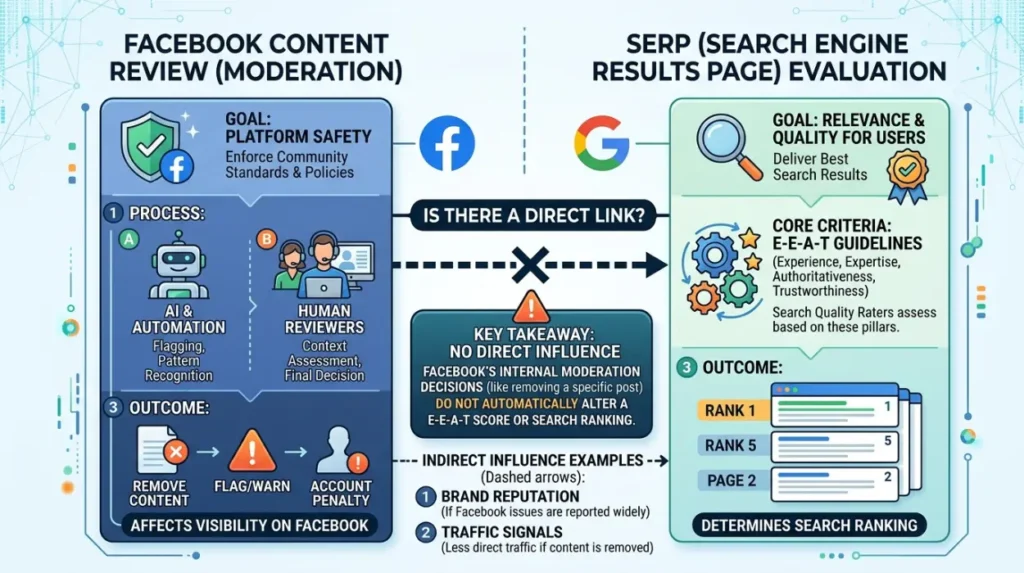
Facebook review content affects SERP evaluation when review pages, Facebook profiles or related references become visible for searches associated with the organisation. SERP evaluation is the process of analysing the composition, ranking and information characteristics of search engine results pages. A procurement researcher searching for a vendor can encounter Facebook-related information alongside the company’s website, directories, industry pages and third-party publications. This creates a mixed information environment containing both first-party and third-party sources. The composition of these results influences the information available during vendor research.
Content ranking dynamics determine which sources receive greater search visibility for specific queries. Relevance, authority, content characteristics and search intent all contribute to how results are presented, although rankings do not represent a direct judgement of whether a company is trustworthy. A highly visible review page therefore becomes an accessible reputation signal rather than a definitive quality assessment. Procurement teams interpret this information alongside other evidence. Understanding the distinction prevents search rankings from being treated as absolute measures of business credibility.

What Makes a Facebook Review More Relevant to B2B Buyers?
A Facebook review becomes more relevant to B2B buyers when it contains specific, verifiable and commercially meaningful information. Comments describing communication, delivery performance, service consistency, contractual interactions or issue resolution provide clearer evaluation criteria than vague expressions of satisfaction. Relevance also increases when the review relates directly to the services being considered by the procurement team. This creates a stronger semantic connection between the review and the vendor-selection decision. Specificity therefore determines informational usefulness.
Review recency also influences how procurement teams interpret information. Older reviews can document historical customer experiences, while newer reviews provide more current evidence about business operations. A consistent pattern across different time periods creates stronger contextual information than an isolated historical comment. However, recency does not automatically establish accuracy. Review analysis remains dependent on source context, factual consistency and alignment with other available information.
How Does Review Sentiment Compare With Other Trust Signals?
Review sentiment provides a customer-experience signal, while other trust signals provide different forms of evidence about organisational credibility. Official company information establishes first-party representation, industry publications provide external authority, professional directories offer structured business information, and customer reviews provide user-generated experience signals. Each source type contributes a different dimension to entity perception. Procurement evaluation becomes more robust when these signals are considered together. No single source provides a complete representation of a business.
Trust signals also differ in their degree of independence and informational purpose. First-party content is controlled by the organisation, while third-party reviews originate from external users. Industry references and authoritative publications introduce another layer of external validation. This creates an information hierarchy in which procurement teams compare sources rather than relying on one platform. Facebook reviews therefore function as one component within a broader credibility ecosystem.
Can Negative Facebook Reviews Influence B2B Procurement Decisions?
Negative Facebook reviews can influence procurement decisions when their content is visible, relevant and consistent with other information encountered during due diligence. Their effect depends on the subject matter and the credibility assigned to the source. A detailed complaint concerning service reliability represents a different signal from an unsupported or unrelated comment. Procurement teams assess the context before determining its relevance to supplier risk. This makes negative sentiment an information signal rather than automatic evidence of poor business performance.
The cumulative effect of negative content becomes more significant when the same theme appears across multiple sources. Repeated references can create stronger semantic associations between an organisation and a particular operational issue. Search visibility then determines how easily researchers encounter those associations. This relationship connects review content with digital footprint analysis and entity perception. Evaluating the complete information environment therefore provides more insight than analysing one negative review independently.
Dive Deeper With Our Expert Guides:
Why Competitors Use Coordinated 1-Star Facebook Attacks
How Fake Facebook Recommendations Get Past Meta’s Filters
How Does Review Consistency Affect Vendor Credibility?
Review consistency affects vendor credibility by influencing whether external descriptions of the business align with its wider digital representation. Consistency exists when reviews, official information, third-party references and business profiles describe compatible aspects of the organisation. Contradictions create uncertainty because procurement teams encounter competing representations of the same entity. This does not automatically establish that one source is inaccurate. Instead, it creates an information condition requiring additional verification.
Semantic consistency also matters because repeated descriptions of similar business characteristics create stronger associations around the entity. For example, recurring references to responsiveness, technical expertise or delivery standards establish identifiable reputation themes. These themes become part of the organisation’s broader online representation. Consistency therefore supports clearer entity perception by reducing conflicting information patterns.
What Role Does Content Indexing Play in Facebook Review Visibility?
Content indexing determines whether search engines can discover, process and potentially display publicly accessible Facebook-related content in response to relevant queries. Indexing is the process through which search engines add discovered content to their searchable databases. Indexed review information has greater potential to appear during online research than content that remains outside searchable results. However, indexing does not guarantee prominent ranking. Visibility depends on subsequent ranking and query relevance.
The relationship between indexing and procurement research is important because public information becomes part of the searchable information environment only when it is accessible to the relevant search system. A review can therefore exist on Facebook without becoming a prominent search result. Conversely, a well-indexed page can appear for queries involving the organisation’s name or services. This distinction explains why content existence and search visibility represent separate reputation variables.
How Should Businesses Interpret Facebook Reviews in B2B Research?
Businesses should interpret Facebook reviews as contextual reputation evidence rather than definitive assessments of supplier quality. The correct analytical approach evaluates review content alongside source credibility, sentiment distribution, recency, specificity and consistency. Procurement teams use these characteristics to determine whether a review provides meaningful evidence about commercial performance. This creates a structured interpretation process rather than an assumption based on star ratings or isolated comments. Facebook reviews therefore become most informative when integrated into wider vendor research.
The same principle applies to the organisation being evaluated. A business’s online credibility develops through the combined information available across its digital footprint. Accurate profiles, consistent business information, credible third-party references and relevant customer feedback collectively shape entity perception. This means Facebook reviews represent one layer within a broader reputation system. Their significance depends on how they interact with other available information.
How Can Businesses Prepare Their Reviews for Procurement Evaluation?
Businesses can prepare their review environment for procurement evaluation by understanding how external audiences interpret publicly available customer feedback. The objective is not to manufacture positive sentiment but to maintain an accurate, consistent and transparent representation of customer experience. Review patterns can be analysed for recurring themes, factual inconsistencies and information gaps. This creates a clearer understanding of how third-party content contributes to the digital footprint. Such analysis also supports more informed interpretation of search visibility.
A useful conceptual framework is preparing Facebook reviews for B2B procurement checks, which focuses on the relationship between review content, credibility signals and commercial due diligence. The framework treats reviews as part of a broader procurement information system rather than an isolated social media feature. It also connects review analysis with SERP evaluation, entity perception and online credibility. This provides a more complete explanation of how B2B buyers interpret publicly accessible reputation information.
What Is the Overall Impact of Facebook Reviews on B2B Vendor Vetting?
Facebook reviews influence B2B vendor vetting by contributing independent reputation signals to the information environment surrounding a supplier. Their value depends on relevance, specificity, recency, sentiment distribution and consistency with other sources. Search visibility determines how easily these signals are discovered during online research, while entity perception determines how users interpret them. Procurement teams therefore evaluate reviews as part of a broader credibility assessment. This makes Facebook an important component of the modern digital footprint.
The central concept is that vendor reputation is formed through interconnected information rather than a single platform. Facebook reviews provide user-generated evidence, search engines organise accessible information, and procurement teams interpret the resulting signals alongside other business evidence. Understanding this relationship explains why review content can influence vendor research without functioning as a standalone procurement decision. Online reputation is consequently best understood as a dynamic information system involving content, visibility, credibility and entity relationships.
Facebook reviews influence B2B vendor vetting because they provide publicly accessible information about customer experience and organisational reputation. Their impact depends on how the content interacts with search visibility, sentiment distribution, authority signals and the wider digital footprint. Search engines organise this information through indexing and ranking processes, while procurement teams evaluate it through credibility and relevance criteria. The resulting perception is therefore shaped by the relationship between multiple information sources.
Understanding Facebook reviews within this wider system prevents simplistic interpretations based solely on ratings or isolated comments. Review content represents one reputation signal among first-party information, third-party references, search results and other digital evidence. B2B vendor vetting consequently involves evaluating the consistency, relevance and credibility of the complete entity representation. This framework provides a more accurate understanding of how online reputation influences commercial research.
How do Facebook reviews influence B2B vendor vetting?
Facebook reviews provide reputation signals that procurement teams can assess alongside company websites, directories and third-party sources. Review sentiment, relevance, recency and consistency can influence how a potential vendor is perceived during due diligence.
Do B2B buyers check Facebook reviews before choosing a vendor?
B2B buyers can use Facebook reviews as part of wider online research when evaluating a supplier’s credibility and customer experience. These reviews provide third-party information that complements official business information and other trust signals.
What makes a Facebook review important for B2B procurement?
Specific reviews that discuss service quality, reliability, communication or delivery provide stronger procurement signals than vague comments. Their relevance increases when the information is recent, credible and consistent with other sources about the business.
Can negative Facebook reviews affect a company’s B2B reputation?
Negative Facebook reviews can affect online reputation when they are highly visible, relevant to procurement concerns and consistent with similar information elsewhere. Their impact depends on context, source credibility, sentiment distribution and how prominently the content appears in search results.
How can businesses prepare Facebook reviews for B2B procurement checks?
Businesses can analyse review sentiment, recurring themes, accuracy and consistency to understand how Facebook content contributes to their digital footprint. Preparing Facebook reviews for B2B procurement checks helps identify reputation signals that procurement teams can encounter during vendor research.