

Preparing Facebook reviews for B2B procurement checks involves evaluating review quality, sentiment, credibility and visibility within the wider digital footprint. Reputation management strategies differ based on whether the objective is to understand existing reputation signals, correct inaccurate information, or strengthen the overall information environment.
Online reputation control methods are evaluated through search visibility, source credibility, entity perception and the consistency of information across digital platforms. For B2B procurement, Facebook reviews represent third-party evidence that sits alongside company websites, directories, industry references and other trust signals.
How Should Facebook Reviews Be Evaluated for B2B Procurement?
Facebook reviews are best evaluated through relevance, specificity, recency, credibility and consistency rather than simple review counts. A procurement-focused assessment examines whether reviews contain information relevant to supplier reliability, service delivery, communication, responsiveness or commercial performance. This creates a distinction between useful procurement evidence and generic customer commentary. The evaluation also considers whether the reviewer appears connected to a genuine customer interaction. These factors determine the informational value of individual reviews.
Review analysis also requires consideration of the wider entity. A review exists within a business profile connected to a specific organisation, location, service category and digital identity. Entity credibility therefore depends partly on whether the information associated with that entity remains consistent across platforms. Contradictory business details create an information-quality issue that extends beyond individual reviews. A structured assessment evaluates the relationship between review content and the broader digital footprint.
Is Review Quality More Important Than Facebook Review Quantity?
Review quality provides stronger procurement value than review quantity because detailed information creates clearer evidence for supplier evaluation. A high review count establishes activity and customer engagement, but it does not automatically demonstrate reliability or commercial capability. Detailed reviews explain specific experiences, giving procurement teams greater context when assessing a vendor. Quality therefore operates through information depth rather than numerical volume. This distinction is important when comparing businesses with different review counts.
Review quantity still contributes to reputation signals because a larger review dataset provides a broader basis for sentiment distribution analysis. A procurement team can identify recurring themes when enough relevant information exists across the review profile. However, numerical volume without meaningful content provides limited insight into operational performance. Effective evaluation therefore combines quantity with specificity, consistency and relevance. This creates a more accurate assessment of the review environment.
How Do Positive and Negative Reviews Compare as Procurement Signals?
Positive and negative reviews provide different reputation signals, but neither category represents a complete measure of supplier credibility. Positive reviews can indicate satisfaction with service delivery, communication or reliability, while negative reviews identify reported problems or areas of dissatisfaction. Procurement teams analyse both because supplier evaluation requires understanding strengths and potential risks. Sentiment distribution therefore provides a balanced view of customer commentary. The analytical value comes from identifying patterns rather than selecting only favourable information.
Negative reviews receive greater significance when their subject matter directly relates to procurement risk. Repeated complaints about missed deadlines, communication failures or inconsistent delivery create a different information pattern from isolated criticism concerning an unrelated issue. Positive reviews addressing the same operational characteristics provide useful comparative context. This creates a reputation analysis framework based on subject relevance. The result is a more structured interpretation of customer sentiment.
Which Approach Works Better: Review Improvement or Content Enhancement?
Review improvement and content enhancement address different parts of the reputation environment. Review improvement focuses on the quality, accuracy and legitimacy of customer feedback, while content enhancement strengthens authoritative information surrounding the business entity. Improving reviews provides direct third-party evidence, whereas content enhancement develops additional context through business information and other relevant resources. These approaches therefore operate through different mechanisms. Comparing them requires identifying whether the underlying issue concerns review content or the wider search environment.
Content enhancement becomes particularly relevant when review information represents only one part of a broader digital footprint. A business with accurate reviews can still have an unclear online representation if company information is inconsistent across other sources. Conversely, strong first-party content does not eliminate the relevance of genuine customer feedback. The two approaches therefore complement different reputation signals. Evaluation depends on the specific information gap affecting procurement research.
How Does Content Removal Compare With Content Enhancement?
Content removal and content enhancement represent fundamentally different reputation management mechanisms. Removal focuses on eliminating information where a legitimate basis exists, such as content that violates platform rules or applicable legal requirements. Enhancement focuses on increasing the visibility and relevance of accurate information that provides additional context. Removal therefore reduces the presence of specific information, while enhancement changes the composition of the wider information environment. These mechanisms require separate evaluation because their outcomes and limitations differ.
Content removal also has a narrower application because legitimate customer criticism and accurate third-party reporting remain part of public information. Attempting to treat all negative content as removable creates unnecessary risk and does not provide a sustainable reputation strategy. Content enhancement offers a broader mechanism by developing useful information around relevant business queries. However, enhancement does not erase existing criticism. The strongest analytical approach distinguishes eligible removal opportunities from situations requiring broader information development.
How Does Organic Reputation Management Compare With Reactive Reputation Management?
Organic reputation management operates through continuous development of credible information, while reactive management responds to identified reputation risks. Organic activity includes maintaining accurate business profiles, generating useful content and monitoring customer sentiment over time. Reactive activity addresses specific negative reviews, inaccurate information or sudden changes in search visibility. These approaches differ primarily in timing and purpose. Comparing them demonstrates why reputation management requires both ongoing monitoring and issue-specific analysis.
Reactive activity offers a direct response to an identified problem, but it does not automatically strengthen the broader entity representation. Organic activity develops a stronger information foundation but does not replace direct action when a serious content issue appears. A combined model therefore provides greater strategic coverage. The evaluation centres on sustainability, risk exposure and the ability to respond to changing search conditions. This makes ongoing reputation monitoring an important part of both approaches.
How Do Facebook Reviews Affect SERP Composition?
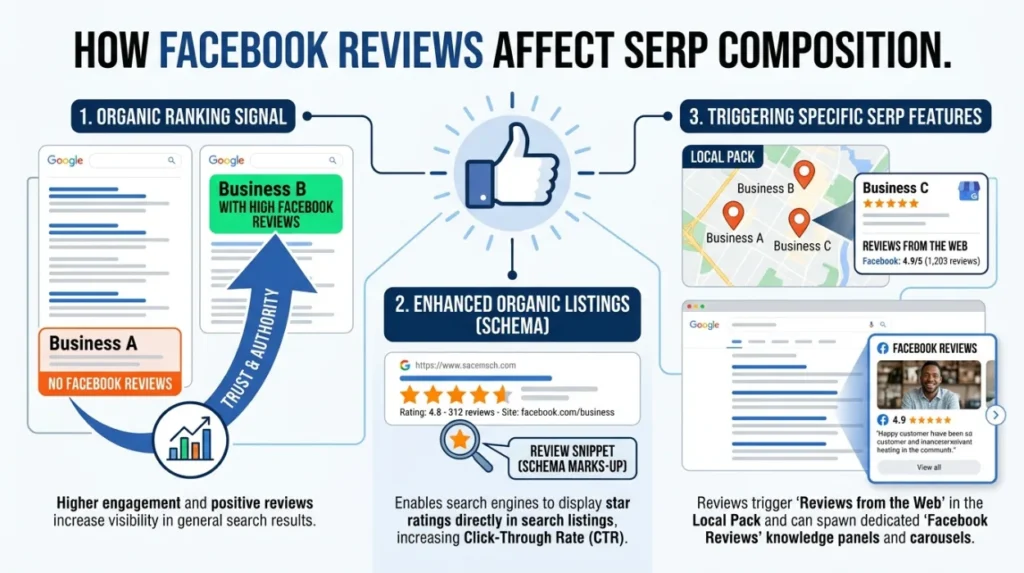
Facebook reviews affect SERP composition when publicly accessible review-related pages become relevant to branded or vendor-specific searches. SERP composition refers to the combination of results presented for a particular query, including company pages, review profiles, directories, publications and third-party resources. Search engines evaluate these pages according to ranking systems that consider relevance and other signals. A Facebook result therefore becomes one component of the information environment rather than a direct representation of business quality. Its practical importance depends on visibility and query relevance.
Search ranking influence also varies according to the search term. A Facebook profile can have limited visibility for broad commercial queries but stronger visibility for searches involving the exact business name. Procurement teams often conduct entity-specific research, making branded search visibility particularly relevant. The relationship between review content and SERP position therefore requires query-level evaluation. Measuring only the Facebook page itself provides an incomplete picture of its reputation influence.
How Can Search Visibility Change the Interpretation of Facebook Reviews?
Search visibility changes interpretation by determining how easily procurement researchers encounter specific review information. A review that receives limited exposure has a different practical effect from content appearing prominently for vendor-related searches. Visibility therefore acts as a multiplier of information access rather than a direct measure of credibility. Search ranking influence determines where information appears, while users determine how that information affects their evaluation. These processes operate together within the wider search ecosystem.
Visibility analysis also identifies whether a reputation issue remains confined to one platform or appears across multiple search surfaces. Repeated references across Facebook, directories, forums and industry pages create a broader information pattern. A single isolated result represents a different risk profile from an interconnected set of sources. This distinction supports more accurate prioritisation. Search visibility must therefore be evaluated alongside source authority and thematic relevance.
Dive Deeper With Our Expert Guides:
Responding to Coordinated 1-Star Facebook Attacks
How to Detect and Dispute Fake Facebook Recommendations
What Provides Stronger B2B Trust Signals: Reviews or First-Party Content?
Reviews and first-party content provide different trust signals, making direct substitution between them ineffective. First-party content communicates information controlled by the organisation, such as services, expertise, company history and operating details. Reviews provide external customer perspectives that add independent context to those claims. Procurement teams compare these information types because each answers different questions about the vendor. Entity credibility develops through the relationship between them.
A consistent relationship between first-party information and customer feedback creates a clearer reputation structure. When official business information accurately describes services and reviews discuss those same services in a consistent way, the entity representation becomes easier to interpret. Contradictions require additional scrutiny because they introduce uncertainty into the information environment. This demonstrates why procurement readiness depends on information consistency rather than one preferred content type.
How Should Businesses Measure Facebook Review Readiness for Procurement?
Facebook review readiness is measured through the quality, relevance, consistency and visibility of information available to procurement researchers. A practical evaluation framework can assess the following factors:
- Analyse review relevance by identifying comments that address service delivery, reliability, communication and commercial performance.
- Measure sentiment distribution by comparing positive, neutral and negative review patterns across the available dataset.
- Verify information consistency by comparing business names, services, locations and other entity attributes across digital sources.
- Evaluate search visibility by checking how Facebook-related results appear for branded and vendor-specific queries.
- Monitor reputation signals by tracking changes in review themes, search results and third-party references over time.
These measurements create a repeatable evaluation process. They also separate review readiness from the simple objective of accumulating positive ratings. A procurement-ready review environment is one where publicly available customer information is relevant, understandable and consistent with the wider business entity.
Does Short-Term Review Management Produce Sustainable Reputation Results?
Short-term review management can address immediate information problems, but sustainable reputation results depend on continuous monitoring and broader digital consistency. A single correction or response changes one information point without necessarily changing the overall entity representation. Long-term reputation stability requires consistent business information, legitimate customer feedback and ongoing assessment of search visibility. Sustainability therefore depends on maintaining the wider information system. This creates a distinction between tactical intervention and strategic reputation management.
Long-term measurement also requires tracking how reputation signals evolve. New reviews, changing customer sentiment and shifts in SERP composition alter the information environment over time. A strategy that performs well at one point requires continued evaluation as new information enters the ecosystem. This makes monitoring a core component rather than an optional activity. Sustainable reputation management therefore operates through continuous information analysis.
How Can Businesses Prepare for B2B Procurement Scrutiny?
Businesses can prepare for procurement scrutiny by treating Facebook reviews as one component of a broader digital due-diligence environment. The process begins with identifying how the business appears across Facebook, search engines, company websites, directories and third-party sources. Review content is then evaluated for accuracy, relevance, sentiment and recurring themes. Search visibility analysis establishes which information procurement teams are most likely to encounter. This creates an evidence-based view of the business’s online reputation.
The concept of B2B-ready Facebook reviews focuses on information quality rather than artificial sentiment manipulation. Reviews remain third-party experiences, so preparation involves understanding and maintaining the accuracy of the surrounding entity information. It also involves distinguishing legitimate criticism from inaccurate or irrelevant content. This approach supports transparent reputation analysis while reducing unnecessary information risk. The result is a more coherent digital footprint for procurement research.
Which Reputation Management Strategy Provides the Most Sustainable Outcome?
The most sustainable strategy combines organic reputation development, reactive issue assessment, review analysis and SERP monitoring. Organic activity strengthens the long-term information environment, while reactive processes address specific risks as they emerge. Review analysis provides third-party sentiment evidence, while search monitoring measures how that information becomes visible to potential buyers. Each mechanism therefore addresses a different part of the reputation system. Sustainability comes from integrating these functions rather than relying on one tactic.
The distinction between content suppression and content enhancement remains central to this evaluation. Suppression applies where content qualifies for legitimate intervention, while enhancement provides additional accurate information that improves contextual understanding. Neither mechanism replaces review analysis or search monitoring. A comprehensive approach instead connects content quality, reputation signals, entity credibility and search visibility. This creates a more durable framework for B2B procurement readiness.
What Defines a Procurement-Ready Facebook Review Profile?
A procurement-ready Facebook review profile is defined by relevant customer information, credible sentiment signals, consistent entity data and appropriate search visibility. Review quantity alone does not establish readiness because procurement teams evaluate the substance and context of publicly available information. Content enhancement, review analysis, legitimate removal and SERP monitoring address different aspects of the reputation environment. Comparing these mechanisms provides a clearer basis for evaluating effectiveness, scalability, risk exposure and sustainability.
The central principle is that Facebook reviews operate as part of a connected reputation system rather than an isolated social media metric. Procurement teams encounter review information alongside first-party content, third-party references and search results, creating an interconnected entity representation. Preparing for B2B checks therefore requires analysis of the complete digital footprint. Preparing Facebook reviews for B2B procurement checks ultimately involves improving information clarity, consistency and relevance while preserving the integrity of genuine customer feedback.
How do Facebook reviews affect B2B procurement checks?
Facebook reviews can act as third-party reputation signals during B2B vendor evaluation. Procurement teams can assess review sentiment, recurring themes, business credibility and customer experience alongside other online sources.
What do B2B buyers look for in Facebook reviews?
B2B buyers typically assess review authenticity, sentiment distribution, response quality and recurring service-related feedback. Consistent and relevant reviews provide stronger context for evaluating a vendor’s online credibility.
How can a business prepare Facebook reviews for procurement checks?
Businesses can prepare by reviewing existing feedback, identifying inaccurate or problematic content, responding professionally and maintaining accurate business information. This creates a clearer reputation profile for procurement research.
Do negative Facebook reviews affect business credibility with B2B buyers?
Negative Facebook reviews can influence perceived credibility when they appear relevant, prominent or consistent with other reputation signals. Their impact depends on context, recency, sentiment and how the business addresses legitimate concerns.
Can Facebook reviews influence a company’s online reputation?
Yes, Facebook reviews contribute to a company’s broader online reputation by adding customer-generated information to its digital footprint. Their sentiment and visibility can influence how prospective buyers interpret brand credibility during vendor research.