
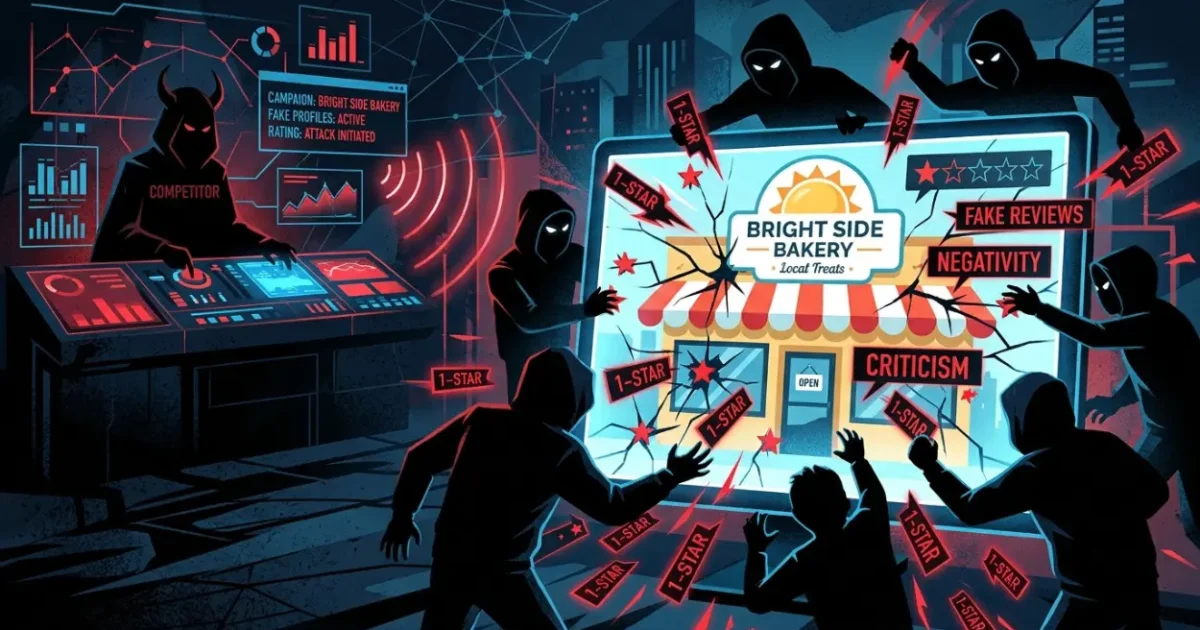
Coordinated 1-star Facebook attacks involve multiple low-rated reviews or reactions appearing within a concentrated period, often creating an unusually negative review pattern. Reputation management is the process of understanding and managing information that shapes how an entity is represented across digital platforms, while online reputation refers to the collection of signals users and search systems associate with that entity.
Why do competitors use coordinated 1-star Facebook attacks?
Coordinated 1-star Facebook attacks are typically intended to distort the visible sentiment surrounding a business by creating a concentrated pattern of negative feedback. A single negative review represents one reputation signal, whereas a cluster of similar low ratings can alter the overall distribution of review signals on a Facebook business presence. The mechanism relies on repetition, timing and rating volume rather than the informational quality of each individual review. When users encounter a sudden concentration of 1-star ratings, the numerical rating and visible comments become part of the entity’s digital footprint. This makes review activity relevant to both public perception and broader reputation analysis.
The distinction between genuine criticism and coordinated activity is based on observable patterns rather than the star rating alone. Review timing, account behaviour, repeated wording, limited customer history and unusual bursts of activity provide contextual signals for evaluating authenticity. A coordinated pattern therefore requires analysis of relationships between individual reviews rather than treating every review as an independent event. This distinction is important because legitimate negative customer experiences remain valid reputation signals. The objective of analysis is to identify abnormal review behaviour without dismissing genuine consumer feedback.
Facebook review activity also exists within a broader search ecosystem. Publicly visible business information can be indexed, referenced or displayed alongside other sources when users search for an organisation. A concentrated negative review pattern can therefore contribute to the information users encounter when evaluating the entity. The impact depends on the visibility and accessibility of the review content, rather than the existence of a low rating alone.
How do coordinated 1-star Facebook reviews affect online reputation?
Coordinated 1-star reviews affect online reputation by changing the visible distribution of sentiment associated with a business. Online reputation refers to how information, reviews, ratings and other digital signals collectively shape perceptions of an entity. Facebook reviews contribute a platform-specific layer to this reputation system through star ratings, written feedback and reviewer activity. When negative signals become concentrated, the overall review profile presents a different information pattern from one containing isolated criticism. This creates a measurable change in the entity’s digital footprint.
Review signals are interpreted through both quantity and context. A high number of negative ratings can influence the visible average rating, while repeated comments can establish recurring associations around service quality, reliability or customer experience. The meaning of these signals depends on their credibility and relationship to the underlying entity. Search systems and users do not evaluate reputation through one universal numerical formula. Instead, different platforms and search environments process information according to their own ranking, relevance and trust mechanisms.
The resulting perception is therefore influenced by the composition of available information. If negative reviews dominate the visible profile, users receive a narrower representation of the business. If the review environment contains a balanced distribution of authentic customer experiences, the entity has a broader set of reputation signals. Analysing this distribution provides greater insight than focusing exclusively on the lowest-rated reviews.
How can a business identify a coordinated Facebook review attack?
A coordinated Facebook review attack is identified through patterns connecting review timing, account behaviour, content characteristics and rating activity. One useful indicator is an unusual concentration of 1-star reviews within a short period that differs significantly from the established review pattern. Another indicator involves repeated language, identical claims or highly similar descriptions appearing across different accounts. Reviewer profiles also provide contextual information when accounts demonstrate little connection with the business or show unusual activity patterns. None of these indicators alone establishes coordination, so evaluation requires multiple signals.
A structured assessment can examine the following factors:
- Compare review timing against historical activity to identify sudden and unusual rating spikes.
- Analyse wording patterns to identify repeated phrases, identical claims or unusually similar descriptions.
- Evaluate reviewer profiles to determine whether accounts demonstrate credible relationships with the business.
- Map rating distribution to determine whether 1-star activity creates an abnormal change in overall sentiment.
- Document relevant evidence by recording dates, ratings, URLs and observable similarities for consistent analysis.
This approach separates evidence from assumptions. A sudden increase in negative reviews is an observable event, while the reason for that increase requires further investigation. Reputation analysis therefore evaluates behavioural and content signals before assigning a classification to the activity. This distinction supports a more accurate interpretation of review authenticity.
Why do repeated 1-star reviews create stronger reputation signals?
Repeated 1-star reviews create stronger visible reputation signals because repetition increases the prominence of a particular sentiment within the review environment. A single low rating has limited informational scope, while a sequence of similar ratings can alter the aggregate rating and the perceived frequency of negative experiences. The resulting signal becomes more noticeable to users examining the business profile. Repetition also creates semantic associations when similar terms or claims appear across multiple reviews. These associations contribute to how the entity is represented within its digital footprint.

Sentiment interpretation is not simply a calculation of positive versus negative words. Context, reviewer credibility, timing and the relationship between reviews all affect how the information is understood. A group of reviews containing identical allegations has a different informational structure from independent reviews describing unrelated experiences. This makes review analysis a pattern-recognition process rather than a basic sentiment-counting exercise.
The effect also depends on platform visibility. Facebook reviews that remain publicly accessible can continue contributing to the visible reputation profile. Changes in the review environment therefore affect both immediate user perception and the information available for broader reputation evaluation. Monitoring the distribution of review signals provides a clearer understanding of whether a negative pattern is isolated or persistent.
How do Facebook review signals influence search visibility?
Facebook review signals influence search visibility through their relationship with publicly available business information and entity references. Search engines evaluate indexed content according to relevance, authority and other ranking signals, while Facebook independently determines how its platform content is displayed. Where review content is accessible to search systems, individual pages or business information can become part of the wider digital footprint. This means Facebook activity exists within an ecosystem containing websites, directories, social profiles, news content and other references. The resulting search environment is therefore broader than the Facebook page itself.
Search visibility does not operate as a direct translation of star ratings into rankings. A 1-star review does not automatically cause a website to lose a specific search position. Instead, review information forms part of the wider reputation and entity context available to users and search systems. The strength of that signal depends on factors including indexing, prominence, relevance and the relationship between sources.
SERP evaluation therefore requires analysis across multiple query types. A business-name search, service-related search and location-based search can produce different results and different information sources. Measuring only the Facebook rating provides an incomplete view of search perception. A broader analysis examines how review-related information interacts with the rest of the entity’s digital footprint.
How do algorithms interpret trust and credibility in review activity?
Algorithms interpret trust and credibility through multiple information signals rather than relying on a single rating or review. Search systems evaluate content according to their own ranking frameworks, while platforms such as Facebook use separate systems to manage reviews and user activity. Factors such as relevance, source characteristics, content quality and behavioural patterns contribute to how information is processed. The precise weighting of individual signals is not publicly available as a universal formula. Reputation analysis therefore focuses on observable outcomes rather than assuming a specific algorithmic calculation.
Trust signals become more meaningful when independent information sources reinforce consistent entity information. A business with authoritative references, accurate contact information and established digital profiles presents a different information environment from an entity surrounded by inconsistent or contradictory references. Review activity forms one component of this wider system. Coordinated negative activity becomes analytically significant when it creates a disproportionate signal compared with the established information profile.
Credibility also depends on the distinction between information and evidence. A review represents a user’s published claim, but the existence of that claim does not independently establish its factual accuracy. Search and reputation analysis therefore benefits from examining source context, publication patterns and corroborating information. This approach prevents raw review volume from being treated as an automatic measure of truth.
Dive Deeper With Our Expert Guides:
How Fake Facebook Recommendations Get Past Meta’s Filters
Why Old Facebook Reviews Signal Stagnation to Buyers
How does coordinated review activity affect brand and entity perception?
Coordinated review activity affects entity perception by introducing a concentrated set of negative associations around the business. Entity perception refers to how information across different sources collectively represents a person, organisation or brand within a digital ecosystem. Facebook reviews contribute descriptive and numerical information to that representation. When negative language or ratings become dominant, those associations become more visible within the platform’s review environment. The effect is stronger when the same claims appear repeatedly across interconnected digital sources.
The language used in reviews also contributes to semantic associations. Repeated references to specific service characteristics, customer experience issues or operational claims establish recurring concepts around the entity. These concepts become part of the textual environment through which users interpret the business. The presence of repeated terminology does not establish factual accuracy, but it does demonstrate how reputation signals are constructed through repeated information.
Entity perception therefore depends on information diversity as well as sentiment. A profile containing reviews with different experiences provides a broader representation than one dominated by a single recurring narrative. Analysing this diversity helps distinguish an organic reputation pattern from an abnormal concentration of similar signals.
What is the difference between genuine negative reviews and coordinated attacks?
Genuine negative reviews represent individual customer experiences, while coordinated attacks display identifiable patterns suggesting that multiple accounts are participating in a concentrated activity. Genuine reviews typically contain distinct experiences, different language and varied publication timing. Coordinated activity presents a stronger pattern when multiple reviews appear within an unusual period and contain overlapping characteristics. The distinction requires evidence because negative sentiment alone does not establish malicious coordination.
Review authenticity can therefore be evaluated through a combination of content and behavioural indicators. Timing patterns identify unusual bursts, while language analysis identifies duplication or highly similar claims. Account analysis provides additional context about reviewer activity and relationships with the business. Rating distribution then shows whether the activity materially changes the overall reputation profile.
This evaluation framework supports accurate classification without assuming intent. A business can document suspicious patterns while continuing to recognise legitimate criticism. Such separation is important because reputation systems depend on authentic customer feedback as a source of information. The objective is to understand the integrity of the review environment rather than simply remove negative sentiment.
How should businesses analyse the long-term impact of coordinated 1-star attacks?
Businesses should analyse long-term impact through changes in rating distribution, review sentiment, content visibility and entity perception. A short-term increase in 1-star reviews represents an immediate reputation signal, while persistent visibility determines whether the signal remains part of the business’s digital footprint. Monitoring therefore extends beyond the original publication period. Changes in review volume, average rating and recurring language provide measurable indicators of the evolving review environment. Search visibility analysis adds another layer by examining how the information appears across relevant queries.
A long-term review analysis can evaluate:
- Track rating changes to measure how concentrated 1-star activity affects the overall review profile.
- Compare sentiment patterns to identify whether negative terminology remains dominant after the initial activity.
- Monitor indexed references to determine whether review-related information appears beyond the original Facebook environment.
- Evaluate entity associations to identify recurring claims connected with the business name.
- Measure persistence to establish whether the negative signal remains visible or declines as newer information enters the ecosystem.
This process provides a more complete understanding of reputation change. A review attack that creates a temporary rating fluctuation has a different long-term significance from one that becomes a persistent search association. Measuring persistence therefore provides an important distinction between immediate disruption and sustained reputation impact.
How can coordinated 1-star Facebook attacks be understood within reputation systems?
Coordinated 1-star Facebook attacks are best understood as concentrated reputation-signal events within a wider digital information ecosystem. Their significance comes from the interaction between rating volume, sentiment, reviewer behaviour, content patterns and visibility. Facebook provides the immediate review environment, while search engines and other platforms contribute additional layers to the entity’s digital footprint. Reputation analysis connects these layers to determine how information is created, repeated, indexed and interpreted. This systems-based approach avoids reducing reputation to one star rating.
The central concept is information distribution. A negative signal becomes more influential when it is repeated, highly visible or reinforced by other sources. A suspicious review pattern therefore deserves contextual analysis rather than automatic acceptance or dismissal. Search visibility, content indexing, authority and trust signals all contribute to the broader assessment.
Understanding these mechanisms also clarifies why reputation is dynamic. New reviews change sentiment distribution, new pages change search visibility and updated information changes entity perception. Reputation systems continuously incorporate new information rather than remaining fixed after one event. Monitoring these changes provides the basis for understanding how digital credibility develops over time.
Coordinated 1-star Facebook attacks represent a concentrated pattern of negative review signals that can influence rating distribution, sentiment interpretation and entity perception. Their significance depends on more than the number of reviews because timing, language, account behaviour, content visibility and source context all contribute to the analysis. Distinguishing genuine customer feedback from coordinated activity requires evidence-based evaluation of multiple signals.
Within search ecosystems, Facebook reviews form one component of a wider digital footprint. Content indexing, SERP evaluation, authority and trust signals influence how information becomes visible and how users encounter an entity. A comprehensive reputation analysis therefore examines both the immediate review environment and the broader information network surrounding the business.
Understanding these mechanisms provides a clearer basis for evaluating unusual review activity and its long-term effect on online credibility. The key distinction is between individual negative feedback and a coordinated concentration of reputation signals, with the latter requiring analysis of patterns, persistence and wider search visibility.
What is a coordinated 1-star Facebook review attack?
A coordinated 1-star Facebook review attack is a concentrated pattern of low ratings or negative reviews appearing within a short period. Unusual timing, repeated wording and limited reviewer history can provide signals for assessing whether the activity is coordinated.
How can businesses identify fake 1-star Facebook reviews?
Businesses can analyse review timing, account activity, repeated language and the relationship between reviewers and the business. A combination of unusual patterns provides stronger evidence than a low rating alone.
Can coordinated Facebook reviews damage a business’s online reputation?
Coordinated reviews can affect the visible rating, sentiment distribution and reputation signals associated with a business. If the content remains publicly visible, it can also contribute to the wider digital footprint users encounter when researching the entity.
Do Facebook reviews affect Google search rankings?
Facebook reviews do not directly determine a specific Google ranking position. However, publicly accessible review content can contribute to the broader information environment surrounding an entity, particularly where it is indexed or referenced elsewhere.
How should businesses respond to coordinated 1-star Facebook attacks?
Businesses should first document unusual review patterns and distinguish potentially coordinated activity from legitimate customer criticism. Responding to Coordinated 1-Star Facebook Attacks involves evaluating review authenticity, platform policies, sentiment patterns and the potential effect on online reputation.