
Facebook’s recommendation algorithm ranks feedback by interpreting recommendation activity, engagement patterns, relevance, quality signals, and contextual information. Reputation management is the structured analysis of information that shapes how an entity is discovered, interpreted, and evaluated across digital environments.
Online reputation refers to the observable information associated with an individual, organisation, or entity across platforms, search results, reviews, recommendations, and other indexed content. On Facebook, recommendation feedback forms part of this information environment because user-generated evaluations contribute to how an entity is perceived within the platform. The ranking system determines which feedback receives greater visibility rather than treating every recommendation as equally prominent. Understanding these ranking dynamics therefore requires separating the existence of feedback from the mechanisms that influence its distribution.
How Does Facebook’s Recommendation Algorithm Interpret Feedback?
Facebook’s recommendation algorithm interprets feedback as a collection of signals rather than as isolated statements. Recommendation activity provides information about how users evaluate an entity, while interactions with that content provide additional context about relevance and engagement. The platform’s ranking systems process these signals to determine which information receives visibility within relevant surfaces. This distinction means that a recommendation can exist without receiving consistent prominence. From a reputation perspective, the important factor is therefore not simply the number of recommendations but how recommendation-related information is interpreted and surfaced.
Recommendation feedback also forms part of an entity’s broader digital footprint. A digital footprint is the collection of publicly accessible information associated with an entity across online platforms. Facebook recommendations contribute to this footprint because they create structured and unstructured information about perceived experiences, quality, and relevance. The resulting information can influence entity perception within Facebook even when the same feedback has limited visibility elsewhere. Reputation analysis therefore considers both the content itself and the platform environment in which that content is distributed.
What Signals Influence How Facebook Ranks Recommendations?
Facebook ranking systems evaluate multiple signals connected to content relevance, user interactions, and contextual relationships. Engagement signals demonstrate how users interact with recommendation content, while relevance signals connect information with particular users, entities, or contexts. Quality-related signals provide additional information about the usefulness and reliability of the content environment. These signals operate collectively rather than as a single public scoring formula. Consequently, recommendation visibility represents the outcome of multiple ranking processes rather than a simple calculation based on positive or negative sentiment.
Authority is also relevant to reputation analysis because information gains interpretive significance when it is associated with credible sources or sustained user activity. Authority signals do not necessarily establish whether an individual recommendation is factually correct. Instead, they help describe the information environment in which the recommendation appears and the degree of prominence it receives. This distinction is important when analysing online credibility because visibility and factual accuracy represent separate properties. A highly visible recommendation therefore requires evaluation based on its source, context, content, and surrounding signals.

How Does Engagement Affect Recommendation Visibility?
Engagement affects recommendation visibility by providing ranking systems with behavioural information about how users interact with content. Interactions such as viewing, responding to, or otherwise engaging with recommendation-related content create measurable signals within the platform. These signals help ranking systems evaluate the relevance and usefulness of content for particular audiences. Engagement does not automatically establish credibility because interaction measures behaviour rather than factual accuracy. Its principal reputation significance lies in its contribution to the distribution and prominence of information.
The relationship between engagement and visibility also creates a distinction between content creation and content amplification. A recommendation begins as user-generated information, but subsequent interactions influence the extent to which that information becomes visible within the platform environment. This process demonstrates how reputation signals can develop after the original feedback has been published. Content indexing, recommendation distribution, and user engagement represent different stages of information exposure. Analysing these stages provides a clearer understanding of how feedback becomes part of an entity’s visible reputation.
Does Positive or Negative Sentiment Determine Facebook Recommendation Rankings?
Positive or negative sentiment provides contextual information but does not independently determine recommendation rankings. Sentiment analysis refers to the interpretation of language or feedback according to expressed attitudes, evaluations, or experiences. A positive recommendation therefore represents one type of reputation signal, while negative feedback represents another. Ranking systems operate across broader signals than sentiment alone, meaning the emotional direction of a statement does not provide a complete explanation of its visibility. Reputation analysis consequently separates sentiment from ranking performance.
Sentiment remains important because repeated patterns of positive or negative feedback contribute to the observable perception surrounding an entity. A consistent pattern creates a broader information signal than a single isolated statement. However, interpreting that pattern requires consideration of content relevance, engagement, source context, and distribution. This prevents sentiment from being treated as a standalone measure of credibility. In semantic SEO terms, sentiment represents one attribute within a larger entity-reputation relationship.
How Does Facebook Feedback Affect Entity Perception?
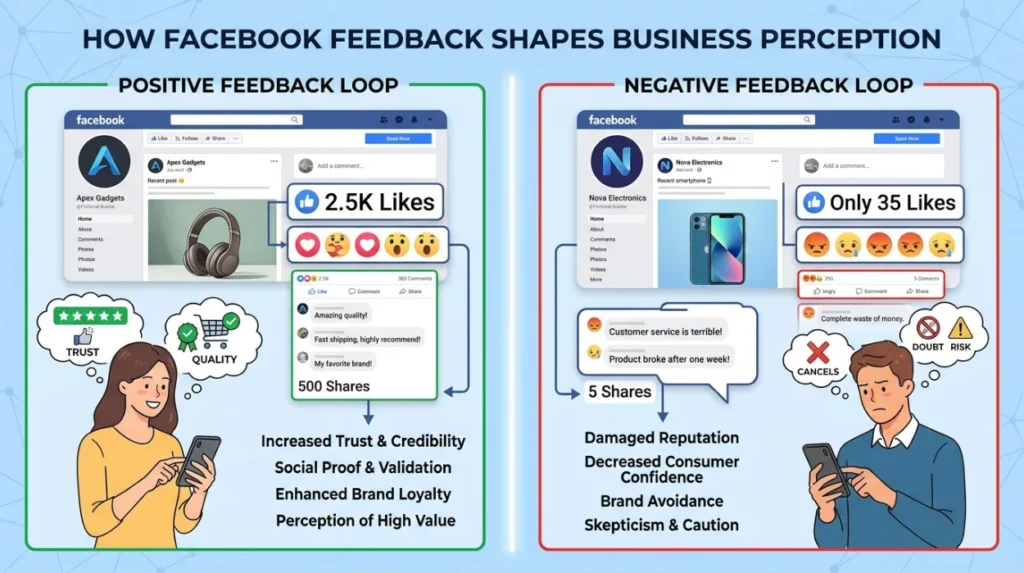
Facebook feedback affects entity perception by adding user-generated information to the digital environment surrounding an entity. Entity perception refers to how an individual, organisation, or brand is interpreted based on available information and associated signals. Recommendations contribute to this interpretation by describing experiences, evaluations, and perceived qualities. When such information becomes prominent, it forms part of the information users encounter while evaluating the entity. The reputation effect therefore arises through information exposure rather than through the recommendation alone.
Entity perception also depends on the consistency of available information. When recommendations align with other credible information sources, they contribute to a more coherent reputation signal. When feedback conflicts with established information, users encounter a more complex information environment requiring additional evaluation. This relationship demonstrates why reputation cannot be reduced to a single review score or recommendation count. Digital reputation represents an interconnected system of content, sources, signals, and interpretations.
How Do Trust and Authority Signals Relate to Facebook Recommendations?
Trust and authority signals provide contextual evidence that helps explain how information is evaluated within a broader digital ecosystem. Trust refers to the perceived reliability of information, while authority refers to the strength or credibility associated with a source or information environment. Facebook recommendations provide user-generated evidence but do not automatically establish either property. Their interpretive value depends on the context surrounding the recommendation and the signals associated with its distribution.
Within reputation systems, trust develops through consistency, relevance, source quality, and corroborating information. Authority develops through recognised expertise, established information sources, and sustained credibility within a particular context. These concepts are distinct from popularity because high engagement does not necessarily establish accuracy or expertise. A recommendation can therefore attract substantial attention while remaining only one component of an entity’s overall credibility profile. SERP evaluation and platform-level reputation analysis both benefit from maintaining this distinction.
How Does Recommendation Content Become Part of a Digital Footprint?
Recommendation content becomes part of a digital footprint when it creates persistent information associated with an entity on an online platform. The digital footprint includes platform profiles, recommendations, reviews, posts, mentions, images, and other publicly accessible information. Each item contributes another data point to the information environment surrounding the entity. The significance of an individual item depends on its visibility, relevance, context, and relationship with other content. This creates a network of reputation signals rather than a single reputation score.
The relationship between Facebook recommendations and search visibility also requires careful distinction. Content available on a platform does not automatically achieve prominent placement in external search engine results. Search engines evaluate their own ranking signals, including relevance, authority, content quality, accessibility, and indexing characteristics. Facebook therefore represents one information environment within a broader search ecosystem. Understanding this separation prevents platform-level visibility from being incorrectly treated as equivalent to Google SERP performance.
Can Recommendation Activity Influence Search Reputation?
Recommendation activity can contribute to search reputation when associated information becomes discoverable, indexed, or referenced within search ecosystems. Search reputation refers to the condition in which available digital information influences how an entity is discovered and interpreted through search. Facebook recommendations form part of the broader content environment, although their direct search impact depends on accessibility, indexing, relevance, and search engine ranking processes. The existence of feedback therefore does not guarantee prominent placement in search results. Its influence depends on whether search systems can access, interpret, and rank the associated information.
Search visibility also involves query-specific ranking dynamics. An entity can appear differently for branded searches, recommendation-related queries, location searches, and other contextual queries. This means reputation analysis requires evaluation across multiple search terms rather than relying on one SERP. How to Rank Higher Within Facebook’s Recommendation Algorithm represents a related evaluation concept because it focuses on visibility within the platform’s recommendation environment rather than solely on external search rankings. Keeping these systems separate creates a more accurate model of how reputation information is distributed.
How Should Facebook Recommendation Signals Be Evaluated?
Facebook recommendation signals are best evaluated by separating content, visibility, engagement, sentiment, and contextual credibility. Each category describes a different property of the information environment. Content analysis identifies what the recommendation communicates, while visibility analysis examines where and when it appears. Engagement analysis measures interaction, whereas sentiment analysis evaluates the expressed direction of feedback. Authority and trust analysis then provide additional context for interpreting the credibility of the surrounding information.
This framework also prevents isolated metrics from becoming misleading reputation indicators. A high recommendation count does not independently establish strong credibility, just as negative feedback does not independently establish poor entity quality. The meaning of each signal depends on its relationship with other information and its visibility within the relevant platform or search ecosystem. Structured evaluation therefore produces a more reliable picture of reputation development. It also creates a distinction between observable ranking changes and assumptions about how users perceive an entity.
Dive Deeper With Our Expert Guides:
Why Some Businesses Turn Off Facebook Recommendations Entirely
How Facebook Reviews Influence B2B Vendor Vetting
What Does Facebook Recommendation Ranking Reveal About Online Reputation?
Facebook recommendation ranking reveals how platform-based information can become part of an entity’s visible reputation environment. Ranking determines information exposure, while the content itself provides the underlying reputation signal. Engagement, relevance, contextual relationships, and other ranking inputs influence how that signal is distributed. Search visibility then operates through a separate layer involving indexing and search engine ranking systems. The complete reputation picture therefore requires analysis across both platform and search environments.
The central principle is that online reputation is an information system rather than a single numerical score. Facebook recommendations represent one category of user-generated reputation data within that system. Their significance depends on content characteristics, ranking behaviour, engagement patterns, contextual credibility, and relationships with other digital information. Understanding these mechanisms allows reputation analysis to distinguish visibility from credibility and sentiment from authority. This systems-based approach provides a clearer explanation of how digital information shapes entity perception across modern search and social ecosystems.
How does Facebook’s recommendation algorithm rank feedback?
Facebook’s recommendation algorithm evaluates signals such as relevance, engagement, context, and content characteristics when determining feedback visibility. Recommendation ranking is not based solely on whether feedback is positive or negative.
What factors affect Facebook recommendation visibility?
Facebook recommendation visibility is influenced by user interactions, relevance, contextual signals, and the relationship between content and users. These signals help determine which recommendation content receives greater prominence.
Do positive reviews rank higher on Facebook?
Positive sentiment alone does not determine Facebook recommendation rankings. Ranking systems evaluate broader signals, including relevance, engagement, context, and content quality, when distributing recommendation feedback.
How do Facebook recommendations affect online reputation?
Facebook recommendations contribute to an entity’s digital footprint by adding user-generated feedback to its online information environment. Their reputation impact depends on visibility, sentiment, engagement, context, and how users interpret the available information.
Can Facebook recommendations influence search reputation?
Facebook recommendations can contribute to search reputation when associated content is accessible, indexed, and ranked by search engines. However, Facebook’s internal recommendation ranking and external Google search rankings operate through separate systems.