

Reputation management is the process of understanding how information about a business shapes public perception across digital environments. Google Questions and Answers (Q&A), where available, contribute to online reputation by displaying questions and responses associated with a business profile and influencing how users interpret its reliability before making contact.
What Is Google Q&A, and How Does It Influence Business Reputation?
Google Q&A refers to the question-and-answer functionality historically associated with Google Business Profiles, where users could ask questions about a business and other users or business representatives could respond. Its purpose was to make practical information accessible directly within the search experience. The availability and presentation of Q&A features have changed over time, so businesses need to distinguish the historical feature from other current profile interactions, such as customer reviews and owner-provided business information. These elements collectively contribute to the information users encounter when researching a company. Their relevance to reputation depends on accuracy, visibility and the context in which the information appears.
Online reputation refers to the collective perception formed through publicly accessible information about an entity. In search ecosystems, this perception develops from multiple sources, including business profiles, reviews, websites, directories and third-party publications. A question about opening hours, pricing, accessibility or service availability introduces a specific topic into the user’s evaluation process. An accurate answer reduces uncertainty by clarifying what the business provides. An unanswered question or an incorrect response leaves an information gap that users must resolve through other sources.
The reputational effect of Q&A content depends on how users interpret the information rather than simply on the presence of a question. A question can reveal a common concern, while its answer can establish whether the business communicates clearly and consistently. Contradictions between profile information and user-generated responses weaken the perceived reliability of the available information. Consistency across authoritative sources makes the business easier to understand. These signals form part of the wider digital footprint through which customers assess an entity.
How Do Google Q&A Sections Affect Search Visibility and SERP Evaluation?
Search visibility refers to how readily a business appears in search results for relevant queries. Search engine results pages (SERPs) present information selected and ordered through systems that evaluate relevance, quality, context and other ranking signals. Business profile content can help users understand an entity, but the presence of a Q&A feature does not guarantee improved organic rankings or a particular local search position. Search engines use multiple signals, and the weight of each signal varies by query and search context. Reputation analysis therefore separates the visibility of a profile element from its direct ranking influence.
SERP evaluation is the process of examining which pages and features appear for a search query and how those results communicate information about an entity. A user searching for a business name encounters a different information environment from someone searching for a general service category. Branded searches often expose the user to the business’s own profile and website alongside third-party information. Category searches introduce comparisons between businesses, reviews and other relevant results. The position and content of each result affect the information available during the decision-making process, even when the underlying ranking systems do not treat every reputation signal equally.
Content indexing refers to the process through which search engines discover, process and store information for potential retrieval. Not every question, answer or profile interaction is independently indexed as a conventional web page. Its visibility depends on the platform’s current features and how the information is presented. This distinction matters because content visible within a business profile does not automatically function as a separate ranking document. Reputation analysis must therefore examine the actual search interface rather than assume that every profile interaction creates an independent search result.

Search perception influence describes how the information displayed in search results shapes a user’s understanding of a business. A profile that presents accurate contact details, consistent services and credible customer feedback creates a clearer informational picture than one containing conflicting details. Q&A content, where available, can add practical context by addressing a specific point of uncertainty. However, the overall impression also depends on the surrounding search results, including review summaries, official pages and independent sources. The relationship between search visibility and reputation is therefore cumulative rather than dependent on one feature alone.
How Do Reviews and Q&A Content Shape Customer Trust?
Reviews and Q&A content serve different informational purposes within a business profile. Reviews primarily communicate customer experiences and evaluations, while questions and answers address specific points about a business’s services, policies or practical arrangements. Review sentiment refers to the positive, negative or neutral attitude expressed in review language. Users can interpret repeated themes across reviews as evidence of consistency, although individual reviews do not independently establish the full quality of a business. Q&A content provides another form of context, but its reliability depends on the accuracy and source of each answer.
Review signals influence user perception through both content and presentation. Star ratings provide a compressed numerical summary, while written reviews explain the experiences behind individual evaluations. Recurring references to communication, reliability, service quality or unresolved complaints help users identify patterns. Search platforms process review information according to their own systems, but public sentiment is not equivalent to verified evidence about every claim. A balanced interpretation considers review volume, recency, specificity and consistency instead of treating one score as a complete representation of the business.
Questions can also reveal the information customers find difficult to locate. Repeated enquiries about delivery arrangements, booking requirements, accessibility or service coverage indicate areas where users seek clarification. When authoritative business information answers these questions consistently, uncertainty decreases. When public responses conflict with the official profile, users face competing explanations and need to decide which source is more reliable. The resulting perception depends on the quality of the evidence and the clarity of the information available.
Trust signals are observable indicators that help users assess whether an entity appears reliable and credible. These include consistent business details, transparent policies, accurate service descriptions, relevant customer feedback and identifiable official sources. No single signal proves that every business claim is true. Instead, users combine available indicators to form an overall judgement. Q&A content contributes to this process when it provides verifiable, relevant information that agrees with the wider business profile.
How Does Inaccurate or Unanswered Q&A Information Affect Entity Perception?
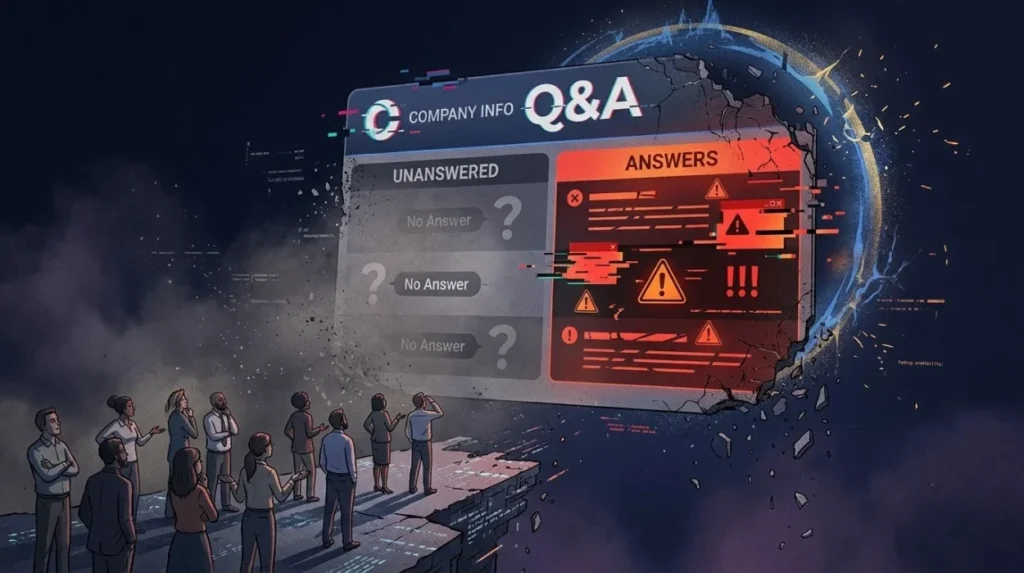
Entity perception refers to the way users and information systems understand a particular business as a distinct organisation with identifiable attributes. These attributes include its name, location, services, contact details and relationships with other sources. Inaccurate Q&A responses can introduce conflicting descriptions of these attributes. For example, a response that gives outdated opening hours conflicts with the current business profile and creates uncertainty about which information is authoritative. The reputational issue arises from the contradiction, not simply from the existence of a question.
Unanswered questions create an information gap rather than proving that a business is unreliable. Users interpret that gap alongside other available signals, such as the completeness of the profile and the clarity of the official website. A question about a core service that remains unresolved can make the available information less useful. By contrast, an unanswered question about a minor detail has a different informational significance. The effect depends on the user’s intent, the importance of the question and whether another credible source provides the answer.
Outdated responses also affect the consistency of the digital footprint. A business can change its prices, service areas, operating arrangements or policies while older information remains visible elsewhere online. Search systems and users do not necessarily encounter every source at the same time, so conflicting information can persist across the digital environment. Consistent updates to authoritative sources help reduce these discrepancies. Reputation analysis therefore considers the accuracy and freshness of information as well as its initial publication.
Misleading or unsupported answers introduce a separate credibility concern. A response that presents speculation as established fact can distort the information available to potential customers. An answer written by an unidentified user does not automatically represent the business’s official position. Users assess source context, wording and consistency with other evidence when interpreting such content. Clear distinctions between official information, customer opinion and unverified claims help preserve the integrity of entity perception.
How Do Authority and Trust Signals Influence Business Reputation in Search?
Authority refers to the degree to which a source is recognised as relevant or credible within a particular context. In search ecosystems, authority is not a single universal score that guarantees accurate information or high rankings. Search engines evaluate pages and entities using multiple signals, while users apply their own judgements based on source identity, evidence and consistency. An official business website has direct relevance to the organisation’s stated policies, but independent reporting and customer reviews provide different forms of information. Reputation analysis evaluates these sources according to what they can reliably establish.
Consistency across sources helps users identify the same business and understand its attributes. When a business name, address, contact details and service descriptions align across its official website and relevant profiles, the digital footprint presents a more coherent identity. Differences do not always indicate a problem, because legitimate changes and platform-specific formats can account for some variation. However, unresolved discrepancies make it harder to determine which information is current. Consistency therefore supports clarity, while accuracy remains essential to credibility.
Trust signals also depend on transparency. Specific answers that explain policies or limitations provide more useful information than unsupported claims of quality. Customer reviews offer insight into reported experiences, while official profile details clarify the business’s stated arrangements. Neither source replaces the need to evaluate evidence in context. A reliable interpretation distinguishes what a source claims, what it demonstrates and what remains unverified.
How Can Businesses Understand and Monitor Their Google Reputation Signals?
Businesses can understand their Google reputation signals by examining the information users encounter across relevant searches and profile features. This analysis begins with the business name, key service queries and location-based searches where local intent is relevant. Reviewing the results reveals which sources are prominent, what information they communicate and whether material contradictions exist. The process also distinguishes platform-controlled information from third-party content that the business does not directly manage. This distinction establishes the limits of direct control over search visibility and public discussion.
A structured review can focus on three connected areas:
- Check profile accuracy by comparing operating hours, contact details, service descriptions and other current information with authoritative business records.
- Analyse review sentiment by identifying recurring themes in customer feedback and separating individual opinions from repeated patterns.
- Compare search results by recording prominent sources, checking factual consistency and identifying outdated or conflicting information.
These actions provide a clearer view of the available reputation signals without assuming that every negative result is inaccurate or every positive result is reliable. Repeated checks also help distinguish persistent information problems from temporary changes in search presentation. The value lies in identifying what users can actually see and what the available evidence supports.
Monitoring requires attention to changes in platform functionality. Google can alter how business profile features appear, which interactions are supported and how information is displayed. A historical description of Google Q&A therefore does not establish that the same feature remains available in every market or interface. Current review tools, profile details and other customer interactions need to be assessed according to the features presently displayed. This prevents outdated assumptions from becoming part of the business’s reputation analysis.
Dive Deeper With Our Expert Guides:
Why a Sudden Spike in Reviews Triggers Google’s Spam Filters
How Photos in Google Reviews Influence Customer Decisions
What Is the Relationship Between Digital Footprint and Long-Term Business Reputation?
A digital footprint is the collection of information and activity associated with an entity across online platforms. It includes official websites, business profiles, customer reviews, directory listings, media coverage and publicly accessible discussions. Each source contributes a different type of information, and its importance depends on relevance, credibility and visibility. A complete digital footprint is not necessarily a favourable one; accuracy and context determine how useful it is for understanding the business. Reputation emerges from how audiences interpret this wider body of information.
Long-term business reputation develops through the continued interaction between published information, customer experiences and changing search results. A single answer or review rarely defines the complete identity of an organisation. Repeated contradictions, unresolved factual errors or outdated information can create a less coherent picture over time. Accurate information across authoritative sources supports a more stable understanding of the business. This stability depends on maintaining factual consistency rather than attempting to control every public opinion.
Google Q&A, where available, is one element within this wider information environment. Its reputational significance comes from the questions users raise, the reliability of the responses and the context provided by other profile information. Managing Your Google Q&A Section to Protect Your Reputation involves monitoring customer questions, providing accurate responses and identifying misleading information that affects customer perceptions. Search visibility determines which information users encounter, while credibility depends on the quality and consistency of that information. Review sentiment, authority signals, content indexing and entity perception are connected concepts, but they describe different parts of the search and reputation process. Understanding those distinctions explains how business reputation forms without attributing the entire outcome to one platform feature.
How do Google Q&A sections affect your business reputation?
Google Q&A sections influence business reputation by allowing customers to ask questions and view answers about a company directly on its Google Business Profile. Inaccurate, outdated or unanswered information can create uncertainty and reduce customer trust.
Can Google Q&A affect customer trust and buying decisions?
Yes, Google Q&A can influence purchasing decisions because customers use business profile information to assess reliability before contacting or visiting a company. Clear, accurate answers help establish credibility, while misleading information can discourage potential customers.
How can businesses manage negative or misleading Google Q&A content?
Businesses can respond to questions with accurate information, correct misunderstandings and report content that violates Google’s policies. Clear My Name helps businesses assess online reputation risks and identify appropriate content management options for misleading or harmful information.
Can you remove negative questions from a Google Business Profile?
Google does not generally allow businesses to remove questions simply because they are negative or critical. Content that violates Google’s policies can be reported for review, but removal depends on Google’s assessment and enforcement decisions.
How can businesses improve their Google Q&A reputation management?
Businesses can improve Google Q&A reputation management by monitoring customer questions, providing factual answers and correcting outdated information promptly. Regular monitoring also helps identify recurring customer concerns and reputation risks that require a consistent response strategy.