

Online reviews influence client decisions more directly than legal awards because 93% of users read reviews before choosing a service, while less than 30% recognise legal rankings. Reviews provide real-time trust signals, while awards reflect past performance with limited accessibility to everyday clients.
Why do clients trust online reviews more than legal awards?
Clients trust online reviews because they reflect real client experiences, are publicly accessible, and update continuously. Legal awards rely on industry recognition, which lacks transparency for most users and does not directly represent current service quality or responsiveness.
Online reviews act as immediate proof of service quality. Platforms like Google, Trustpilot, and Avvo display feedback from verified users. These reviews include specific details such as response time, case handling, and communication clarity.
Legal awards follow a different structure. They depend on nominations, peer endorsements, and submission-based evaluations. Many clients do not understand ranking criteria such as Chambers tiers or Legal 500 placements. This gap reduces their influence during decision-making.
Clients focus on relatable insights. A review describing “clear communication during a contract dispute” carries more weight than a badge stating “Top 100 Lawyers.” Reviews translate expertise into practical outcomes.
How do online reviews impact law firm visibility in search results?
Online reviews directly impact local SEO rankings because Google’s algorithm prioritises review quantity, quality, and recency. Law firms with consistent 4.5+ ratings and regular feedback appear higher in local search results and Google Maps listings.
Search engines evaluate three primary review signals: volume, velocity, and sentiment. A law firm with 150 reviews and a 4.7 rating ranks higher than one with 20 reviews and a 5.0 rating. Quantity signals authority, while consistency signals reliability.
Review keywords also influence rankings. Clients often mention services like “family law consultation,” “corporate compliance advice,” or “immigration appeal success.” These phrases strengthen topical relevance.
Google Business Profiles display star ratings prominently. When users search “lawyer near me,” firms with stronger review profiles dominate the top three local results. Awards do not appear in these search snippets.
Law firms that invest in reputation management for lawyers gain measurable SEO advantages. Structured review acquisition and response strategies improve both rankings and click-through rates.
Why are legal awards less effective in attracting new clients?
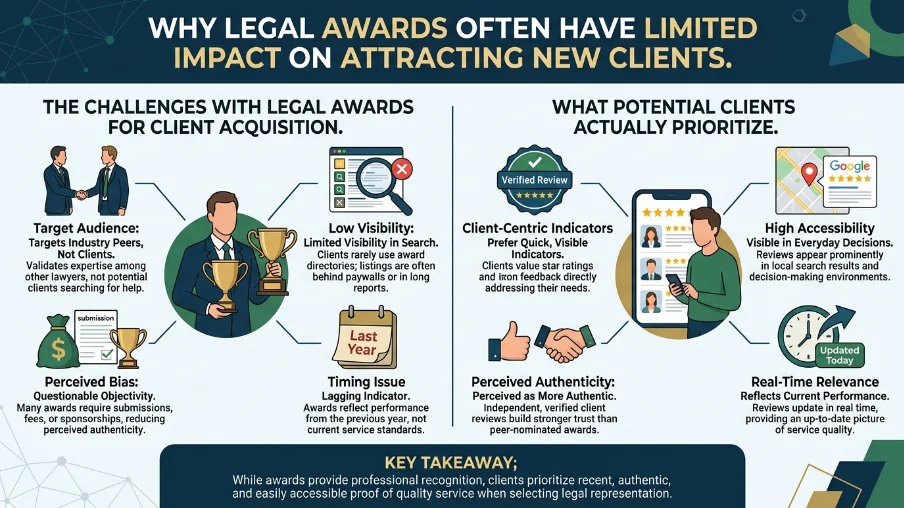
Legal awards have limited client impact because they target industry peers rather than potential clients. Most awards require submissions, fees, or nominations, making them less objective and less visible in everyday search or decision-making environments.
Awards operate within professional ecosystems. They validate expertise among lawyers, not clients. A corporate client searching for legal help rarely filters options based on award directories.
Accessibility remains a barrier. Many award listings exist behind paywalls or in long reports. Clients prefer quick, visible indicators such as star ratings and written feedback.
Timing also reduces relevance. Awards often reflect performance from the previous year. Reviews update in real time, reflecting current service standards.
Perceived bias further reduces credibility. When awards involve paid submissions or sponsorships, clients question their objectivity. Reviews, especially verified ones, appear more authentic.
How do online reviews influence client conversion rates?
Online reviews increase conversion rates by up to 270% because they reduce uncertainty and provide social proof. Positive reviews validate decision-making, while detailed feedback answers key concerns about cost, communication, and outcomes before contact.
Conversion begins with trust. A potential client evaluating three law firms compares ratings, review count, and recent feedback. A firm with consistent 5-star reviews gains immediate preference.
Review content addresses specific concerns. Clients look for:
- Case outcomes such as “successful settlement” or “case dismissed”
- Communication quality such as “clear updates” or “fast responses”
- Professional behaviour such as “transparent fees” or “honest advice”
These details eliminate friction in the decision process.
Negative reviews also play a role. A firm that responds professionally to criticism demonstrates accountability. This behaviour increases trust more than a flawless but inactive profile.
A structured approach to reputation management for lawyers ensures consistent review generation and response handling. This process directly supports higher enquiry rates.
What role does reputation management play in law firm growth?
Reputation management for lawyers controls how reviews are generated, monitored, and responded to, ensuring consistent brand perception. It transforms client feedback into a measurable growth driver by improving trust signals, search visibility, and client acquisition efficiency.
Reputation management involves three core processes: review acquisition, sentiment monitoring, and response optimisation. Each process contributes to a stronger online presence.
Review acquisition focuses on timing and method. Law firms collect reviews after key milestones such as case resolution or consultation completion. Structured requests increase response rates.
Sentiment monitoring identifies patterns. For example, repeated mentions of “slow response time” highlight operational gaps. Firms use this data to improve service delivery.
Response optimisation ensures professionalism. Responding within 24–48 hours increases credibility. Responses must acknowledge feedback, clarify issues, and reinforce expertise.
Firms that invest in reputation management for lawyers build a scalable system. This system continuously strengthens online authority and client trust.
For a structured approach, explore reputation management for lawyers services that focus on measurable outcomes.
How do reviews shape a law firm’s digital brand perception?
Reviews define a law firm’s digital identity because they create a consistent narrative about service quality, professionalism, and reliability. This narrative forms the first impression for 87% of clients before visiting a website or making contact.
Brand perception forms through repeated signals. A law firm with reviews mentioning “clear legal guidance,” “timely updates,” and “successful outcomes” builds a strong, consistent image.
In contrast, inconsistent reviews create uncertainty. Mixed feedback such as “great results but poor communication” weakens trust.
Visual elements reinforce perception. Star ratings, review snippets, and response tone appear directly in search results. These elements shape expectations before any interaction.
Reviews also influence referral behaviour. Clients often share review links instead of direct recommendations. This behaviour amplifies reach without additional marketing spend.
Law firms that actively manage reviews maintain control over their digital narrative. This control ensures alignment between service delivery and public perception.
Why is review recency more important than historical achievements?
Review recency matters because clients prioritise current performance indicators. Reviews from the last 30–90 days signal active service quality, while older achievements such as awards do not reflect present-day client experience or operational standards.
Search engines prioritise fresh content. Recent reviews signal ongoing activity, which improves ranking visibility. A law firm with weekly reviews performs better than one with outdated feedback.
Clients interpret recency as reliability. A review from last week confirms that the firm is active and responsive. An award from three years ago lacks this assurance.
Operational changes also affect relevance. Staff turnover, process improvements, or service expansion alter client experience. Only recent reviews capture these changes.
Consistency matters more than spikes. A steady flow of reviews over time builds stronger trust than a large volume collected in a short period.
Law firms benefit from systems that generate continuous feedback. This approach maintains both SEO performance and client confidence.
How can law firms systematically generate more client reviews?
Law firms generate more reviews by implementing structured processes such as automated follow-ups, timing requests after key milestones, and simplifying review submission. These methods increase response rates by up to 3x compared to manual or inconsistent requests.
Effective review generation depends on timing and clarity. Requests sent immediately after a successful case outcome receive higher engagement.
Three proven methods include:
- Send automated email requests within 24 hours of case resolution
- Provide direct review links to reduce friction
- Follow up once within 3–5 days if no response is received
Personalisation improves results. Using the client’s name and referencing the service increases response likelihood.
Training staff also matters. Legal assistants and client managers play a key role in initiating review requests.
For a detailed breakdown, read how to generate more client reviews for your law firm.
When should a law firm prioritise reviews over awards?
Law firms prioritise reviews when targeting new client acquisition, improving local SEO rankings, or building digital trust. Awards remain relevant for peer recognition, but reviews deliver measurable impact on visibility, engagement, and conversion.
Timing depends on business goals. Firms entering new markets rely on reviews to establish credibility quickly. Awards do not provide immediate visibility in local searches.
Digital-first strategies require review focus. Clients searching online evaluate ratings before credentials. Reviews influence both discovery and selection.
Budget allocation also matters. Investing in review generation and management delivers higher ROI compared to award submissions.
Awards retain value in specific contexts. Corporate clients or institutional partnerships may consider rankings. However, these cases represent a smaller segment of total client volume.
Balancing both elements works best, but reviews take priority for growth-focused strategies.
Explore our reputation management for lawyers guides,
How Search Results Shape a Lawyer’s Reputation
How Fake Reviews Can Damage a Law Firm
How does Clear My Name support law firms in managing online reviews?
Clear My Name provides structured reputation management for lawyers by implementing review generation systems, monitoring feedback across platforms, and optimising responses to strengthen trust signals and search visibility. This approach converts client feedback into measurable business growth.
Clear My Name focuses on data-driven processes. These include automated review workflows, sentiment tracking, and response frameworks aligned with legal industry standards.
The service integrates with existing client communication systems. This integration ensures consistent review requests without disrupting operations.
Performance tracking provides measurable insights. Metrics such as review volume growth, average rating improvement, and response time help firms evaluate progress.
Clear My Name also ensures compliance with platform guidelines. This compliance protects review authenticity and prevents penalties.
Law firms seeking higher conversion rates benefit from structured systems that manage every stage of the review lifecycle.
For firms ready to improve results, explore get more five-star reviews for your law firm.
Online reviews outperform legal awards because they influence real client decisions, improve search visibility, and reflect current service quality. Awards validate expertise within the legal industry, but reviews drive measurable growth through trust, accessibility, and relevance.
Clear My Name enables law firms to implement structured reputation management for lawyers, transforming client feedback into a consistent source of visibility and conversion.
Frequently Asked Questions
What is reputation management for lawyers?
Reputation management for lawyers involves monitoring, generating, and responding to online reviews across platforms like Google and legal directories. Clear My Name structures this process to improve visibility, client trust, and consistent brand perception.
Why do online reviews matter for law firms?
Online reviews influence client decisions because they provide real feedback on service quality, communication, and outcomes. Reputation management for lawyers ensures these reviews are actively managed to maintain strong ratings and accurate public perception.
How can lawyers get more client reviews?
Lawyers generate more reviews by requesting feedback after key milestones, using direct review links, and following up within a defined timeframe. Clear My Name implements structured systems that increase review volume while maintaining compliance with platform guidelines.
How does reputation management improve SEO for law firms?
Reputation management for lawyers improves SEO by increasing review quantity, enhancing keyword relevance in feedback, and maintaining high ratings. Search engines prioritise these signals, which boosts local rankings and visibility in results.
How should law firms respond to negative reviews?
Law firms respond to negative reviews by acknowledging the issue, maintaining professionalism, and providing factual clarification without disclosing confidential information. Clear My Name applies response frameworks that protect reputation while demonstrating accountability.