

Online reputation refers to how individuals, organisations, and entities are interpreted across digital search ecosystems. Reputation management is the process of monitoring, analysing, and influencing reputation signals that affect search visibility, trust evaluation, and public perception.
What Is Online Reputation Management?
Online reputation management is the structured process of evaluating and influencing how digital entities appear within search engine results pages (SERPs). Reputation management defines how search systems interpret credibility through indexed content, review signals, user engagement metrics, and entity associations. Search engines analyse these signals to determine whether an entity demonstrates authority, relevance, and trustworthiness within a specific topic area.
Online reputation refers to the cumulative perception created through reviews, articles, social profiles, directory listings, and third-party references. Search ecosystems interpret these data points as interconnected reputation signals. Algorithms evaluate consistency, sentiment, topical authority, and engagement behaviour to classify entity perception. This classification directly influences search visibility and click-through behaviour.
Reputation management also involves controlling informational accuracy across digital platforms. Search engines compare content consistency between sources to identify entity legitimacy and reliability. Contradictory or outdated information weakens trust evaluation within indexing systems. Consistent identity signals strengthen semantic relationships between content assets and improve entity recognition.
Digital trust is created through repeated positive validation signals. Search engines interpret these signals through natural language processing, sentiment analysis, and behavioural metrics. Positive reviews, authoritative mentions, and accurate information improve perceived trustworthiness. Negative sentiment clusters reduce perceived reliability and alter SERP evaluation patterns.
Read More:
Best Online Reputation Management Services to Protect Your Brand
Fix Your Online Reputation and Remove Negative Search Results
How Is Online Reputation Formed in Search Engines?
Online reputation is formed through indexed content, user interactions, and algorithmic interpretation of trust-related signals. Search engines collect information from websites, review platforms, social networks, directories, and news sources to construct entity profiles. These profiles become part of a broader semantic understanding framework used to evaluate credibility.
Search engines use crawling and indexing systems to collect reputation-related content. Crawlers identify reviews, mentions, citations, ratings, and engagement data connected to a digital entity. Indexing systems then organise this information according to topical relevance, authority level, and sentiment classification. This process creates a searchable reputation layer within the SERP environment.
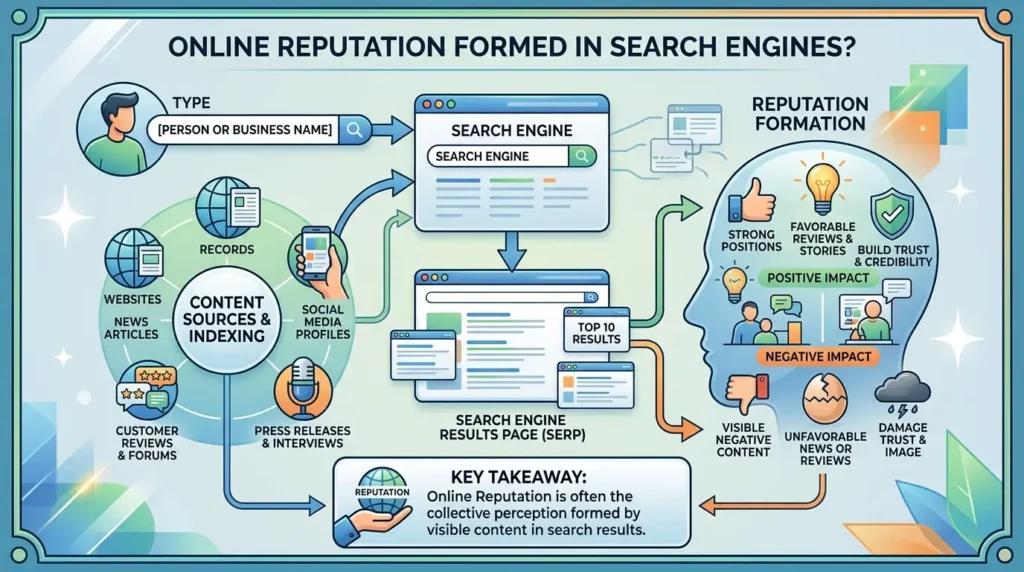
Entity perception develops when algorithms connect multiple references to the same organisation or individual. Consistent naming conventions, location data, and topical associations strengthen entity recognition. Semantic relationships between indexed pages define how search systems understand authority within a subject area. Strong entity clarity improves reputation stability within search results.
User-generated content contributes significantly to reputation formation. Reviews, comments, ratings, and discussions provide behavioural and sentiment-based data. Search engines evaluate language patterns to identify positive, neutral, or negative sentiment. Repeated negative language associated with an entity alters trust interpretation and influences ranking dynamics.
Search engines also analyse behavioural signals linked to search performance. High click-through rates, low bounce rates, and extended dwell time indicate perceived relevance and credibility. Poor engagement metrics indicate dissatisfaction or low informational quality. These behavioural patterns reinforce or weaken reputation signals within ranking systems.
Why Do Positive Reviews Influence Search Visibility?
Positive reviews influence search visibility because search engines interpret review sentiment as a trust and quality signal. Reviews contribute directly to local search rankings, entity credibility, and SERP evaluation. Algorithms analyse review frequency, recency, diversity, and sentiment consistency to determine reliability.
Review signals define public perception within search ecosystems. A high volume of positive reviews demonstrates repeated user validation. Search systems interpret this validation as evidence of credibility and service consistency. Strong review sentiment increases the probability of higher visibility in local and branded search results.
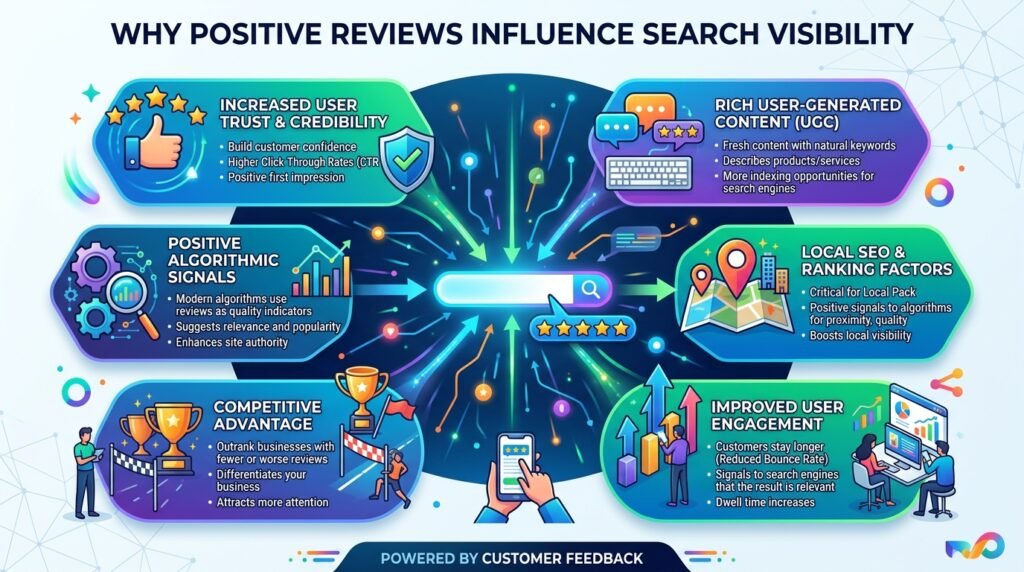
Review content also contributes to semantic relevance. Users naturally include keywords, product references, and service terminology within reviews. Search engines analyse this language to strengthen topical associations related to the entity. Detailed reviews increase contextual understanding and expand search relevance across related queries.
Review recency affects ranking interpretation. Frequently updated reviews indicate active engagement and operational relevance. Outdated reviews weaken freshness signals and reduce the perceived accuracy of reputation data. Search engines prioritise recent sentiment because it reflects current user experience patterns.
Sentiment analysis systems evaluate linguistic structure within reviews. Positive adjectives, trust-related terminology, and satisfaction indicators contribute to favourable sentiment scoring. Negative language patterns trigger lower trust evaluation and influence click behaviour. Search systems integrate these sentiment interpretations into overall reputation scoring models.
Review diversity also influences credibility analysis. Reviews distributed across multiple authoritative platforms create stronger validation signals than isolated reviews on a single source. Search engines compare consistency across platforms to evaluate authenticity. Broad distribution improves entity reliability within search indexing systems.
What Creates a Strong Digital Footprint?
A digital footprint is the total collection of indexed information connected to an entity across online environments. A strong digital footprint demonstrates consistency, authority, relevance, and trust across search ecosystems. Search engines use digital footprint analysis to evaluate legitimacy and credibility.
Content consistency forms the foundation of a strong digital footprint. Matching names, descriptions, contact information, and topical focus across platforms strengthen entity recognition. Search engines compare these signals to identify authoritative relationships between content assets. Inconsistent information weakens semantic clarity and reduces trust evaluation accuracy.
Authoritative content contributes to reputation stability. Search engines prioritise content that demonstrates expertise, topical depth, and informational accuracy. Detailed educational content, structured metadata, and semantic relevance strengthen authority signals. High-authority content improves indexing confidence and reinforces entity perception.
Third-party references also define digital footprint quality. Mentions from authoritative sources function as external trust signals. Search systems interpret these references as validation mechanisms that support credibility analysis. Repeated authoritative mentions increase perceived legitimacy within SERP evaluation frameworks.
Indexed multimedia assets influence reputation interpretation as well. Images, videos, interviews, and structured media contribute to search visibility and entity association. Multimedia content expands indexed surface area and increases informational coverage within search results. This broader visibility strengthens digital presence and reputation recognition.
Search engines additionally evaluate content freshness and update frequency. Regularly updated content indicates operational activity and informational relevance. Static or abandoned digital profiles weaken engagement interpretation and reduce indexing confidence. Fresh content maintains active trust signals within search ecosystems.
How Do Search Engines Interpret Trust and Credibility?
Search engines interpret trust and credibility through interconnected reputation signals derived from content quality, authority, behavioural data, and sentiment analysis. Trust evaluation systems classify entities according to perceived reliability and informational integrity. These systems influence ranking potential and SERP positioning.
Authority signals define topical expertise within search ecosystems. Search engines analyse backlink quality, citation relevance, structured content, and semantic depth to evaluate authority. Strong authority signals indicate that an entity consistently publishes relevant and credible information. Weak authority structures reduce ranking stability.
Content indexing systems also assess factual consistency. Repeated contradictions between indexed sources reduce trust evaluation accuracy. Search engines prioritise entities that maintain stable informational alignment across digital platforms. Consistency strengthens semantic confidence and improves entity reliability.
User engagement metrics contribute to credibility interpretation. Search systems evaluate click behaviour, return visits, interaction duration, and content consumption patterns. Positive behavioural signals indicate that users perceive content as useful and trustworthy. Negative engagement patterns weaken credibility scoring within search algorithms.
Search engines additionally analyse source reputation. Content published on authoritative platforms receives stronger trust weighting than content from low-quality domains. Reputation transfer occurs when trusted sources reference or validate another entity. This interconnected trust structure influences broader entity perception.
Spam detection systems also affect credibility evaluation. Artificial reviews, manipulative links, and duplicated content trigger quality filters within search algorithms. Search systems prioritise authenticity and penalise deceptive reputation manipulation techniques. Authentic engagement patterns create sustainable trust signals within indexing systems.
How Does Negative Content Affect Online Reputation?
Negative content affects online reputation by altering sentiment interpretation, reducing trust signals, and influencing user behaviour within search results. Search ecosystems interpret repeated negative associations as indicators of reduced credibility. This perception directly impacts search visibility and click-through performance.
Negative reviews contribute to sentiment imbalance within indexed reputation data. Search engines classify sentiment using language analysis models that identify dissatisfaction indicators. Repeated negative terminology weakens trust evaluation and changes entity perception within SERPs. Strong negative sentiment clusters increase reputational volatility.
High-visibility negative content also influences behavioural metrics. Users encountering negative headlines or reviews demonstrate lower engagement confidence. Reduced click-through rates and increased bounce rates reinforce negative perception signals. Search systems interpret these behaviours as evidence of diminished relevance or trustworthiness.
Content persistence intensifies reputational impact. Indexed negative articles, complaints, or discussions remain accessible within search archives for extended periods. Search engines continue evaluating these references as part of the entity’s reputation profile. Persistent negative indexing creates long-term perception effects.
Negative content additionally disrupts authority evaluation. Search systems compare positive and negative references to determine sentiment balance. A high concentration of critical content weakens credibility classification. This imbalance influences ranking dynamics across branded and non-branded search queries.
Search engines also assess content prominence. Negative content appearing on authoritative domains receives stronger visibility weighting than low-authority mentions. Prominent negative references therefore exert greater influence on entity perception. Authority amplification increases reputational impact within search ecosystems.
How Can Positive Reviews Be Encouraged Organically?
Positive reviews are encouraged organically through consistent user experience quality, structured feedback collection, and transparent communication systems. Search ecosystems prioritise authentic review acquisition because organic feedback reflects genuine user sentiment. Authenticity strengthens review credibility and improves trust interpretation.
Structured review requests increase review frequency. Follow-up communication after completed interactions encourages users to submit detailed feedback. Search systems interpret increased review activity as evidence of operational engagement. Consistent review generation strengthens freshness signals and sentiment diversity.
Clear review accessibility also improves participation rates. Simplified review submission pathways reduce friction within feedback processes. Search engines recognise active review ecosystems as indicators of legitimacy and user involvement. Accessible review systems therefore contribute indirectly to search visibility.
Detailed responses to reviews strengthen reputation perception as well. Public responses demonstrate engagement transparency and operational accountability. Search systems evaluate interaction patterns between entities and reviewers to interpret responsiveness. Consistent review engagement reinforces trust-related behavioural signals.
Content quality further influences review generation. Informative, accurate, and useful content increases user satisfaction and trust perception. Satisfied users demonstrate higher participation rates in review ecosystems. This relationship connects content credibility with reputation growth.
Authenticity remains central to organic review acquisition. Search engines analyse behavioural anomalies, linguistic repetition, and submission patterns to identify manipulation. Genuine reviews demonstrate varied language structures and natural timing patterns. Authentic review ecosystems maintain long-term credibility within SERP evaluation systems.
What Is the Relationship Between Reputation Management and SERPs?
Reputation management and SERPs are directly connected through search visibility, sentiment analysis, and entity perception systems. SERPs function as the primary environment where users evaluate credibility and trustworthiness. Reputation management therefore focuses on understanding how indexed information shapes perception within search results.
SERPs organise information according to algorithmic relevance and trust evaluation. Search engines prioritise authoritative, relevant, and credible content when displaying results. Positive reputation signals improve the prominence of favourable content assets. Negative signals increase visibility for critical or damaging content.
Branded search queries intensify reputation visibility. Users searching for entity-specific terms receive a concentrated overview of indexed reputation data. Reviews, articles, profiles, and multimedia assets collectively define first-page perception. Search engines therefore use SERPs as a reputation evaluation interface.
Featured snippets, review stars, and knowledge panels also influence perception. These SERP features provide condensed trust signals directly within search results. Search systems use structured data and entity recognition to populate these elements. Strong reputation signals improve eligibility for enhanced SERP visibility.
Reputation management additionally intersects with content indexing strategies. Search engines continuously reassess indexed content according to freshness, relevance, and engagement metrics. Updated positive content strengthens favourable visibility patterns over time. Content decay reduces ranking strength and weakens perception control.
SERP evaluation ultimately determines digital credibility exposure. Users interpret ranking position, review sentiment, and content prominence as indicators of trustworthiness. Search ecosystems therefore transform reputation into a measurable visibility factor connected directly to user perception.
Conclusion
Online reputation management defines how digital entities are interpreted within search ecosystems through reviews, indexed content, authority signals, and behavioural data. Search engines evaluate these interconnected reputation signals to determine credibility, relevance, and visibility across SERPs.
Positive reviews, authoritative content, consistent entity information, and authentic engagement patterns strengthen digital trust and semantic clarity. Negative sentiment, inconsistent data, and weak authority structures reduce trust evaluation and influence perception within search environments. Reputation management therefore functions as a structured process of understanding how search systems interpret and rank credibility-related information.
Within modern search ecosystems, reputation is not limited to opinion alone. Reputation refers to a measurable collection of trust signals, sentiment patterns, and indexed entity associations that define visibility and perception across digital environments. For organisations and individuals alike, understanding these mechanisms remains central to interpreting how search engines evaluate online credibility and authority.
What is online reputation management, and why is it important?
Online reputation management is the process of monitoring, improving, and maintaining how a business or individual appears online. It helps build trust, improve search engine visibility, and increase customer confidence through positive reviews and accurate online information.
How can I get more positive customer reviews online?
Businesses can get more positive reviews by asking satisfied customers for feedback at the right time and making the review process simple. Consistent customer service, timely responses, and active engagement on review platforms also improve review generation naturally.
How do negative reviews affect online reputation?
Negative reviews can impact customer trust, local SEO rankings, and conversion rates if they are ignored. Responding professionally and resolving customer concerns quickly can help reduce damage and show potential customers that the business values feedback.
Can online reputation management help improve Google search results?
Yes, online reputation management can improve Google search visibility by promoting positive content, optimizing business profiles, and increasing authentic customer reviews. Strong online signals often help businesses appear more trustworthy in search results.
How long does it take to improve an online reputation?
Improving an online reputation depends on factors like review history, search visibility, and customer engagement. In most cases, businesses begin seeing gradual improvements within a few months through consistent review management and reputation monitoring.