

Google Reviews directly influence search visibility, customer trust, and conversion performance. Businesses with controlled reputation signals secure stronger SERP control, higher engagement rates, and improved purchasing confidence.
Search perception influence now determines whether a prospect contacts a business or leaves for a competitor. A structured Google Reviews strategy strengthens entity credibility, stabilises public sentiment, and reduces the commercial risk created by unmanaged customer feedback.
Which Google Reviews strategy delivers measurable reputation control?
A professional Google Reviews strategy delivers measurable reputation control by improving review quality, increasing review consistency, and strengthening positive search perception influence across local search environments. Google evaluates review velocity, review relevance, reviewer authority, and engagement frequency as trust-based reputation signals. These signals directly affect map pack visibility, click-through rates, and customer confidence during decision-stage searches. Businesses with unmanaged reviews lose SERP control because negative sentiment gains visibility faster than positive customer experiences. A structured review management process ensures that positive experiences become searchable trust assets rather than lost opportunities. This creates a controlled digital footprint that supports sustainable conversion performance.
Clear My Name applies a process-driven review management framework designed to improve search ecosystem trust signals without relying on artificial manipulation or short-term tactics. The service strengthens review acquisition workflows, monitors sentiment trends, and improves response consistency to reinforce entity credibility within Google’s local ranking systems. This process reduces the impact of isolated negative reviews by increasing the visibility of authentic positive experiences across relevant search surfaces. Stronger review quality improves behavioural metrics such as engagement time, interaction rates, and customer contact actions. Google interprets these behaviours as indicators of business reliability and relevance. The result is improved search visibility combined with stronger customer trust at the exact point of decision-making.
The effectiveness of Google Reviews management becomes more evident when businesses compare performance metrics against competitors operating within the same search category. Businesses with higher review consistency and stronger average sentiment secure stronger local rankings and improved conversion stability. The influence of customer feedback extends beyond ratings because search engines analyse semantic relevance within review content itself. Review language associated with professionalism, reliability, and service quality strengthens topical authority within local search ecosystems. This directly improves visibility for commercially valuable searches linked to buyer intent. Businesses that actively manage reputation signals maintain stronger control over how their brand appears during critical customer evaluation stages.
Why does professional Google Reviews management improve conversion rates?
Professional Google Reviews management improves conversion rates because reputation signals influence buying decisions before a customer visits a website or submits an enquiry. Search users evaluate trust through review quality, response behaviour, rating distribution, and review recency within seconds. Negative review dominance weakens entity credibility and increases perceived risk during commercial decision-making. A structured management strategy ensures that customer sentiment remains aligned with business positioning across search environments. This creates consistency between brand messaging and public perception. Consistent reputation signals improve trust acceleration and reduce customer hesitation during high-intent searches.
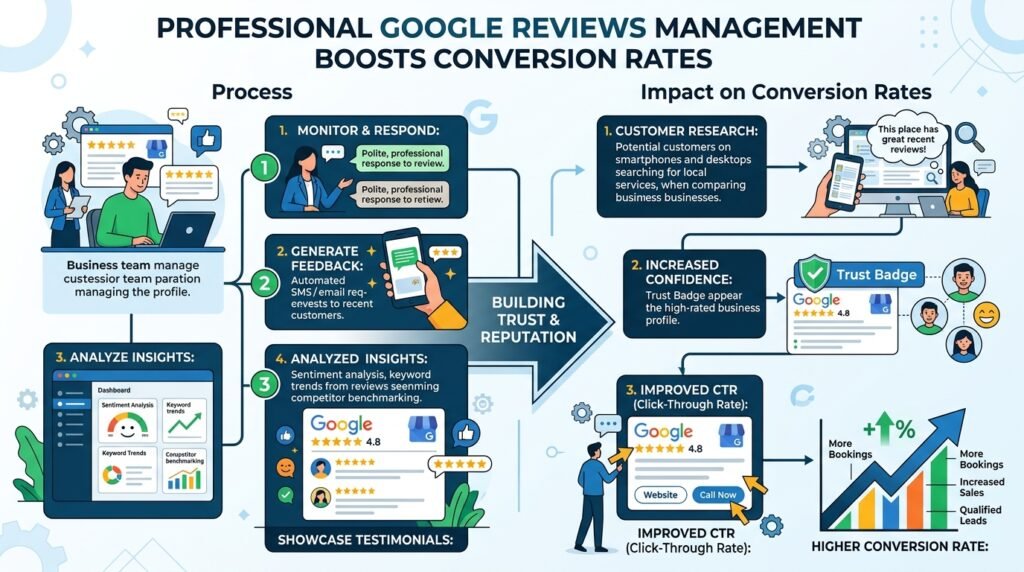
A professionally managed review ecosystem delivers measurable operational benefits:
- Strengthen review acquisition workflows to increase positive review frequency and stabilise average ratings.
- Improve response consistency to reinforce professionalism and increase customer confidence.
- Reduce negative sentiment visibility through structured negative content suppression strategies.
- Increase local search engagement through stronger review relevance and topical keyword alignment.
- Stabilise search perception influence by maintaining consistent reputation signals across Google surfaces.
Businesses investing in review management achieve stronger long-term customer acquisition efficiency because trust becomes embedded within their search presence. Review-rich search listings secure higher engagement rates than listings with weak or inconsistent customer feedback. Positive reviews also strengthen post-click conversion behaviour because customer expectations align with perceived service quality before interaction occurs. This reduces lead friction and improves sales efficiency. Businesses relying solely on paid advertising without reputation optimisation experience weaker trust transfer because prospects encounter unmanaged sentiment during evaluation. Reputation management therefore functions as both a visibility strategy and a conversion protection mechanism.
Get Deep Insight:
Clear My Name’s Complete Google Review Management Framework
How Clear My Name Helps Businesses Recover From Negative Google Reviews
Decision-stage buyers actively compare businesses based on trust indicators rather than marketing claims alone. This explains why businesses increasingly analyse customer review trends to understand how reputation signals affect purchasing behaviour. Informational research validates the growing influence of review ecosystems on local search performance and commercial trust formation. Businesses that ignore these trends surrender search perception influence to competitors with stronger reputation management systems. Active review governance protects long-term brand equity while supporting sustainable visibility growth. Strong reputation infrastructure therefore becomes a competitive asset rather than a reactive support function.
How does Google Reviews management strengthen SERP control?
Google Reviews management strengthens SERP control by increasing the visibility of positive reputation signals while reducing the prominence of harmful sentiment patterns. Search engines prioritise content demonstrating trust, engagement, and relevance within local commercial searches. Reviews operate as dynamic user-generated content that continuously influences these ranking systems. Businesses with active review ecosystems maintain stronger content freshness and engagement relevance than competitors with inactive profiles. This improves positioning within local search results and strengthens brand authority across search environments. Controlled review activity therefore contributes directly to search result stability.
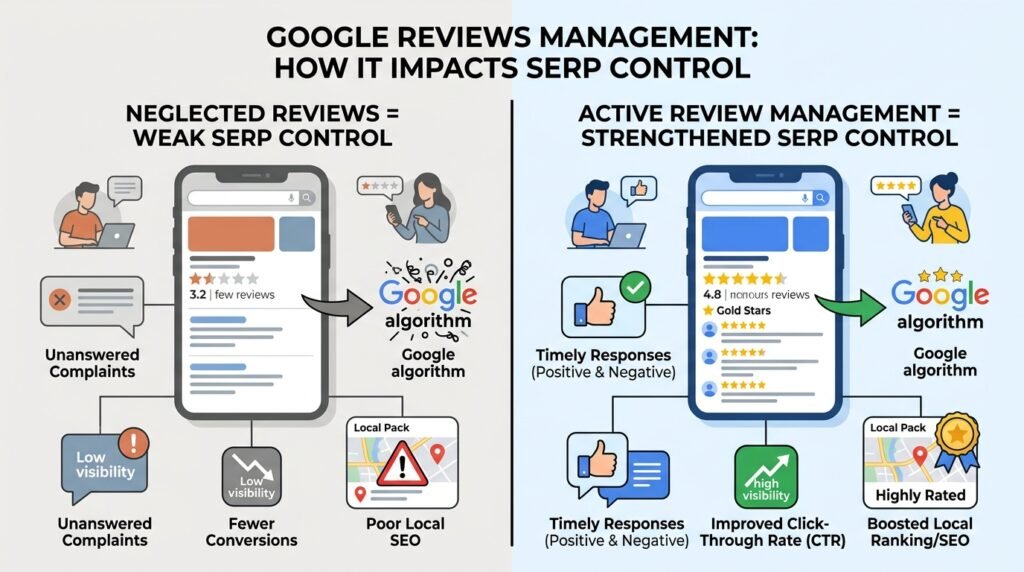
Negative content suppression functions through signal balancing rather than removal alone. A strategic review management process increases the frequency and authority of positive reputation signals so isolated negative sentiment loses proportional influence. This protects search perception influence without violating platform guidelines or creating credibility risks. Google’s ranking systems reward authentic engagement patterns supported by consistent customer interaction. Businesses that systematically collect, respond to, and optimise reviews strengthen their reputation footprint across multiple search layers. This creates stronger resilience against visibility disruption caused by isolated complaints or reputation attacks.
The relationship between reviews and SERP control extends into branded search behaviour. Prospective customers searching for a business name immediately encounter Google ratings, review excerpts, and response quality before accessing owned digital assets. Poor review governance therefore damages branded conversion opportunities even when advertising performance remains strong. Professional management improves control over this first-impression environment by ensuring positive sentiment dominates visible search surfaces. Stronger review sentiment also increases trust transfer between branded and non-branded searches. This improves customer acquisition efficiency across broader marketing campaigns.
Businesses seeking long-term search stability increasingly evaluate Google review comparison metrics to benchmark reputation performance against high-ranking competitors. Benchmarking exposes the operational gap between average businesses and dominant local entities. High-performing businesses consistently maintain stronger review velocity, higher engagement quality, and more responsive customer communication patterns. These factors reinforce entity credibility within Google’s search ecosystem. Businesses implementing structured review strategies therefore improve both competitive visibility and perception resilience. Reputation management becomes an active search optimisation discipline rather than a reactive customer service task.
Which risks does unmanaged Google Reviews activity create for businesses?
Unmanaged Google Reviews activity creates commercial risk because search users interpret visible sentiment as objective proof of business quality. Negative reviews reduce trust immediately when no structured response or reputation balancing strategy exists. A weak review profile also damages local search rankings because engagement signals decline alongside customer confidence. Search engines interpret these patterns as indicators of lower relevance and weaker user satisfaction. Businesses experiencing declining review quality therefore lose both visibility and conversion efficiency simultaneously. This creates a compounding reputation problem that weakens long-term growth stability.
The most significant risks include:
- Reduce customer trust through visible unresolved complaints and inconsistent response behaviour.
- Damage local ranking performance through declining engagement and weaker review relevance signals.
- Increase customer acquisition costs as paid campaigns compensate for declining organic trust.
- Strengthen competitor visibility when alternative businesses display stronger reputation signals.
- Destabilise brand perception through unmanaged sentiment amplification across search environments.
Negative review visibility affects more than public perception because review content frequently appears within indexed search results. Search engines analyse semantic review content to understand business quality associations linked to branded queries. Businesses accumulating repeated complaints around reliability, service delays, or communication failures weaken their entity credibility within these systems. This reduces both ranking strength and customer confidence simultaneously. Professional review management reduces this risk by ensuring that positive customer experiences maintain higher visibility and stronger search relevance. The strategy therefore protects both visibility performance and commercial reputation continuity.
Businesses often underestimate the speed at which reputation deterioration affects search performance. Search ecosystems prioritise freshness, engagement, and behavioural interaction data. A sudden increase in negative sentiment rapidly influences customer click behaviour and engagement rates. Reduced engagement weakens ranking performance further, increasing visibility loss across local search environments. Professional management frameworks interrupt this cycle by stabilising sentiment visibility before reputational decline accelerates. Early intervention preserves search authority and reduces long-term recovery costs.
How does a structured reputation management process deliver sustainable results?
A structured reputation management process delivers sustainable results because it aligns operational behaviour, customer experience, and search visibility within one controlled framework. Sustainable reputation management depends on continuous signal optimisation rather than isolated review campaigns. Google’s ranking systems reward consistency, authenticity, and ongoing engagement patterns. Businesses maintaining structured review governance build stronger entity trust over time because search ecosystems interpret consistency as reliability. This strengthens long-term ranking durability and customer confidence simultaneously. Sustainable outcomes therefore depend on process clarity rather than reactive reputation repair alone.
Clear My Name implements review management through measurable operational stages designed to strengthen reputation signals continuously. The process begins with sentiment auditing to identify visibility risks, review gaps, and negative perception triggers affecting search performance. Structured customer outreach then improves positive review acquisition from verified experiences. Review responses are optimised to reinforce professionalism, accountability, and customer engagement quality. Performance monitoring ensures that review velocity, rating trends, and search perception influence remain stable over time. This systematic approach creates durable reputation resilience rather than temporary visibility improvements.
The long-term value of structured reputation management exceeds the immediate impact of rating improvements because trust compounds across search ecosystems. Businesses with stable review sentiment secure stronger referral confidence, improved click-through performance, and higher branded search engagement. Search engines increasingly reward businesses demonstrating sustained user satisfaction through authentic interaction signals. This creates cumulative visibility advantages that strengthen over time. Professional management therefore functions as a long-term digital trust infrastructure rather than a short-term promotional activity. Businesses investing in consistent review governance achieve stronger market positioning with lower reputation volatility.
A structured process also improves risk mitigation because businesses maintain active oversight of evolving customer sentiment trends. Early identification of negative perception patterns prevents escalation into broader search visibility problems. Businesses operating without monitoring frameworks often discover reputation damage only after rankings and conversions decline significantly. Proactive management protects operational stability by maintaining control over public-facing trust signals. This reduces recovery costs and preserves competitive positioning within local search ecosystems. Sustainable reputation management therefore delivers both defensive and growth-oriented commercial value.
Is professional Google Reviews management worth the long-term investment?
Professional Google Reviews management delivers long-term value because trust signals directly influence revenue performance, customer acquisition efficiency, and competitive search visibility. Businesses with stronger review ecosystems secure higher conversion rates without proportionally increasing advertising expenditure. Positive reputation signals improve organic trust transfer, reducing reliance on expensive customer persuasion tactics. This creates stronger marketing efficiency across both paid and organic channels. Businesses maintaining weak review governance experience the opposite effect because reputation friction reduces conversion consistency. Investment in review management therefore protects revenue stability while improving search competitiveness.
The long-term commercial value becomes measurable through improved lead quality, increased engagement rates, and stronger branded search performance. Positive review environments reduce customer uncertainty during decision-stage evaluation. This shortens buying cycles and increases contact confidence. Businesses with trusted search profiles also experience stronger referral behaviour because customer satisfaction becomes publicly visible and continuously reinforced. Reputation management therefore contributes directly to both acquisition growth and retention strength. The value extends beyond visibility into broader customer trust infrastructure.
Professional reputation management also reduces the operational cost of reputation recovery. Businesses addressing negative sentiment early avoid larger visibility losses requiring expensive corrective campaigns later. Structured review governance prevents isolated complaints from dominating search perception influence. This preserves entity credibility across search ecosystems while strengthening long-term market stability. Businesses delaying reputation management often face higher suppression costs, reduced trust recovery speed, and prolonged visibility disruption. Proactive management therefore delivers stronger commercial efficiency over time.
Businesses seeking reliable search perception control require more than isolated review responses or sporadic reputation repair activity. A structured, evidence-driven process ensures that reputation signals remain aligned with customer expectations and search engine trust evaluation systems. Clear My Name delivers this stability through professional Google Reviews management focused on measurable visibility improvement, stronger entity credibility, and sustainable trust reinforcement. The result is controlled reputation growth supported by transparent processes and long-term search resilience.
Use professional reputation management service to strengthen Google Reviews performance, improve SERP control, and stabilise customer trust across competitive search environments. Businesses evaluating broader industry patterns can also review customer review trends and Google review comparison metrics to validate how reputation signals influence local search visibility and conversion performance.
What is Google review management and why is it important for businesses?
Google review management involves monitoring, responding to, and improving customer reviews on Google Business Profiles. A strong review strategy helps businesses build trust, improve local SEO rankings, and influence customer purchasing decisions.
How can negative Google reviews affect a business online?
Negative Google reviews can reduce customer trust, lower local search visibility, and impact conversion rates. Consistent review monitoring and professional response management help businesses protect their online reputation and maintain credibility.
Can businesses remove fake or policy-violating Google reviews?
Businesses can report reviews that violate Google’s review policies, including fake, spam, or misleading content. Services like Clear My Name help identify review violations and guide businesses through the review dispute and reputation management process.
How does a Google review strategy improve local SEO?
A consistent Google review strategy increases customer engagement signals that support local SEO performance. Positive reviews, regular responses, and keyword-relevant feedback can improve visibility in Google Maps and local search results.
What should businesses include in professional review responses?
Professional Google review responses should address customer concerns clearly, remain polite, and provide accurate information. Timely responses demonstrate accountability and help strengthen customer trust and brand reputation online.