

Rebuilding review velocity requires a consistent flow of authentic customer feedback rather than simply increasing the total number of Facebook reviews. Reputation management strategies differ based on review activity, customer engagement, platform behaviour, reputation signals, and the sustainability of the approach.
What does review velocity mean for a Facebook page?
Review velocity is the rate at which new customer reviews are generated over a defined period. It measures the freshness and frequency of customer feedback rather than the total number of reviews accumulated throughout a page’s history. A Facebook page with 500 historical reviews and no recent activity has a different review velocity from a page receiving consistent reviews each month. Review velocity therefore adds a temporal dimension to review volume. This distinction is important when evaluating whether a business’s visible reputation reflects current customer experiences.
Review velocity operates as a reputation signal because recent reviews provide evidence of ongoing customer interaction. The signal does not independently establish service quality, business activity, or customer satisfaction. Instead, it contributes to the broader information environment that users evaluate when researching an organisation. Review age, sentiment distribution, rating patterns, and frequency collectively influence how current the review profile appears. A stagnant profile contains historical evidence but provides less recent evidence for evaluating present-day credibility.
Why does a stagnant review profile require a different approach?
A stagnant review profile requires a different approach because historical review volume does not automatically create current reputation evidence. Adding large amounts of content without considering recency, authenticity, or customer experience does not address the underlying information gap. The objective is to establish sustainable customer feedback activity that accurately reflects real interactions. This requires understanding why review velocity declined before selecting an intervention. Diagnosis therefore comes before optimisation.
A stagnant profile can result from low customer engagement, changes in purchasing behaviour, limited review awareness, reduced platform activity, or an inconsistent feedback process. Each cause produces a different strategic requirement. Increasing customer awareness of the review process addresses a different problem from improving customer experience or rebuilding platform engagement. Reputation management strategies therefore need to distinguish the cause of stagnation from its visible effect.
The distinction also affects risk exposure. Artificially accelerating review volume can create authenticity concerns and distort the reputation signal. A sustainable approach connects review generation with genuine customer experiences and normal business activity. This produces a more defensible review profile and reduces the risk associated with unnatural patterns.
Which methods are most effective for rebuilding review velocity?
Authentic customer feedback generation provides the strongest foundation because it creates new reputation signals from genuine interactions. A structured feedback process operates by making it easier for customers to understand where and how to leave an honest review after an interaction. The method focuses on accessibility and consistency rather than influencing the content or sentiment of the review. This maintains the informational value of the resulting feedback.
Review requests represent one component of this process. They can be integrated into normal customer communication after a completed transaction or service interaction. The timing needs to correspond with the customer experience rather than relying on arbitrary bursts of activity. Consistency creates a more natural review pattern than concentrated review generation after a prolonged period of inactivity.
Content and engagement strategies provide a supporting role. Active Facebook content can maintain page relevance and create additional opportunities for customer interaction, but social activity does not automatically produce reviews. The two mechanisms need to remain conceptually separate. Engagement improves interaction opportunities, while review generation directly affects review velocity.
How does organic review generation compare with reactive review campaigns?
Organic review generation focuses on establishing an ongoing feedback process, while reactive campaigns respond to a sudden decline in review activity or reputation visibility. Organic approaches prioritise sustainability because review generation becomes part of normal customer interaction. Reactive approaches prioritise speed because they attempt to address a visible gap within a shorter timeframe. The difference therefore concerns timing, process integration, and long-term stability.
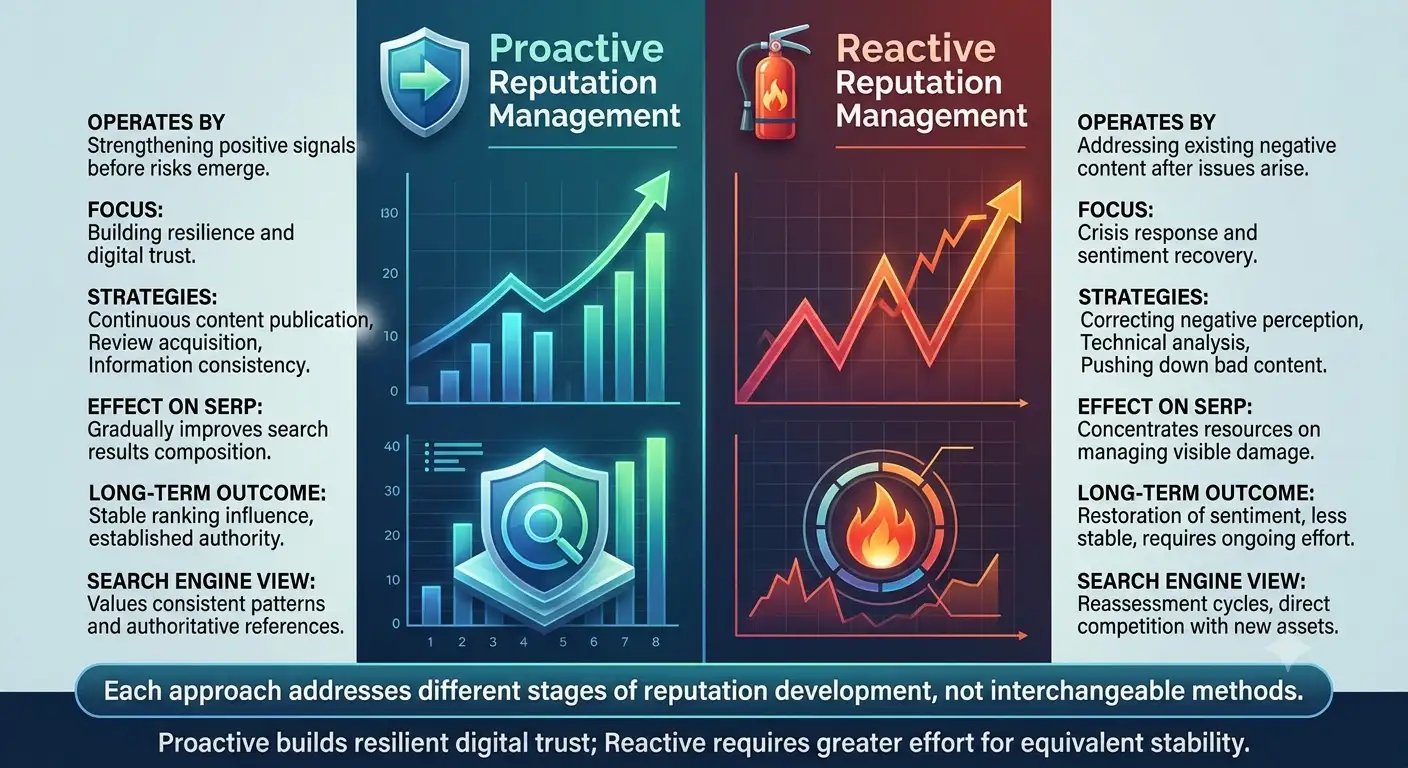
Organic approaches provide a stronger foundation for consistent review velocity. Customers encounter review opportunities as part of the normal post-service process, creating a recurring source of feedback. This approach reduces dependence on one-off campaigns and makes review activity easier to maintain. Its limitation is that sustainable growth depends on actual customer interactions and therefore does not provide an instant increase in review volume.
Reactive approaches can provide faster attention to an obvious review gap. They are useful when a business identifies a sudden reduction in feedback or a significant change in customer activity. Their limitation appears when the intervention is not connected to a continuing process. Once the campaign ends, review velocity can return to its previous level.
Is increasing review volume more important than increasing review freshness?

Review freshness is more informative for current reputation analysis than historical volume alone. A large review count demonstrates accumulated customer feedback, but it does not establish how recently customers have contributed that feedback. Fresh reviews provide current evidence that complements historical reputation. This makes review velocity a useful metric alongside total review volume.
A page with 1,000 reviews accumulated over ten years has substantial historical depth. A page with 300 reviews accumulated consistently over the previous two years provides a different temporal signal. The first profile demonstrates long-term customer feedback, while the second provides stronger evidence of recent interaction. Neither metric independently determines credibility.
The appropriate evaluation therefore combines volume with recency. Total reviews measure accumulated evidence, while review velocity measures the rate at which new evidence enters the profile. Sentiment distribution adds another dimension by showing whether recent customer experiences align with historical patterns. Together, these metrics provide a more complete reputation assessment.
How can businesses rebuild review velocity without creating artificial signals?
Businesses can rebuild review velocity by connecting review opportunities to genuine customer interactions and maintaining consistent feedback processes. The objective is to increase the availability of authentic customer feedback rather than manufacture a specific rating or sentiment outcome. This distinction is essential because reputation systems rely on the credibility of user-generated information. Artificial activity can weaken the reliability of the review profile.
A structured process can:
- Identify completed customer interactions where an honest review request is contextually appropriate.
- Simplify the review process by providing customers with a direct and accessible route to the relevant Facebook review function.
- Standardise review-request timing so feedback opportunities occur consistently after relevant interactions.
- Monitor review frequency to identify whether new feedback is becoming more regular over defined periods.
- Analyse sentiment distribution without attempting to control whether customers leave positive or negative feedback.
The mechanism is straightforward: genuine interactions create opportunities for genuine feedback, and consistent opportunities increase the likelihood of continued review activity. The process does not guarantee a particular number or sentiment of reviews. Instead, it establishes a sustainable system for collecting authentic customer-generated reputation signals.
How do review requests affect reputation signals?
Review requests affect reputation signals by increasing opportunities for customers to contribute current feedback. A request itself is not a reputation signal equivalent to a published review. The resulting review becomes the actual user-generated signal that contributes rating, sentiment, recency, and experience information.
The timing of the request affects the temporal pattern of review generation. A consistent process produces a more stable flow of reviews than an isolated campaign. This improves the freshness of the visible review profile without requiring artificial concentration of feedback.
The content of the request also matters from a risk perspective. A neutral request invites honest feedback, while language that directs customers towards a specific sentiment compromises the independence of the resulting signal. Reputation management therefore evaluates not only review quantity but also the integrity of the generation process.
Dive Deeper With Our Expert Guides:
Raising a Sub-4.0 Facebook Rating Without Breaking Meta’s Rules
How to Remove a ‘Not Recommended’ Snippet From Google Results
What role does customer experience play in review velocity?
Customer experience provides the underlying source of authentic review generation. Review velocity cannot be evaluated independently from the number and nature of customer interactions taking place. A business with limited customer transactions naturally has fewer opportunities to generate reviews than one with frequent transactions. Review frequency therefore needs to be interpreted relative to operational activity.
Customer experience also influences sentiment distribution. A higher review velocity does not automatically produce a stronger reputation if recent reviews contain recurring negative themes. Increasing the number of reviews without addressing the underlying customer experience changes the quantity of reputation signals without improving their quality.
This creates an important distinction between reputation generation and reputation improvement. Review generation increases the availability of customer feedback, while service improvement influences what customers report. Sustainable reputation management addresses both dimensions without manipulating the resulting customer sentiment.
How do short-term and long-term review strategies compare?
Short-term strategies focus on quickly increasing visible review activity, while long-term strategies establish a repeatable feedback process. Short-term interventions provide immediate attention to review stagnation but depend heavily on concentrated activity. Long-term approaches require process integration but provide greater sustainability.
The effectiveness of a short-term strategy depends on the reason for stagnation. If the issue resulted from a temporary disruption in customer communication, restoring the normal feedback process can produce a relatively direct improvement. If the underlying issue is weak customer engagement, a short-term review campaign does not resolve the cause.
Long-term strategies operate differently because they treat review velocity as an ongoing operational metric. The business monitors review frequency, recency, sentiment, and customer interaction continuously. This creates a feedback loop in which changes in review activity reveal changes in customer engagement.
The most reliable evaluation therefore considers both time horizons. Short-term activity can address an immediate visibility gap, while long-term process development determines whether review velocity remains stable.
Does review velocity influence search visibility?
Review velocity can influence the information environment associated with a business, but it is not a standalone Google or Facebook ranking factor that guarantees improved search positions. Search engines evaluate content using multiple systems, including relevance, quality, authority, freshness, and search intent. Reviews contribute information about an entity, but their existence does not automatically determine rankings.
The search impact is therefore indirect and contextual. Recent reviews create newer user-generated content that can contribute to the digital footprint surrounding the business. When review-related information is accessible to search engines, it forms part of the wider set of information associated with the entity.
SERP composition provides the relevant measurement. Businesses can compare how their Facebook page and review-related content appear for branded searches before and after changes in review activity. This separates actual search visibility changes from assumptions about ranking influence.
Search perception also matters because customers interpret what they see. A more current review profile can provide fresher information during the research process, even when the Facebook page’s ranking position remains unchanged.
How should review velocity be measured?
Review velocity should be measured using consistent time periods, review counts, recency, sentiment distribution, and comparison against historical activity. A single increase in review volume does not demonstrate sustainable improvement. Measurement needs to identify whether the rate of new reviews remains stable after the initial intervention.
A useful evaluation framework compares:
| Metric | What it measures | Strategic value |
|---|---|---|
| Review velocity | Rate of new reviews | Measures current feedback activity |
| Review recency | Age of latest reviews | Measures freshness |
| Review volume | Total accumulated reviews | Measures historical depth |
| Sentiment distribution | Positive, neutral and negative themes | Evaluates current perception |
| Rating distribution | Spread of customer ratings | Provides quantitative context |
| SERP visibility | Search presence of related content | Measures search exposure |
These metrics work together rather than independently. High velocity with worsening sentiment presents a different situation from low velocity with consistently positive sentiment. Similarly, strong review freshness with weak search visibility creates a different challenge from strong visibility with outdated reviews.
Measurement therefore converts review management from a subjective perception into an evaluative process. The objective is to identify whether review activity is becoming fresher, more consistent, and more representative of current customer interactions.
Which approach is most sustainable for a stagnant Facebook page?
A repeatable, authentic customer-feedback process is the most sustainable approach because it integrates review generation into ongoing customer interactions. It does not depend on one-off campaigns or artificial increases in review volume. The process creates recurring opportunities for customers to provide independent feedback. This gives review velocity a stable operational foundation.
Sustainability also requires continuous analysis. Review velocity can change because customer activity changes, platform behaviour changes, or the business changes its communication process. Monitoring identifies these changes before the review profile becomes stagnant again.
A sustainable strategy also protects against reputation risk. It does not attempt to manufacture positive sentiment or suppress legitimate criticism. Instead, it allows customer-generated information to develop naturally while the business monitors the resulting reputation signals.
This approach creates stronger long-term information quality than simply pursuing a higher review count. The objective is not maximum review volume but a current, authentic, and informative review profile.
How should businesses evaluate review velocity strategies?
Businesses should evaluate review velocity strategies through effectiveness, scalability, risk exposure, and sustainability. Effectiveness measures whether review activity becomes more current and consistent. Scalability examines whether the feedback process remains practical as customer volume changes. Risk exposure considers whether the approach complies with platform expectations and maintains review authenticity. Sustainability measures whether review velocity remains stable after the initial intervention.
A structured evaluation can:
- Compare review velocity before and after implementation using identical measurement periods.
- Assess sentiment distribution to determine whether increased activity reflects genuine customer experiences.
- Measure review freshness by tracking the age of the latest published feedback.
- Evaluate scalability by testing whether the process remains practical across different customer volumes.
- Monitor long-term stability by reviewing activity after the initial increase has passed.
This framework prevents businesses from judging a strategy solely by the number of new reviews generated. A temporary increase without sustained activity provides limited strategic value. A moderate but consistent improvement provides stronger evidence of a functioning reputation process.
What is the most effective way to rebuild review velocity?
Rebuilding review velocity is primarily a process-design challenge rather than a simple review-volume exercise. Authentic customer feedback, consistent review opportunities, customer experience, and ongoing measurement work together to create a sustainable review profile.
Organic approaches provide stronger long-term stability because they integrate feedback generation into normal customer interactions. Reactive approaches can address immediate stagnation but require a continuing process to prevent the profile from becoming static again. Content and engagement activity provide supporting signals but do not replace authentic customer reviews.
The strongest evaluation combines review velocity, freshness, sentiment distribution, rating patterns, and search visibility. These measurements distinguish genuine improvements in current reputation evidence from temporary increases in review volume.
Review velocity therefore functions as one component of a broader digital reputation system. A sustainable approach improves the availability of current customer feedback while preserving authenticity, reducing risk, and creating a more informative representation of present customer experiences.
What is review velocity on a Facebook page?
Review velocity refers to the rate at which new Facebook Reviews are published over a specific period. It measures the freshness and frequency of customer feedback rather than the total number of reviews.
How can a business rebuild review velocity on Facebook?
A business can rebuild review velocity by creating a consistent process that makes it easy for genuine customers to leave honest feedback. Monitoring review frequency and customer engagement helps identify whether activity is becoming more consistent.
Why do Facebook Reviews become stagnant?
Facebook Reviews can become stagnant when customer feedback processes are inconsistent, review requests are limited, or customer engagement declines. A stagnant profile contains less recent feedback about current customer experiences.
Does review velocity affect online reputation?
Review velocity contributes to online reputation by providing a measure of how frequently fresh customer feedback enters a review profile. Recent reviews add current reputation signals alongside historical ratings, review volume and sentiment.
How should Facebook review velocity be measured?
Facebook review velocity can be measured by tracking the number of new reviews within consistent time periods and comparing the results with historical activity. Review freshness, rating distribution and sentiment provide additional context for evaluating reputation performance.