
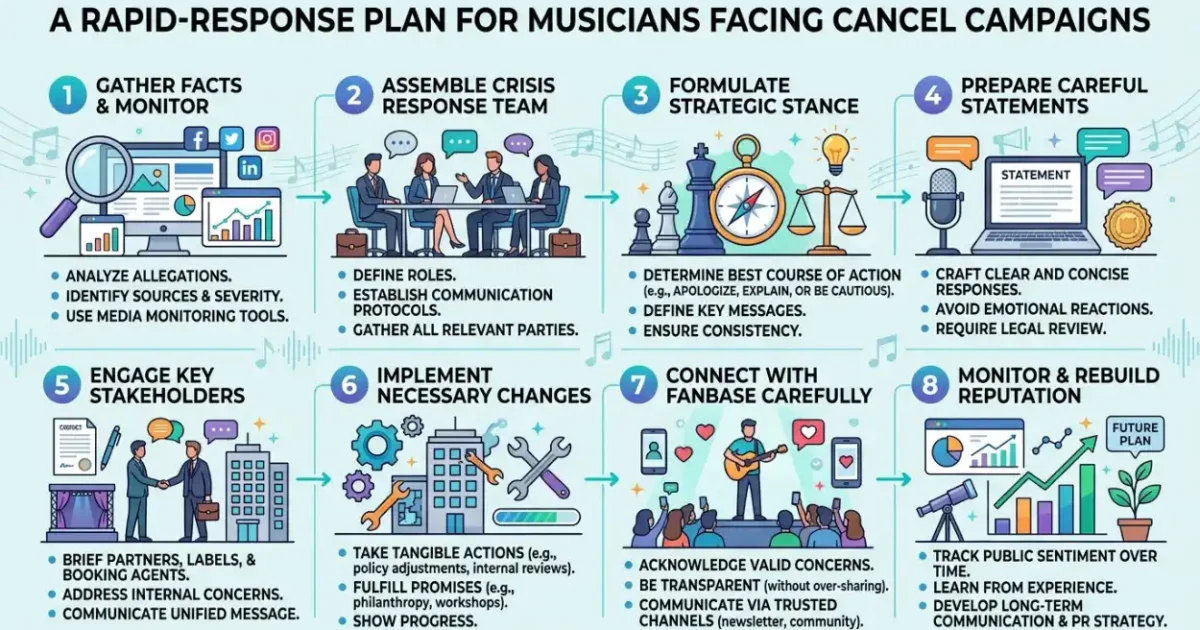
A rapid-response plan helps musicians evaluate a cancel campaign through content visibility, reputation signals, sentiment distribution and search perception. Reputation management strategies differ based on the source, speed, persistence and search visibility of reputation-related information.
Online reputation control methods are evaluated through how effectively they identify emerging content, assess source credibility and maintain an accurate digital footprint. For musicians, reputation management involves analysing the relationship between public discussion, search results, social content and entity perception. A structured response separates immediate online activity from lasting changes in search visibility. This distinction creates a clearer basis for evaluating reputation risk without treating every criticism as an equivalent search threat.
What makes a rapid-response reputation plan effective?
A rapid-response reputation plan is effective when it establishes a measurable process for detecting, classifying and evaluating reputation signals. The first priority is identifying what has changed within the musician’s digital footprint. This includes new articles, social discussions, videos, reviews, references and search results associated with the musician’s name. Each content type has different authority, indexability and persistence characteristics. Evaluating these differences prevents unrelated online activity from being treated as a single reputation event.
A structured plan also defines the relationship between content discovery and search visibility. Newly published material does not automatically receive prominent SERP placement, while established pages can continue competing for the same branded queries. Search engines independently evaluate relevance, quality, authority and other ranking signals. Therefore, response planning focuses on measurable changes in the search environment rather than assumptions about algorithmic reputation scores.
The effectiveness of a response process is also determined by consistency. A single search review provides a snapshot, while repeated monitoring reveals whether content remains visible, increases in prominence or loses relevance. Comparing these measurements establishes a clearer distinction between short-term attention and persistent reputation exposure.
How does reactive reputation management compare with proactive reputation management?
Reactive reputation management responds after negative information enters the public information environment, while proactive reputation management establishes reputation assets before a significant event occurs. Reactive methods prioritise detection, classification and response timing. Proactive methods focus on maintaining accurate, authoritative and relevant content within the musician’s digital footprint. Both approaches operate differently and address different stages of reputation risk.
Reactive management has a strong emphasis on speed because newly published information can alter the composition of branded search results. Its limitation is that the information environment has already changed when monitoring begins. Proactive management provides an established baseline of official profiles, professional information and credible references. This baseline creates a stronger analytical reference point when new content appears.
The two approaches therefore differ in their primary measurement criteria. Reactive management is evaluated through detection speed, source analysis, content visibility and SERP changes. Proactive management is evaluated through information completeness, source authority, content consistency and long-term search presence. Combining both creates a more comprehensive reputation framework than relying exclusively on either method.
Is content creation or content removal more effective during a cancel campaign?
Content creation and content removal address different reputation problems, making effectiveness dependent on the type of information involved. Content removal focuses on eliminating material where a valid removal basis exists, such as policy violations, privacy concerns or other applicable grounds. Content creation focuses on strengthening the availability of accurate, relevant information associated with the musician. These approaches therefore operate through different mechanisms.

Removal directly changes the availability of a specific piece of content when the relevant platform or publisher accepts the request. Its limitation is that removal depends on the source, applicable rules and circumstances surrounding the content. Creating authoritative content does not remove existing material, but it expands the information environment with additional relevant sources. Its effect therefore relates more closely to content enhancement and search visibility.
A balanced evaluation examines whether the objective is removal, correction, contextualisation or broader SERP development. Treating content suppression and content enhancement as interchangeable creates an inaccurate strategy assessment. Each method has distinct benefits, limitations, risk exposure and sustainability characteristics.
How should musicians evaluate content suppression versus content enhancement?
Content suppression is the process of reducing the search prominence or availability of unwanted material through legitimate mechanisms. Content enhancement is the process of increasing the presence and quality of accurate, relevant information within the digital ecosystem. These approaches produce different effects on SERP composition. Suppression focuses on reducing exposure, while enhancement focuses on strengthening alternative information.
The strongest evaluation begins with source classification. A search result from an authoritative publication represents a different challenge from an isolated social comment. The page’s ranking position, indexation status, relevance and source authority also influence its practical visibility. These factors determine whether suppression, correction, contextual content or another approach represents the appropriate analytical category.
Search visibility provides the common measurement framework. Changes in rankings, indexed pages and branded SERP composition reveal whether an approach is producing an observable effect. A reputation strategy therefore requires measurable indicators rather than relying on general perceptions of improvement.
How does a rapid response influence SERP composition?

Rapid response influences SERP composition primarily through the timing and management of information entering the search ecosystem. Search engines continuously discover and evaluate online content, while users encounter only a selected portion of that information on a results page. A rapid response identifies which new pages compete for branded queries and how those pages relate to existing results. This creates a basis for monitoring changes in search visibility.
SERP composition is not determined solely by the number of pages discussing a controversy. Relevance, authority, content quality and query intent influence which pages receive visibility. A large volume of low-authority commentary does not function identically to a small number of highly authoritative publications. Consequently, response analysis must measure both content quantity and content quality.
The timing of analysis also matters because search results change over time. A result appearing prominently during an initial period does not establish permanent ranking influence. Tracking the same branded queries across consistent intervals reveals whether visibility is persistent, declining or expanding.
Which reputation signals matter most when evaluating a cancel campaign?
The most useful reputation signals are those that reveal changes in content visibility, source credibility, sentiment distribution and entity associations. Content volume measures how much new information enters the digital footprint. Source authority measures the credibility context surrounding that information. Sentiment distribution identifies the balance between negative, neutral and positive references.
Entity association provides another important measurement. This refers to the topics, phrases and concepts repeatedly connected with the musician’s name across indexed content. A stronger association does not establish factual accuracy. It indicates that the subject has become more prominent within the information environment surrounding the entity.
Search position then determines practical exposure. A negative reference buried beyond prominent results has a different user-facing effect from a negative page appearing among the first results for the musician’s name. Evaluating reputation signals therefore requires both content analysis and search visibility measurement.
Dive Deeper With Our Expert Guides:
How to Keep One Bad Concert Review From Defining Your Tour
Auditing and Cleaning Up Old Lyrics and Posts Before a Release
How should musicians compare short-term and long-term reputation strategies?
Short-term reputation strategies prioritise immediate detection, source assessment and visibility monitoring, while long-term strategies focus on sustainable digital footprint development. Short-term action provides rapid information about what has changed. Long-term management measures whether the resulting search environment stabilises over time. The distinction is important because reputation signals do not remain static after an initial controversy.
A short-term approach is measured through response time, newly indexed content and immediate SERP movement. It provides operational visibility during periods of rapid information growth. Its limitation is that short-term measurements do not demonstrate long-term sustainability. A result that changes within days provides less evidence of lasting reputation development.
Long-term strategies are evaluated through content persistence, search visibility, source diversity and consistency of entity information. They require repeated measurement because search ecosystems continue to evolve. The strongest evaluation therefore separates immediate risk controls from sustained reputation development.
How does search engine interpretation affect reputation strategy selection?
Search engine interpretation affects strategy selection because different content types receive different treatment within retrieval and ranking systems. Search engines evaluate individual pages rather than applying a universal reputation rating to a musician. Relevance, quality, authority and other signals influence which content becomes visible for specific queries. Strategy selection therefore requires an understanding of how the relevant content competes within search results.
A highly authoritative article represents a different search environment from a low-authority discussion thread. Similarly, an indexed page targeting the musician’s name has a different practical significance from content that is not discoverable through branded queries. These distinctions affect the appropriate measurement framework.
Understanding search interpretation also prevents unrealistic expectations. No legitimate reputation strategy guarantees a predetermined ranking position. Instead, the measurable objective is to evaluate changes in content visibility, SERP composition, entity associations and the overall digital footprint.
What risks affect rapid-response reputation strategies?
The primary risks involve inaccurate classification, excessive reaction, unsupported claims and inconsistent information. Misclassifying legitimate criticism as harmful content creates an unreliable reputation assessment. Treating every social post as a high-authority source also distorts the measurement of reputation signals. A structured classification system reduces these analytical errors.
Another risk involves focusing exclusively on negative content. This creates an incomplete view of the entity because reputation consists of the total information environment. Official profiles, professional publications, interviews, reviews and neutral references also contribute to entity perception. Evaluating the entire SERP provides stronger evidence than analysing isolated negative pages.
A final risk concerns sustainability. A short-term change in search visibility does not demonstrate lasting reputation improvement. Continued monitoring provides evidence about persistence, recurrence and changes in content ranking. This makes measurement an essential component of reputation strategy evaluation.
How can a rapid-response plan remain sustainable?
A sustainable rapid-response plan combines monitoring, classification, measurement and periodic reassessment. Monitoring identifies new content and changes in branded search results. Classification determines the source type, authority and relevance of each item. Measurement then establishes whether search visibility and reputation signals have changed materially.
The process also requires a stable digital baseline. Accurate musician profiles, official information and established professional references create reference points for future analysis. When new content appears, analysts can compare the new SERP composition with the previous information environment. This reduces reliance on isolated observations.
A sustainable framework also defines clear review intervals. Consistent monitoring identifies whether reputation signals persist, decline or reappear. For musicians evaluating practical response options, cancel campaign response strategies provide a relevant decision framework for understanding how rapid detection, search visibility and reputation risk connect.
What should musicians measure after implementing a response strategy?
Musicians should measure observable changes in search visibility, content indexing, sentiment distribution and entity associations. These metrics provide evidence about how the information environment changes after a response is implemented. Rankings identify visibility changes, while indexing reveals whether relevant content remains available for retrieval. Sentiment analysis provides additional context about the tone of the indexed information.
- Measure branded SERP positions to identify movement in the visibility of relevant pages.
- Track indexed content to determine whether newly published material remains searchable over time.
- Compare sentiment distribution to identify changes in the balance of negative, neutral and positive references.
- Evaluate source authority to distinguish high-credibility publications from lower-authority commentary.
- Review entity associations to identify recurring topics connected with the musician’s name.
These measurements create a consistent framework for evaluating effectiveness. They also separate reputation perception from simple social engagement metrics. A strategy demonstrates stronger analytical value when its outcomes are observable across multiple reputation indicators.
Which rapid-response approach provides the strongest reputation framework?
The strongest rapid-response approach combines immediate monitoring with structured content evaluation and long-term search analysis. Reactive methods provide speed, while proactive methods establish a stronger digital baseline. Content suppression addresses specific removal opportunities, while content enhancement strengthens the availability of accurate and authoritative information.

The central strategic distinction is between activity and measurable impact. Social discussion, publication volume and engagement indicate information movement, but SERP composition, indexing, source authority and entity associations provide stronger evidence of search perception. Evaluating these factors together creates a more reliable understanding of reputation change.
For musicians facing a rapidly developing cancel campaign, a sustainable framework therefore requires detection, classification, measurement and continuous reassessment. The objective is not to control every online discussion but to understand how information enters, persists within and influences the wider search ecosystem.
What is a rapid-response reputation plan for musicians?
A rapid-response reputation plan is a structured process for detecting, assessing and monitoring reputation risks during a cancel campaign. It evaluates search visibility, content indexing, source authority and sentiment distribution.
How can musicians respond to a cancel campaign online?
Musicians can begin by monitoring branded search results, identifying newly indexed content and evaluating the credibility of sources discussing the issue. A structured response separates temporary social activity from persistent changes in online reputation.
Is content removal or content creation better for reputation management?
Content removal addresses specific material where a legitimate removal basis exists, while content creation strengthens the availability of accurate and authoritative information. The appropriate approach depends on the content source, search visibility and reputation objective.
How does a cancel campaign affect Google search results?
A cancel campaign can introduce new content that competes for visibility in branded search results. Its impact depends on factors including relevance, indexing, source authority, content quality and existing SERP composition.
What should musicians monitor during a reputation crisis?
Musicians can monitor branded SERPs, newly indexed content, sentiment distribution, source authority and recurring entity associations. Tracking these signals over time helps measure whether reputation changes are temporary or persistent.