

Law school alumni and professional networks generate reputation signals by connecting a legal entity with identifiable institutions, professionals, publications and career histories across the digital ecosystem. These relationships influence entity credibility by creating contextual information that search engines can use when evaluating relevance, authority and professional identity.
Reputation management strategies differ based on whether the objective focuses on strengthening credible information, reducing harmful visibility, or correcting inaccurate information. Online reputation control methods are evaluated through search visibility, trust signals, sentiment distribution, SERP composition and the consistency of information associated with an entity.
How do alumni networks compare with traditional reputation management methods?
Alumni networks provide contextual reputation signals, whereas traditional reputation management methods often focus directly on content creation, removal, review management or search suppression. An alumni network is a collection of professional relationships connected through educational institutions, professional associations or career progression. These relationships operate by producing identifiable connections between an individual, organisation and authoritative external sources. Content creation strengthens the information environment by publishing relevant material, while removal strategies focus on eliminating information that violates legal, platform or editorial standards. The comparative value therefore depends on whether the reputation problem results from insufficient positive context or excessive negative visibility.
Professional network signals have a different mechanism from removal-based reputation management. Alumni references, institutional biographies, professional profiles and conference participation create additional contextual entities around a lawyer or law firm. Removal strategies operate by addressing specific content through platform procedures, legal mechanisms or policy-based requests where applicable. Content enhancement operates by increasing the quantity and relevance of credible information rather than eliminating competing pages. The first approach addresses an information deficit, while the second addresses an information-risk source.
Is content creation more sustainable than content removal for reputation signals?
Content creation provides greater scalability when the reputation challenge involves limited authoritative information about an entity. Content enhancement operates by establishing accurate, relevant and interconnected resources that reinforce professional identity over time. Alumni-related biographies, institutional profiles and professional publications can create durable contextual signals when they remain accurate and independently useful. Removal strategies have a narrower application because they depend on the nature of the content, the platform’s rules and the availability of a valid removal basis. Consequently, content enhancement generally addresses the information ecosystem, while removal addresses individual information assets.
The sustainability of content creation also depends on relevance and information quality. Publishing repetitive pages without genuine contextual value does not create equivalent reputation signals to authoritative professional references. Search engines evaluate content through relevance, authority, relationships and other ranking systems rather than treating every newly published page as an equally strong reputation asset. Alumni and professional network content becomes more meaningful when it accurately reflects the entity’s qualifications, affiliations and professional history. This makes contextual consistency a central factor in evaluating long-term reputation value.
How do organic and reactive approaches differ when building professional reputation signals?
Organic reputation development builds signals through legitimate professional activity, authoritative references and consistent digital information, whereas reactive management responds to an identified reputation problem. Organic approaches operate by gradually expanding the entity’s credible digital footprint through information that exists for legitimate professional purposes. Reactive approaches operate by addressing a specific negative result, inaccurate statement, review, profile or other reputation-risk asset. The organic model therefore emphasises continuity, while the reactive model emphasises intervention. Their effectiveness depends on the underlying SERP composition and the nature of the reputation issue.
A reactive approach offers greater precision when a specific harmful result dominates a high-intent search query. An organic approach provides broader coverage when reputation risk extends across multiple queries, entities and information sources. For example, a law firm with strong professional visibility but one problematic result requires a different evaluation from a firm with limited authoritative information across its entire digital footprint. Reactive intervention targets the identified weakness, while organic development strengthens the wider information environment. Combining both mechanisms remains analytically different from treating them as interchangeable strategies.
How do search engines interpret alumni and professional network signals?
Search engines interpret professional relationships through the wider context surrounding entities, pages, authors, organisations and institutions. A reputation signal is information that contributes to how an entity is understood within a search ecosystem. Alumni information operates by connecting an entity to an identifiable educational or professional context, creating relationships between names, organisations, qualifications and activities. These relationships contribute to entity understanding rather than functioning as a direct ranking guarantee. Search ranking influence therefore depends on the overall quality and relevance of the information ecosystem.
Professional network signals also contribute to entity disambiguation. Lawyers and law firms frequently share similar names, professional categories and geographical references, making contextual information important for distinguishing entities. Consistent biographies, institutional references and professional profiles create supporting information that clarifies identity. In contrast, inconsistent dates, job titles or affiliations introduce ambiguity into the digital footprint. The evaluation therefore focuses on consistency and contextual relevance rather than the simple number of professional references.
Does alumni-based reputation management outperform review and removal strategies?
Alumni-based reputation signals perform differently from review management and removal strategies because they address different information types. Review management primarily concerns customer-generated sentiment, while alumni signals concern professional identity, institutional relationships and career context. Removal strategies address specific content assets that meet applicable legal, policy or editorial criteria. Alumni-based approaches operate by strengthening contextual credibility rather than directly altering third-party sentiment. Each method therefore has a distinct role within reputation management.
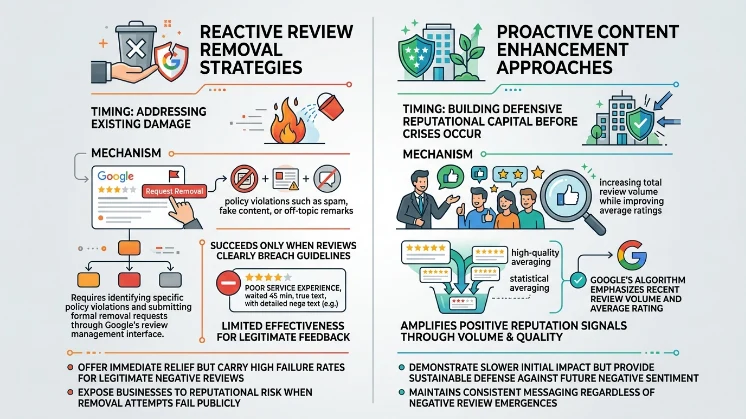

Sentiment distribution provides an important distinction between these approaches. Review management can influence the balance of positive and negative customer-generated information, while professional network signals influence the contextual interpretation of an entity. Removal can reduce the presence of qualifying harmful information, but it does not automatically create replacement credibility. Alumni content can provide additional positive context, but it does not remove an inaccurate or harmful page. Evaluating effectiveness therefore requires measuring the actual reputation problem rather than assuming one universal method produces the strongest outcome.
What is the difference between short-term and long-term reputation impact?
Short-term reputation interventions focus on immediate visibility changes, while long-term strategies focus on sustained entity credibility and information consistency. Reactive removal requests can address a specific page when a valid basis exists, producing a direct change to the affected information source. Search suppression techniques focus on changing the relative visibility of competing pages within SERPs. Long-term professional network development instead builds a broader information environment that remains relevant across future searches. These mechanisms operate on different time horizons and require different measurements.
Short-term impact is typically evaluated through changes in the visibility of a specific result or query. Long-term impact is evaluated through broader search coverage, consistency, entity associations and the stability of credible information. A strategy focused exclusively on immediate visibility can leave the underlying digital footprint unchanged. A strategy focused exclusively on long-term content development can fail to address an urgent high-risk result. Effective evaluation therefore distinguishes immediate SERP movement from durable reputation improvement.
How does SERP composition affect the effectiveness of reputation signals?
SERP composition determines how reputation information is presented to people searching for a lawyer or law firm. SERP composition is the arrangement of indexed pages, profiles, publications, directories, institutional references and other results returned for a particular query. Reputation signals influence this environment indirectly by affecting the relevance, authority and contextual strength of available information. Strong professional references become more valuable when they occupy relevant search positions and provide accurate information about the entity. Weak or poorly connected content has less practical influence even when it is technically positive.
Search perception depends on the combined information landscape rather than one isolated page. If negative content occupies prominent positions, adding a new professional profile does not automatically change the SERP structure. Conversely, a strong network of authoritative references can provide search engines with additional entities and documents for evaluation. Activate Alumni-Network Reputation Signals therefore represents a content-enhancement concept rather than a standalone ranking mechanism. Its effectiveness is measured through changes in relevant search visibility and the balance between credible and harmful information.
Which approach offers greater scalability: network development or reactive intervention?
Network development generally provides broader scalability because one authoritative professional relationship can support multiple pieces of contextual information across the digital footprint. A professional biography, institutional profile or alumni reference can reinforce identity across related queries and entities. Reactive intervention is more narrowly scalable because each reputation-risk asset requires individual assessment and an appropriate response mechanism. Removal requests, for example, depend on the specific content, platform and applicable policy or legal basis. The two approaches therefore scale differently according to the number and type of reputation issues.
Scalability also depends on whether the information remains useful beyond the immediate reputation problem. High-quality professional content can continue contributing to entity understanding after a particular search query changes. Reactive actions generally remain tied to the individual asset being addressed. This distinction makes network development more suitable for broad digital footprint optimisation, while reactive methods remain more targeted. Measuring scalability requires assessing the number of queries, entities and reputation risks influenced by each intervention.
Dive Deeper With Our Expert Guides:
Handling Review Scrutiny Unique to Contingency-Fee Attorneys
How Attorneys Can Earn and Maintain a Wikipedia Presence Ethically
How should risk exposure be evaluated across reputation management strategies?
Risk exposure differs according to the mechanism used to influence online reputation. Content enhancement carries lower strategic risk when information is accurate, independently useful and professionally relevant. Removal strategies carry greater dependency on external platform decisions because approval relies on policy, legal or editorial criteria. Search suppression requires careful analysis because attempts to manipulate visibility without meaningful content value can produce weak or unsustainable results. Risk evaluation therefore examines both the intended mechanism and the assumptions behind its expected outcome.
Professional network strategies also require accuracy because incorrect affiliations can damage entity credibility rather than strengthen it. Alumni references need factual consistency across names, dates, institutions and professional roles. Contradictory information creates additional ambiguity within the digital footprint and weakens the reliability of reputation signals. Risk management therefore involves validating information before expanding its visibility. The strongest strategic comparison is not simply between positive and negative content, but between reliable and unreliable information systems.
Which strategy provides the strongest long-term reputation sustainability?
Long-term sustainability depends on whether reputation signals remain accurate, relevant and connected to genuine professional activity. Organic network development provides continuity because professional affiliations, publications and institutional references can remain useful as part of an entity’s digital footprint. Reactive management provides sustainability when it resolves a persistent and legitimate reputation issue through an appropriate mechanism. Content suppression provides a different form of sustainability by changing the relative visibility of competing information rather than removing every negative result. The appropriate method therefore depends on the structure of the underlying reputation problem.
A sustainable strategy also requires ongoing evaluation of search visibility and entity credibility. Search results change as pages are indexed, updated, consolidated or displaced by new information. Professional relationships can therefore contribute to a continuing reputation ecosystem rather than functioning as a one-time intervention. The value of alumni signals increases when they remain factually accurate and contextually relevant over time. Reputation management consequently becomes an ongoing process of evaluating information relationships rather than a single content action.
How can reputation signals be evaluated before selecting an approach?
A structured evaluation begins by identifying the reputation issue, the affected search queries and the information sources contributing to current perception. It then compares the available mechanisms according to effectiveness, scalability, risk exposure and sustainability. This approach prevents content creation, removal and suppression from being treated as interchangeable tactics. Each mechanism operates through a different relationship with search visibility and entity credibility. Evaluation therefore needs to connect the chosen intervention with the specific SERP condition it intends to influence.
A practical comparison can assess the strategy through four criteria:
- Measure the affected SERPs to identify which pages, entities and information sources influence current search perception.
- Compare content enhancement against removal by determining whether the problem results from insufficient credible information or harmful existing visibility.
- Evaluate organic and reactive mechanisms according to their scalability, external dependencies and expected longevity.
- Assess reputation signals through changes in entity consistency, search visibility, sentiment distribution and SERP composition.
This framework creates a clearer distinction between tactical intervention and broader reputation development. It also prevents a single method from being selected without analysing the underlying information environment.
What do alumni and professional networks contribute to a wider reputation strategy?
Alumni and professional networks contribute contextual authority by connecting an entity with identifiable institutions, professionals and career information. Their principal value lies in strengthening the information architecture around an entity rather than providing a direct ranking shortcut. Professional relationships can support entity disambiguation, contextual relevance and broader digital footprint consistency. Their influence becomes more meaningful when the associated information is authoritative, accurate and independently useful. These characteristics distinguish legitimate reputation signals from artificial or repetitive content.
The wider strategic comparison shows that no single reputation management method addresses every reputation condition. Content enhancement expands credible information, removal addresses qualifying harmful assets, reactive intervention responds to defined risks, and organic network development supports longer-term entity credibility. Search suppression focuses on SERP composition and relative visibility when harmful content remains indexed. The strongest evaluation therefore considers how each mechanism affects search visibility, trust signals, risk exposure and sustainability. Reputation management is most accurately understood as a system of interconnected information decisions rather than one isolated technique.
Which reputation management approach provides the most balanced outcome?
Alumni and professional networks provide reputation signals by strengthening contextual relationships around lawyers and law firms, while removal and suppression strategies address specific visibility or information risks. Content creation offers broader long-term scalability when authoritative information is limited, whereas reactive methods provide greater precision for defined reputation problems. Organic approaches build continuity through legitimate professional activity, while short-term interventions focus on immediate SERP conditions. Activate Alumni-Network Reputation Signals represents a strategic approach to strengthening credible professional context within the wider digital footprint. Effectiveness therefore depends on the relationship between the reputation objective and the mechanism selected.
A balanced evaluation considers search visibility, entity credibility, sentiment distribution, SERP composition, scalability, risk exposure and sustainability together. Professional network signals work best as part of a coherent digital footprint rather than as an isolated ranking tactic. Removal remains dependent on the eligibility of specific content, while suppression and enhancement influence the relative visibility of competing information. Comparing these mechanisms through their actual search and reputation effects provides a more reliable basis for reputation management decisions.
How do alumni networks affect a law firm’s online reputation?
Alumni networks create professional and institutional references that contribute to a law firm’s digital footprint. These references provide contextual reputation signals that help establish professional identity, credibility and entity relationships online.
Can professional networks improve a law firm’s online credibility?
Professional networks can strengthen online credibility when they generate accurate, relevant and authoritative references. Consistent profiles, institutional affiliations and professional publications help create a clearer entity profile across search ecosystems.
Do alumni connections directly improve Google rankings for law firms?
Alumni connections are not a direct Google ranking factor. Their value comes from relevant and authoritative information that helps search engines understand a lawyer’s education, professional history and relationship with a firm.
What reputation signals do alumni networks provide for lawyers?
Alumni networks can provide signals relating to education, institutional affiliation, professional identity and career history. These signals contribute to entity credibility when the information is accurate, consistent and supported by authoritative sources.
How do professional networks influence a law firm’s digital footprint?
Professional networks expand the digital footprint through profiles, institutional references, publications and other legitimate professional information. This broader information environment helps shape search perception and the context surrounding a law firm’s online presence.