

Every local business should use a mix of review management, local SEO, customer service improvements, and active monitoring to protect and grow its reputation; these 15 strategies deliver measurable trust and visibility gains when implemented consistently.
What are the 15 online reputation management strategies every local business should know?
Fifteen practical strategies include review acquisition, review response, local SEO, Google Business Profile optimisation, social listening, content publishing, crisis playbooks, customer service training, citation management, competitor benchmarking, paid reputation ads, PR outreach, legal takedowns, employee advocacy, and metrics dashboards.
Reputation management for business links measurement to action. These 15 strategies form an operational checklist. They combine proactive reputation building with reactive damage control. Each item below explains what to do and why it matters for local firms.
How do I acquire more authentic local reviews?
Request reviews at the point of service, follow up via SMS or email, add a direct review link on receipts, and train staff to ask every satisfied local customer.
Ask customers immediately after a positive interaction. Send one follow-up message within 48 hours containing a shortened review URL. Use two platforms: Google Business Profile and one industry-specific site (examples: TripAdvisor, Yelp, Trustpilot). Track conversion rate from requests to published reviews. Aim for a 10–20% conversion in the first three months.
Read our articles, Local Business Reputation Management Services That Increase Trust and Which Reputation Strategies Deliver the Best Results for Local Businesses?
How should a business respond to positive and negative reviews?
Respond within 72 hours, thank positive reviewers, acknowledge facts in negative reviews, offer an offline remediation step, and document outcomes for follow-up.
A timely response signals care to search engines and future customers. For positives, state the service, date, and one detail to validate authenticity. For negatives, validate the customer’s concern, state corrective steps, and invite direct contact. Remove personally identifiable information only in private follow-up. Maintain a template bank for common scenarios and log each interaction.
How do I optimise Google Business Profile for local trust?
Complete every field, verify the location, add 15+ photos, publish posts weekly, list services with prices, and enable messaging.
A fully optimised profile increases local pack placement. Use service-based keywords in the services section and a clear business description under 750 characters. Add photos of the storefront, team, and products. Publish at least one GBP post per week highlighting offers or local events. Verify hours for holidays and enable Q&A monitoring.
How does local SEO support reputation growth?
Optimise title tags for local intent, build citations on authoritative directories, use structured data for reviews, and create location pages with unique content.
Local SEO drives discovery and amplifies reviews. Use schema markup for localBusiness and aggregateReview to make review data more visible in search. Create separate pages for each location when applicable. Claim consistent NAP (name, address, phone) across all citations. Monitor ranking shifts after major review inflows or citations.
When should a business use social listening tools?
Use social listening continuously to catch mentions, sentiment shifts, and emerging issues on platforms and forums.
Deploy a basic listening stack: Google Alerts, a social monitoring tool (examples: Hootsuite, Brandwatch), and manual checks of key community forums. Track sentiment weekly and escalate negative spikes to the crisis team. Record source, author, and reach for each mention to prioritise responses.
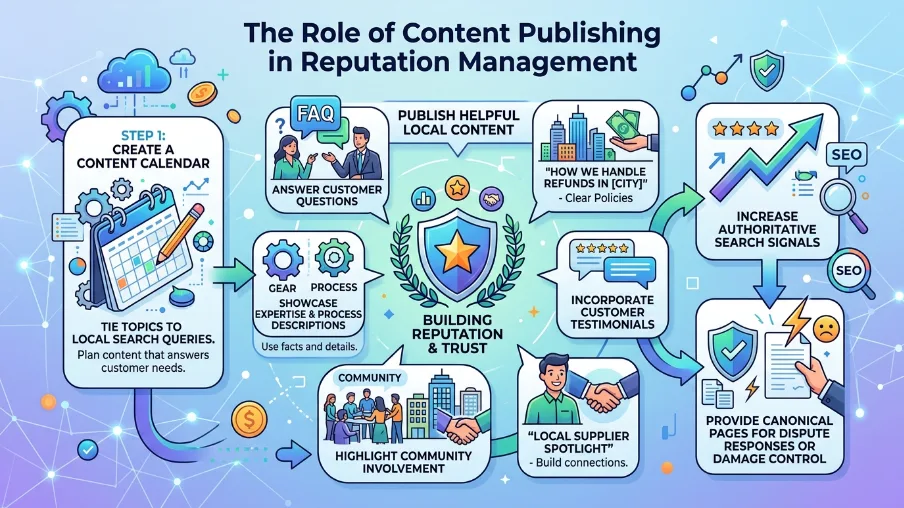
What is the role of content publishing in reputation management?
Publish helpful local content that answers customer questions, showcases expertise, and highlights community involvement.
Create a content calendar with topics tied to local search queries. Example topics: “How we handle refunds in [city]” or “Local supplier spotlight.” Use facts, customer testimonials, and process descriptions. Content increases authoritative search signals and provides canonical pages for dispute responses or damage control.
How do you prepare a reputation crisis playbook?
Define roles, escalation paths, pre-approved messaging, and a 24-hour response protocol for critical incidents.
Assign a crisis lead, legal contact, and communications person. Create templated public statements and a decision tree for takedowns or apologies. Include monitoring checkpoints at 1, 6, 24, and 72 hours. Test the playbook quarterly using scenario drills and update based on outcomes.
How can customer service training improve online reputation?
Train staff to resolve complaints immediately, document cases, and invite follow-up reviews after resolution.
Set clear response scripts for common complaints. Teach active listening and de-escalation techniques. Track resolution rate, time-to-resolution, and post-resolution review rate. Tie part of staff performance reviews to customer satisfaction metrics.
How should local businesses manage citations and directories?
Audit citations quarterly, correct inconsistent entries, and register with three authoritative local directories and two industry-specific directories.
Use a citation audit tool to find inconsistencies. Correct differences in NAP immediately. Add or update photos and service descriptions on each listing. Prioritise directories used by customers in your city and region.
How do you benchmark competitors for reputation improvement?
Compare review volume, average rating, response times, and content output for three top local competitors.
Collect competitor data monthly. Identify gaps in review volume and common complaint themes. Use findings to set targets: for example, increase monthly review requests by 25% or reduce average response time to under 48 hours.
When are paid reputation ads useful?
Use paid search or social ads to promote positive content and direct high-intent local users to verified landing pages.
Create ads that link to case studies, testimonials, or the Google Business Profile. Target radius-based audiences around each location. Monitor cost-per-acquisition and engagement. Pause ads when organic visibility improves to keep costs efficient.
How does PR outreach support reputation recovery?
Pitch local press with factual progress updates, customer success stories, and community initiatives to rebuild trust.
Share measurable outcomes: remediation numbers, safety improvements, or refunds processed. Focus on local outlets and trade publications. Track pickup, reach, and referral traffic to owned channels.
When are legal takedowns necessary for reputation management?
Use legal notices for clearly defamatory, false claims that harm business operations after documentation and failed remediation.
Document the false claim, gather supporting evidence, and request removal via platform procedures first. If platforms refuse, issue a targeted legal notice citing jurisdictional statutes. Keep legal action as a last resort and coordinate with communications to control messaging.
How does employee advocacy amplify reputation?
Encourage employees to share verified company content, local events, and success stories with simple sharing guidelines.
Provide a monthly content pack with approved messages and images. Track shares and referral traffic. Reward top advocates with recognition or small incentives. Clear guidelines prevent accidental disclosures or inconsistent messaging.
Explore our Reputation Management for business guides,
What Factors Influence Reputation Management Costs?
What Is Business Reputation Management and Why Does It Matter?
What metrics should a local business track in a reputation dashboard?
Track average rating, review volume, response rate, sentiment score, local search ranking, and referral traffic weekly.
Set numeric targets for each metric. Example: raise average rating from 3.8 to 4.4 in 12 months, and increase monthly review volume by 50%. Use dashboards that integrate Google My Business, review platforms, and web analytics to create a single view.
This 15-step framework unites operational tasks with measurable goals. Reputation Management for business becomes a repeatable process when teams request reviews, verify local listings, respond to feedback, and monitor sentiment. Clear My Name helps local firms implement these strategies with structured playbooks and measurement systems that restore trust and increase visibility.
Frequently Asked Questions
What is Reputation Management for business and how does it work?
Reputation Management for business involves monitoring, influencing, and improving how a company appears online. Clear My Name uses review management, local SEO, content publishing, and monitoring tools to identify issues, respond to feedback, and boost trusted signals in search and maps.
How long does it take to see results from Reputation Management for business?
Initial visibility and response-rate improvements typically appear within 4–8 weeks, while measurable rating increases and search-rank gains take 3–6 months. Clear My Name tracks review volume, average rating, and local search position to report progress monthly.
Which metrics matter most in Reputation Management for business?
Key metrics include average rating, monthly review volume, response rate and time, sentiment score, and local search ranking. Clear My Name recommends specific numeric targets and dashboards to validate progress and guide remediation actions.
Can Reputation Management for business remove false or defamatory reviews?
Platforms remove only demonstrably false or policy-violating reviews after documentation and formal requests; legal takedowns apply when platform routes fail. Clear My Name documents evidence, follows platform procedures, and escalates to legal notices when necessary.
How does Reputation Management for business help local customer acquisition?
Improved ratings, consistent citations, and optimized Google Business Profile increase local pack visibility and click-through rates, driving more qualified local traffic. Clear My Name aligns review acquisition and local SEO tactics to convert searchers into visitors and calls.