

Clear My Name provides a structured approach to managing acquisition and merger speculation by analysing search visibility, reputation signals and entity credibility across the digital ecosystem. Effective reputation management for business focuses on controlling how relevant information appears in search results while reducing the risk created by inaccurate, outdated or damaging content.
When acquisition or merger speculation enters search results, decision-makers often encounter a mixture of confirmed information, historical content, commentary and unverified claims. This creates a reputation environment in which search visibility directly affects trust and corporate perception. A structured reputation management process evaluates the sources behind these signals, identifies the highest-impact risks and applies appropriate search perception strategies. The objective is not to remove legitimate information indiscriminately but to establish a more accurate and authoritative representation of the business.
Which reputation management approach delivers the strongest control during acquisition speculation?
A structured combination of content analysis, factual correction, negative content suppression and authoritative content enhancement delivers the strongest control because acquisition speculation affects multiple layers of a company’s digital footprint. Each method addresses a different reputation mechanism, so relying on one intervention creates an incomplete response. Content analysis identifies which pages influence branded searches and which sources carry the strongest authority. Correction addresses inaccurate information, while content enhancement strengthens authoritative information surrounding the company’s current identity. Suppression focuses on reducing the prominence of damaging content where legitimate search strategies support that outcome.
The effectiveness of this approach comes from treating the search environment as a connected system. A single negative article does not exist independently from the company’s website, professional profiles, directories, news coverage and other indexed sources. Search engines evaluate these relationships when determining which pages appear for branded and corporate queries. Reputation management therefore needs to measure both individual URLs and the wider SERP composition. This provides a more reliable basis for determining where intervention creates the greatest search visibility improvement.
For businesses facing acquisition speculation, professional reputation management for businesses provides a structured way to evaluate these signals without treating every negative result as an identical problem. The process connects content visibility with entity credibility and search perception influence. This makes the strategy more measurable because changes can be assessed through rankings, indexed content and the composition of relevant search results.
How does reputation management influence search visibility during a merger?
Reputation management influences search visibility by strengthening relevant information and addressing search results that create inaccurate or damaging perceptions. Search engines rank pages according to complex systems involving relevance, content quality, authority and other signals. Reputation management does not directly control search algorithms. Instead, it works within the search ecosystem by improving the information signals associated with the business entity.
The first stage involves identifying the search queries that stakeholders use when evaluating the organisation. Branded searches, company-name variations, executive searches and acquisition-related queries can reveal different reputation risks. Each query produces a different SERP composition containing first-party and third-party sources. Analysing these results establishes which content receives prominent visibility and which information users encounter first.
The next stage evaluates the content behind those rankings. A highly visible article from an authoritative publication has a different risk profile from an outdated directory listing with limited visibility. Similarly, an inaccurate corporate reference creates a different problem from legitimate negative commentary. This distinction determines whether correction, suppression, content enhancement or another intervention provides the appropriate response.
The result is measurable search visibility control rather than an assumption that reputation has improved simply because new content exists. Rankings, indexed pages, search-result composition and the prominence of relevant corporate information provide observable indicators. These metrics allow reputation activity to be evaluated against actual search behaviour.
Can negative acquisition content be suppressed or removed effectively?
Negative acquisition content can be addressed through legitimate removal, de-indexing, suppression or content enhancement depending on the nature of the source. Removal provides the most direct change when a specific page qualifies for an appropriate removal mechanism. De-indexing reduces a page’s presence within search results under qualifying circumstances. Suppression focuses on reducing prominence through changes to the competitive information environment. Content enhancement provides an alternative when legitimate third-party information remains available but authoritative context requires stronger visibility.
Each mechanism has a different level of control. Removal directly affects the targeted source, but it does not prevent equivalent information from appearing elsewhere. Suppression influences visibility rather than eliminating the underlying content. Content enhancement creates additional authoritative material that competes for relevant search positions. The appropriate strategy therefore depends on the source, its visibility, its authority and the factual basis of the information.
A reliable process also separates legitimate negative information from inaccurate or misleading content. Reputation management cannot treat unfavourable but accurate reporting as equivalent to demonstrably incorrect information. This distinction protects the credibility of the strategy and reduces unnecessary risk. It also ensures that search perception influence remains connected to factual accuracy.
How does content enhancement compare with negative content suppression?
Content enhancement strengthens the positive and authoritative information available to search engines, while negative content suppression focuses on reducing the prominence of unwanted results. Enhancement works by expanding the relevant content environment around the business entity. Suppression works by influencing which pages receive prominent visibility for relevant searches. Both methods can improve SERP composition, but their mechanisms and timelines differ.
Content enhancement has a stronger foundation for long-term sustainability because authoritative pages remain part of the digital footprint. Corporate websites, leadership pages, publications and relevant informational resources create persistent signals about the organisation. These signals provide search engines with additional evidence when evaluating entity relevance. The approach therefore supports broader reputation development rather than targeting one URL.
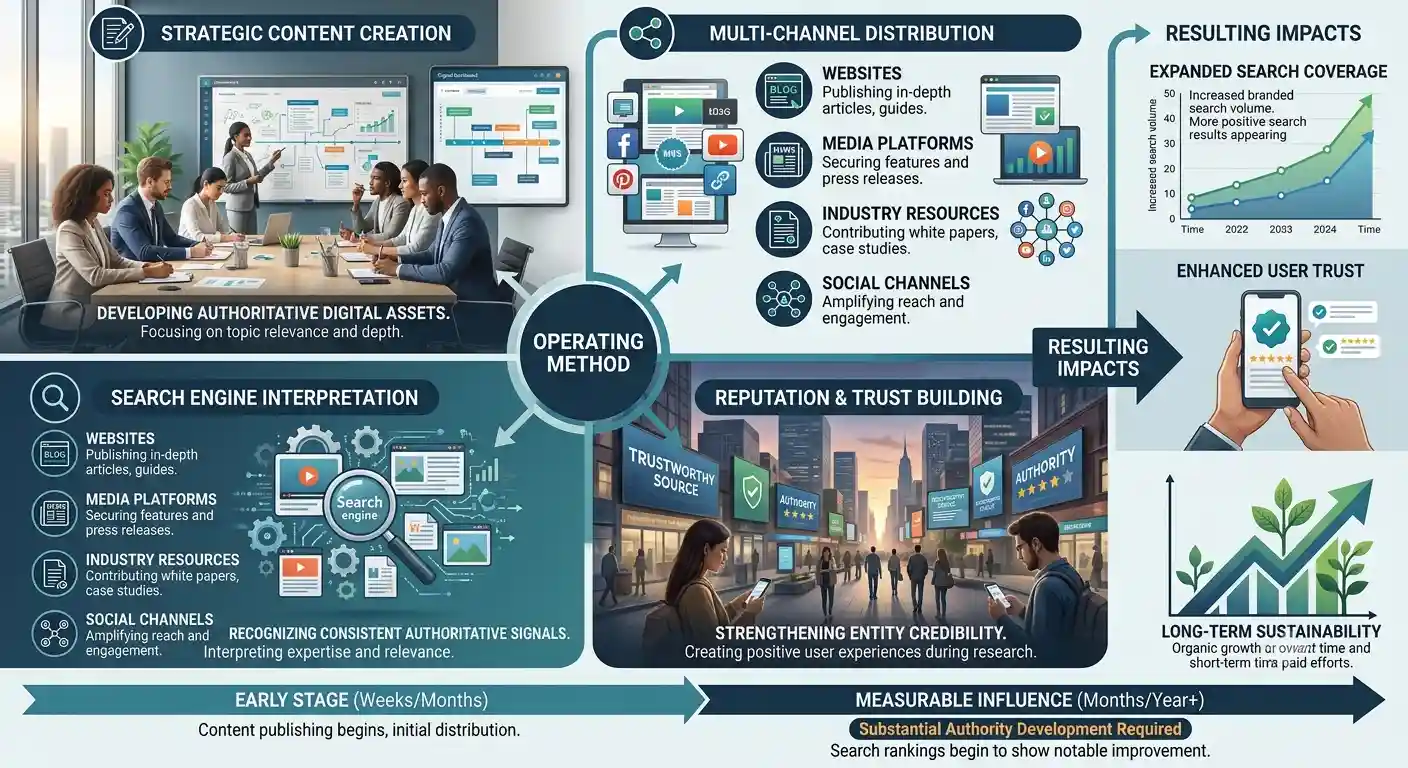
Suppression offers greater tactical value when a specific negative result dominates a commercially important query. The objective is to reduce its visibility by strengthening competing relevant results and improving the overall search environment. This requires monitoring because rankings change as search engines reassess indexed pages. Suppression therefore demands continuous SERP evaluation rather than a one-time content action.
The strongest strategy integrates both approaches. Enhancement strengthens the company’s information foundation, while suppression addresses high-priority visibility risks. This combination balances immediate search perception needs with long-term entity credibility.
How does reputation management reduce merger-related reputation risk?
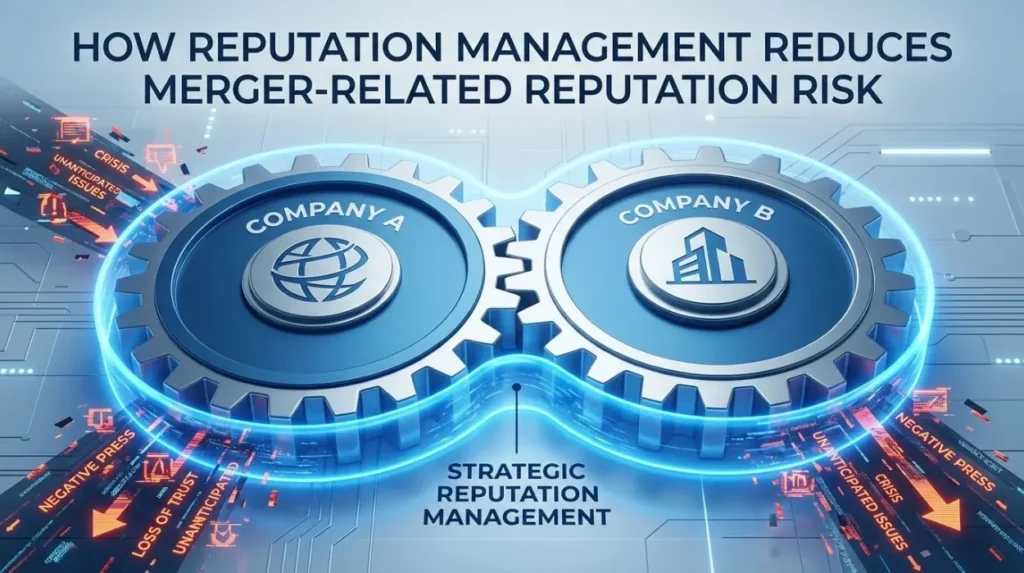
Reputation management reduces merger-related reputation risk by identifying conflicting information before it becomes a persistent feature of the company’s search environment. Mergers introduce changes involving names, ownership, leadership, websites, corporate structures and external references. These changes create additional entity relationships that search engines need to interpret. Inconsistent information increases the possibility of search confusion and inaccurate associations. A structured process identifies these inconsistencies and prioritises the signals with the greatest visibility.
Risk evaluation begins with a search audit. The audit examines branded SERPs, acquisition-related queries, corporate profiles, directories, reviews, news coverage and other relevant indexed sources. Each result is assessed according to accuracy, authority, sentiment, visibility and relationship to the business entity. This produces a reputation risk profile rather than a generic list of negative pages.
The risk profile then informs the intervention. High-ranking inaccurate information receives priority because it directly influences user perception. Authoritative but accurate negative reporting receives a different treatment because suppression or removal is not equivalent to correcting factual errors. Outdated information receives another classification when it no longer represents the current corporate identity. This structured categorisation improves process clarity and reduces unnecessary intervention.
Risk reduction also requires monitoring after changes are implemented. Search engines need to process updated information before ranking changes become visible. Monitoring confirms whether corrections have been indexed, whether targeted pages have changed position and whether new reputation signals have entered the SERP. This creates an ongoing feedback loop between intervention and measurable search outcomes.
How quickly can reputation management change acquisition-related search results?
The speed of change depends on the intervention, the affected content and search-engine processing. A factual correction can improve the accuracy of a source once the relevant publisher updates and indexes the change. A successful removal or de-indexing action can produce a more direct visibility change. Content enhancement requires indexing and competitive ranking before it materially changes SERP composition. These different mechanisms make timeline measurement an essential part of reputation management.
Short-term outcomes are generally easier to measure when an individual URL is directly affected. A change in the ranking position or indexing status provides an observable result. However, a ranking improvement does not automatically demonstrate broader reputation recovery. The wider SERP still needs evaluation to determine whether users encounter more authoritative and accurate information.
Long-term results depend on the stability of the information environment. New articles, corporate announcements and third-party references can change SERP composition after an initial intervention. Search engines also reassess existing pages as content and relevance signals change. Continuous monitoring therefore provides stronger evidence of sustainable search perception control than a single ranking snapshot.
Clear My Name approaches this process through reputation analysis focused on search visibility, content signals and entity representation. The value of the process lies in connecting interventions to measurable search outcomes rather than treating reputation management as an undefined visibility exercise.
Dive Deeper With Our Expert Guides:
Contain Viral Customer-Service Complaints With Clear My Name
Remove Counterfeit Marketplace Listings With Clear My Name
What makes a reputation management strategy reliable during corporate change?
A reliable strategy combines process clarity, factual analysis, measurable objectives and continuous monitoring. Corporate changes create a high volume of information relationships, so an effective process needs a defined method for identifying, classifying and prioritising reputation signals. Without this structure, individual content actions can produce fragmented results. A systematic approach creates a clear connection between the reputation problem, selected intervention and measurable outcome.
Process clarity begins with establishing the current search environment. This includes identifying prominent results, analysing source authority and mapping relationships between the business and associated entities. The assessment then determines whether the problem relates to misinformation, negative sentiment, outdated content, insufficient authoritative information or entity confusion. Each category requires a different response.
The process can be measured through specific outcomes:
- Measure branded SERP positions to identify changes in the visibility of high-priority content.
- Track content indexing to confirm whether updated information has entered the search ecosystem.
- Evaluate entity consistency across corporate and third-party sources to identify conflicting business information.
- Analyse sentiment distribution to determine whether negative, neutral and positive signals have changed across relevant results.
- Monitor search-result composition to establish whether authoritative corporate information has gained greater prominence.
These measurements create evidence for evaluating effectiveness. They also separate genuine search improvements from assumptions based solely on content publication. A reliable reputation strategy therefore uses observable search signals throughout the process.
Is reputation management for business worth the long-term investment?
Reputation management for business provides long-term value when reputation risks have a direct relationship with search visibility, stakeholder research and corporate credibility. The cost of reputation intervention needs to be evaluated against the potential consequences of persistent inaccurate or damaging information. A prominent negative result can influence first impressions across repeated branded searches. An inconsistent corporate identity can also create continuing search confusion after a merger or acquisition.
The value extends beyond individual search positions. Stronger entity credibility improves the consistency of information users encounter across corporate and third-party sources. A more coherent SERP also reduces the likelihood that one isolated result defines the search narrative. These outcomes support a more stable digital footprint that remains useful beyond the immediate acquisition event.
Sustainability provides another component of long-term value. A strategy based entirely on temporary suppression requires ongoing attention to ranking changes. A strategy that also strengthens authoritative information creates a more durable foundation. Combining short-term risk reduction with long-term content enhancement therefore produces a more balanced investment model.
The key measurement remains outcome relevance. Businesses need to assess whether the strategy improves search visibility, strengthens factual consistency, reduces high-priority reputation risks and supports clearer entity perception. These indicators provide a more meaningful evaluation than content volume or activity counts alone.
Why choose Clear My Name for acquisition and merger reputation management?
Clear My Name provides a focused reputation management process for businesses dealing with acquisition and merger-related search risks. The approach centres on analysing reputation signals, identifying high-impact content and applying appropriate mechanisms based on the characteristics of each search result. This creates a defined path from reputation assessment to intervention and measurement. The emphasis remains on search visibility, entity credibility and risk reduction.
The process begins by establishing which information influences the company’s current SERP environment. Relevant content is then assessed according to authority, accuracy, visibility and sentiment. This evaluation determines whether content enhancement, factual correction, suppression or another legitimate mechanism represents the most appropriate response. The resulting strategy remains connected to the specific reputation risk rather than relying on generic reputation tactics.
Decision-makers researching the wider issue can first review how acquisition rumours affect a company’s market perception to understand why search visibility changes during corporate speculation. The analysis provides the informational foundation for evaluating how third-party reporting, entity relationships and reputation signals influence stakeholder perception.
For businesses requiring a deeper strategic assessment, managing perception during acquisition or merger speculation provides the next level of consideration by comparing content enhancement, suppression, correction and removal approaches. This distinction helps establish which mechanisms align with the nature, visibility and authority of the affected content.
How does Clear My Name support measurable reputation outcomes?
Clear My Name supports measurable outcomes by connecting reputation interventions with observable search indicators. Instead of defining success through the quantity of content produced, the evaluation focuses on search visibility, SERP composition, content indexing and entity credibility. These indicators demonstrate whether the information environment is becoming more accurate and coherent. Measurement also allows the strategy to adapt when search conditions change.
The outcome framework includes three connected areas. Visibility measures whether high-priority results change position or prominence. Trust evaluates whether authoritative and accurate information provides stronger context around the business entity. Control assesses whether damaging or inaccurate information receives less prominence and whether the broader SERP presents a more coherent corporate narrative.
This evidence-driven structure strengthens accountability. Each intervention has a defined purpose, an expected mechanism and an observable measurement point. That clarity reduces the risk of treating activity as an outcome. It also provides a more reliable basis for evaluating reputation management as a strategic business function.
What is the most reliable way to manage acquisition speculation?
The most reliable approach combines search analysis, factual accuracy, content enhancement and targeted reputation interventions according to the specific characteristics of acquisition-related content. Negative content suppression provides tactical visibility control, while authoritative content enhancement establishes a stronger long-term information environment. Correction addresses factual inconsistency, and legitimate removal or de-indexing addresses eligible sources directly.
For businesses experiencing acquisition or merger speculation, reputation management needs to operate as a measurable search-perception process. SERP composition, entity credibility, content indexing and reputation signals provide practical indicators of progress. This approach connects reputation activity with the way stakeholders actually encounter corporate information online.
Clear My Name positions its solution around process clarity, evidence-based assessment and measurable search outcomes. By evaluating each reputation signal according to its authority, visibility, accuracy and influence, the strategy reduces unnecessary intervention while prioritising the results with the greatest potential impact. The outcome is a structured framework for strengthening search visibility, stabilising entity perception and managing reputation risk during significant corporate change.
How can businesses manage acquisition and merger speculation online?
Businesses can manage acquisition and merger speculation by monitoring search results, identifying inaccurate or misleading content, and responding with accurate, verifiable information. A structured online reputation management approach can help reduce confusion around unconfirmed claims.
Can merger speculation affect a company’s online reputation?
Yes, merger speculation can influence how customers, employees, investors, and other stakeholders perceive a company. Unverified acquisition rumours may create uncertainty, particularly when misleading information appears prominently in search results.
How do you remove inaccurate acquisition rumours from search results?
Inaccurate acquisition rumours may be addressed by requesting corrections or removals from publishers where appropriate and by reporting content that violates platform policies. Where removal is not possible, reputation management can focus on improving the visibility of accurate, authoritative information.
What should a company do about false merger claims online?
A company should first verify the claim and document the inaccurate information before deciding on an appropriate response. Depending on the source, options may include contacting the publisher, requesting a correction, or managing the company’s search presence with factual content.
Can Clear My Name help with acquisition and merger speculation?
Clear My Name can be used as part of an online reputation management strategy for addressing problematic search results and misleading information. The appropriate approach depends on the source, accuracy of the claim, and whether the content qualifies for correction or removal.