
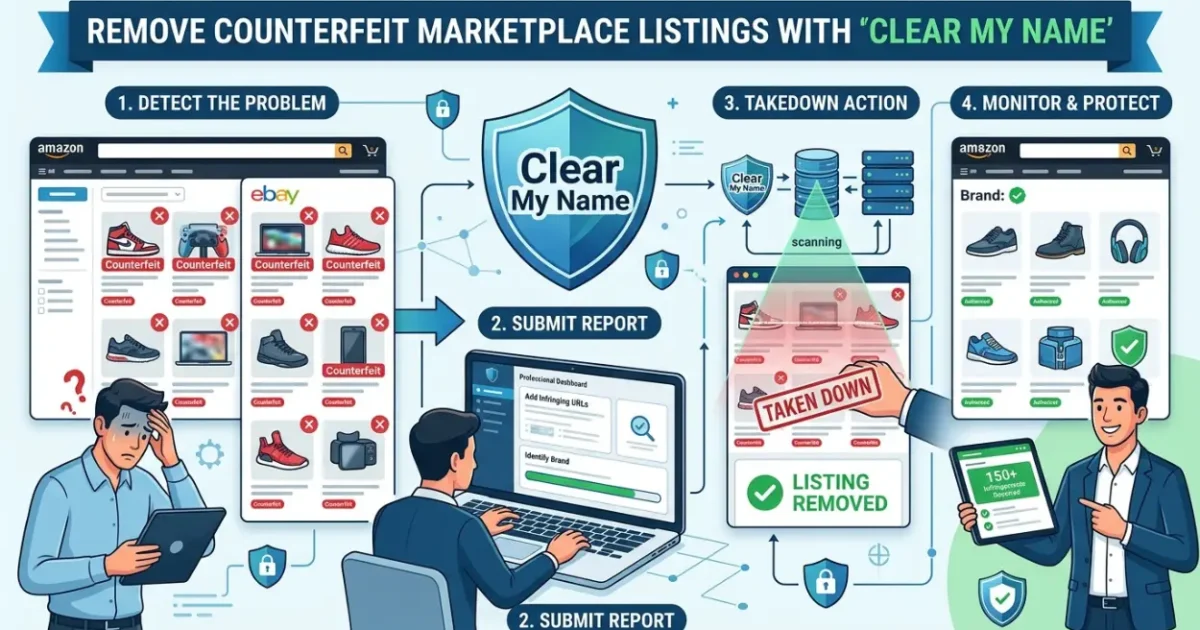
Counterfeit marketplace listings require direct visibility control because unauthorised products can weaken reputation signals, distort customer perception, and occupy branded search results. Clear My Name addresses counterfeit-related reputation risk through structured assessment, evidence-led intervention, content visibility management, and ongoing monitoring.
Why Is Counterfeit Marketplace Listing Removal Important for Brand Reputation?
Counterfeit listing removal is important because unauthorised product pages can associate a legitimate brand with inaccurate information, poor-quality products, misleading claims, and negative customer experiences. Marketplace content forms part of the brand’s wider digital footprint when product pages, seller profiles, ratings, and reviews become visible to customers and search engines. Search users frequently evaluate a brand through the information presented around its products rather than relying exclusively on official websites. This makes marketplace visibility a direct reputation consideration rather than an isolated ecommerce problem. A structured reputation management service addresses the relationship between counterfeit content, search visibility, reputation signals, and entity credibility.
The risk increases when counterfeit pages use the legitimate brand name, product imagery, descriptions, model numbers, or other identifying information. Customers can interpret the resulting information as evidence about the genuine brand, particularly when seller attribution is unclear. Negative reviews attached to unauthorised products can further distort sentiment distribution by associating poor experiences with the legitimate entity. Search engines then process the marketplace content according to relevance, authority, indexing, and ranking signals. Removing eligible counterfeit listings therefore protects both the marketplace environment and the wider search perception surrounding the brand.
Brands assessing this risk can first understand counterfeit marketplace reputation damage by examining how unauthorised listings influence reviews, search visibility, entity associations, and customer interpretation. This analysis establishes whether the primary problem exists within one marketplace or extends into Google search results and other third-party properties.
Which Reputation Management Approach Delivers the Strongest Counterfeit Listing Results?
A source-level enforcement strategy delivers the strongest direct result when a counterfeit listing meets the relevant marketplace, intellectual property, or legal enforcement criteria. The process begins by identifying the listing, seller, product, intellectual property connection, and evidence supporting the complaint. This establishes a factual basis for intervention rather than relying on general reputation claims. Once a valid enforcement route is identified, the relevant marketplace process can address the original source. Source-level action therefore provides greater direct control than relying exclusively on search visibility optimisation.
Search optimisation provides a complementary mechanism when counterfeit content remains visible or when removal alone does not resolve the wider SERP problem. Legitimate brand content can be strengthened to improve entity clarity and compete for relevant branded queries. This approach does not alter factual third-party records and does not guarantee removal of a marketplace page. Instead, it improves the visibility balance between authoritative information and unwanted content. Combining enforcement with legitimate search optimisation creates a more complete framework for reputation risk reduction.
How Does Clear My Name Handle Counterfeit Listing Risk?
Clear My Name uses a structured process that separates evidence assessment, source identification, intervention, search visibility analysis, and monitoring. The first stage establishes exactly what content creates the reputation risk and whether the listing represents a genuine counterfeit concern. This prevents legitimate third-party content from being incorrectly classified as harmful material. The process then evaluates the relevant marketplace mechanism and available evidence before intervention begins. This creates process clarity and reduces unnecessary enforcement risk.
The next stage focuses on the relationship between the counterfeit listing and the brand’s wider search environment. Indexed marketplace pages, branded product queries, seller references, customer reviews, and external mentions are evaluated for visibility and entity association. This determines whether the issue is confined to the marketplace or has entered the broader SERP landscape. The analysis also identifies authoritative brand content that provides stronger context around the genuine products and business entity. This combination connects source-level intervention with search perception influence.
A structured process can:
- Identify counterfeit listings by analysing seller information, product identifiers, copied descriptions, imagery, and marketplace URLs.
- Verify the underlying issue by comparing unauthorised content against genuine product information and relevant ownership evidence.
- Assess search visibility by reviewing indexing, branded-query rankings, marketplace prominence, and associated review signals.
- Address eligible listings through the relevant marketplace or intellectual property enforcement mechanism.
- Monitor subsequent visibility by tracking replacement listings, recurring sellers, altered product information, and new search-result associations.
This process creates measurable checkpoints rather than treating reputation repair as an undefined activity. Each stage produces information that supports the next decision, improving transparency around the work being performed.
Can Counterfeit Listing Removal Improve Search Visibility?
Counterfeit listing removal can improve search visibility when an unauthorised page is indexed, ranking for relevant branded queries, or attracting meaningful marketplace traffic. Removing the source eliminates that page from its original marketplace environment, although search engines require separate processing before an indexed URL disappears from search results. The ranking effect therefore depends on indexing status, crawl frequency, competing content, and the authority of replacement results. A successful intervention reduces the availability of inaccurate information without artificially manipulating search rankings. This makes legitimate source-level removal an important component of SERP control.
Search visibility also depends on what replaces the removed content. If authoritative brand pages, accurate product information, recognised retailer pages, and relevant third-party references already provide strong coverage, the resulting SERP can become more informative. Where legitimate content lacks relevance or authority, removing one counterfeit result does not automatically establish strong search representation. Reputation management therefore evaluates both the unwanted page and the surrounding information environment. The objective is a more accurate visibility balance rather than an unsupported promise of a particular ranking position.
How Does Negative Content Suppression Support Counterfeit Listing Removal?

Negative content suppression supports counterfeit listing removal by addressing harmful search visibility that remains after source-level action. Suppression in this context involves legitimate search optimisation designed to reduce the relative prominence of unwanted content while strengthening relevant and authoritative information. It does not involve falsifying information, manipulating reviews, or removing accurate third-party reporting without a valid basis. The mechanism operates through content relevance, authority, internal relationships, indexing, and competitive ranking factors. This makes negative content suppression a search-level strategy rather than a substitute for valid marketplace enforcement.
The distinction between removal and suppression is essential for risk management. Removal targets the original marketplace source when a valid enforcement route exists. Suppression addresses the visibility of content that remains accessible but occupies disproportionate search prominence. A reputation management service evaluates these mechanisms separately so the intervention matches the underlying problem. This improves strategic precision and prevents search optimisation from being presented as a replacement for legitimate intellectual property enforcement.
What Outcomes Can a Brand Expect From Counterfeit Listing Management?
The principal outcomes involve improved information accuracy, reduced exposure to unauthorised product pages, stronger entity credibility, and clearer search representation. These outcomes depend on the specific marketplace, evidence available, content authority, indexing conditions, and competitive search environment. A reliable process therefore measures changes rather than presenting reputation improvement as an automatic consequence of submitting a complaint. Visibility tracking establishes whether the targeted listing remains active, indexed, ranked, or associated with branded searches. Reputation monitoring then evaluates whether customer-facing signals have changed.
Key outcomes include:
- Reduce unauthorised marketplace visibility by addressing eligible counterfeit listings through the relevant enforcement process.
- Strengthen entity credibility by increasing the prominence of accurate product and brand information.
- Improve SERP composition by supporting authoritative content around branded and product-specific queries.
- Protect reputation signals by reducing associations between the legitimate brand and unauthorised products.
- Stabilise search perception by monitoring replacement listings and recurring counterfeit activity.
These outcomes connect operational enforcement with measurable search and reputation indicators. The result is a clearer framework for assessing whether intervention has reduced the specific risk that triggered the project.
Dive Deeper With Our Expert Guides:
Rank Higher on B2B Comparison Sites With Clear My Name
Shield Your Company From Founder Controversy With Clear My Name
Is Counterfeit Listing Removal Worth the Long-Term Investment?
Counterfeit listing removal provides long-term value when the visibility of unauthorised products creates recurring reputation, customer trust, or search risks. The cost of intervention needs to be assessed against the persistence of counterfeit activity and the potential reach of affected marketplace content. A single removal addresses one source, while repeated counterfeit activity requires monitoring and scalable detection. Long-term value therefore comes from reducing recurring exposure rather than treating every listing as an isolated event. A structured reputation strategy creates efficiencies by identifying patterns across sellers, products, platforms, and search queries.
Cost evaluation also needs to account for risk mitigation. An inexpensive process that lacks evidence verification can create rejected complaints, incorrect claims, or wasted enforcement activity. A structured process invests in source analysis and evidence quality before intervention, reducing avoidable errors. It also establishes monitoring criteria that demonstrate whether the problem has actually changed. This makes process quality an important part of the commercial value of counterfeit reputation management.
How Quickly Can Counterfeit Marketplace Visibility Be Reduced?
The speed of counterfeit listing removal depends on the marketplace’s review process, evidence requirements, listing status, and the specific enforcement mechanism used. A submitted complaint does not itself remove a listing, and search engines operate on separate crawling and indexing systems. Marketplace action and search-result changes therefore occur through different processes. A professional approach measures both rather than treating marketplace removal as immediate SERP removal. This distinction provides a more accurate expectation of the timeline.
Speed also depends on the quality of the evidence submitted. Clear ownership information, precise listing identification, product comparisons, and relevant intellectual property documentation make the enforcement case easier to evaluate. Ambiguous evidence creates additional review requirements and increases the risk of unsuccessful intervention. Reputation management therefore prioritises accuracy before speed. Fast action without reliable evidence provides weaker risk control than a properly documented intervention.
How Does Clear My Name Reduce Risk During the Removal Process?
Clear My Name reduces risk by separating factual verification from enforcement activity and search optimisation. The process assesses whether content genuinely represents counterfeit activity before an intervention is recommended. This protects the brand from inaccurate claims against legitimate sellers, authorised retailers, or valid third-party content. It also ensures that reputation management remains aligned with factual information governance. Accurate classification is essential because reputation protection loses credibility when enforcement decisions are unsupported.
Risk reduction also extends to search perception. Removing one page without monitoring related sellers, duplicate listings, reviews, and indexed URLs leaves the wider information environment exposed. A complete strategy tracks the relevant entity associations after intervention and identifies replacement content. This creates a continuous feedback mechanism rather than a one-off removal attempt. The result is stronger control over recurring counterfeit-related visibility and more reliable reputation signals.
Which Counterfeit Listing Strategy Provides the Most Sustainable Protection?
A combined enforcement, search optimisation, and monitoring strategy provides the strongest foundation for sustainable counterfeit reputation control. Enforcement addresses eligible counterfeit sources directly, while content enhancement strengthens the legitimate information environment surrounding the brand. Monitoring identifies replacement listings and new seller activity before the same reputation risk expands across additional pages. These mechanisms operate at different levels, making them complementary rather than interchangeable. Sustainability therefore comes from maintaining the complete process rather than depending on one intervention.
The strategy also preserves factual integrity. Legitimate marketplace content remains distinguishable from counterfeit material, and accurate third-party information is not treated as harmful simply because it is unfavourable. This distinction protects entity credibility while supporting legitimate reputation improvement. Search visibility control then operates alongside information governance, ensuring that optimisation does not compromise accuracy. For businesses facing persistent counterfeit activity, this structured approach delivers stronger long-term control than isolated listing removal.
Why Is Clear My Name a Reliable Solution for Counterfeit Marketplace Listings?
Clear My Name provides a structured reputation management approach centred on evidence, source-level intervention, search visibility analysis, and ongoing monitoring. The process connects marketplace enforcement with the wider reputation ecosystem, ensuring that counterfeit listings are evaluated according to their actual visibility and impact. This creates clearer decision-making around removal, suppression, content enhancement, and monitoring. The emphasis on evidence also reduces the risk of unsupported enforcement claims. Each intervention is therefore connected to a defined reputation or visibility objective.
The broader value lies in maintaining control after the initial intervention. Counterfeit activity can reappear through replacement sellers, duplicated content, altered product descriptions, or new marketplace pages. Continuous monitoring identifies these changes and preserves visibility awareness across relevant search results. This supports stronger reputation signals and protects the consistency of the brand entity across digital properties. The approach therefore addresses both the immediate counterfeit listing and the longer-term search perception risk.
When businesses need a dedicated professional reputation management service, the decision should centre on evidence quality, process clarity, enforcement capability, search visibility analysis, and monitoring depth. These criteria distinguish structured reputation management from isolated listing complaints and provide a clearer basis for evaluating long-term value.
How Does Counterfeit Listing Management Strengthen Brand Trust?
Counterfeit listing management strengthens brand trust by improving the accuracy of the information customers encounter when researching products. Removing eligible unauthorised listings reduces exposure to misleading product information, while authoritative brand content reinforces the legitimate product identity. Customer reviews and marketplace signals then become easier to interpret because the distinction between genuine and unauthorised products is clearer. This supports stronger entity credibility within both marketplace and search environments. Trust therefore develops from improved information quality and clearer attribution.
The relationship between counterfeit activity and reputation is also explained through the broader impact of counterfeit listings on brand reputation. Unauthorised products can influence search perception through seller associations, reviews, product descriptions, and indexed pages. Understanding these mechanisms helps establish why enforcement, content enhancement, and monitoring operate together. Reputation protection becomes a measurable information-management process rather than a purely subjective perception exercise.
Why Is Structured Counterfeit Listing Removal the Right Decision?
Counterfeit marketplace listings create a direct reputation risk when unauthorised products become associated with a legitimate brand through marketplace pages, reviews, seller profiles, and search results. Effective management therefore requires more than submitting isolated complaints. It requires evidence verification, source-level enforcement, search visibility analysis, negative content suppression where appropriate, authoritative content enhancement, and continuous monitoring.
Clear My Name provides this structured approach by connecting counterfeit listing intervention with SERP control, reputation signals, entity credibility, and search perception influence. The process prioritises factual accuracy, measurable visibility outcomes, and risk reduction while addressing both immediate listings and recurring counterfeit activity. This creates greater process clarity and stronger long-term control over the digital environment surrounding the brand. For businesses evaluating reputation management as a strategic investment, evidence-led counterfeit listing management provides a reliable framework for protecting online credibility without relying on exaggerated or unsupported outcomes.
How can Clear My Name help remove counterfeit marketplace listings?
Clear My Name uses evidence-led assessment, marketplace enforcement processes, search visibility analysis, and ongoing monitoring to address eligible counterfeit listings. The approach focuses on reducing unauthorised content exposure while strengthening accurate brand information and reputation signals.
Can removing counterfeit listings improve a brand’s online reputation?
Removing eligible counterfeit listings can reduce associations between the brand and unauthorised products, misleading information, or negative customer experiences. It can also support stronger entity credibility and improve the accuracy of the brand’s marketplace and search environment.
How does counterfeit listing removal affect Google search visibility?
Removing an indexed counterfeit listing eliminates that unauthorised page from its original marketplace source, although search engines process indexing changes separately. Search visibility also depends on competing content, authority, relevance, and the overall SERP composition.
What evidence is needed to remove counterfeit marketplace listings?
Evidence can include intellectual property ownership records, product identifiers, genuine product images, listing URLs, seller details, and comparisons between authentic and counterfeit products. Clear evidence establishes the factual basis for marketplace enforcement and reduces the risk of unsupported claims.
How does reputation management prevent recurring counterfeit listings?
Reputation management combines listing enforcement with marketplace monitoring, seller analysis, search-result tracking, and accurate brand content. This helps identify replacement listings and recurring counterfeit activity while maintaining stronger reputation signals and search visibility control.