

Managing your reputation through a band breakup involves controlling how historical, current and newly published information contributes to search perception. Different reputation strategies affect search visibility, entity credibility and the composition of results in different ways.
Reputation management strategies differ based on whether the objective involves removing problematic information, strengthening authoritative content, correcting inaccurate context or monitoring changes across search results. Online reputation control methods are evaluated through their effect on reputation signals, search visibility, sentiment distribution and long-term entity perception. A band breakup creates a distinct reputation-management environment because one established entity can divide into multiple identities while existing digital content remains indexed.
Which reputation management approach works best after a band breakup?
The most effective approach depends on whether the primary issue involves inaccurate information, unwanted visibility, weak current context or fragmented identity signals. Content removal addresses information that qualifies for deletion, while content enhancement strengthens accurate material that provides search engines with clearer contextual evidence. Suppression focuses on reducing the visibility of damaging results rather than eliminating the underlying source. Monitoring provides measurement across these approaches and identifies changes in SERP composition over time.
How does content removal compare with content enhancement?
Content removal is a source-level intervention that attempts to eliminate information from the website or platform where it exists. Its strongest characteristic is direct control over the underlying material, but removal depends on ownership, platform rules, legal grounds or editorial decisions. Content enhancement operates by publishing or strengthening authoritative information that establishes a more accurate representation of the artist, band or individual member. Its advantage lies in building contextual depth, while its limitation is that existing content remains available unless its ranking position changes.
The distinction becomes important when historical breakup coverage remains factually accurate but no longer represents the current identity of an artist. Removing accurate historical information is different from improving the visibility of current information. Search ecosystems continue to value historical relevance, so content enhancement frequently functions as a contextual strategy rather than a replacement for source-level removal.
How does content suppression compare with content enhancement in search results?
Content suppression reduces the prominence of unwanted pages, while content enhancement increases the relevance and authority of preferred pages. Suppression operates through changes in SERP composition, where stronger competing pages gain ranking positions and reduce exposure to less desirable results. Enhancement operates by developing content and entity signals that provide search engines with stronger evidence about current identity, expertise and relevance.
Suppression is more closely associated with visibility control, while enhancement is more closely associated with credibility development. A damaging article can remain indexed even when its position declines, meaning suppression changes discoverability rather than source existence. Enhanced content can establish alternative ranking candidates, but its effectiveness depends on relevance, authority, indexing, competition and the query context.
Why does SERP composition matter after a breakup?
SERP composition is the distribution of pages, profiles, media results, social accounts and other indexed resources appearing for searches connected with an entity. After a breakup, searches for individual members can begin returning a mixture of former-band content, solo-project pages, interviews, event listings and historical coverage. Search engines evaluate these resources according to relevance and other ranking signals rather than treating the breakup as a single reputation event.
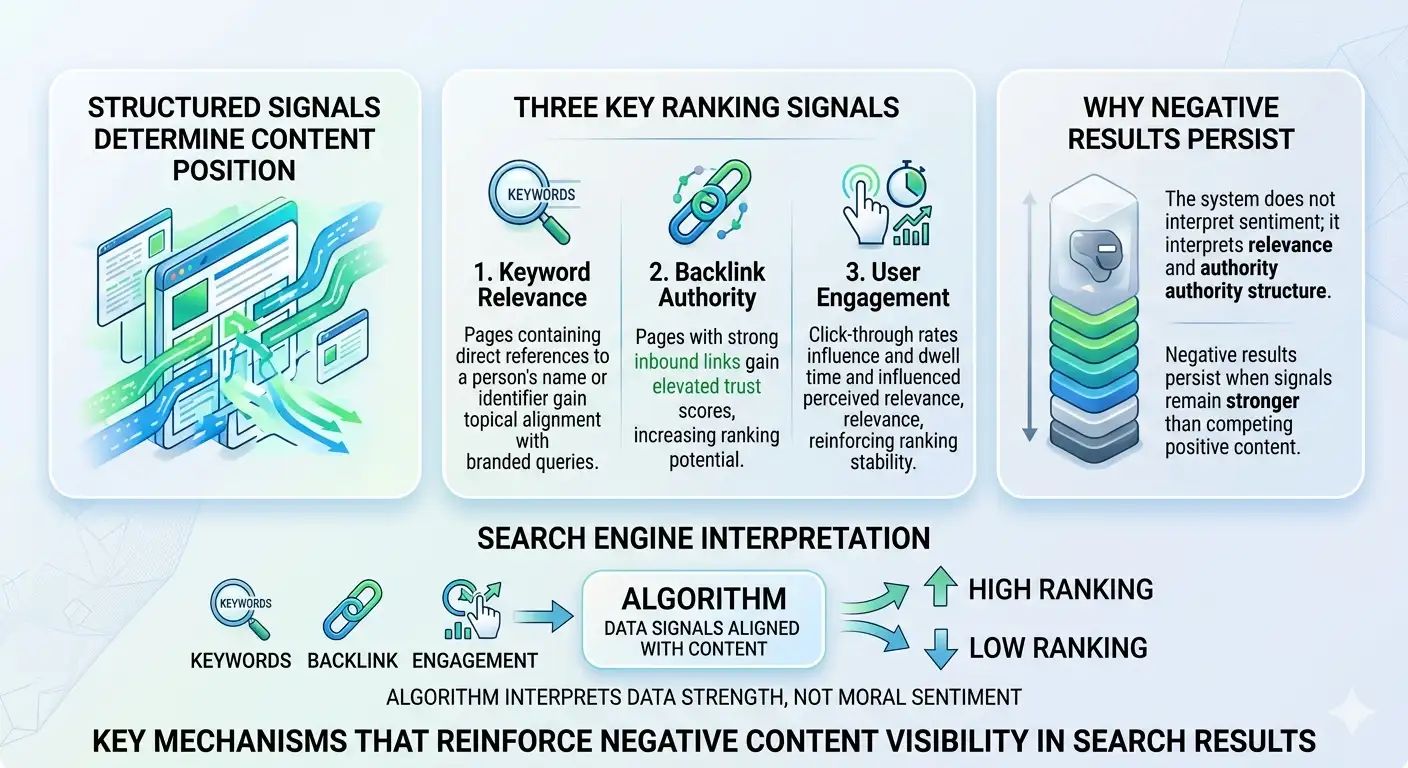
A reputation strategy therefore needs to account for the entire result environment rather than one isolated page. If historical breakup coverage occupies prominent positions, stronger current resources provide additional contextual competition. If inaccurate information appears, source-level correction or removal becomes more relevant. The appropriate strategy depends on the relationship between the unwanted result and the wider SERP.
Is an organic reputation strategy more sustainable than a reactive approach?
Organic reputation management builds reputation signals continuously through authoritative, accurate and relevant content, whereas reactive management responds to a specific reputation problem after it appears. Organic activity creates a stronger information ecosystem around an entity because current profiles, publications and professional references establish consistent signals before individual issues dominate search visibility. Reactive activity concentrates resources on specific pages, claims or search-result changes.
Organic strategies generally provide broader sustainability because they build entity credibility rather than addressing one isolated result. Their limitation is that they require consistent content development, accurate information architecture and ongoing monitoring. Reactive strategies provide greater precision when a specific harmful or inaccurate result requires immediate assessment. Their limitation is that resolving one page does not automatically address related content distributed across independent platforms.
How do organic and reactive strategies affect risk exposure?
Organic approaches reduce ambiguity by maintaining a consistent and authoritative digital footprint. Accurate biographies, professional profiles, official websites and credible third-party references provide search engines with corroborating information about the entity. Reactive approaches carry greater dependency on the specific circumstances surrounding each result because the available intervention depends on the platform, source and nature of the content.
Risk evaluation also involves content duplication. A breakup-related statement can appear across news websites, interviews, social platforms and syndicated publications. Removing or suppressing one version does not automatically eliminate replicated information. Organic authority therefore provides broader contextual protection, while reactive intervention provides targeted control over defined reputation risks.
Dive Deeper With Our Expert Guides:
Handling Ticketing and Refund Complaints Without Backlash
How to Shut Down False Collaboration Rumours Quickly
How does short-term reputation control compare with long-term reputation management?
Short-term reputation control focuses on reducing immediate search exposure, correcting inaccurate information or addressing a specific reputation signal. Long-term reputation management focuses on sustaining accurate entity representation across search engines, websites, profiles and other digital properties. The two approaches operate at different timescales but can form part of the same evaluation framework.
Short-term interventions often prioritise speed and measurable SERP changes. Source removal, corrections and targeted suppression provide direct responses when an unwanted result receives substantial visibility. Long-term strategies prioritise sustainability by strengthening authoritative content, maintaining consistent entity information and monitoring search changes after the initial intervention.
Which approach provides stronger sustainability?
Long-term management provides stronger sustainability when the underlying objective involves maintaining a stable and accurate digital identity. Search engines continuously process new pages, links, mentions and behavioural signals, so a one-time intervention does not permanently define an entity’s search environment. Continued monitoring identifies changes in rankings, new references and shifts in sentiment distribution.
Short-term control remains valuable when a specific result presents an immediate reputational risk. Its sustainability depends on whether the underlying cause persists and whether replacement content continues to occupy strong search positions. Sustainable reputation control therefore combines intervention with ongoing evaluation rather than treating a single ranking change as a permanent outcome.
How do search engines interpret reputation signals after a band breakup?
Search engines interpret reputation through signals distributed across indexed content, entities, links, mentions, profiles and other sources rather than through one dedicated reputation score. They analyse relationships between names, topics, organisations, locations, creative works and other identifiable entities. A breakup can therefore alter the associations surrounding both the former band and its individual members.
Entity credibility is strengthened when authoritative sources provide consistent information about an artist’s current identity and activities. Contradictory information introduces additional contextual complexity because different pages can describe the same person through different stages of their career. Search ranking influence emerges from how individual resources satisfy a query and how those resources fit within the wider information ecosystem.
How does sentiment distribution influence perception?
Sentiment distribution describes the balance of positive, neutral and negative references associated with an entity across indexed content. A breakup can introduce commentary that changes this distribution through reviews, interviews, opinion pieces and social discussions. Search engines do not simply convert sentiment into a universal reputation score, but sentiment-related language contributes to the information available around an entity.
Evaluation therefore requires distinguishing factual reporting from subjective commentary. A neutral news article describing a breakup operates differently from an opinion article making negative claims about an individual. Reputation analysis examines the source, context, prominence and relationship of each result rather than treating all negative references as equivalent.
When is removal more effective than suppression?
Removal is more effective when the underlying content is inaccurate, defamatory, privacy-sensitive or otherwise eligible for a legitimate removal process. It addresses the source itself and therefore provides stronger control over the existence of the information. Suppression is more relevant when content remains legally and factually available but occupies disproportionate search visibility.
How does source control affect search visibility?
Source control changes the underlying information available for indexing. Once a page is removed or materially changed, search engines eventually process the updated state through crawling and indexing systems. This distinction separates source removal from search-result management because removing content from a website does not guarantee immediate disappearance from every search result.
Suppression works differently. It seeks to alter the relative visibility of competing pages by strengthening relevant alternatives or addressing search-result composition. The original content can remain accessible while becoming less prominent for targeted queries. This makes suppression a visibility strategy rather than a deletion mechanism.
How can reputation strategies be evaluated for effectiveness and scalability?

Effectiveness is evaluated through measurable changes in search visibility, content prominence, entity consistency, sentiment distribution and the quality of ranking results. Scalability measures whether the same strategic framework can address additional queries, platforms and identity variations without requiring a completely separate process for every result. A method that resolves one page but fails across related searches has limited strategic scalability.
A practical evaluation framework can compare strategies through four actions:
- Measure ranking changes across branded, individual and breakup-related searches to establish actual SERP movement.
- Compare source-level removal with suppression to determine whether the objective concerns content existence or search visibility.
- Evaluate entity credibility by examining whether authoritative profiles and references consistently describe the current identity.
- Monitor new indexed content to identify whether reputation signals and sentiment distribution are changing after intervention.
These measures distinguish visible search improvement from deeper reputation control. A temporary ranking movement does not establish long-term sustainability if new negative or contradictory content continues entering the search ecosystem. Conversely, a stronger entity footprint provides evidence of broader control when accurate sources consistently occupy relevant search positions.
What strategic factors matter most when managing reputation through a breakup?
The primary considerations are content accuracy, source control, search visibility, entity separation, authority, risk exposure and sustainability. A strategy focused only on removing breakup-related pages can overlook legitimate historical information that continues to support entity understanding. A strategy focused only on publishing new content can leave inaccurate or harmful source material untouched.
Search perception also changes when individual members establish separate professional identities. Their names become associated with solo projects, interviews, new releases, events and professional profiles. Strengthening these independent entity signals helps search engines distinguish current identity from historical band associations.
Where direct reputation intervention is required, a decision-stage evaluation can examine Protect Your Name Through a Breakup as a distinct objective rather than treating every breakup-related result as the same problem. The appropriate method remains dependent on whether the underlying issue concerns removal, correction, suppression, enhancement or monitoring.
What is the best way to balance immediate control with long-term reputation stability?
The strongest strategic model combines targeted intervention with sustained development of accurate entity signals. Immediate control addresses identifiable risks, while long-term content enhancement establishes a stronger information environment around the artist or former band. Neither approach provides the same function, so effectiveness depends on matching the intervention to the underlying reputation problem.
A balanced strategy begins by evaluating the current SERP, identifying the source and type of problematic information, and measuring the authority of competing results. It then compares removal, correction, suppression and enhancement according to effectiveness, scalability, risk exposure and sustainability. Monitoring completes the process by measuring whether the search environment remains aligned with the intended current identity.
Managing reputation through a band breakup requires comparison between source control, search-result suppression, content enhancement and continuous monitoring. Removal addresses the underlying source, suppression addresses visibility, enhancement strengthens alternative authority, and monitoring measures how the search ecosystem changes over time.
Organic strategies provide broader long-term entity development, while reactive strategies provide targeted responses to defined reputation risks. Short-term interventions focus on immediate SERP conditions, whereas sustainable reputation management concentrates on consistent entity credibility and accurate information across the digital footprint.
The central consideration is therefore strategic alignment. Reputation signals, search ranking influence, sentiment distribution and SERP composition need to be evaluated together because a band breakup changes relationships between historical content and current individual identities. Effective reputation analysis measures not only whether an unwanted result remains indexed, but also how prominently it appears, what authoritative information surrounds it and whether the overall search environment accurately represents the current entity.
How does a band breakup affect an artist’s online reputation?
A band breakup can change search results by introducing new articles, interviews, social media posts and artist profiles. These sources influence reputation signals and how search engines and users interpret the current identity of each musician.
How can musicians manage their reputation after a band breakup?
Musicians can manage their online reputation by maintaining accurate profiles, strengthening authoritative content and monitoring search results. Reputation management for musicians also involves addressing inaccurate information and controlling unwanted search visibility where appropriate.
Can old band-related content be removed from Google after a breakup?
Removal depends on the source, content type and applicable platform or legal policies. Removing information from the original website and changing its Google visibility are separate processes, with search engines requiring time to recrawl and update indexed results.
Does creating new content help protect a musician’s reputation after a breakup?
Creating accurate, authoritative content can strengthen current entity signals and provide search engines with clearer information about a musician’s present activities. Content enhancement can also influence SERP composition by creating stronger relevant results around the individual.
What does reputation management for musicians involve after a band breakup?
Reputation management for musicians involves evaluating search visibility, reputation signals, entity credibility and the accuracy of indexed information. It can include content correction, removal, suppression, content enhancement and ongoing monitoring, depending on the specific search environment.