
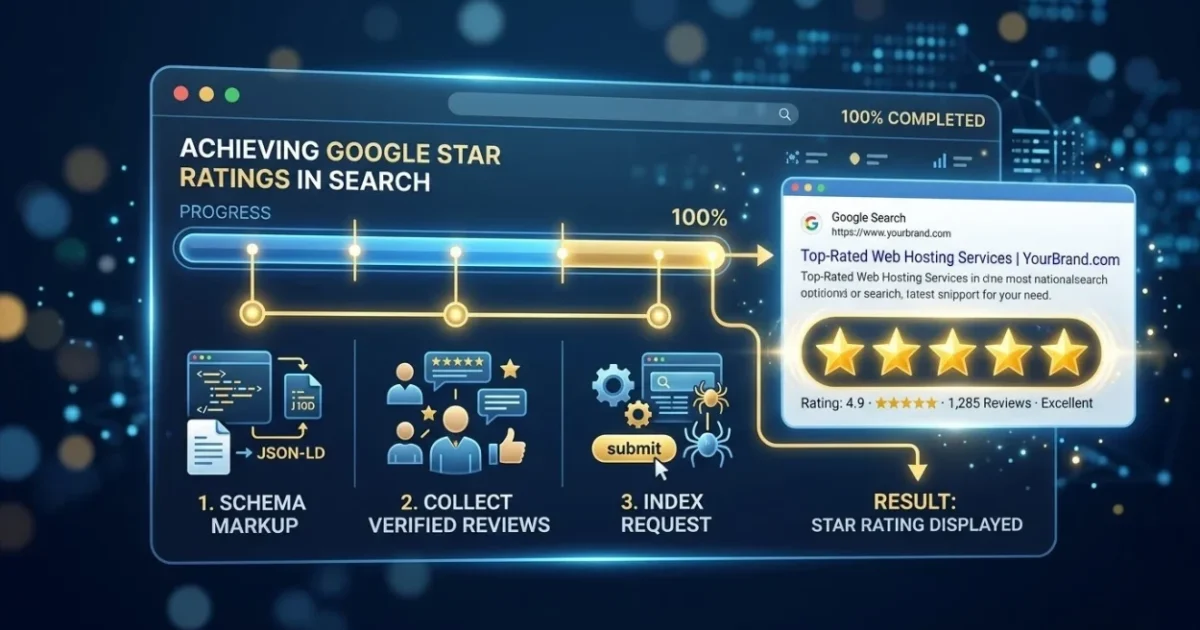
Getting star ratings to display in Google Search depends on review eligibility, structured data, entity relationships and Google’s independent evaluation of search features. A business can have Google Reviews and an aggregate rating without receiving a visible star feature beside every organic search result.
Reputation management strategies differ based on whether the objective concerns review availability, rating visibility, structured data or broader SERP presentation. Online reputation control methods are evaluated through search visibility, reputation signals, entity credibility and the relationship between review information and the relevant webpage. Star ratings therefore require a distinction between possessing a rating and qualifying for its display in a particular search context. This distinction is central to evaluating which technical and reputation-management approaches have relevance.
Which Factors Determine Whether Star Ratings Appear in Google Search?
Star-rating visibility depends on the interaction between review information, entity relevance, structured data, search intent and Google’s eligibility systems. A rating is information associated with an entity, while a star feature is a particular SERP presentation of that information. Google evaluates the relationship between the webpage, the represented entity and the review information before deciding which search features appear. This means the existence of reviews alone does not determine organic star visibility.
The search result itself also matters because review information needs to correspond accurately with the subject represented by the page. Structured data provides machine-readable information, while visible webpage content provides contextual evidence. Entity recognition connects the information with the correct business or organisation. These mechanisms operate together rather than functioning as independent guarantees of a visible rating feature.
Is Structured Data or Google Review Activity More Important for Star Visibility?
Structured data and review activity perform different functions, so their effectiveness cannot be assessed as interchangeable ranking factors. Review activity creates the underlying rating and customer-feedback information associated with an entity. Structured data communicates information about the webpage and its content in a format search engines can process more efficiently. Neither mechanism independently guarantees that Google displays stars in organic search.
Review activity has greater relevance to the existence of the rating itself, while structured data has greater relevance to how webpage information is interpreted. A business with a valid rating but inaccurate or incomplete webpage information faces a different technical situation from a business with correctly implemented structured data but no eligible review information. Evaluation therefore begins by identifying which part of the system is creating the visibility limitation.
How Does Google Review Data Compare With Review Structured Data?
Google review data and review structured data represent related but distinct information systems. Google review data exists within Google’s business-profile ecosystem, while structured data exists on a webpage and communicates information about that page to search engines. The two systems can support an entity’s overall information environment but do not function as interchangeable sources. Their relationship needs to be evaluated according to the specific search result being analysed.
This distinction explains why a business can have an active Google rating while its website does not display review stars in organic results. The business profile and website operate as different information surfaces. Google evaluates information from these surfaces when constructing its understanding of the entity and deciding which SERP features are eligible. A visible rating in one Google environment therefore does not establish guaranteed star visibility in another.
Can Structured Data Alone Make Star Ratings Appear?
Structured data alone does not determine whether Google displays a star rating. It provides structured information that helps search engines interpret content, but Google independently evaluates whether the associated rich result is eligible for display. The information also needs to accurately represent the content visible to users on the webpage. This makes structured data an interpretation mechanism rather than a direct SERP-control mechanism.
The limitation is important when comparing technical optimisation with reputation management. Technical implementation can improve the clarity of machine-readable information, while reputation analysis examines the wider relationship between reviews, entities and search visibility. A technically valid implementation therefore represents one part of the evaluation rather than the complete solution. The final SERP presentation remains controlled by Google’s systems.
How Does Entity Consistency Affect Star Rating Visibility?
Entity consistency strengthens the connection between a business, its website and associated reputation information. Entity consistency refers to the accurate and coherent representation of the same organisation across relevant digital sources. Business names, website information, locations and descriptions provide contextual information that helps search systems distinguish one entity from another. Clear relationships reduce ambiguity during SERP evaluation.
Inconsistent entity information creates a different problem from missing review data. A business can possess genuine reviews while its online information contains conflicting names, locations or organisational details. Search systems then have to resolve these relationships before presenting information confidently. Improving entity consistency therefore supports the interpretation of reputation signals without guaranteeing a specific star feature.
Does Having More Google Reviews Increase the Chance of Star Ratings Appearing?

Review volume and star visibility represent different concepts. Increasing the number of Google Reviews changes the amount of review information associated with a business, but it does not create an automatic entitlement to a star feature in organic search. Google evaluates review information within its own eligibility and presentation systems. The presence of additional reviews therefore needs to be distinguished from the visibility of review enhancements.
Review quality and relevance also form part of the wider reputation environment. Google applies policies to review content and excludes content that violates applicable requirements. A larger review count therefore does not automatically represent stronger search visibility or stronger trust signals. Evaluation needs to consider the validity, relevance and entity association of the available review information.
Which Approach Is More Effective: Technical Optimisation or Reputation Management?
Technical optimisation and reputation management address different layers of the search ecosystem. Technical optimisation improves how webpages communicate information through structured data, page architecture and other machine-readable signals. Reputation management evaluates the broader digital footprint, including reviews, sentiment distribution, entity credibility and SERP composition. Their effectiveness therefore depends on the specific problem affecting visibility.
Technical work has a defined scope and provides measurable implementation checks. Reputation management has a broader scope because it evaluates how multiple information sources influence search perception. A business experiencing a structured-data issue requires a different intervention from one experiencing inconsistent entity information or fragmented reputation signals. The evaluation process therefore begins with diagnosis rather than assuming that one method applies universally.
How Does Content Enhancement Compare With Content Removal for Review Visibility?
Content enhancement and content removal influence different parts of the search environment. Content enhancement adds or improves authoritative information that can compete within the SERP, while content removal attempts to eliminate specific content through an applicable policy or legal mechanism. Neither approach directly guarantees the appearance of star ratings. Their relevance depends on whether the primary issue concerns missing information, unwanted information or search-result presentation.
Content enhancement has broader scalability because improved pages can compete for multiple related searches. Removal has narrower scope because it targets individual content assets and depends on eligibility criteria. For star-rating visibility, technical and entity optimisation generally address the underlying information structure more directly than removal. Removal becomes relevant when inaccurate, prohibited or otherwise eligible content affects the reputation environment surrounding the entity.
Is an Organic or Reactive Approach More Sustainable for Star-Rating Visibility?
An organic approach focuses on maintaining accurate entity information, valid review signals and technically sound webpages over time. A reactive approach responds after a specific visibility or reputation problem becomes apparent. Organic management provides continuous maintenance of the digital footprint, while reactive management concentrates resources on defined issues. Sustainability depends on maintaining the underlying information environment rather than repeatedly addressing isolated symptoms.
Organic activity also provides a stronger foundation for monitoring changes in SERP composition. Consistent business information, accurate structured data and ongoing review monitoring create a stable baseline for measurement. Reactive intervention remains useful when a specific technical or reputation issue emerges. The two approaches therefore differ in timing and scope rather than functioning as mutually exclusive systems.
Dive Deeper With Our Expert Guides:
A Practical Guide to Google’s Review Content Policies
How to Detect and Report AI-Generated Fake Reviews on Google
How Do Short-Term and Long-Term Strategies Differ?
Short-term strategies focus on correcting identifiable technical or information issues, while long-term strategies focus on maintaining consistent reputation signals and entity credibility. A short-term review can identify invalid structured data, inconsistent business information or indexing problems. A long-term programme evaluates whether the digital footprint continues to provide coherent and authoritative information. The distinction is therefore based on the duration and scope of the objective.
Short-term improvements can produce measurable technical changes without producing a corresponding change in SERP presentation. Long-term monitoring captures how Google reassesses webpages and entities over time. Search visibility is dynamic because indexes, content and ranking systems change. Sustainable evaluation therefore requires measurements that extend beyond the initial implementation stage.
How Can You Evaluate Why Star Ratings Are Not Showing?
A structured diagnostic framework provides a more reliable evaluation than assuming that missing stars indicate a single technical fault. The process separates rating availability, entity association, structured-data implementation and SERP presentation. Each layer represents a different mechanism and therefore requires a different form of analysis. This prevents unrelated problems from being treated as one visibility issue.
A practical evaluation framework can:
- Verify the active Google rating to establish whether review information exists for the entity.
- Inspect structured data to confirm that the webpage communicates accurate review-related information.
- Compare search surfaces to identify whether the rating appears in Maps, business profiles or other Google environments.
- Analyse entity consistency across the website and relevant business references to identify conflicting information.
- Monitor SERP presentation across target queries to distinguish technical problems from Google’s independent feature selection.
This framework separates measurable inputs from Google’s final presentation decision. It also provides a repeatable method for assessing changes after technical or reputation-related work.
How Does Search Intent Affect Star-Rating Presentation?
Search intent influences which information Google considers relevant to a particular query. A branded query for a specific business has a different information requirement from a generic query about a service category. Google evaluates search features according to the context of the query and the available information about the relevant entity. Star visibility therefore needs to be assessed against defined search queries rather than assumed to be universal.
Search intent also affects SERP composition. A query with strong navigational intent can prioritise business or entity information, while an informational query can prioritise explanatory content. The same business can therefore appear with different search features across different queries. This makes query-level monitoring essential when evaluating review visibility.

How Should Reputation Signals Be Measured?
Reputation signals should be measured through observable changes in review information, entity representation and search-result visibility. Review metrics include rating distribution, review volume and sentiment characteristics. Search metrics include rankings, SERP features and the visibility of relevant pages. Entity metrics examine consistency between the business and its associated online information.
Separating these measurements prevents one metric from being interpreted as evidence of another. A higher review rating does not prove that star features will appear in organic search. Improved structured data does not prove that search visibility will increase. A stronger evaluation therefore tracks each mechanism independently before assessing how they interact.
What Role Does Sentiment Distribution Play in Google Reviews?
Sentiment distribution describes the balance of positive, neutral and negative themes expressed within review content. It provides contextual information beyond the aggregate star rating because written reviews explain the subjects behind customer assessments. Search systems can process textual information as part of their understanding of webpage and entity content. Sentiment analysis therefore contributes to reputation assessment even when it does not directly determine a star feature.
For reputation management, sentiment distribution is useful because it identifies recurring themes within customer feedback. It can also distinguish between a numerical rating and the underlying language associated with that rating. This creates a more complete representation of online reputation than relying on the average star score alone. However, sentiment analysis remains separate from Google’s decision to display a particular SERP feature.
How Can Search Visibility Be Improved Without Assuming Star Display?
Search visibility can be improved by strengthening the overall information environment rather than treating star display as the only success criterion. Accurate entity information, technically valid webpages, useful content and coherent reputation signals create a stronger foundation for search evaluation. These activities improve the quality and consistency of the information available to search systems. Star visibility remains a separate outcome controlled by Google’s automated presentation systems.
A broader SERP evaluation also identifies whether authoritative pages are visible for important branded and service-related queries. This provides a more meaningful view of search performance than monitoring stars alone. A business can maintain strong search visibility even when a specific review enhancement is not displayed. The strategic distinction is between improving the underlying search environment and attempting to force one visual feature.
What Is the Most Sustainable Way to Evaluate Star-Rating Visibility?
The most sustainable evaluation combines technical monitoring, review analysis, entity management and SERP tracking. Technical monitoring identifies changes to structured data and webpage implementation. Review analysis tracks the underlying reputation signals, while entity management maintains consistency across digital sources. SERP tracking then measures how these inputs relate to visible search features.
This approach creates a continuous evaluation loop rather than a one-time optimisation exercise. Changes in reviews, webpages, indexing and search presentation can be recorded against a consistent baseline. The resulting data separates short-term technical corrections from longer-term changes in search visibility. It also provides a clearer framework for identifying whether an issue concerns reputation, technical implementation or Google’s independent SERP evaluation.
What Determines Whether Star Ratings Appear in Google Search?
Star-rating visibility is determined by the interaction between review information, structured data, entity relationships, search intent and Google’s eligibility systems. Technical optimisation can improve information clarity, while reputation management evaluates the broader relationship between reviews, credibility and SERP composition. Content enhancement and removal address different problems and therefore require separate evaluation. Organic monitoring provides continuity, while reactive intervention addresses defined issues.
The central distinction is between having a Google rating and having that rating displayed as a SERP feature. A business can control the accuracy of its information, maintain valid reviews and implement appropriate structured data without controlling Google’s final presentation decision. Evaluating these mechanisms separately provides a more accurate understanding of search visibility, reputation signals and star-rating display.
The consideration-stage approach therefore focuses on diagnosis, comparative effectiveness, risk exposure and sustainability rather than treating star visibility as an automatic outcome of one optimisation method.
How do I get star ratings to display in Google Search results?
Star ratings depend on eligible review information, accurate entity data, structured data and Google’s SERP evaluation. Having Google Reviews alone does not guarantee that stars appear beside an organic search result.
Does adding review schema make Google show star ratings?
Review structured data helps Google interpret review and rating information but does not guarantee a star-rating rich result. Google independently evaluates eligibility, accuracy, content and search context before displaying enhanced results.
Why are my Google Reviews visible but star ratings are missing from search?
Google Reviews can remain visible on a Business Profile while stars are absent from the website’s organic listing. This difference results from separate Google search surfaces and the eligibility requirements for SERP features.
How do Google Reviews affect star ratings in search results?
Google Reviews provide the underlying rating and customer-feedback signals associated with a business entity. Google then evaluates those signals alongside structured information, entity relevance and search context when determining SERP presentation.
Can reputation management improve Google star rating visibility?
Reputation management can analyse review signals, entity consistency, structured data and SERP composition to identify factors affecting search visibility. It cannot directly control Google’s decision to display a particular star-rating feature.