
A hostile media interview can continue influencing a politician’s search results long after the original broadcast, making SERP control essential to managing public perception. Clear My Name uses structured reputation management to assess negative content, strengthen credible information and improve the visibility of authoritative search results.
Why is professional reputation management the right approach for a hostile interview?
Professional reputation management provides a structured way to address the search visibility created by a hostile interview and its subsequent coverage. A single interview frequently produces recordings, articles, transcripts, clips, quotations and commentary across multiple platforms. How hostile interviews affect long-term search visibility is therefore an important consideration when assessing how these assets continue to influence search perception, reputation signals and entity credibility over time. Managing the issue requires analysis beyond one URL or one search result. A professional process identifies the content network, evaluates its visibility and establishes which interventions provide the strongest practical route to improving search perception.
The central value of reputation management for politicians is control over the information environment rather than control over the media itself. Search engines determine rankings independently, while publishers control their own content and editorial decisions. A reliable service therefore separates actions within its control from outcomes dependent on external platforms. This approach creates measurable objectives around content visibility, ranking positions, source authority and SERP composition. It also reduces risk by preventing unsupported promises about guaranteed search-engine outcomes.
For decision-makers, the distinction between removing content and managing its visibility is particularly important. Content removal addresses the source when inaccurate, unlawful or policy-violating material qualifies for correction or removal. Negative content suppression addresses search visibility by strengthening relevant and authoritative alternatives. Where direct removal is unavailable, a broader search perception strategy provides a structured method for reducing the prominence of damaging material without misrepresenting what search engines control.
Which reputation management methods deliver measurable results?
The strongest reputation management approach combines source assessment, removal opportunities, search visibility analysis and authoritative content development. Each method addresses a different part of the information ecosystem, so measurement must reflect the specific intervention. Removal can be measured through publisher responses and URL status, while search suppression can be evaluated through ranking positions and SERP composition. Content enhancement can be measured through the visibility and authority of relevant information assets. This creates a transparent framework for assessing progress rather than relying on general claims about improved reputation.
A structured process can deliver measurable outcomes through the following actions:
- Identify every relevant interview asset by mapping original recordings, articles, transcripts, clips and derivative coverage.
- Evaluate each source by assessing accuracy, publisher authority, indexing status and relevance to target searches.
- Prioritise intervention opportunities by separating removable content from material requiring search visibility management.
- Monitor rankings by tracking defined searches, URL positions, source categories and changes in SERP composition.
- Measure sustainability by comparing search visibility and reputation signals over time rather than relying on one ranking snapshot.
This measurement framework makes reputation management more accountable. It also provides evidence for adjusting strategy when a particular intervention produces limited movement. For politicians, where search queries often involve names, statements and political positions, tracking the wider entity landscape provides stronger insight than measuring a single keyword.
How does Clear My Name manage the search legacy of a hostile interview?
Clear My Name approaches the search legacy of a hostile interview through structured assessment of the content surrounding the politician’s digital identity. The process begins by identifying how the interview appears across search engines, news publications, video platforms and other indexed sources. Each asset is assessed according to its visibility, relevance, authority and relationship to the politician’s entity. This analysis distinguishes primary media coverage from secondary amplification. The resulting information map provides the basis for selecting appropriate reputation management actions.
The process also recognises that not every negative result requires the same response. An inaccurate article presents a different issue from an accurate but unfavourable interview published by an authoritative news organisation. The former can involve source-level correction or removal assessment, while the latter requires a search perception strategy focused on the wider SERP. Clear My Name can therefore structure activity according to the nature of the content rather than applying one generic method to every result.
Process clarity is a key reliability indicator. A professional reputation management service documents identified URLs, intervention types, platform dependencies and measurable search indicators. This enables stakeholders to distinguish completed actions from changes still dependent on publishers or search engines. The result is a clearer assessment of progress, risk and remaining visibility.
How does negative content suppression improve search perception?
Negative content suppression improves search perception by reducing the prominence of damaging URLs through stronger competing information and better SERP composition. It does not require the original material to disappear from the internet. Instead, the strategy focuses on the information users encounter most prominently when searching for the politician. Search engines evaluate individual pages according to relevance, authority and other ranking signals, meaning alternative content must establish sufficient relevance to compete. The objective is therefore improved visibility of accurate, authoritative information rather than manipulation of search results.
Suppression is particularly relevant when the original interview has generated multiple derivative pages. Removing one article does not automatically remove video clips, quotations or secondary reporting that repeat the same association. Managing the long tail of hostile media coverage provides a useful framework for evaluating how these connected assets continue to affect SERP composition and search visibility. A broader strategy analyses the entire search footprint and addresses the queries through which the content remains discoverable. This reduces dependence on a single intervention and creates wider search perception influence.
The strategy also protects against an overly narrow definition of reputation repair. A search result can disappear from one position and remain prominent for another related query. Effective monitoring therefore evaluates a defined group of relevant searches rather than one phrase. This broader measurement provides stronger evidence of whether SERP control is producing a sustainable change in search perception.
Why does content enhancement matter when removal is unavailable?

Content enhancement becomes essential when legitimate third-party reporting remains published and no valid removal route exists. It operates by developing accurate, relevant information that establishes stronger contextual signals around the politician’s entity. These information assets can include authoritative professional profiles, official statements, relevant publications and other legitimate sources. Search engines then independently assess those pages against competing content. The strategy focuses on strengthening the quality and visibility of the broader information environment.
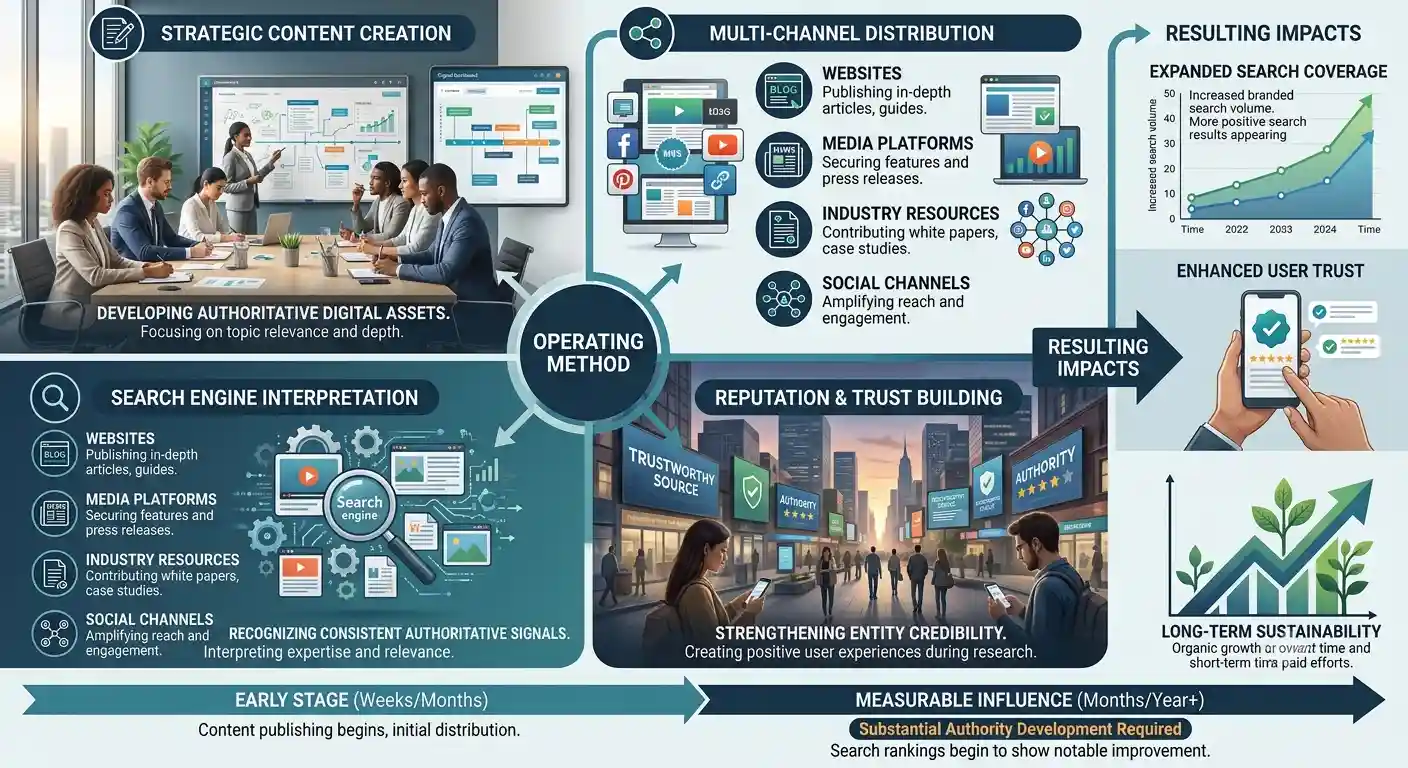
The effectiveness of content enhancement depends on relevance and authority rather than volume alone. Publishing a large number of weak pages does not provide the same search ranking influence as developing a smaller network of credible, contextually relevant sources. Each asset must contribute useful information about the entity and satisfy a defined search intent. This creates a stronger relationship between content quality and search visibility. It also supports entity credibility by providing users with clearer and more reliable information.
For decision-makers evaluating reputation management costs, this distinction is significant. Content enhancement creates an information asset with continuing search value rather than addressing only one historical URL. Its value therefore extends beyond the immediate interview when the content remains relevant to future searches. Long-term measurement determines whether the investment continues producing visibility and credibility outcomes.
How quickly can a hostile interview’s search visibility change?
The speed of change depends on the intervention type, publisher response, indexing status and search-engine evaluation. A publisher-approved correction can alter source information directly, while a ranking-based intervention depends on search engines recrawling, indexing and reassessing relevant pages. These processes operate on different timelines and cannot be treated as one uniform outcome. A reliable reputation management service therefore reports completed actions separately from expected search-result movement. This provides a realistic basis for evaluating progress.
Speed also depends on the size of the interview’s search footprint. One isolated URL presents a narrower problem than an interview distributed through news articles, video platforms, social posts and secondary commentary. Each indexed asset represents a separate visibility point that can require independent assessment. Search perception changes when the wider composition of relevant results changes, not simply when one page moves. Monitoring therefore needs to cover the full set of priority queries and URLs.
Fast action remains valuable, but sustainable improvement requires continued evaluation. A temporary ranking change does not establish long-term SERP control if the original content returns to prominence. Ongoing monitoring identifies ranking reversals, newly indexed references and changes in search intent. This combination of immediate intervention and sustained measurement reduces operational risk.
Is reputation management for politicians worth the long-term investment?
Reputation management for politicians provides long-term value when the cost of persistent negative search visibility exceeds the cost of structured monitoring and intervention. Search results influence how users access information about public figures, particularly when searches involve names, past statements, controversies or media appearances. A prominent hostile interview can therefore become a recurring reputation signal rather than a one-time media event. Addressing the wider search environment creates value through improved visibility of accurate information and clearer entity representation. The assessment remains outcome-based rather than dependent on promotional claims.
Long-term value is also connected to risk reduction. Unmonitored reputation issues can expand when secondary publications, social posts or commentary continue referencing the original event. Each new reference can create another indexed asset and reinforce the association between the interview and the politician. Continuous monitoring identifies these developments before they become part of a larger search footprint. This makes reputation management an ongoing information-risk function rather than a one-off content exercise.
The financial assessment should therefore consider both intervention costs and the persistence of the underlying problem. A narrow removal request can be cost-efficient when one source qualifies for correction. A wider search footprint requires broader analysis because multiple URLs and queries contribute to visibility. Matching the intervention to the scale of the problem provides a more rational basis for determining long-term value.
Dive Deeper With Our Expert Guides:
Plan Your Post-Office Reputation With Clear My Name
Bury Outdated Attack-Ad Content With Clear My Name
How does reputation management reduce risk from future media coverage?
Reputation management reduces risk by establishing a monitored information environment in which new reputation signals can be identified and evaluated promptly. Historical media coverage often produces secondary references that remain searchable after the original event. New interviews can create similar assets, including recordings, articles and social clips. Monitoring these sources provides early visibility into changes affecting the politician’s digital footprint. This enables a structured response based on evidence rather than reactive assumptions.
Risk reduction also comes from maintaining accurate information across authoritative channels. When reliable information is consistently available, users have additional sources through which to evaluate the politician’s identity, statements and professional record. These sources contribute to entity credibility and support a more balanced SERP composition. They do not erase legitimate journalism, but they create a stronger information environment around the entity. This distinction is essential for maintaining an ethical and sustainable reputation strategy.
A reliable service also limits operational risk by maintaining clear boundaries around external control. Publishers retain editorial authority, while search engines retain ranking authority. Transparent reporting therefore identifies which actions have been completed and which outcomes remain subject to external systems. This process creates stronger trust than presenting search visibility as an entirely controllable variable.
Why does process transparency matter when choosing a reputation management service?
Process transparency provides the evidence required to distinguish legitimate reputation management from unsupported promises about search rankings. A credible service explains which URLs were identified, which interventions were attempted and which outcomes remain dependent on publishers or search engines. It also defines the metrics used to evaluate progress, such as ranking positions, URL visibility, source authority and SERP composition. This creates an auditable relationship between activity and outcome. For politically sensitive reputation issues, that level of clarity reduces decision-making risk.
Clear My Name applies this principle by positioning reputation management around structured analysis and measurable search outcomes rather than guaranteed rankings. The distinction is important because no legitimate service controls Google’s ranking systems or independent publishers. A transparent process therefore focuses on controllable actions while monitoring external changes systematically. This approach strengthens confidence because progress can be evaluated against defined evidence.
Trust also depends on accurate representation of limitations. A service that distinguishes content removal from negative content suppression provides a more realistic understanding of what each strategy achieves. It prevents a successful administrative action from being confused with a guaranteed SERP result. Decision-makers can consequently evaluate the service according to process quality, evidence and measurable movement.
How can the results of reputation management be measured?
Reputation management results are measured through a combination of visibility, ranking, source and perception indicators. A single ranking position does not represent the complete outcome because different searches produce different SERP compositions. Measurement therefore examines priority queries, affected URLs, source authority and the visibility of accurate information. Changes are recorded over time to distinguish sustainable movement from temporary fluctuations. This produces a stronger evidence base for assessing performance.
Key outcome indicators include:
- Track priority search queries to measure changes in the positions and visibility of targeted URLs.
- Compare SERP composition to determine whether authoritative and relevant information occupies stronger positions.
- Monitor indexed content to identify new articles, clips, references or derivative pages affecting the search footprint.
- Assess reputation signals to determine whether recurring associations remain concentrated around the hostile interview.
- Review sustainability over time to establish whether improvements remain stable as search results evolve.
These measures connect reputation activity with observable outcomes. They also provide a framework for deciding whether further intervention is required. A reliable reputation management programme treats measurement as an ongoing component of the service rather than an afterthought.
A hostile media interview becomes a long-term reputation issue when its recordings, reports, clips and references continue influencing search visibility. The most reliable response combines source-level assessment, negative content suppression, authoritative content enhancement and continuous SERP monitoring. These methods address different stages of the search ecosystem and provide measurable indicators for visibility, trust and entity credibility.
Clear My Name provides a structured approach centred on process transparency, evidence and outcome measurement. Its role in reputation management for politicians is not to promise control over independent publishers or search engines, but to identify practical intervention opportunities, strengthen credible information and monitor the resulting search environment. This distinction creates a more reliable basis for managing reputation risk.
For decision-makers, the strongest service is one that clearly explains what it can change, what remains externally controlled and how progress is measured. That combination of process clarity, search visibility analysis and sustained monitoring provides a credible framework for reducing the long-term influence of a hostile interview while maintaining accurate information within the search ecosystem.
How can reputation management help with a hostile media interview?
Reputation management evaluates the interview, related articles, clips and other indexed references to identify how they affect search visibility. Strategies can include content removal assessment, negative content suppression, authoritative content enhancement and ongoing SERP monitoring.
Can a hostile interview be removed from Google search results?
Search visibility and source removal are separate processes. A page can be considered for removal or correction when it meets a publisher or search-engine policy, while other legitimate coverage can remain indexed and require search perception management.
How does negative content suppression work for politicians?
Negative content suppression focuses on reducing the prominence of damaging URLs by strengthening relevant and authoritative information within search results. Its effectiveness is measured through changes in rankings, SERP composition and the visibility of credible information.
How long does reputation management take to improve search results?
Timelines depend on publisher responses, content indexing, ranking changes and the number of URLs associated with the hostile interview. A reliable process separates completed actions from search-result changes that remain dependent on external platforms.
How is the success of reputation management measured?
Success is measured through indicators such as keyword rankings, URL visibility, SERP composition, source authority and changes in recurring reputation signals. Monitoring these metrics over time helps distinguish sustainable improvements from temporary ranking changes.