

Managing the long tail of a hostile media interview involves evaluating how the original interview, subsequent coverage, clips and references continue to affect search visibility over time. Reputation management strategies differ based on whether the objective involves correcting source information, reducing the visibility of unwanted content, or strengthening accurate information across the search ecosystem.
Which reputation management approach is most effective for a hostile interview?
The most effective approach depends on whether the problem originates from inaccurate source information or from the continued visibility of accurate but damaging coverage. Content removal addresses the source level, while content enhancement works at the search-result level by increasing the visibility of relevant, authoritative information. Removal therefore provides a direct intervention when a publisher has grounds to amend or delete material. Enhancement operates differently by changing the composition of information available within search results rather than eliminating the original source.
Hostile interview coverage frequently produces multiple digital assets, including video recordings, transcripts, news reports, quotations and secondary commentary. Removing one asset does not automatically remove the associated references from other indexed sources. A broader evaluation therefore examines the entire content network surrounding the interview. This distinction separates source correction from search visibility management and provides a more accurate basis for measuring reputation signals.
How does content removal compare with content enhancement?
Content removal is a source-level strategy that seeks to eliminate, correct or amend information at its original publication point. It operates through publisher policies, legal procedures, editorial review or platform-specific reporting mechanisms. Its principal advantage is directness because successful removal eliminates the source page itself rather than attempting to compete with it in search results. Its limitation is external dependency, since the publisher or platform controls the final decision.
Content enhancement operates through the development and optimisation of accurate, relevant information that competes within search results. It does not necessarily alter the original interview or its source page. Instead, it seeks to strengthen alternative documents through relevance, authority, structured information and contextual relationships. This approach offers broader scalability when multiple search queries and content assets are involved, but its effectiveness depends on search ranking influence and the authority of competing pages.
The difference between these approaches can be assessed through the location of the intervention. Removal changes the underlying information environment, while enhancement changes the distribution of visibility within that environment. When inaccurate information is eligible for correction, source-level intervention provides a more direct mechanism. When the content remains published and searchable, enhancement focuses on SERP composition and the prominence of alternative information.
Is content suppression more sustainable than organic content enhancement?
Content suppression and organic content enhancement address different parts of search visibility, making sustainability dependent on the underlying reputation problem. Suppression focuses on reducing the prominence of particular URLs through search-result competition, while enhancement focuses on building stronger relevant content around the entity. Suppression can produce faster changes when strong supporting assets already exist and search competition is favourable. Its limitation is that the underlying source remains available and can regain visibility if ranking conditions change.
Organic enhancement operates through sustained development of relevant information across authoritative digital properties. It strengthens the information architecture surrounding an entity rather than targeting one negative URL alone. This creates a broader foundation for search perception because multiple documents contribute to entity credibility. The process is generally more dependent on content quality, indexing, authority and ongoing search demand than on one intervention.
Sustainability therefore relates to whether the strategy addresses a single result or the wider search environment. A suppression-led approach can be appropriate for a narrow ranking problem, while organic enhancement provides greater structural coverage across a larger set of queries. Evaluating both methods requires measuring ranking stability, source authority and the persistence of the reputation signals associated with the interview.
How do reactive and organic reputation strategies differ?
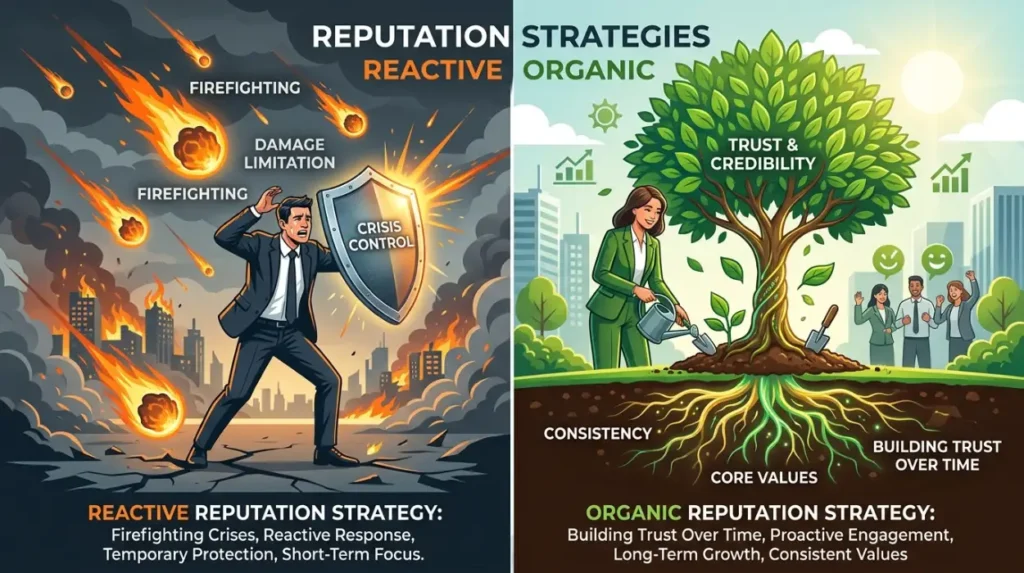
Reactive reputation management responds to existing content after a reputation event has occurred, while organic reputation management develops information assets that establish a stronger search environment over time. Reactive methods include publisher contact, content correction requests, platform reporting and responses to specific search-result problems. These methods directly address identified sources and can provide a clear record of individual actions. Their limitation is that each intervention usually relates to a defined piece of content.
Organic methods focus on creating and maintaining accurate information before or alongside reputation events. They operate through owned websites, professional profiles, authoritative publications and other legitimate information sources that contribute to an entity’s digital footprint. This creates a broader network of reputation signals rather than concentrating activity on one hostile interview. Organic strategies require sustained content relevance and authority because search engines independently evaluate the resulting pages.
The two approaches therefore differ in timing and scope. Reactive methods are more closely connected to immediate content issues, whereas organic methods address the longer-term composition of search results. A comprehensive evaluation considers whether the problem involves one source, multiple related URLs or an established search association. The scale of the information footprint determines whether a narrow reactive intervention or a broader organic strategy provides greater coverage.
Which has a stronger short-term impact: removal or search-result optimisation?
Removal generally has a stronger direct short-term effect when the relevant publisher accepts a valid correction or removal request. Eliminating the source page removes that specific URL from the publisher’s information environment, although copies and references elsewhere can remain indexed. Search-result optimisation produces change through ranking competition, which requires search engines to reassess the relative relevance and authority of available pages. Its impact therefore depends on indexing and ranking processes rather than a single publisher decision.
Short-term impact also depends on the number of affected URLs. One removable page presents a different problem from an interview that has generated dozens of reports, clips and references. Removing one article does not address the broader sentiment distribution if other sources continue to repeat the same narrative. Search-result optimisation can address a wider query set by strengthening alternative information across multiple documents.
The appropriate measurement therefore extends beyond whether a page disappears. Analysts can evaluate the number of affected URLs, keyword positions, SERP composition, source authority and the persistence of associated reputation signals. These indicators distinguish a genuine change in search perception from a temporary movement affecting one result.
How does long-term reputation control differ from short-term intervention?
Long-term reputation control focuses on maintaining a stable and credible information environment rather than resolving one isolated search-result problem. Short-term intervention targets a defined event, URL or ranking issue, while long-term control evaluates how information about the entity develops across time. The long-term approach includes monitoring new publications, maintaining authoritative information and evaluating changes in search intent. It therefore treats reputation as a continuously changing information system.
Short-term intervention provides clearer boundaries because the target content is identifiable. A removal request can be measured through the status of a specific URL, while a ranking intervention can be measured through defined search queries. Long-term control involves broader indicators such as the proportion of authoritative results, recurring themes, sentiment distribution and the stability of entity associations. These measurements provide insight into whether reputation signals remain concentrated around the original hostile interview.
Sustainability depends on maintaining relevance as search results change. Search engines continually reassess content according to ranking systems, user queries and available information. A long-term strategy therefore requires monitoring rather than assuming that one successful intervention permanently changes search perception. This distinction is central when assessing the continuing search legacy of a political interview.
How do reputation strategies influence SERP composition?
Reputation strategies influence SERP composition by changing which information sources are available, relevant and competitive for searches associated with an entity. Source removal reduces the presence of a specific document, while content enhancement introduces or strengthens alternative documents that compete for visibility. Search engines independently evaluate these pages according to relevance, authority and other ranking signals. The resulting SERP therefore reflects the combined strength and relationships of the available information.
A hostile interview can occupy different search positions across different queries. The original video can rank for an interview-related query, while a news article ranks for a statement-related query and an official biography ranks for a name-based query. Each query produces a distinct information environment. Effective evaluation therefore measures SERP composition across a defined query set rather than relying on one branded or name search.
Search visibility is consequently a distribution problem rather than a single ranking metric. Analysts can compare the number of negative, neutral and authoritative results, their positions and their source types. This provides a clearer picture of how reputation signals are distributed across the search ecosystem. It also explains why content suppression versus content enhancement represents a strategic distinction rather than interchangeable terminology.
Dive Deeper With Our Expert Guides:
Reputation Transition Planning for Politicians Leaving Office
How to Suppress Outdated Attack-Ad Content in Search Results
How should effectiveness, scalability and risk exposure be compared?
Effectiveness, scalability and risk exposure provide three useful dimensions for comparing reputation management approaches. Effectiveness measures whether the strategy changes the targeted information or its visibility, while scalability measures whether the method remains practical across multiple URLs and queries. Risk exposure measures dependence on third parties, policy restrictions, ranking volatility and the possibility of renewed visibility. Evaluating all three dimensions prevents a short-term ranking change from being treated as a complete reputation outcome.
A structured evaluation can compare approaches through four mechanisms:
- Measure removal outcomes by recording whether the original publisher corrects, updates or removes the targeted information.
- Measure suppression outcomes by tracking the position and recurrence of specific URLs across defined search queries.
- Measure enhancement outcomes by evaluating the visibility, authority and relevance of alternative information assets.
- Measure sustainability outcomes by monitoring SERP composition and reputation signals over an extended period.
This framework distinguishes completed actions from external outcomes. It also identifies where a strategy depends on publishers, platforms or search engines rather than treating every result as directly controllable. The resulting assessment provides a more reliable basis for comparing strategic options.
What role does authority play when managing a hostile interview’s search legacy?
Authority affects how effectively alternative information competes with established media coverage in search results. High-authority publications and well-established digital entities possess stronger contextual relationships within their subject areas. A newly published page therefore does not automatically displace an established news article simply because it contains more favourable information. Search engines evaluate relevance, authority and other signals when determining ranking positions. Entity credibility must consequently be supported by information that is both accurate and contextually relevant.
Authority also affects scalability. If a hostile interview has generated coverage across high-authority news sources, competing against each individual URL requires a substantial information network. A single page has limited capacity to influence a broad SERP when multiple authoritative sources establish the same association. A network of relevant, trustworthy information provides broader coverage because it addresses multiple queries and entity relationships.
This explains why long-term reputation analysis examines the quality and distribution of sources rather than simply counting positive pages. Ten low-authority pages do not necessarily exert the same search ranking influence as one established publication. Strategic evaluation therefore measures source authority alongside ranking position, topical relevance and the persistence of the interview-related association.
How can the search legacy of a hostile interview be evaluated?
The search legacy of a hostile interview is evaluated by mapping the content network, identifying affected queries and measuring how the interview-related information appears across SERPs. The evaluation begins with the original interview and expands to transcripts, news reports, clips, quotations, commentary and derivative pages. Each asset is classified according to source type, authority, sentiment and relationship to the politician. This creates an information map that distinguishes primary coverage from secondary amplification.
The next stage measures search visibility across defined queries. Analysts compare URL positions, source categories, recurring themes and the distribution of authoritative versus less authoritative information. Changes are then tracked over time to identify whether an intervention produces stable or temporary movement. This approach evaluates the search environment rather than treating one ranking position as the entire reputation outcome.
A final assessment considers the limitations of each intervention. Publisher-controlled removal depends on editorial or platform decisions, while search-result enhancement depends on ranking systems and content authority. Neither approach provides universal control over third-party information. The strongest evaluation therefore identifies what changed, what remains indexed and which reputation signals continue to influence entity perception.
Managing the long tail of a hostile media interview requires a comparison between source-level intervention, search-result suppression and organic content enhancement. Removal directly addresses eligible source material, while suppression focuses on reducing the visibility of specific URLs and enhancement develops stronger information assets around the entity. Each approach has different mechanisms, dependencies, scalability characteristics and sustainability requirements.
Short-term intervention provides measurable changes to individual sources or rankings, whereas long-term reputation control examines the stability of the wider search environment. SERP composition, authority, sentiment distribution, content indexing and entity credibility provide useful indicators for evaluating these differences. A neutral assessment therefore considers the complete information network surrounding the interview rather than relying on one removal request or one ranking position.
The central strategic distinction is between changing the source and changing its visibility. Neutralise a Hostile Interview’s Search Legacy represents the search-perception objective, while the underlying methods determine how that objective is approached within the constraints of publishers, platforms and search-engine evaluation.
How can you manage the long tail of a hostile media interview?
Managing the long tail involves identifying the original interview, related news reports, clips, transcripts and secondary references that remain indexed. Reputation management strategies can then evaluate whether removal, correction, content suppression or organic content enhancement is appropriate for each source.
Is removing a hostile interview better than suppressing it in search results?
Removal directly addresses the original source when a publisher accepts a valid correction or removal request. Search suppression focuses on reducing the visibility of the URL through competing relevant content, so the two approaches operate at different levels.
How does content enhancement affect a hostile interview’s search visibility?
Content enhancement strengthens accurate and authoritative information that competes within search results for relevant queries. Its effectiveness is assessed through changes in SERP composition, ranking positions, source authority and entity credibility.
How long does it take to reduce the search visibility of a hostile interview?
The timeframe depends on factors such as publisher response times, content indexing, search ranking changes and the number of related URLs. A change affecting one source can occur differently from a broader shift across multiple search results.
What is the difference between short-term and long-term reputation management?
Short-term reputation management targets specific URLs, corrections or immediate search-result issues, while long-term management evaluates the wider information environment around an entity. Long-term assessment considers ranking stability, reputation signals, authority and the continued appearance of related content.