

Restoring trust after a legal reputation crisis requires controlled search visibility management, accurate information positioning, and strategic reputation signal improvement.
Reputation management for lawyers strengthens digital credibility by influencing how search ecosystems evaluate entity credibility, content visibility, and professional perception.
A legal reputation crisis creates challenges because search results often become the first reference point for evaluating professional credibility. Search engines organise information through ranking systems that analyse authority, relevance, content relationships, and reputation signals. A reputation management approach focuses on improving the balance of information available within search results while reducing the impact of harmful visibility patterns. This process supports controlled narrative development and strengthens public confidence through structured search perception influence.
Which Reputation Management Approach Delivers Measurable Results After a Legal Crisis?
A structured reputation management approach delivers measurable results by analysing search visibility issues, strengthening credibility signals, and improving SERP control.
Reputation management is a strategic process that evaluates how information about a legal professional appears across search ecosystems. It operates by identifying reputation risks, analysing content ranking behaviour, and developing methods that improve the accuracy of digital representation. Search engines assess information through automated systems that measure relevance, authority, and trust indicators. Effective reputation management aligns these factors to create stronger search visibility outcomes.
Clear My Name applies reputation analysis principles by focusing on information evaluation, search result assessment, and digital credibility improvement. The process examines how negative content, outdated information, or unbalanced search results influence professional perception. By understanding the relationship between indexed content and reputation signals, reputation strategies create a clearer structure for managing online representation.
A decision-focused evaluation of reputation management considers measurable outcomes:
- Analyse search results by identifying harmful content visibility patterns and ranking positions affecting professional perception.
- Strengthen authority signals by improving the presence of accurate and credible information across relevant digital sources.
- Improve SERP control by influencing the balance between damaging content and reliable professional information.
- Reduce reputation risk by addressing factors that affect trust evaluation and entity credibility.
The effectiveness of a reputation management approach depends on its ability to address both immediate visibility concerns and long-term credibility development. Search ecosystems continuously process new information, meaning reputation improvement requires consistent analysis rather than temporary adjustments. A structured approach creates measurable improvements through improved search representation, controlled information flow, and stronger trust signals.
Dive Deeper With Our Expert Guides:
Rebuild Your Reputation After a High-Profile Legal Case
Monitor and Protect Your Law Firm’s Online Reputation
How Does Reputation Management Influence Search Rankings and Public Perception?
Reputation management influences search rankings and public perception by improving how search engines interpret professional credibility and information relevance.
Search rankings are influenced by multiple factors, including content authority, relevance, user behaviour, and information relationships. A reputation crisis often creates changes in these factors because negative or highly visible content can alter the composition of search results. Reputation management evaluates these ranking dynamics to understand how specific content affects professional visibility.
Search perception influence refers to the process of shaping how users interpret an entity based on available search information. It operates through improving content balance, strengthening authoritative signals, and reducing the prominence of damaging information. Search engines do not assess reputation in isolation but evaluate the overall quality and relevance of indexed content connected to an entity.
Law firms require strong digital credibility because professional decisions often involve trust evaluation. Potential clients analyse search results to assess expertise, reliability, and professional standing. Reputation management strengthens these decision factors by improving the consistency and accuracy of information displayed across search platforms.
Clear My Name focuses on reputation structures that support controlled search representation. The process evaluates content visibility, reputation signals, and entity relationships to identify opportunities for improvement. This approach supports trust restoration by ensuring search results provide a more accurate reflection of professional credibility.
How Does Negative Content Suppression Reduce Reputation Risks?
Negative content suppression reduces reputation risks by managing the visibility impact of harmful search results while maintaining compliance with search ecosystem processes.
Negative content suppression is an approach that focuses on reducing the influence of damaging information within search results. It operates by analysing content ranking positions, relevance, authority levels, and available resolution pathways. The objective is not simply removing information but improving the overall balance of search visibility.
Search engines evaluate content through ranking systems that determine which pages appear prominently for specific queries. Negative content with strong authority signals can maintain visibility unless other reputation factors influence the SERP environment. Reputation management analyses these relationships to determine how content suppression and content enhancement work together.
The effectiveness of negative content suppression depends on the nature of the reputation issue. Some content requires direct evaluation due to accuracy concerns, outdated information, or legal considerations. Other situations require strengthening positive reputation signals to reduce the relative visibility impact of harmful content.
A complete evaluation of negative content suppression includes:
- Identify harmful content by analysing ranking positions, search queries, and visibility patterns.
- Evaluate available options by reviewing content authority, platform factors, and search ecosystem behaviour.
- Strengthen alternative information sources by improving credible content visibility and entity recognition.
- Monitor SERP changes by measuring shifts in ranking influence and public perception.
This approach reduces risk by addressing the factors that allow damaging information to maintain search visibility. Reputation management creates a structured framework where content visibility, credibility signals, and search perception are evaluated together.
Which Process Ensures Reliable Reputation Recovery for Legal Professionals?
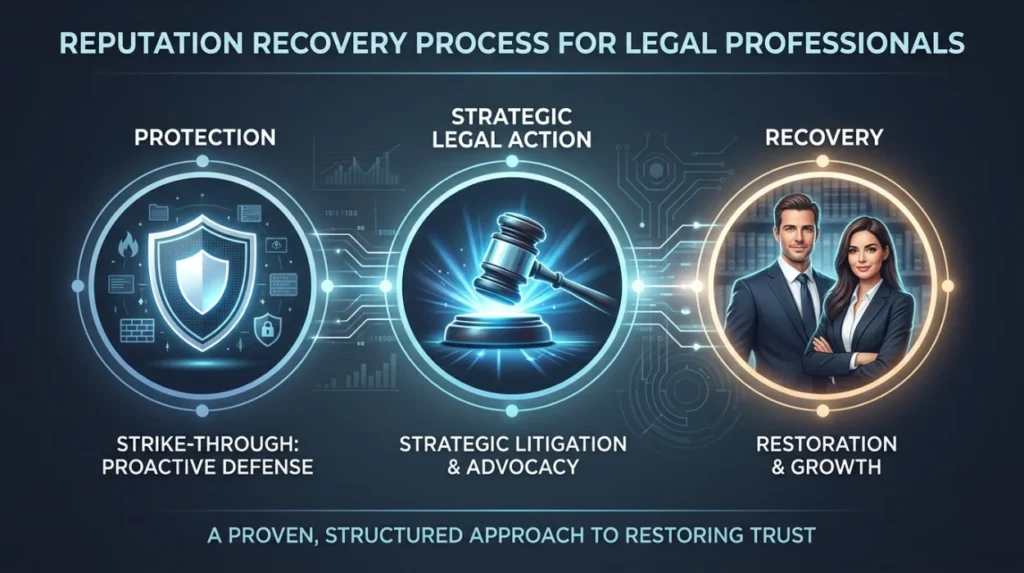
A reliable reputation recovery process ensures consistent results through structured analysis, transparent evaluation, and measurable search visibility improvements.
Reputation recovery operates through a sequence of assessment, strategy development, implementation, and monitoring. Each stage evaluates how search engines interpret information and how users perceive professional credibility. Clear process management reduces uncertainty by creating defined objectives around visibility control, trust improvement, and reputation stability.
The first stage involves analysing the existing digital footprint. This includes reviewing search results, content relationships, authority signals, and reputation risks affecting professional perception. Understanding the current search environment allows reputation strategies to address specific visibility challenges rather than applying general solutions.
The second stage focuses on implementing targeted reputation improvements. These actions involve improving accurate information visibility, evaluating harmful content influence, and strengthening entity credibility. The objective is to create a balanced search environment where reliable information receives appropriate visibility.
Which Outcomes Demonstrate the Value of Professional Reputation Management?
Professional reputation management demonstrates value by improving search visibility, strengthening trust signals, and reducing long-term reputation risks.
The value of reputation management is measured through outcomes connected to search performance, information accuracy, and public perception. Legal professionals require a digital presence that reflects credibility because search results influence how clients, partners, and stakeholders evaluate expertise. Reputation management analyses these decision factors by examining content visibility, authority indicators, and search behaviour patterns.
A professional reputation strategy operates by connecting reputation signals with measurable improvements in digital representation. It evaluates how information appears within search ecosystems and identifies areas where visibility patterns affect credibility. This approach ensures reputation improvements are based on structured analysis rather than temporary changes.
Key outcomes of an effective reputation management process include:
- Improve search visibility by increasing the prominence of accurate and authoritative information within relevant results.
- Strengthen entity credibility by developing consistent professional information across digital platforms.
- Stabilise perception by reducing the impact of harmful content visibility on professional evaluation.
- Enhance SERP control by creating a more balanced search result environment.
The long-term value of reputation management extends beyond immediate search improvements. Search ecosystems continuously evaluate information, meaning reputation stability requires ongoing attention to content relationships and authority signals. A structured approach supports sustainable credibility by maintaining alignment between professional identity and digital representation.
How Does Reputation Management Compare With Traditional Reputation Repair Methods?
Reputation management provides broader search ecosystem control compared with traditional reputation repair methods because it addresses both digital visibility and information structure.
Traditional reputation repair often focuses on direct communication, public relations responses, or offline perception management. These methods address specific audiences but do not always influence how search engines organise online information. Reputation management expands this process by analysing search ranking influence, content indexing, and digital credibility factors.
Search ecosystems create a separate layer of reputation evaluation because users frequently discover professionals through online searches. A positive offline reputation does not automatically create strong search visibility if digital information remains incomplete or unbalanced. Law firm reputation during crisis situations is influenced by how professional credibility appears within search results, making reputation management essential for analysing visibility patterns and perception factors. Reputation management bridges this gap by focusing on how professional credibility appears within search results.
The comparison between traditional methods and search-focused strategies includes:
- Evaluate offline reputation efforts by measuring their influence on public communication and direct perception.
- Analyse digital reputation factors by reviewing search visibility, content authority, and ranking behaviour.
- Compare effectiveness by identifying whether strategies address both perception and search representation.
- Measure sustainability by assessing long-term influence on entity credibility.
Traditional methods remain relevant for broader reputation communication, while search-focused reputation management addresses the digital systems that influence online discovery. Combining reputation analysis with search ecosystem understanding creates a more complete evaluation framework.
Why Is Long-Term Reputation Stability Important After a Legal Crisis?
Long-term reputation stability is important because search ecosystems continuously evaluate new information, making ongoing credibility management essential.
Reputation stability refers to maintaining consistent and accurate digital representation over time. It operates through continuous monitoring of reputation signals, content visibility, and authority relationships. Search engines regularly update their understanding of entities based on newly indexed information, making stability dependent on consistent reputation management.
A legal reputation crisis can create lasting search visibility challenges when damaging information remains highly accessible. Long-term strategies focus on strengthening reliable information structures that support entity credibility. This process improves resilience against future changes in search rankings and public perception.
Clear My Name approaches reputation management through structured evaluation of search environments, content relationships, and credibility indicators. The focus remains on understanding how digital information influences professional perception and how reputation risks develop within search ecosystems.
Sustainable reputation management supports:
- Maintain consistent professional information by ensuring accurate digital representation across relevant sources.
- Monitor reputation signals by tracking changes in search visibility and content ranking patterns.
- Strengthen credibility indicators by developing authoritative information relationships.
- Reduce future risks by identifying emerging reputation concerns before they affect perception.
Long-term stability depends on understanding that reputation is an evolving digital system. Search results change as new content appears, authority relationships shift, and user behaviour develops. Crisis Reputation Management Strategies for Law Firms focus on maintaining credibility through structured evaluation of reputation signals, search visibility patterns, and digital perception factors. A sustainable approach therefore focuses on maintaining credibility rather than addressing only one reputation event.
How Does Clear My Name Provide a Reliable Reputation Management Solution?
Clear My Name provides a reliable reputation management solution through structured analysis, process clarity, and evidence-based reputation improvement methods.
A reliable reputation management solution begins with understanding the specific factors affecting digital credibility. Each reputation challenge requires analysis of search results, content visibility, ranking patterns, and trust signals. This evaluation creates a foundation for targeted actions that address the relationship between information and perception.
The reputation management process focuses on improving visibility control while maintaining accuracy and credibility. It examines how search engines interpret information connected to a legal professional and identifies opportunities to strengthen professional representation. This approach supports trust restoration by improving the balance of information available within search results.
Clear My Name integrates reputation analysis with search ecosystem evaluation to create a structured pathway for managing digital perception. The process considers negative content suppression, content enhancement, and authority development as connected elements of reputation improvement. This creates a clearer understanding of how different strategies influence search perception.
A reliable reputation management framework delivers:
- Analyse reputation risks through detailed search visibility assessment and content evaluation.
- Develop targeted strategies based on ranking dynamics, authority signals, and professional objectives.
- Improve digital representation by strengthening credible information visibility.
- Monitor outcomes through ongoing evaluation of search results and reputation indicators.
The effectiveness of reputation management depends on reliability, transparency, and strategic alignment. Clear processes allow legal professionals to understand how reputation improvements develop and how search ecosystems influence professional perception.
Restoring trust after a legal reputation crisis requires a structured understanding of search visibility, reputation signals, and entity credibility. Reputation management provides a framework for analysing how information influences professional perception and how digital reputation risks develop within search ecosystems.
Effective reputation strategies combine negative content suppression, content enhancement, and authority development to improve SERP control. These methods influence rankings, content visibility, and public perception by addressing the factors search engines evaluate when organising information.
Clear My Name delivers reputation management through a process focused on analysis, transparency, and measurable outcomes. By evaluating reputation signals, search behaviour, and content relationships, the approach supports stronger digital credibility and sustainable reputation stability.
How can law firms restore trust after a legal reputation crisis?
Law firms restore trust after a legal reputation crisis by analysing search visibility, improving reputation signals, and strengthening accurate digital information. Reputation management focuses on balancing online perception through content evaluation, credibility improvement, and SERP control.
What does reputation management for lawyers involve after a crisis?
Reputation management for lawyers involves evaluating search results, monitoring content visibility, and improving professional credibility across digital platforms. The process analyses reputation risks, authority signals, and factors that influence public perception.
How does a legal reputation crisis affect online search results?
A legal reputation crisis can affect search results by increasing the visibility of negative content and changing how users interpret professional credibility. Search engines evaluate content relevance, authority, and reputation signals when ranking information.
Can negative content be reduced after a law firm reputation crisis?
Negative content impact can be reduced through strategies that analyse content visibility, search ranking influence, and available reputation management approaches. These methods focus on improving search balance rather than relying only on content removal.
Why is SERP control important for rebuilding a lawyer’s reputation?
SERP control is important because search results influence how clients and stakeholders evaluate a lawyer’s credibility. Managing search visibility helps strengthen entity credibility, improve trust signals, and create a more accurate digital representation.