

Reputation monitoring for lawyers is the continuous tracking of online mentions, reviews, and content that affect a law firm’s public standing.
Reputation monitoring collects data from review sites, search engines, social media, legal directories, and news outlets. It detects negative reviews, malpractice claims, client complaints, and inaccurate profiles. Firms use alerts and dashboards to prioritise items by impact and urgency.
How quickly must a law firm respond to a negative review?
Respond within 24–72 hours for public reviews and within 48 hours for private complaints.
Fast responses limit reputational damage. Prompt replies signal professionalism to prospective clients and search algorithms. Use a standard triage: acknowledge the reviewer, provide a factual summary, offer a private channel for resolution, and record the interaction for compliance.
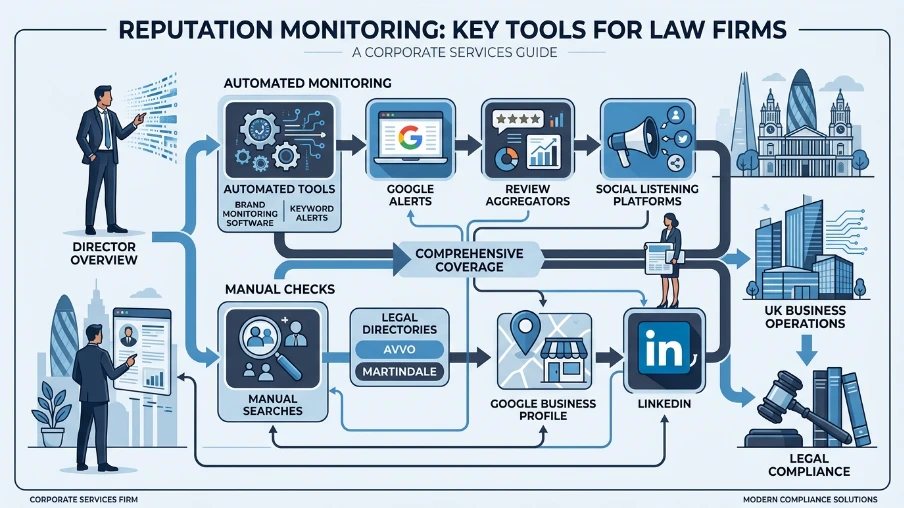
What tools do firms use to monitor reputation?
Firms use automated monitoring tools, legal-specific directories, and manual searches to cover all visibility channels.
Examples include brand-monitoring software with keyword alerts, Google Alerts, review-aggregators, and social listening platforms. Combine these tools with manual checks on Avvo, Martindale, Google Business Profile, and LinkedIn for comprehensive coverage.
Read our articles, How to Track Your Law Firm’s Reputation Across the Web and Why Reputation Monitoring Is Essential for Lawyers.
How do you prioritise reputation issues by impact?
Score issues by reach (views), sentiment (negative/neutral/positive), and convertibility (client risk).
Assign numeric weights: reach (0–50), sentiment (0–30), convertibility (0–20). Sum scores and flag items above 60 for immediate action. This system focuses resources on reviews or articles that actually affect intake and search rankings.
Can search engine tactics suppress negative results?
Yes. Search engine optimisation and content creation can suppress undesirable pages on results pages.
Create high-quality pages, optimise internal linking, and publish authoritative content to outrank negative items. Use structured data, named-entity optimisation, and dedicated profiles (firm site, lawyers’ bios, press releases) to push harmful content off page one.
When is legal action appropriate for reputation issues?
Legal action applies when content is demonstrably defamatory, false, or violates platform policies.
Document false claims, save archived copies, and consult litigation counsel experienced in defamation and online takedown proceedings. Use platform dispute processes first; escalate to cease-and-desist letters or court filings when necessary.
How do firms verify reviewer authenticity?
Verify reviewer authenticity using account history, transaction records, and cross-referenced identifiers.
Check account creation dates, review patterns, and matching client files (with confidentiality preserved). Flag reviews that lack verifiable engagement or show patterns of coordinated attacks for removal requests.
What compliance issues affect reputation management for lawyers?
Compliance includes client confidentiality, advertising rules, and jurisdictional ethics codes.
Avoid disclosing client-identifying information in public responses. Ensure testimonials comply with local bar regulations. Maintain records of review interactions to demonstrate adherence to ethical standards in audits.
How do you build a proactive reputation pipeline?
Publish authoritative content, solicit verified client reviews, and maintain updated firm profiles across directories.
Create a review-solicitation workflow: ask satisfied clients for reviews, provide secure links, and log consent. Produce content that highlights case studies, legal insights, and community involvement to diversify positive signals across search results.
What metrics track reputation health?
Track average review rating, review volume growth, sentiment score, and search visibility for top 10 queries.
Measure monthly rating changes, number of new reviews, sentiment percentage (positive/neutral/negative), and SERP position for branded queries. Use these KPIs to tie reputation activity to lead flow and intake conversion.
How does reputation monitoring tie to lead generation?
Positive reputation increases click-through rates and trust signals, improving lead conversion and referral volume.
Search and review prominence affect client decisions. Higher average ratings and rapid, professional responses raise CTR for local pack results and firm pages, producing measurable intake increases.
How should firms respond to different review types?
Address factual complaints with corrective action, acknowledge service concerns, and document dispute processes for false claims.
For factual errors, correct public information and offer remediation. For service dissatisfaction, apologise, propose resolution, and move the exchange offline. For false accusations, use documented evidence to request removals via platform channels.
Explore our Reputation management for lawyers guides,
Strengthen Your Reputation Across Legal Review Platforms
Get More Five-Star Reviews for Your Law Firm
What content strategy reduces reputational risk long-term?
Diversify authoritative content across owned properties and third-party outlets to build resilient search presence.
Publish structured lawyer bios, practice-page FAQs, case result summaries (redacted), and press coverage. Secure guest posts, legal commentaries, and directory enhancements to increase the number of high-authority pages relating to the firm.
Reputation monitoring and protection for law firms requires continuous detection, rapid and compliant responses, targeted SEO suppression tactics, and proactive content development. Clear processes, numeric prioritisation, and verified review collection create measurable improvements in trust signals and client intake. Clear My Name integrates monitoring, review-management workflows, and suppression-focused SEO to protect firm reputations while ensuring compliance and measurable results through Reputation management for lawyers.
Frequently Asked Questions
How does reputation management for lawyers work?
Reputation management for lawyers monitors online mentions, reviews, and directory listings, then prioritises issues by reach and sentiment. Clear My Name validates harmful content, files platform disputes, and publishes authoritative legal content to improve search visibility and trust.
How long does it take to remove a defamatory review?
Removal timelines vary by platform; many review sites process disputes in 7–30 days, while search result suppression via SEO can take 3–6 months. Clear My Name documents evidence, files takedown requests, and implements content strategies to expedite visibility changes.
Can reputation management for lawyers comply with legal ethics rules?
Yes. Reputation management for lawyers follows confidentiality and advertising rules by avoiding client-identifying details and using compliant testimonial procedures. Clear My Name records consent and aligns responses with jurisdictional bar regulations to maintain ethics compliance.
What are the top signals to monitor for a law firm’s online reputation?
Monitor average review rating, new review volume, sentiment trends, SERP position for branded queries, and mentions on legal directories (Avvo, Martindale). Clear My Name tracks these KPIs to measure reputation health and guide remediation efforts.
How much does reputation management for lawyers typically cost?
Costs depend on scope: basic monitoring starts from monthly subscriptions, takedown and SEO suppression projects run from several hundred to several thousand pounds, and full-service programs scale by firm size. Clear My Name provides tailored estimates after an initial audit of citations, reviews, and search visibility.