

Google review management errors influence search visibility, sentiment distribution, and entity credibility across local search ecosystems.
Reputation management strategies differ based on how organisations collect, respond to, monitor, and structure review-related reputation signals.
Online reputation control methods are evaluated through search ranking influence, review velocity, response consistency, and trust signal alignment. Google Reviews operate as a reputation signal framework that affects local pack visibility, click-through behaviour, and branded search perception. Review management errors distort sentiment interpretation and weaken entity reliability within search engine systems. Some errors create direct ranking instability, while others reduce trust formation during commercial investigation searches. Effective review management depends on consistency, transparency, and alignment between customer sentiment and search-facing reputation assets. Poorly structured review practices often create long-term visibility problems that extend beyond review platforms into broader SERP composition.
What makes inconsistent review responses a major reputation management error?
Inconsistent review responses weaken entity credibility because search ecosystems evaluate responsiveness as a behavioural trust signal. Review response management is a reactive reputation control method that operates by addressing publicly visible customer sentiment after publication. Organisations using inconsistent response frameworks create fragmented tone patterns, irregular resolution standards, and uneven engagement signals. Search engines interpret these inconsistencies as unstable reputation behaviour rather than structured customer communication. This reduces sentiment reliability across branded search environments.
Manual response systems and templated response systems produce different outcomes in reputation management analysis. Manual systems allow contextual specificity and issue acknowledgement, but they often generate tone inconsistency and delayed response times. Templated systems improve scalability and timing consistency, yet repetitive wording reduces authenticity signals and weakens perception quality. Hybrid response frameworks combine structured language controls with contextual adaptation, creating balanced sentiment management. This approach improves operational scalability while maintaining response relevance.
Response inconsistency also affects review visibility patterns. High-engagement review profiles often sustain stronger trust signals because active responses increase perceived accountability within local search interfaces. Profiles with selective engagement patterns create negative sentiment amplification, particularly when unresolved criticism remains publicly visible without clarification. Search ranking influence becomes unstable when customer interactions display irregular moderation patterns. Long-term reputation management therefore depends on maintaining predictable engagement standards rather than isolated reputation repair activity.
How does review gating compare with transparent review collection methods?
Review gating damages reputation integrity because it manipulates sentiment distribution before publication. Review gating is a filtering mechanism that directs satisfied users toward public review platforms while diverting dissatisfied users into private complaint channels. Transparent review collection operates by requesting feedback uniformly across all customer experiences without sentiment-based segmentation. Search ecosystems evaluate transparency through review diversity, temporal consistency, and behavioural authenticity.
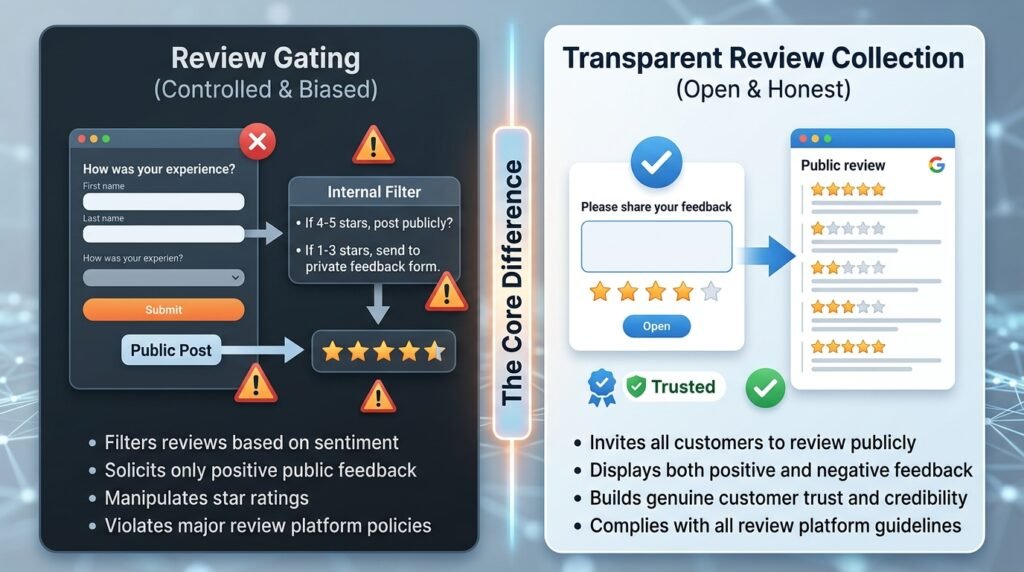
Short-term reputation appearance differs significantly between gated systems and transparent systems. Gated systems create artificially inflated ratings and compressed negative sentiment visibility. Transparent systems generate broader rating variation but improve authenticity signals and trust stability. Search engines increasingly analyse behavioural anomalies such as sudden rating inflation, repetitive sentiment phrasing, and unnatural positivity concentration. These patterns weaken long-term search ranking influence because manipulated reputation signals reduce confidence in entity authenticity.
Transparent review frameworks also improve perception resilience. A balanced review profile containing mixed sentiment appears more credible than uniformly positive feedback clusters. Users evaluating commercial intent queries often compare criticism handling rather than absolute rating scores. Transparent systems therefore strengthen trust formation through visible accountability mechanisms. Review gating, by contrast, creates reputation fragility because suppressed criticism eventually emerges through alternative platforms or branded search content.
Operational scalability also differs between both methods. Gated systems require continuous sentiment filtering workflows and escalation management processes. Transparent systems simplify collection operations by standardising feedback requests across customer interactions. This operational simplicity supports sustainable reputation management without introducing behavioural manipulation risks. Search ecosystems increasingly reward consistency and authenticity over artificially enhanced review presentation.
Why does ignoring negative reviews reduce search trust signals?
Ignoring negative reviews weakens search trust signals because unresolved criticism becomes persistent perception content within branded SERPs. Negative review management is a reactive reputation control strategy that operates by contextualising criticism, clarifying resolution actions, and restoring sentiment balance. Organisations that avoid public responses allow negative sentiment to dominate visible review ecosystems. This creates asymmetric perception exposure where criticism remains unchallenged and unresolved.
Reactive response strategies and proactive issue resolution strategies produce different outcomes in search ecosystems. Reactive-only approaches address visible complaints after publication but fail to reduce future review recurrence. Proactive systems analyse complaint patterns, operational failures, and sentiment trends before additional reviews emerge. Proactive methods improve long-term sentiment distribution because operational improvements reduce complaint frequency at source level. Reactive systems alone maintain recurring reputation instability.
Search engines also interpret review freshness and engagement frequency as behavioural relevance indicators. Dormant profiles containing unresolved criticism display weaker activity signals than actively managed profiles with visible engagement. Public responses demonstrate monitoring behaviour and organisational accountability. This contributes to entity credibility within local ranking systems and customer evaluation journeys. Ignored criticism therefore affects both perception quality and engagement relevance.
The impact on branded search perception extends beyond review platforms. Negative reviews frequently appear within featured snippets, local panels, and indexed third-party content. Unanswered criticism becomes part of the searchable reputation narrative surrounding an entity. Structured response frameworks reduce this effect by introducing contextual balance into publicly indexed sentiment ecosystems. Reputation management therefore requires active criticism engagement rather than passive review observation.
How do fake reviews compare with authentic reputation development strategies?
Fake reviews create artificial reputation inflation, while authentic reputation development strengthens sustainable trust signals. Fake review strategies operate by generating fabricated sentiment intended to influence rating averages and visibility metrics. Authentic reputation development operates through legitimate customer feedback acquisition, operational consistency, and transparent sentiment accumulation. Search engines increasingly distinguish between behavioural authenticity and manipulated engagement activity.
Artificial review generation creates identifiable search ecosystem anomalies. Sudden review velocity spikes, repetitive linguistic structures, and geographically inconsistent reviewer behaviour weaken authenticity evaluation models. Search platforms analyse reviewer account histories, engagement timing, and sentiment repetition patterns to identify manipulation indicators. Once detected, fake review activity damages entity credibility more severely than moderate negative sentiment. The long-term reputational cost exceeds the temporary visibility benefit.
Read More:
Creating a Data-Driven Google Review Growth Strategy for 2026
Google Review Benchmarking: How Top-Rated Businesses Compare
Authentic reputation development produces slower but more stable perception growth. Genuine customer feedback creates natural sentiment diversity, contextual specificity, and behavioural consistency. These signals strengthen trust formation because users interpret nuanced reviews as more credible than uniformly positive language clusters. Authentic reviews also improve search ranking influence through sustained engagement patterns rather than short-term manipulation activity.
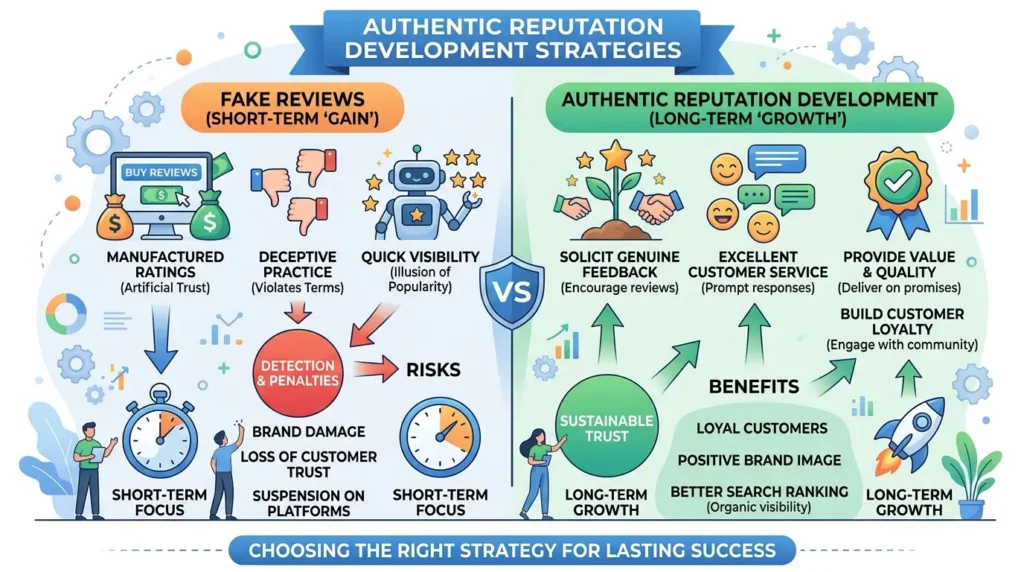
Risk exposure differs substantially between both approaches. Fake review systems create compliance risks, platform penalties, and public trust deterioration. Authentic systems rely on operational quality and transparent review acquisition practices, reducing reputational volatility. Sustainable reputation management therefore prioritises sentiment credibility over artificial rating enhancement. Search ecosystems reward long-term behavioural consistency rather than synthetic perception engineering.
What problems emerge when organisations focus only on star ratings?
Star-rating fixation creates incomplete reputation analysis because sentiment distribution extends beyond numerical scoring. Rating averages operate as simplified trust indicators, but search ecosystems also evaluate textual relevance, review recency, engagement behaviour, and contextual sentiment depth. Organisations focusing exclusively on ratings often neglect narrative perception management. This reduces the strategic value of review ecosystems within broader reputation frameworks.
Quantitative reputation analysis and qualitative sentiment analysis provide different insights. Quantitative analysis measures average ratings, review frequency, and comparative score positioning. Qualitative analysis evaluates complaint themes, recurring praise patterns, operational weaknesses, and customer language structures. Search engines interpret both numerical and textual signals when analysing entity relevance and credibility. Overemphasis on ratings therefore creates incomplete optimisation strategies.
Textual review content strongly influences branded search perception. Specific phrases within reviews often appear in search snippets, local panels, and voice search summaries. Reviews containing operational details, service descriptions, or product references improve semantic relevance for search queries. High ratings without descriptive review content contribute limited contextual value to search visibility systems. Balanced review management therefore requires both numerical performance and semantic richness.
Consumer perception patterns also differ between ratings and review narratives. Users analysing consideration-stage queries frequently compare complaint handling, operational transparency, and issue recurrence rather than relying solely on average scores. Detailed negative reviews with professional responses often strengthen credibility more effectively than perfect ratings without contextual depth. Reputation management systems therefore require multidimensional sentiment analysis rather than score-focused monitoring alone.
How does inconsistent review acquisition affect reputation stability?
Inconsistent review acquisition weakens reputation stability because search ecosystems evaluate temporal review patterns as authenticity indicators. Review acquisition is a reputation development mechanism that operates by generating ongoing customer feedback through structured engagement processes. Irregular acquisition creates review gaps, sudden activity spikes, and unstable sentiment timelines. These inconsistencies reduce behavioural reliability within local search systems.
Continuous acquisition strategies and campaign-based acquisition strategies produce different search outcomes. Continuous systems generate predictable review flow, balanced sentiment accumulation, and stable engagement patterns. Campaign-based systems create temporary visibility surges followed by inactivity periods. Search engines interpret continuous engagement as evidence of operational consistency and active customer interaction. Irregular acquisition therefore reduces long-term trust signal stability.
Review freshness also affects search perception. Recent reviews reinforce operational relevance because they reflect current customer experiences rather than historical sentiment. Profiles dominated by outdated reviews display reduced temporal relevance within commercial investigation searches. Consistent acquisition maintains updated sentiment ecosystems that align with current operational standards. This improves both visibility consistency and perception reliability.
Scalability considerations further distinguish both approaches. Campaign-based systems require repeated activation efforts and short-term engagement incentives. Continuous systems integrate review requests into operational workflows, reducing volatility and administrative complexity. Sustainable reputation management depends on ongoing sentiment generation rather than isolated review accumulation initiatives. Search ecosystems favour behavioural continuity over intermittent visibility spikes.
Why does deleting criticism create greater reputation exposure?
Deleting criticism increases reputation exposure because suppression attempts often amplify perception distrust. Content suppression is a reputation control strategy that operates by removing or concealing negative sentiment from public visibility. Content enhancement strategies operate differently by introducing balanced positive sentiment and contextual clarification into search ecosystems. Search users generally interpret visible moderation patterns as indicators of transparency or manipulation.
Suppression-focused reputation management creates visibility risks across search ecosystems. Removed criticism frequently reappears through screenshots, third-party platforms, or discussion forums. This extends negative perception beyond the original review environment and increases branded search volatility. Search engines also evaluate external discussion consistency when analysing entity credibility. Aggressive deletion behaviour therefore damages trust formation more than moderate visible criticism.
Content enhancement frameworks produce more sustainable outcomes. Positive review acquisition, structured responses, and informational content development dilute negative visibility through broader sentiment distribution. This approach changes SERP composition gradually rather than attempting direct removal. Search ecosystems generally reward content diversity and behavioural transparency over overt suppression activity. Reputation stability therefore improves through balanced signal expansion rather than criticism concealment.
User perception patterns reinforce this distinction. Visible criticism accompanied by professional engagement often strengthens accountability signals. Deleted criticism creates suspicion regarding operational transparency and review authenticity. Reputation management systems focused on enhancement rather than suppression maintain stronger credibility across both search algorithms and user evaluation processes.
How do automated review systems compare with manual reputation monitoring?
Automated review systems improve scalability, while manual monitoring improves contextual interpretation accuracy. Automation operates by collecting reviews, triggering alerts, categorising sentiment, and generating response workflows through software-driven processes. Manual monitoring relies on human evaluation of sentiment nuance, complaint context, and perception implications. Each method influences reputation management efficiency differently.
Automated systems strengthen operational consistency. Sentiment categorisation tools identify recurring complaints, review velocity changes, and rating fluctuations across large-scale review ecosystems. Alert systems reduce response delays and improve engagement frequency. However, automation limitations emerge when contextual interpretation requires linguistic nuance or issue-specific judgement. Generic automation frameworks also risk repetitive responses that weaken authenticity signals.
Manual monitoring improves perception analysis depth. Human reviewers identify sarcasm, emotional escalation, contextual misunderstandings, and operational patterns that automated systems often misclassify. This improves response quality and issue resolution relevance. However, manual systems reduce scalability and increase response inconsistency during high-volume review periods. Reputation management therefore requires balancing efficiency with interpretive accuracy.
Hybrid monitoring frameworks combine automation and human oversight. Automated detection systems identify review trends and prioritise escalation categories, while human moderators manage sensitive or complex interactions. This structure improves scalability without sacrificing contextual precision. Search ecosystems benefit from consistent engagement timing combined with authentic sentiment interpretation. Hybrid systems therefore create stronger long-term reputation stability than purely automated or purely manual frameworks.
What are the long-term limitations of reactive reputation repair strategies?
Reactive reputation repair creates temporary visibility corrections but weak long-term sustainability. Reactive repair is a reputation management method that operates by responding after negative sentiment, criticism, or visibility decline has already emerged. Preventative reputation management operates through continuous sentiment monitoring, operational refinement, and ongoing trust signal development. Search ecosystems evaluate sustained behavioural consistency more favourably than episodic correction activity.
Reactive strategies often prioritise immediate sentiment suppression or short-term review balancing. This approach addresses visible symptoms without correcting operational causes behind recurring criticism. Search engines continue identifying repeated complaint themes, inconsistent review patterns, and perception volatility. Reactive repair therefore produces cyclical reputation instability rather than durable trust reinforcement.
Preventative systems strengthen long-term entity credibility through continuous optimisation. Operational feedback analysis, consistent review acquisition, and structured engagement frameworks create stable sentiment ecosystems over time. Preventative methods also improve search ranking influence because behavioural consistency aligns with authenticity evaluation systems. Reputation management becomes integrated into operational processes rather than isolated crisis responses.
Cost efficiency and scalability also differ between both approaches. Reactive repair requires repeated intervention during visibility decline periods, increasing operational intensity and perception volatility. Preventative systems distribute management effort consistently across customer engagement cycles. This reduces crisis frequency and improves long-term reputation sustainability. Strategic reputation management therefore depends more on continuous trust cultivation than episodic reputation repair activity.
Google review management errors influence entity credibility, search ranking influence, and sentiment distribution across local search ecosystems. Inconsistent responses, review gating, fake reviews, criticism suppression, and reactive-only strategies reduce long-term trust stability because search engines evaluate behavioural authenticity alongside numerical ratings.
Transparent review acquisition, balanced sentiment management, hybrid monitoring systems, and preventative reputation frameworks create more sustainable reputation signals. Content enhancement approaches generally outperform suppression-focused methods because they improve SERP composition through broader trust development rather than visibility concealment. Long-term reputation management effectiveness depends on consistency, operational transparency, and continuous sentiment analysis rather than isolated reputation repair actions commonly associated with outsourced Google Review Management Services frameworks.
What is the most common Google review management mistake businesses make?
One of the most common Google review management errors is ignoring negative reviews or responding too late. Businesses that actively monitor and reply to customer feedback on Google reviews often build stronger trust and improve local SEO visibility.
How do fake Google reviews affect a business?
Fake Google reviews can damage a company’s online reputation, lower customer trust, and impact local search rankings. Proper review management helps businesses identify suspicious reviews and report policy violations through Google’s review system.
Should businesses respond to every Google review?
Yes, responding to both positive and negative Google reviews shows customer engagement and professionalism. Consistent review responses can also improve reputation management efforts and help businesses maintain a trustworthy online presence.
Can deleting negative reviews hurt local SEO?
Attempting to remove legitimate negative reviews instead of addressing customer concerns can reduce credibility. Effective Google review management focuses on resolving issues professionally rather than suppressing authentic feedback.
Why is Google review management important for local businesses?
Google review management helps local businesses improve online reputation, customer trust, and local search performance. Regularly monitoring reviews, responding to feedback, and maintaining accurate business information can strengthen visibility in Google Search and Maps.