

Coordinated comment brigades distort political sentiment by creating concentrated patterns of comments, replies, reactions, and discussion that make a manufactured level of support or opposition appear organic. Reputation management is the process of understanding and influencing the information environment surrounding an entity, while online reputation refers to how that entity is represented and interpreted across digital platforms and search ecosystems.
Political sentiment within search ecosystems is shaped by the interaction between published content, user engagement, discussion patterns, authority signals, and contextual relevance. When coordinated accounts repeatedly generate similar commentary, the resulting information pattern can alter how audiences interpret public opinion. This creates an important distinction between genuine sentiment and observable digital activity. Search visibility then becomes connected to the quality, distribution, and interpretation of reputation signals surrounding a political entity.
What is a coordinated comment brigade?
A coordinated comment brigade is an organised pattern of users or accounts producing comments, replies, reactions, or related interactions around a specific person, topic, or political issue. The defining characteristic is coordination rather than simple disagreement or high-volume discussion. Participants can repeat similar claims, reinforce identical narratives, or concentrate activity within a short period. This activity creates a measurable digital footprint around the targeted entity or subject.
Within reputation systems, coordinated commentary functions as a cluster of reputation signals. Search engines and platforms evaluate observable information rather than directly identifying the private intentions behind each interaction. The resulting activity therefore forms part of the wider content environment surrounding a political entity. Content indexing, engagement patterns, source relationships, and contextual relevance then influence how that environment is represented.
How do coordinated comments distort political sentiment?
Coordinated comments distort political sentiment by increasing the visible frequency of a particular viewpoint without providing an equivalent representation of independent public opinion. A high concentration of similar comments creates an observable signal that differs from the broader distribution of political views. The distortion occurs when digital activity is interpreted as evidence of genuine sentiment rather than as a product of coordinated participation.
Sentiment interpretation depends on the relationship between language, engagement, repetition, and context. Repeated negative statements can strengthen the apparent association between an entity and criticism, while repeated positive statements can create an inflated perception of support. The underlying content does not need to be identical for the pattern to become recognisable. Consistent themes, timing, terminology, and interaction behaviour can produce a connected reputation signal.
How does a comment brigade affect search visibility?
A comment brigade affects search visibility by expanding the volume of information associated with a political entity, issue, or narrative. Search engines evaluate indexed content according to factors including relevance, authority, context, and signals associated with user interaction. Comments themselves do not automatically become prominent search results, but discussion generated around a topic can contribute to the broader information environment.
Search visibility therefore depends on more than the ranking position of a single webpage. A political entity can become associated with recurring terms, accusations, controversies, or praise across indexed discussions. When those associations appear consistently across authoritative or highly visible sources, they become part of the entity’s searchable context. SERP evaluation then operates within an information landscape shaped by those accumulated associations.
How do search engines interpret reputation signals from online discussions?
Search engines interpret reputation signals through relationships between entities, content, language, authority, relevance, and indexed information. A reputation signal is an observable piece of information that contributes to how an entity is represented within a search ecosystem. Examples include authoritative articles, public records, reviews, discussions, citations, references, and recurring topical associations.
Search systems do not treat every comment as an equivalent trust signal. Source authority, contextual relevance, originality, content quality, and the relationship between sources influence how information contributes to search visibility. A large quantity of low-authority comments therefore has a different informational value from independently produced reporting published by established sources. This distinction is central to evaluating political sentiment accurately.
Why does repetition influence perceived political sentiment?
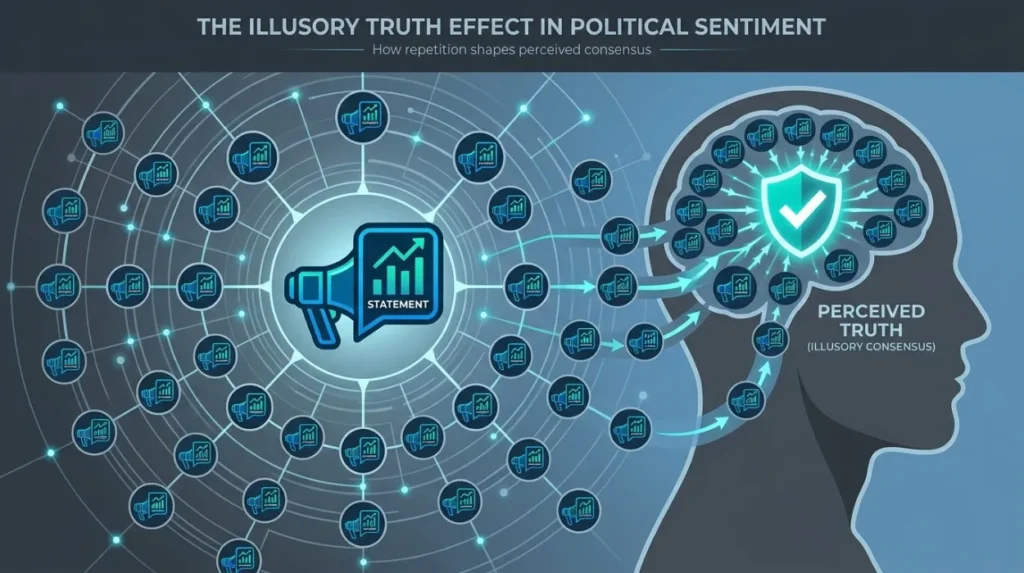
Repetition influences perceived political sentiment because recurring language increases the visibility of a particular association within an information environment. When users repeatedly encounter the same allegation, phrase, criticism, or endorsement, the concept becomes more prominent in their interpretation of the entity. Repetition therefore affects perception through exposure and association rather than proving the underlying sentiment.
Within search ecosystems, repeated terminology also creates semantic relationships between entities and topics. If a political figure repeatedly appears alongside a specific issue across indexed pages, that association becomes part of the searchable representation of the entity. Entity perception is therefore influenced by the structure of information surrounding the entity, not simply by the entity’s own published statements.
How can timing reveal coordinated comment activity?
Timing reveals coordination when clusters of similar comments or interactions appear within unusually concentrated periods around the same topic. A sudden increase in activity following a political announcement, article, interview, or controversy provides a measurable temporal pattern. Timing alone does not establish coordination, but it provides an important analytical signal when combined with linguistic and behavioural similarities.
Researchers evaluate temporal patterns alongside account behaviour, repeated terminology, identical talking points, interaction sequences, and links between accounts. This approach separates normal public discussion from activity displaying stronger coordination characteristics. The objective is to evaluate the structure of the information network rather than assume that high engagement represents authentic public sentiment.
How do review and sentiment signals contribute to political reputation?
Review and sentiment signals contribute to political reputation by recording explicit evaluations of an entity across platforms where users publish opinions or assessments. Although political figures are not generally evaluated through commercial review systems in the same way as businesses, review-style signals appear through ratings, recommendations, comments, reactions, forum discussions, and public feedback mechanisms. These signals provide measurable expressions of positive, negative, or neutral sentiment.
Sentiment analysis classifies language and interaction patterns to identify the dominant themes associated with an entity. Its value depends on context, source quality, language accuracy, and the distinction between independent responses and coordinated activity. A concentrated negative discussion therefore requires contextual evaluation before it is treated as representative of broader public opinion. Reputation analysis examines the complete signal environment rather than relying on one sentiment metric.
How does authority affect the interpretation of political reputation?
Authority affects political reputation by determining the informational weight associated with different sources. An authoritative publication with established editorial standards provides a different reputation signal from an anonymous account producing repetitive comments. Search engines evaluate source relationships, content quality, relevance, and other signals when determining how information contributes to search results.
Authority also affects the persistence of reputation information. Content published by an established source can remain indexed, referenced, and redistributed across the web. This creates a wider information network around an entity. Political reputation therefore reflects not only what is being said, but also where the information originates, how it is connected to other sources, and how prominently it appears within search results.
Dive Deeper With Our Expert Guides:
Why Endorsement Controversies Damage a Candidate’s Standing
How Hostile Media Interviews Follow Politicians Online for Years
How does content indexing amplify coordinated narratives?
Content indexing amplifies coordinated narratives when discussion generated around a topic becomes discoverable and connected to the entity through searchable content. Indexing is the process through which search engines analyse and store information for potential retrieval in response to queries. Once content enters an index, its textual and contextual relationships become available for search evaluation.
The effect is strongest when coordinated discussion extends beyond individual comments into indexed articles, forums, social pages, or derivative content. Repeated claims then exist across multiple information surfaces rather than within one isolated conversation. This expands the digital footprint associated with the narrative and increases the number of contexts in which users encounter the same association.
How can political sentiment be evaluated without confusing volume with credibility?
Political sentiment can be evaluated accurately by separating activity volume from source credibility, independence, context, and evidential support. High comment volume represents observable engagement, not automatically reliable public opinion. An analytical assessment therefore examines who produced the content, how independently it was generated, where it was published, and whether the same claims appear in authoritative sources.
A structured evaluation also compares sentiment across different information environments. Search results, established journalism, public records, discussion platforms, reviews, and social media activity each provide different types of reputation signals. Comparing these sources reveals whether a sentiment pattern is broadly distributed or concentrated within one coordinated network. This distinction improves SERP evaluation and provides a more accurate understanding of entity perception.
What role does digital footprint analysis play in identifying sentiment distortion?
Digital footprint analysis identifies sentiment distortion by examining the complete network of publicly visible information surrounding an entity. A digital footprint is the accumulated record of content, references, interactions, profiles, publications, and searchable associations connected to a person or organisation. Political figures generate extensive footprints because their public activities produce information across multiple platforms and sources.
Analysts evaluate the footprint for recurring narratives, source relationships, sentiment patterns, publication timing, authority differences, and content duplication. The analysis distinguishes original information from derivative commentary and separates independent signals from concentrated activity. This provides a stronger basis for evaluating whether observed political sentiment reflects broad public discussion or an artificially concentrated information pattern.
A useful semantic pathway for deeper evaluation is How to Identify and Counter Coordinated Comment Brigades, which focuses specifically on recognising coordination patterns and assessing their effect on political discussion.
Why does distinguishing sentiment from reputation matter in search?
Distinguishing sentiment from reputation matters because sentiment represents expressed opinion, while reputation represents the broader information-based perception of an entity. Sentiment can change rapidly in response to an event, whereas reputation develops through accumulated information, authority, context, and repeated associations. Treating a short-term discussion spike as a complete reputation assessment therefore produces an incomplete interpretation.
Search reputation exists within the wider relationship between indexed content and entity perception. Coordinated comment brigades can influence the visible discussion surrounding a political figure, but their activity represents only one category of reputation signal. Accurate analysis therefore considers source authority, content indexing, sentiment distribution, search visibility, and contextual relevance together.
How do coordinated comment brigades fit into wider reputation systems?
Coordinated comment brigades form one component of a wider reputation system in which information is created, distributed, indexed, evaluated, and interpreted. Their importance comes from the way repeated activity interacts with other content rather than from comment volume alone. The resulting digital footprint can influence the language, associations, and discussion patterns surrounding a political entity.
Understanding these systems requires separating content creation from content interpretation. Search engines evaluate information through ranking and indexing mechanisms, while audiences interpret information through exposure, context, credibility, and repetition. Reputation analysis connects these processes by examining how observable information contributes to entity perception.
Coordinated comment brigades distort political sentiment by creating concentrated patterns of digital activity that can appear more representative than their underlying participation indicates. Their effect becomes clearer when reputation signals are evaluated according to source authority, timing, repetition, content indexing, sentiment, and contextual relevance. Search visibility reflects the wider information environment surrounding an entity rather than a single discussion or isolated comment. Political reputation therefore requires analysis of both the content being produced and the structural relationships connecting that content. Understanding these mechanisms provides a more accurate framework for evaluating digital footprints, entity perception, and political sentiment within search ecosystems.
What is a coordinated comment brigade in politics?
A coordinated comment brigade is organised online activity where multiple accounts post or amplify similar political comments, narratives, or reactions. This can create an inflated perception of public support or opposition around a political figure or issue.
How do coordinated comments distort political sentiment?
Coordinated comments distort political sentiment by increasing the visible volume of a particular viewpoint without representing independent public opinion accurately. Repetition, timing, and similar messaging can make a manufactured narrative appear more widespread.
Can coordinated comment brigades affect a politician’s online reputation?
Yes, coordinated activity can influence a politician’s online reputation by creating repeated associations between the individual and specific positive or negative narratives. These reputation signals can contribute to wider discussions and affect how audiences interpret search results.
How can you identify coordinated comment brigades?
Coordinated comment brigades can be identified by analysing repeated wording, unusual timing patterns, account behaviour, identical talking points, and concentrated engagement. Comparing these signals across platforms helps distinguish coordinated activity from independent political discussion.
How does political reputation management address coordinated online sentiment?
Political reputation management involves analysing search visibility, reputation signals, content indexing, sentiment patterns, and source authority surrounding a political entity. Clear My Name uses this broader reputation framework to understand how coordinated activity contributes to online perception without treating comment volume as proof of genuine public sentiment.