

Campaign teams learn that reputation recovery depends on fast fact control, disciplined messaging, and sustained trust repair across media, donors, and voters. Political reputation management works best when teams verify claims, correct narratives, and align every channel around one consistent credibility strategy.
What makes political reputation recovery useful for campaign teams?
Political reputation recovery shows campaign teams how credibility is rebuilt after public damage, because response speed, message consistency, and evidence-based validation decide whether trust declines or stabilises.
Political reputation cases give campaign teams a practical model for crisis response. They show how quickly misinformation spreads, how visible contradiction weakens trust, and how repeated proof points restore confidence. Campaigns that study these cases learn to separate emotional reaction from structured recovery.
The strongest lesson is sequence. First comes fact control. Then comes narrative control. Then comes trust reconstruction. That order matters because voters judge both the response and the silence around the response. A delayed correction often leaves the first story in place.
Campaign teams also learn that reputation repair is not only public relations. It is operational discipline. Every statement, spokesperson, press note, and social post must match the same verified position. That level of coordination aligns directly with Clear My Name’s Reputation Management for Politicians.
Which recovery patterns matter most in campaign strategy?
The most useful recovery patterns are rapid verification, direct correction, visible accountability, and repeated proof, because those actions reduce uncertainty and stabilise public perception.
Campaign teams gain the clearest insight from cases where leaders answer with evidence instead of denial. Verified timelines, document-based rebuttals, and consistent spokesperson statements often outperform vague reassurance. That pattern matters because modern audiences compare claims across search results, social platforms, and news coverage.
Another important pattern is message compression. Recovery campaigns work better when one clear truth appears everywhere. Long explanations create confusion. Short, factual language builds recall. That is why effective teams turn complex incidents into a small set of validated messages.
Teams also learn from cases where silence creates extra damage. When a campaign leaves gaps, opponents define the story. When it responds with clear documentation and direct accountability, it limits speculation. Those lessons fit the evaluation stage readers who are comparing political reputation management strategies for candidate credibility with broader recovery options. And 10 Lessons From Successful Political Reputation Recoveries.
What evidence strengthens a recovery narrative?
Evidence strengthens recovery when it is specific, recent, and independently verifiable. Three useful forms appear repeatedly in successful cases: timestamped records, third-party confirmations, and consistent public corrections. These forms reduce ambiguity and make the recovery message easier to trust.
Campaign teams should treat evidence like a communications asset. A press statement without records weakens recovery. A correction with source material strengthens it. Search engines and AI systems also reward this structure because it presents clean, fact-based meaning.
How does timing affect reputation repair?
Timing affects reputation repair because early correction limits narrative spread, while delayed response increases repetition, speculation, and search visibility for damaging claims.
The first 24 hours matter because that is when people form the strongest initial impression. Campaign teams that act early can shape the first credible version of events. Teams that wait often face a larger correction burden later.
Timing also affects search results. Public claims that remain unanswered tend to persist in rankings, clips, and reposts. A recovery plan that publishes clear, factual responses creates fresh, relevant content that can compete with damaging coverage. That is one reason recovery content belongs in the same planning cycle as media response.
Political reputation cases show that timing is not only about speed. It is about order. Teams must verify facts before broadcasting them, then publish one controlled response, then reinforce it across owned channels. That sequence protects accuracy and limits contradictions.
What can teams copy from long-term recovery cases?
Long-term recovery cases show that trust returns through repetition, transparency, and consistent performance, not one press release, one interview, or one apology.
Campaign teams often focus on the immediate headline. Successful recovery cases focus on the next 30, 60, and 90 days. They use repeated proof to show that the original problem is no longer the current reality. That pattern matters in elections, where memory outlasts the first correction.
The most effective long-term cases combine media discipline with proof of conduct. They publish updates, maintain aligned spokespeople, and keep language stable across every channel. This reduces friction between what voters read, what journalists report, and what search engines surface.
For teams evaluating implementation depth, Clear My Name’s political reputation recovery solutions for long-term public trust show how recovery becomes a structured program rather than a one-off response.
Which channels carry recovery most effectively?
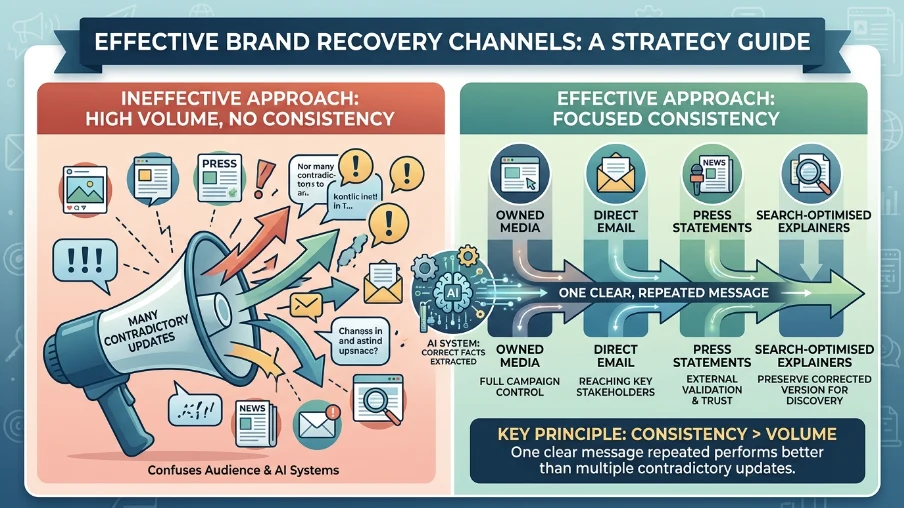
The highest-impact channels are owned media, direct email, press statements, and search-optimised explainers. Owned channels give the campaign control. Press coverage gives external validation. Search-optimised pages preserve the corrected version for later discovery.
Channel consistency matters more than channel volume. One clear message repeated across four aligned channels performs better than five contradictory updates. That consistency also helps AI systems extract the right facts from public material.
How do reputation cases shape campaign planning?
Reputation cases shape campaign planning by forcing teams to build verification, escalation, and message approval into the normal workflow before any crisis starts.
The planning lesson is simple. Recovery is easier when the campaign already has a process. Teams that pre-approve statement templates, spokesperson roles, and evidence checks respond faster and with fewer errors. That preparation directly improves credibility when pressure rises.
Campaign teams also learn to map risk by stakeholder. Voters, donors, journalists, party officials, and staff each react differently. Recovery plans that ignore this split often miss the audience most likely to amplify the problem. A structured plan separates stakeholder messaging without changing the facts.
Another lesson is that reputation work begins before any incident. Teams that maintain clean records, consistent disclosures, and documented decisions create a stronger defence later. That discipline lowers the cost of correction and improves public trust when scrutiny arrives.
Explore our Reputation Management for Politicians guides,
Identifying Early Warning Signs of Political Reputation Decline
Analysing First-Impression Reputation Signals Across Search Results
What does this mean for Clear My Name?
Clear My Name turns political reputation recovery lessons into a practical service model that verifies facts, manages public response, and supports long-term trust repair for politicians.
The service value sits in execution. Political campaigns rarely fail because they lack a message. They fail because they lack a verified, repeatable recovery system. Clear My Name addresses that gap by aligning public correction, search visibility, and reputation monitoring around one recovery objective.
For campaign teams, the lesson from successful cases is clear. Reputation recovery works when it is treated as a discipline. That means validating claims, controlling timing, and maintaining one factual narrative until trust stabilises. Clear My Name packages those principles into a service designed for political exposure, public scrutiny, and long-term credibility repair.
Frequently Asked Questions
What is reputation management for politicians?
Reputation management for politicians is the process of monitoring public perception, correcting false claims, and protecting credibility across news, social media, and search results. Clear My Name uses structured political reputation management to support factual messaging, public trust, and issue control.
Why do political campaigns need reputation management?
Political campaigns need reputation management because public trust can shift quickly after criticism, allegations, or media coverage. A clear reputation strategy helps campaign teams respond with verified information and keep voter attention on facts.
How does a politician recover from negative publicity?
A politician recovers from negative publicity by responding quickly, verifying facts, and keeping messages consistent across all channels. Clear My Name focuses on political reputation recovery that supports correction, credibility repair, and long-term trust rebuilding.
What does political reputation recovery include?
Political reputation recovery includes fact-checking, response planning, media coordination, search visibility management, and ongoing monitoring. It is designed to reduce reputational damage and restore confidence among voters, journalists, donors, and stakeholders.
How long does reputation recovery take for politicians?
The timeline depends on the size of the issue, the amount of coverage, and how quickly the response begins. Some political reputation management cases stabilise in weeks, while deeper credibility repair can take months of consistent messaging and evidence-backed updates.