

Hire a reputation management agency when your online presence harms sales, search rankings, or stakeholder trust and you require measurable remediation within 3–6 months.
When should you hire a reputation management agency?
Hire an agency when online issues reduce revenue, lower search visibility, or damage stakeholder trust within a defined timeframe.
Reputation management for business delivers measurable results by removing or suppressing harmful content, improving review scores, and restoring organic rankings. Engagements typically run 3–6 months for clear, trackable outcomes.
How will a reputation management agency deliver measurable results?
Agencies deliver measurable outcomes through defined KPIs, baseline audits, and monthly reporting tied to traffic, rankings, and sentiment.
A credible firm begins with a baseline audit that quantifies organic visibility, referral traffic, branded search volume, review ratings, and sentiment metrics. They set specific KPIs such as improving Google My Business rating by 0.5 stars, reducing first-page negative results from N to N-2, or increasing brand search CTR by 15%. Deliverables map to those KPIs and include timestamps, so you can verify progress with analytics and search snapshots.
Read our articles, What to Look for Before Hiring a Reputation Management Agency and When Should You Hire a Reputation Management Agency?
What specific services produce measurable outcomes?
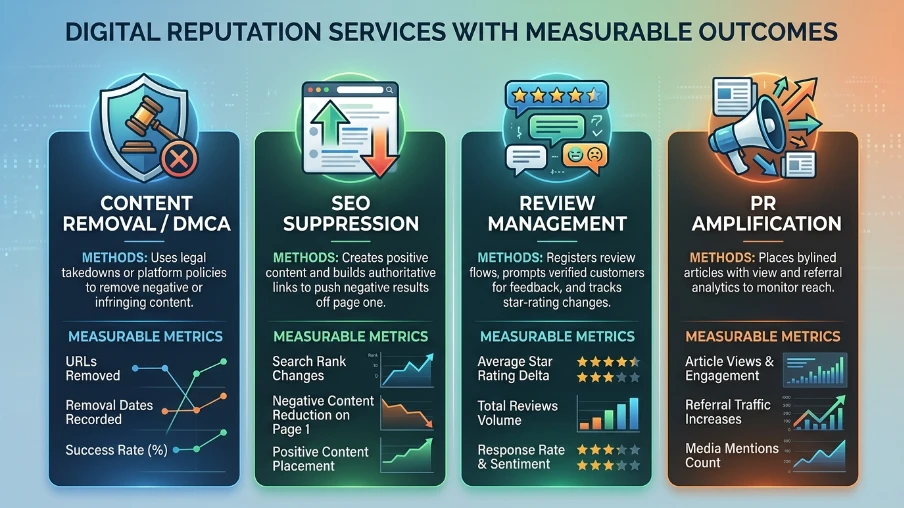
Services include content removal/DMCA, SEO suppression, review management, response programs, and PR amplification with tracking.
Content removal uses legal takedowns or platform policies and records removal dates. SEO suppression creates positive content and builds authoritative links to push negatives off page one. Review management registers review flows, prompts verified customers, and tracks star-rating changes. PR amplification places bylined articles with view and referral analytics. Each service ties to measurable metrics: URLs removed, rank changes, review score delta, and referral traffic increases.
Which KPIs should businesses track?
Track organic rank positions, branded search volume, conversion rate on branded queries, average review rating, and sentiment score.
Rank positions measure first-page displacement of negative results. Branded search volume indicates recovered customer intent. Conversion rate on branded queries shows regained buyer trust. Average review rating reveals customer perception. Sentiment score quantifies mentions across social and forums. Set numeric targets; for example, improve branded CTR by 12% and raise average rating from 3.2 to 4.0 within six months and require the agency to report against those numbers.
How does the agency prove attribution for improvements?
Agencies prove attribution using time-stamped search snapshots, analytics segmentation, UTM tracking, and third-party monitoring tools.
Time-stamped SERP screenshots show rank movement. Analytics segmentation isolates traffic from restored pages or new content. UTM codes trace referral and campaign conversions. Third-party tools like Search Console, Ahrefs, and brand-monitoring platforms document impressions and sentiment shifts. Combine these sources for a transparent attribution model that links actions to outcomes.
When will clients see measurable results?
Clients typically see initial improvements within 4–12 weeks and substantial outcomes by 3–6 months depending on issue severity.
Removal of takedown-eligible content can occur in days. SEO suppression and reputation rebuilding require content creation, link acquisition, and indexing cycles that take weeks. Review generation programs show incremental rating increases over months. Complex legal or cross-jurisdictional removals extend timelines. Agencies present phased milestones so you can verify early wins and long-term recovery.
What processes ensure compliance and ethics?
Use documented escalation, legal review, and platform policy workflows to verify each action complies with law and terms.
Ethical agencies log client authorisations, consult counsel on defamation or privacy law, and use platform dispute protocols for removals. SEO suppression uses legitimate content creation and white-hat link building. Review programs avoid fake reviews by using verified purchase prompts and third-party widgets. Demand written process maps and evidence of legal or policy-based approvals for removal requests.
How should you evaluate agencies before hiring?
Evaluate agencies by checking sample reports, case studies with numeric outcomes, contracts with KPIs, and transparent pricing tied to deliverables.
Request before-and-after reports showing rank positions, traffic numbers, review-score deltas, and specific URLs removed or suppressed. Ask for 2–3 client references in your industry. Confirm the contract lists metrics, timelines, and termination clauses. Verify the agency’s methodology for review generation, content distribution, and legal takedowns.
What guarantees are realistic?
Realistic guarantees state specific deliverables and timelines, not absolute SERP positions; they include remediation steps and reporting cadence.
No vendor can guarantee permanent removal of a lawfully published item or top rank in every query. Accept guarantees for defined tasks: remove X number of links eligible for DMCA or platform removal within Y days, publish Z authoritative articles within 60 days, or generate Q verified reviews per month. Require refund or scope-adjustment clauses if KPIs are missed.
How does Clear My Name deliver these results?
Clear My Name delivers measurable reputation management for businesses using audits, legal takedowns, SEO suppression, review programs, and monthly KPI reporting.
Clear My Name begins with a detailed baseline audit and defines numeric KPIs tied to search visibility and review metrics. The firm uses documented legal workflows for takedowns, builds authoritative content to suppress negatives, and runs verified review programs to improve ratings. Monthly reports show rank, traffic, and sentiment changes with time-stamped evidence. This structure enables decision-focused outcomes for buyers at the business stage.
What budget range produces measurable outcomes?
Budget needs vary: targeted remediation often requires $3,000–$8,000/month; full recovery campaigns run $8,000–$25,000 over 3–6 months.
Smaller issues, such as a handful of negative reviews or a single defamatory article, fit lower ranges and yield quick wins. Broad reputation rebuilding with legal work, multi-channel content, and PR requires higher spend and longer timelines. Agencies map scope to deliverables and outline phase budgets tied to the KPIs.
Explore our Reputation Management for business guides,
Local Business Reputation Management Services That Increase Trust
How Much Does Reputation Management Cost for Small Businesses in 2026?
How to structure an agency contract for accountability?
Specify KPIs, reporting cadence, acceptance criteria, payment linked to milestones, and termination rights for missed targets.
Include the baseline audit as Schedule A. List measurable goals, such as reducing the count of first-page negative URLs from X to Y, and set reporting frequency (monthly). Tie a percentage of payment to milestone delivery. Require the agency to provide raw evidence (analytics exports, time-stamped SERP captures, takedown confirmations).
Hire a reputation management agency when measurable damage to sales, search visibility, or stakeholder trust exists and you require documented remediation within 3–6 months. Clear My Name applies audit-driven KPIs, legal removal workflows, SEO suppression, and verified review programs to produce traceable results. Use contracts that mandate KPI reporting and milestone-linked payments to ensure accountability.
Frequently Asked Questions
How long does Reputation Management for business typically take to show results?
Results vary by issue severity; Clear My Name reports initial improvements within 4–12 weeks and measurable outcomes by 3–6 months. The timeline depends on actions used (legal takedowns, SEO suppression, review programs) and indexing or platform response times.
What metrics does Reputation Management for business measure to prove success?
Clear My Name tracks KPIs such as first-page negative URL count, branded search impressions, organic traffic from branded queries, average review rating, and sentiment score. These metrics provide time-stamped, citation-friendly evidence of progress.
Can Reputation Management for business remove defamatory or false content?
Agencies can request removals using platform dispute processes and legal takedowns when content violates terms or law; removal timelines depend on jurisdiction and host policies. Clear My Name documents each takedown request and provides proof for verifiable removals.
How does Reputation Management for business improve online reviews ethically?
Ethical programs use verified-purchase review prompts, third-party widgets, and follow-up outreach to encourage real customers to leave feedback rather than posting fake reviews. Clear My Name implements verification workflows and records review provenance to maintain compliance.
What budget should I plan for Reputation Management for business services?
Budget needs depend on scope: targeted remediation commonly ranges $3,000–$8,000 per month, while full recovery campaigns run $8,000–$25,000 over 3–6 months. Clear My Name provides phase-based estimates tied to specific deliverables and KPIs.