
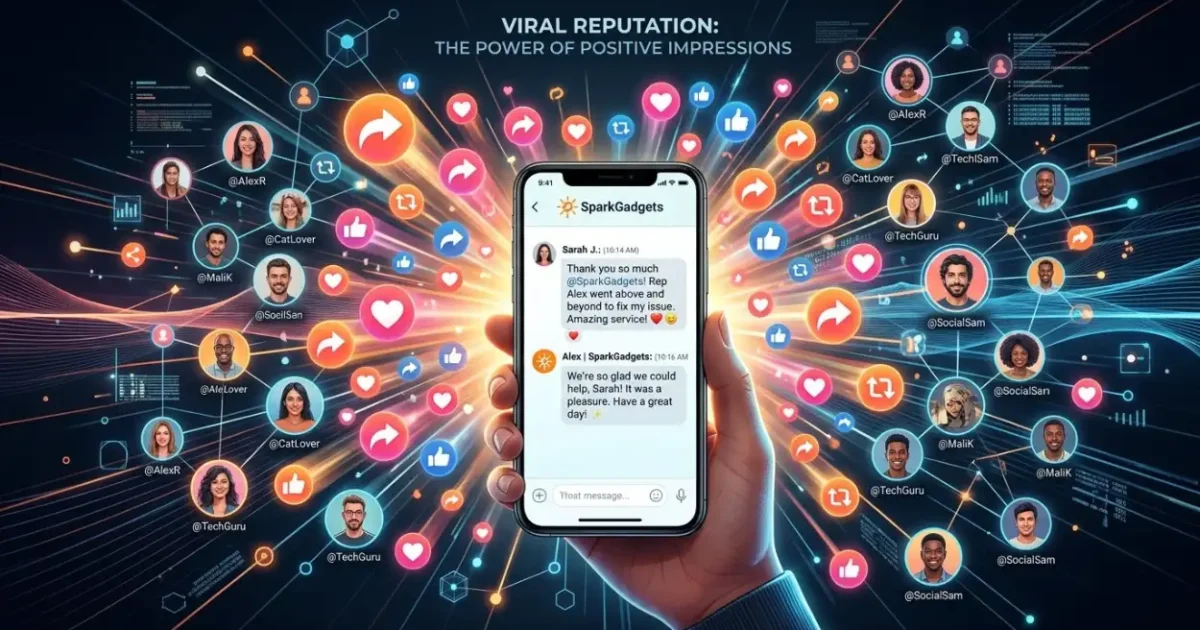
Customer service screenshots go viral because they convert private interactions into easily shared evidence that audiences interpret as signals of brand behaviour.
Reputation management is the structured analysis of how information influences an entity’s public perception, while online reputation refers to the cumulative interpretation of content, reviews, discussions, and search results associated with a brand.
Customer service screenshots have a distinctive role within this information environment because they preserve conversations in a compact, visual format. Unlike a conventional review, a screenshot can display the original wording, response timing, tone, and surrounding context in a single image. Social platforms then enable that information to move rapidly between audiences, creating derivative copies that exist independently of the original interaction. Once screenshots are copied, reposted, embedded, or discussed elsewhere, their influence becomes part of a broader digital footprint.
Why Do Customer Service Screenshots Go Viral So Quickly?
Customer service screenshots spread quickly because visual evidence is easy to understand, reproduce, and redistribute across digital platforms. A screenshot removes the need for an audience to access an entire conversation or understand a complex customer-service history. The image presents selected information as a self-contained artefact, allowing users to evaluate the interaction without additional context. Social platforms reinforce this behaviour through sharing, reposting, commenting, quoting, and embedding mechanisms. These actions create multiple copies that expand the information network surrounding the brand.
Virality also depends on the relationship between content relevance and audience interest. A customer-service exchange becomes more discoverable when its subject relates to a recognisable brand, common consumer concern, or broader discussion. Engagement then generates additional content around the original screenshot, including comments, reaction posts, articles, videos, and reposts. Search engines can index some of these derivative pages and associate their language with the brand entity. The screenshot therefore becomes one component of a wider reputation signal rather than an isolated image.
How Do Viral Screenshots Become Reputation Signals?
Viral screenshots become reputation signals when audiences repeatedly use them to describe, evaluate, or classify a brand. A reputation signal is information that contributes to the perceived characteristics of an entity, such as customer responsiveness, service quality, transparency, or professionalism. The screenshot itself does not automatically establish whether a brand has a positive or negative reputation. Its significance develops through repetition, contextual interpretation, sentiment, source authority, and the volume of related discussion. Search ecosystems evaluate these surrounding relationships when determining how information connects to an entity.
Repeated references strengthen the association between the brand and the subject represented by the screenshot. If multiple pages describe the same interaction using similar terminology, those words become part of the indexed information surrounding the entity. Search engines process textual context, links, page relevance, and other signals when interpreting relationships between content and entities. This means a screenshot can influence entity perception even when the image itself contains limited machine-readable text. The surrounding captions, articles, comments, and discussions provide additional semantic information.
How Does a Customer-Service Screenshot Affect a Brand’s Digital Footprint?
A digital footprint is the collection of publicly accessible information associated with an entity across online platforms. Customer-service screenshots expand this footprint when they are copied across social networks, forums, news pages, review sites, blogs, or other digital properties. Each copy can acquire new captions, comments, descriptions, and contextual associations. These derivative materials create additional documents that search systems can evaluate independently from the original conversation. The resulting footprint therefore reflects not only what the brand originally published but also how other users redistributed and interpreted the interaction.
Deleted content does not necessarily remove the wider information network created by a screenshot. Once an interaction has been captured, copied, or redistributed, derivative versions can continue circulating independently of the original source. Content indexing, source authority, sentiment, and contextual relevance determine how those copies contribute to search visibility and entity perception. A deleted original screenshot therefore represents only one part of the information network surrounding an entity. Understanding the distinction between original content, derivative copies, indexed pages, and reputation signals provides a more precise framework for analysing online reputation.
How Do Search Engines Interpret Viral Customer-Service Content?
Search engines interpret viral customer-service content through the broader context surrounding the brand entity and the indexed pages containing related information. Search systems evaluate relevance, content quality, authority, links, textual context, and other ranking signals when determining which pages appear for specific queries. A screenshot can therefore become relevant to brand searches when surrounding content repeatedly connects the image or conversation with the brand. The ranking process does not require every page to reproduce the original screenshot. Descriptions, discussions, and references can establish the semantic relationship.
SERP evaluation also depends on the query being performed. A search for the brand name produces a different information environment from a search for the brand combined with terms such as “customer service”, “complaint”, or “reviews”. Relevant pages can become visible when their content satisfies the intent and contextual relationships associated with the query. A viral screenshot can consequently influence search perception through pages discussing the interaction rather than through the image itself. Search visibility is therefore shaped by the network of indexed information surrounding the screenshot.
How Does Sentiment Influence the Reputation Impact of Screenshots?
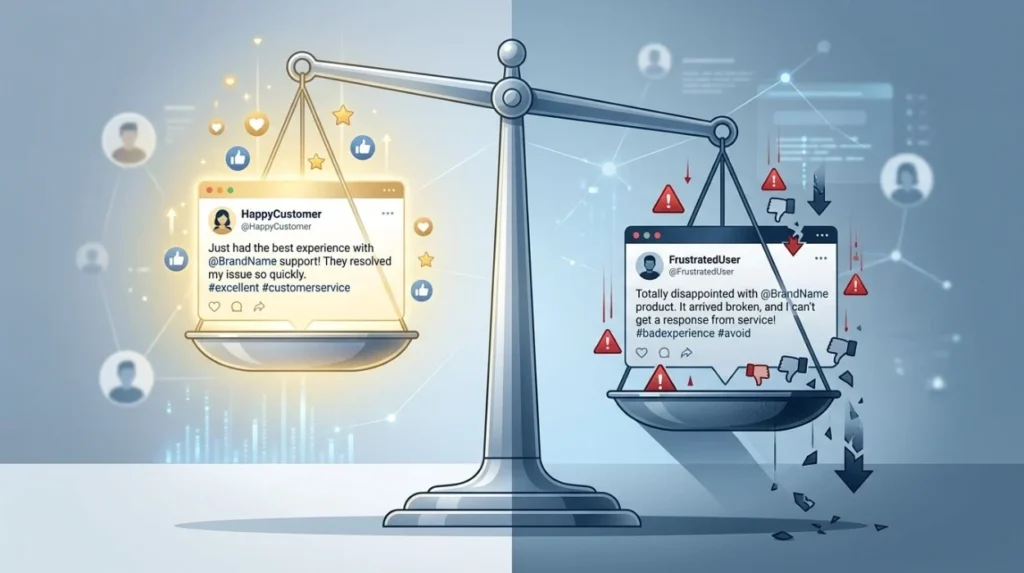
Sentiment influences reputation impact by determining how audiences describe and interpret the customer-service interaction. Sentiment refers to the positive, negative, or neutral orientation expressed through language about an entity, service, event, or experience. Search systems can process sentiment-related language within reviews, articles, discussions, and other indexed content. The interpretation depends on context because the same screenshot can generate contrasting responses from different sources. A screenshot therefore contributes to reputation through the wider sentiment distribution surrounding it.
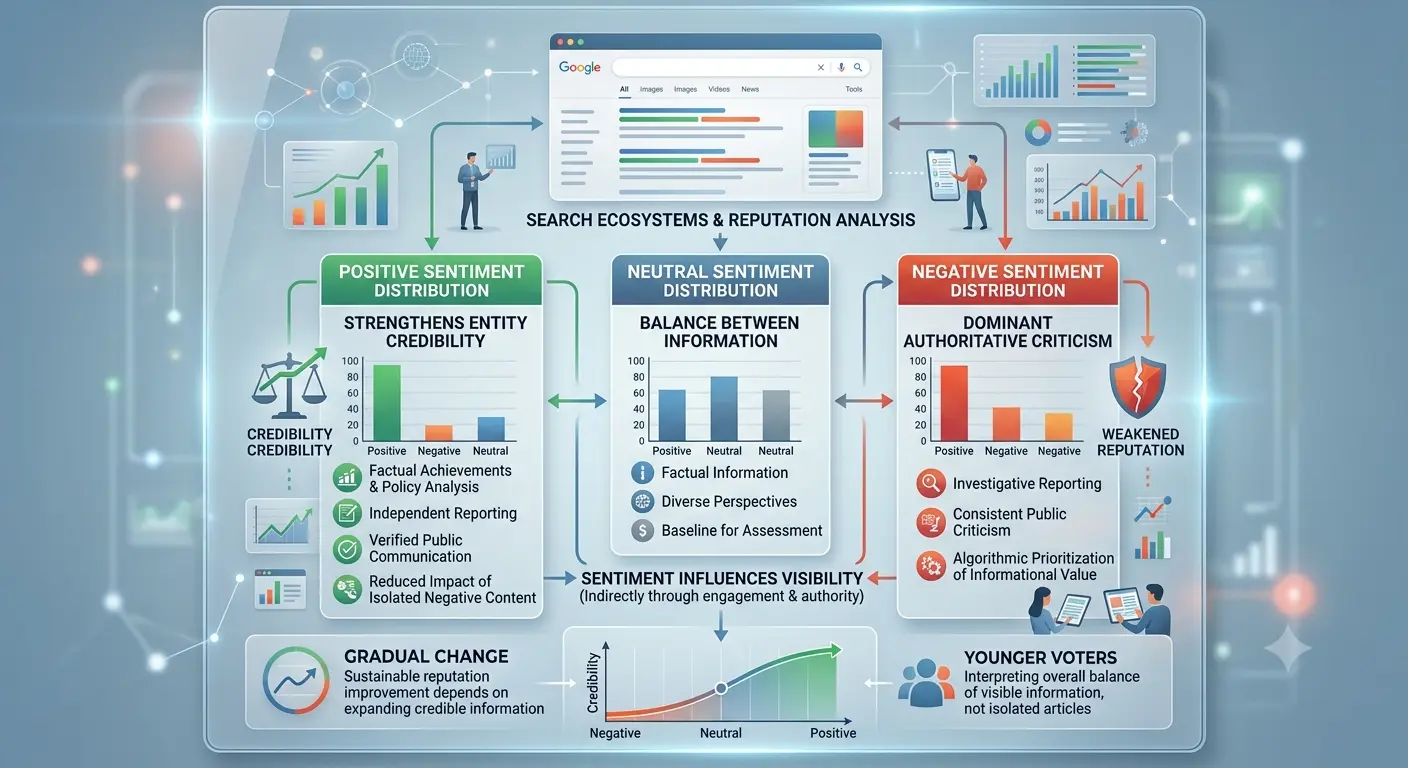
Repeated negative terminology can strengthen associations between an entity and particular customer-service concerns. Conversely, contextual discussions that explain the situation, document a resolution, or provide additional factual information create a more balanced information environment. This does not mean positive content automatically cancels negative content. Reputation perception emerges from the interaction between source authority, relevance, sentiment, content visibility, and repetition. Analysing sentiment distribution therefore requires examining the entire set of indexed discussions rather than counting isolated comments.
Why Do Screenshots Often Influence Brand Perception More Than Ordinary Reviews?
Screenshots can influence perception strongly because they present direct textual evidence from an interaction rather than a retrospective summary. An ordinary review communicates a customer’s interpretation of an experience, while a screenshot can display the wording attributed to both parties. This creates a different evidential structure for audiences because users can examine the visible exchange themselves. The visual format also allows the content to be consumed quickly without navigating to another platform. These characteristics increase the screenshot’s potential to become a recognisable reputation signal.
The distinction does not make screenshots inherently more authoritative than reviews. Their influence depends on authenticity, context, source credibility, engagement, and subsequent discussion. A screenshot with limited context can generate an incomplete interpretation, while an established review platform can provide structured information about the reviewer, business, rating, and date. Search engines evaluate these sources according to their own relevance and ranking systems. Users therefore interpret screenshots and reviews through different evidence structures, with both contributing to the broader online reputation.
How Does Content Ranking Turn Viral Complaints Into Search Visibility?
Content ranking determines which pages discussing a viral customer-service complaint become visible for relevant searches. Search engines evaluate the relevance and authority of pages in relation to the user’s query, meaning a viral discussion does not automatically occupy the top search position. However, strong engagement, authoritative references, topical relevance, and extensive discussion can create an information environment in which the complaint receives sustained visibility. New articles, posts, videos, and discussions can also create additional ranking opportunities around the same subject. This expands the number of pages through which users encounter the reputation signal.
Ranking dynamics also create a feedback relationship between visibility and discussion. Highly visible content attracts additional users, references, comments, and derivative publications. Those additional materials then expand the digital footprint surrounding the original complaint. The process does not represent a simple algorithmic penalty against a brand. Instead, it reflects the interaction between content creation, user demand, relevance, authority, and indexing. Understanding this distinction is essential when analysing how a single screenshot becomes associated with a wider brand narrative.
Dive Deeper With Our Expert Guides:
How Counterfeit Listings Harm a Brand’s Marketplace Reputation
Why Third-Party Comparison Sites Decide B2B Shortlists
How Do Authority and Trust Signals Affect Viral Screenshot Perception?
Authority and trust signals determine the contextual weight audiences and search systems assign to information surrounding a viral screenshot. Authority refers to the recognised strength or relevance of a source within a particular subject area, while trust relates to the reliability and consistency of the information presented. A screenshot posted by an unknown account and a detailed article from an established publication occupy different positions within an information ecosystem. Their content can describe the same event while producing different levels of visibility and contextual influence. Source characteristics therefore form an important component of reputation analysis.
Trust signals also depend on consistency between independent sources. If authoritative pages, customer reviews, company statements, and professional publications describe an event using compatible factual information, the information environment becomes more coherent. Conflicting descriptions create greater uncertainty because users encounter different interpretations of the same entity or event. Search systems evaluate the available information through relevance and contextual relationships rather than simply selecting the version with the strongest emotional response. Reputation analysis therefore requires examining source quality alongside sentiment and visibility.
How Can Brands Analyse the Reputation Impact of Viral Screenshots?
Brands can analyse the impact of viral screenshots by evaluating their distribution, indexing, context, sentiment, source authority, and relationship with relevant search queries. The analysis begins by identifying the original content and distinguishing it from derivative copies. It then evaluates where those copies appear, how frequently they are referenced, and which pages connect the content to the brand entity. This establishes the scale and structure of the information network. Search visibility provides the next layer by showing which pages users encounter during relevant brand searches.
A structured analysis can:
- Identify the original screenshot and distinguish it from reposts, cropped versions, quotations, and derivative discussions.
- Map indexed references by examining websites, social platforms, review pages, forums, publications, and other sources where the content appears.
- Evaluate sentiment distribution by analysing recurring descriptions, positive or negative language, and changes in discussion context.
- Measure search visibility by assessing which pages appear for brand-related queries connected to the customer-service issue.
- Assess authority by comparing the relevance, credibility, and visibility of sources contributing to the reputation signal.
This framework separates virality from actual search impact. A screenshot can receive extensive social engagement without becoming a dominant search result, while a less visible post can influence perception when it appears on an authoritative indexed page. Measuring both distribution and SERP visibility therefore provides a more accurate assessment. The objective is to understand how information moves from an individual interaction into a broader reputation system.
How Can Viral Customer-Service Complaints Be Managed Before They Define a Brand?
Managing viral customer-service complaints requires early analysis of the information network, response context, and resulting reputation signals. The objective is not to prevent legitimate criticism from existing but to understand how a customer-service interaction becomes associated with the brand entity across digital platforms. Monitoring identifies rapidly spreading screenshots, repeated descriptions, emerging sentiment patterns, and high-authority references. This allows organisations to distinguish an isolated interaction from a developing search perception issue. The resulting analysis provides a foundation for evaluating handling viral customer-service complaints before they define you as a broader reputation-management concept.
Effective analysis also requires separating the original event from its subsequent interpretations. A company response, customer reaction, media article, repost, and review each represent different information objects within the network. Treating them as identical content obscures the mechanisms that determine visibility and perception. Each source needs evaluation according to authority, relevance, sentiment, indexing, and contextual accuracy. This produces a clearer understanding of how the complaint contributes to the brand’s digital footprint.
Customer-service screenshots become powerful reputation signals because they transform private interactions into portable, searchable, and repeatedly interpretable information. Their impact develops through redistribution, content indexing, sentiment, source authority, contextual relevance, and search visibility rather than through virality alone. Once derivative copies circulate, the original post becomes only one component of the wider information network surrounding the brand. Search engines then evaluate the pages, discussions, references, and contextual signals that connect the complaint with the brand entity.
Understanding this process clarifies why online reputation is a networked information system. A screenshot can influence brand perception through social discussion, review content, indexed pages, and SERP composition, while authoritative sources and contextual information affect how that signal is interpreted. Analysing the full digital footprint therefore provides a more accurate basis for understanding reputation than focusing exclusively on the original post. The central issue is how information moves, accumulates meaning, gains visibility, and becomes associated with an entity over time.
Why do customer service screenshots go viral online?
Customer service screenshots spread quickly because they present a complete interaction in an easily shareable visual format. Reposts, comments, and derivative content can expand the information network and increase the screenshot’s influence on brand reputation.
How do viral customer service screenshots affect brand reputation?
Viral screenshots can become reputation signals when users repeatedly associate the content with a brand’s customer service, responsiveness, or professionalism. Their impact depends on sentiment, context, source authority, engagement, and search visibility.
Can customer service screenshots affect Google search results?
Yes, viral screenshots can influence search perception when indexed pages repeatedly connect the content with a brand entity. Articles, reviews, social posts, and discussions surrounding the screenshot can contribute to SERP visibility and reputation signals.
Do deleted customer service screenshots continue affecting a brand online?
Deleting the original post does not necessarily remove screenshots that have already been copied, reposted, or indexed elsewhere. These derivative copies can continue contributing to a brand’s digital footprint and online reputation.
How can businesses manage viral customer service complaints?
Businesses can monitor screenshots, identify derivative content, evaluate sentiment and source authority, and assess how the complaint affects relevant search results. This helps determine whether the issue is primarily a social-media concern or a broader online reputation risk.