

Handling viral customer-service complaints requires controlling how information develops, spreads, and becomes associated with a business entity across search and social ecosystems.
Reputation management strategies differ based on whether the objective is to contain an emerging complaint, correct inaccurate information, strengthen authoritative content, or reduce long-term search visibility risks.
Online reputation control methods are evaluated through search visibility, reputation signals, sentiment distribution, source authority, and the resulting SERP composition. A viral customer-service complaint becomes a reputation issue when repeated references connect the complaint with the brand entity across indexed content. The strategic question is therefore not simply how to respond to the original customer interaction, but how to manage the information network created around it. Content creation, content correction, legitimate removal, monitoring, and search-focused reputation management each operate through different mechanisms. Comparing these approaches provides a clearer basis for determining effectiveness, scalability, risk exposure, and sustainability.
Which Reputation Management Approach Best Handles a Viral Customer-Service Complaint?
A combined approach provides the strongest framework because viral complaints involve both the original interaction and the expanding information network around it. Reputation management for business analyses the complaint, its derivative copies, search visibility, sentiment, source authority, and contextual relevance before selecting an appropriate response. Content enhancement strengthens accurate information, while legitimate removal or correction addresses qualifying problematic material. Monitoring identifies new references as the discussion develops. This combination prevents the strategy from focusing exclusively on social engagement while ignoring search perception.
A reactive response operates by addressing an identifiable reputation event after it appears. This approach offers specificity because the organisation can evaluate the exact complaint, source, language, and audience reaction. Its limitation is that derivative content can continue spreading after the original response, creating additional reputation signals. Organic reputation development operates differently by establishing authoritative information before a crisis occurs. Comparing both approaches shows that reactive management addresses immediate risk, while organic development establishes a stronger foundation for long-term entity credibility.
The distinction becomes particularly important when the complaint receives significant secondary coverage. A single screenshot can become an article, a review, a social post, a forum discussion, or a video, with each format generating a separate information object. Search engines can index these pages independently and associate their content with the business entity. Removing the original complaint therefore does not automatically remove its derivative information network. Effective evaluation must account for the entire content ecosystem.
How Does Content Enhancement Compare With Content Removal?
Content enhancement strengthens authoritative information surrounding the business, while content removal reduces the availability of specific information that qualifies for legitimate deletion. Enhancement operates by creating or improving relevant pages that communicate accurate business information, service standards, policies, and contextual facts. Removal operates by addressing content that violates applicable platform rules, legal requirements, or other legitimate removal criteria. The two methods therefore address opposite sides of the information environment. One increases the strength of relevant information, while the other reduces the presence of qualifying problematic information.
Content enhancement provides greater scalability when the reputation issue involves insufficient authoritative information rather than a single removable source. A strong business profile, detailed service information, authoritative publication, or factual response can contribute to the entity’s digital footprint across time. The limitation is that enhancement does not automatically eliminate inaccurate third-party content. If an inaccurate page remains highly visible, additional authoritative content competes with an existing reputation signal rather than removing its source.
Content removal offers a more direct mechanism when specific content qualifies for removal. It can reduce visibility at the source and therefore eliminate one route through which users encounter the complaint. However, removal depends on the nature of the content and the policies governing the relevant platform or publisher. It also does not prevent users from creating new copies or discussing the same event elsewhere. For that reason, removal provides targeted risk reduction but requires complementary monitoring and reputation analysis for sustainability.
Is Reactive Reputation Management More Effective Than Organic Reputation Building?
Reactive reputation management is more effective for immediate risk identification because it directly addresses an existing complaint and its visible consequences. The process analyses the source, determines the nature of the issue, evaluates the resulting reputation signals, and identifies the appropriate corrective mechanism. This creates a defined response pathway around a specific event. The limitation is that the organisation enters the information environment after the complaint has already generated visibility. Search engines and users therefore already have access to a developed set of contextual signals.
Organic reputation building operates before or independently of a specific reputation incident. It establishes authoritative information, consistent business descriptions, relevant resources, professional references, and other trust signals that define the entity over time. When a complaint emerges, this existing information provides additional context within the search ecosystem. Organic development therefore contributes to resilience rather than simply responding to individual incidents. Its limitation is that it does not directly resolve a high-risk page that already ranks prominently.
The strongest comparison therefore concerns timing and function. Reactive management reduces immediate exposure by addressing the specific complaint, while organic development strengthens the underlying information architecture. Reactive methods provide precision, whereas organic methods provide continuity. Combining both creates a more sustainable reputation framework because immediate issues receive targeted attention while the wider entity remains supported by authoritative information. This distinction is central to evaluating reputation management as an ongoing digital trust process.
How Do Viral Complaints Influence SERP Composition?
Viral complaints influence SERP composition when indexed pages repeatedly connect the complaint with the business entity and satisfy relevant search intent. Search engines evaluate relevance, authority, content quality, context, and other ranking signals when determining which pages appear for a query. A viral social post does not automatically become a dominant search result. Its search ranking influence develops through the wider ecosystem of articles, reviews, discussions, references, and other indexed content created around the event.
SERP composition is therefore more important than the visibility of the original post alone. A complaint can receive extensive social engagement while producing limited search visibility, whereas a detailed article on an authoritative website can create stronger long-term search exposure. The information environment changes as new pages are published and existing pages gain or lose visibility. Search perception consequently depends on which sources occupy prominent positions for relevant queries. Reputation analysis must therefore evaluate search results separately from social virality.
The relationship between visibility and discussion also creates a feedback mechanism. Highly visible pages attract additional references and engagement, which generates more derivative content. Those derivatives then provide additional opportunities for search engines to encounter the same reputation signal. This process can expand the digital footprint surrounding the complaint. Understanding this mechanism allows organisations to distinguish temporary attention from sustained search perception risk.
How Do Sentiment and Trust Signals Affect a Viral Complaint?
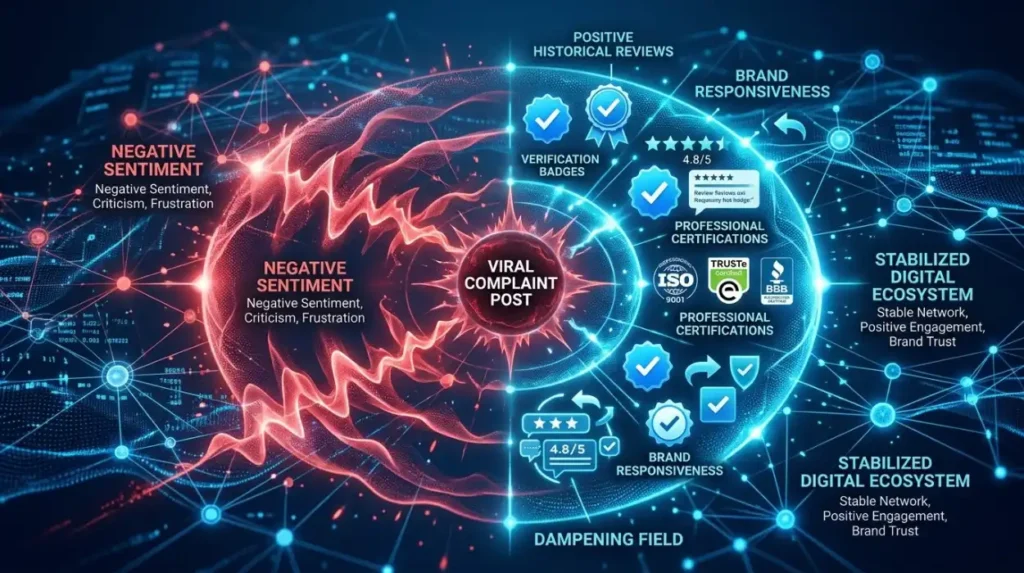
Sentiment distribution determines how the wider information ecosystem describes and interprets the customer-service complaint. Sentiment refers to the positive, negative, or neutral orientation expressed in reviews, articles, comments, posts, and other content. A single complaint does not establish an overall sentiment profile by itself. Its influence develops through repetition, contextual framing, source authority, and the volume of related discussion. Analysing sentiment therefore requires evaluating the complete set of relevant reputation signals.
Trust signals provide another layer of evaluation because source quality affects the perceived credibility of information. A customer comment, an independent review, a recognised publication, and an authoritative industry source carry different contextual characteristics. Search systems evaluate pages according to relevance and authority, while users independently assess source credibility and consistency. Contradictory information can create uncertainty around the entity’s reputation. Consistent factual information from credible sources creates a more coherent information environment.
Content enhancement can contribute to this balance by providing authoritative factual context. It does not erase negative sentiment, nor does it transform legitimate criticism into positive information. Instead, it introduces additional relevant material that users and search systems can evaluate alongside existing content. This creates a more complete representation of the business entity. The strategic value therefore comes from improving information quality and context rather than artificially changing sentiment.
What Is the Difference Between Short-Term and Long-Term Complaint Management?
Short-term complaint management focuses on immediate containment, while long-term reputation management focuses on sustainability and entity credibility. Short-term actions include assessing the complaint, correcting factual inaccuracies, responding with relevant information, and addressing qualifying harmful content. These actions target immediate search perception and reduce unnecessary escalation. Their effectiveness is measured through changes in visibility, sentiment, and information accuracy. However, short-term interventions do not automatically prevent future reputation issues.
Long-term management operates by maintaining a consistent digital footprint and monitoring reputation signals over time. It evaluates search results, reviews, third-party profiles, publications, social discussions, and other sources that contribute to entity perception. This creates an ongoing information system rather than a one-time response. Long-term monitoring also identifies new derivative content and changes in SERP composition. Sustainability therefore depends on maintaining accurate and authoritative information after the original complaint loses attention.
The distinction also affects resource allocation. Short-term management prioritises high-risk content and prominent search results, while long-term management allocates resources towards monitoring, content quality, source consistency, and digital footprint development. A strategy focused only on immediate containment leaves the entity exposed to future information changes. A strategy focused only on long-term development can overlook an active complaint that already influences search perception. Effective evaluation therefore considers both time horizons.
Dive Deeper With Our Expert Guides:
Removing Counterfeit Listings That Damage Your Brand on Marketplaces
How to Influence Your Ranking on B2B Comparison and Review Sites
How Should Businesses Evaluate the Effectiveness of Complaint Management?
Businesses can evaluate complaint-management strategies by measuring their impact on visibility, reputation signals, entity credibility, risk exposure, and sustainability. Effectiveness is not defined solely by whether a complaint disappears from social media. The relevant question is whether the strategy changes the information environment surrounding the business in a measurable and legitimate way. Search visibility, sentiment distribution, source authority, and content accuracy provide stronger evaluation criteria. These metrics connect reputation activity with observable changes in digital perception.
A structured evaluation framework can:
- Measure SERP composition by comparing the visibility and prominence of complaint-related pages for relevant brand queries.
- Analyse sentiment distribution by tracking recurring positive, negative, and neutral descriptions across indexed discussions.
- Assess source authority by evaluating the credibility, relevance, and visibility of pages contributing to the reputation signal.
- Track content development by identifying new articles, reviews, reposts, references, and derivative copies connected to the complaint.
- Evaluate sustainability by monitoring whether improvements remain stable after the initial complaint receives less attention.
This framework separates activity from outcomes. Publishing new content does not automatically demonstrate reputation improvement, just as removing one page does not establish long-term control. The outcome depends on how those interventions change the information landscape surrounding the entity. Measuring results through defined reputation signals provides a more reliable basis for comparing approaches. This also supports better decisions about where additional resources are required.
Which Strategy Provides the Lowest Reputation Risk?
A risk-controlled strategy combines factual accuracy, legitimate content intervention, authoritative content enhancement, and continuous monitoring. The lowest-risk approach is not necessarily the strategy that produces the fastest visible change. It is the strategy that addresses the underlying reputation issue without creating additional compliance, credibility, or search-quality risks. Content must remain accurate, relevant, and supported by appropriate evidence. Removal requests must also have a legitimate basis rather than being used to eliminate lawful criticism.
Risk exposure increases when businesses rely on manipulative tactics or attempt to create artificial reputation signals. Search ecosystems contain multiple independent sources, meaning artificial changes often fail to establish durable entity credibility. A sustainable strategy instead strengthens genuine information and addresses inaccurate material through appropriate channels. This creates a clearer relationship between the intervention and the reputation outcome. It also protects the business from introducing new trust concerns while attempting to resolve an existing one.
Risk evaluation therefore includes both the original complaint and the response strategy. An inaccurate response can create additional content that becomes part of the digital footprint. A poorly supported removal request can also create further complications. Accurate communication, documented facts, compliant intervention, and systematic monitoring reduce these risks. The objective is controlled reputation development rather than simple suppression of criticism.
How Does Scalability Affect the Choice of Reputation Management Method?
Scalability determines whether a reputation strategy remains effective as the number of sources, queries, and derivative content increases. Manual intervention can address an individual complaint but becomes less efficient when the same issue appears across multiple platforms. Content enhancement provides greater scalability because a well-structured authoritative resource can address recurring questions and search queries simultaneously. Monitoring systems also improve scalability by identifying changes across the wider digital footprint. The method therefore needs to match the volume and complexity of the reputation environment.
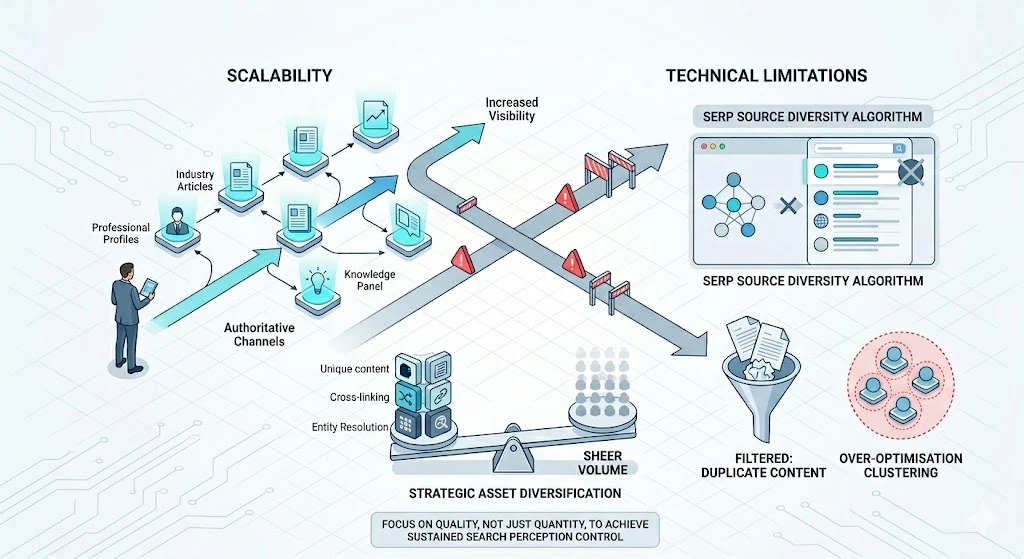
Content removal has narrower scalability because each source requires separate evaluation and often separate action. One successful removal does not automatically affect copied versions hosted elsewhere. Reactive responses face the same limitation when derivative discussions continue to emerge. Organic content development provides broader coverage but does not resolve every source-specific issue. Comparing scalability therefore reinforces the value of combining methods rather than treating one approach as universally superior.
The appropriate strategy depends on the structure of the complaint network. A single inaccurate page presents a different problem from a widespread collection of reviews, reposts, articles, and discussions. Mapping the digital footprint identifies where the highest concentration of reputation signals exists. This enables resources to be directed towards the sources with the greatest search ranking influence and entity-perception impact. Scalability then becomes a measurable strategic consideration rather than a generic operational benefit.
How Can Businesses Contain Viral Customer-Service Complaints Sustainably?
Sustainable containment requires reducing unnecessary visibility risk while strengthening accurate information around the business entity. The process begins by separating the original complaint from derivative copies, commentary, reviews, articles, and other information objects. Each source is then evaluated according to authority, relevance, sentiment, accuracy, indexing, and search visibility. This establishes whether the issue is primarily social, reputational, or search-driven. The resulting analysis determines which combination of enhancement, correction, legitimate removal, and monitoring provides the most appropriate response.
Sustainability depends on what happens after the complaint loses its immediate attention. Search results can change as pages are updated, new content is indexed, and user interest shifts. A temporary reduction in visibility does not guarantee that the same reputation signal will remain suppressed. Continuous monitoring identifies new references and changes in SERP composition. This converts complaint management from a single intervention into an ongoing reputation-control framework.
The underlying objective is information balance rather than artificial narrative control. Accurate business information needs sufficient visibility to provide context around negative or incomplete discussions. Qualifying harmful material requires appropriate treatment based on its actual characteristics and applicable rules. The result is a search environment in which users encounter a more complete representation of the business. This approach reduces long-term risk while preserving the distinction between legitimate criticism and inaccurate information.
The concept of contain viral customer-service complaints therefore involves more than responding quickly to the original customer interaction. It requires analysing how information spreads, which sources gain authority, how sentiment develops, and which pages become visible in search. These factors determine whether temporary virality becomes sustained reputation risk. Evaluating the entire information network provides a stronger basis for choosing between content enhancement, content removal, reactive management, and organic reputation development.
Viral customer-service complaints create reputation risks through the interaction of content distribution, sentiment, source authority, search visibility, and entity perception. Content enhancement strengthens authoritative information, while legitimate removal addresses specific qualifying sources. Reactive strategies provide immediate issue-specific intervention, while organic reputation development creates longer-term resilience. Short-term containment reduces immediate exposure, whereas continuous monitoring supports sustainability. No single mechanism provides universal control because each operates at a different stage of the information ecosystem.
The strongest reputation management framework evaluates effectiveness, scalability, risk exposure, and sustainability together. Businesses need to distinguish social virality from actual search ranking influence, separate original content from derivative copies, and evaluate which reputation signals influence the SERP most strongly. This produces a more precise understanding of whether a viral complaint represents temporary attention or a sustained digital reputation issue. Contain Viral Customer-Service Complaints is therefore best understood as an information-management objective involving visibility, context, credibility, and long-term entity perception.
How can businesses handle viral customer service complaints online?
Businesses can analyse the original complaint, derivative posts, sentiment, source authority, and search visibility before selecting an appropriate response. Reputation management for business combines monitoring, factual content enhancement, legitimate removal, and SERP analysis to manage the wider information network.
Can a viral customer complaint affect a company’s online reputation?
A viral complaint can become a significant reputation signal when repeated references connect the issue with the business entity. Its impact depends on content indexing, sentiment distribution, source authority, engagement, and visibility in relevant search results.
Is content removal better than creating positive content for reputation management?
Content removal directly addresses specific material that qualifies for legitimate removal, while content enhancement strengthens accurate and authoritative information around the business. The appropriate method depends on the content’s accuracy, source, search visibility, and effect on entity credibility.
How long does it take to manage a viral customer service complaint?
The timeframe depends on the number of sources, indexing activity, search ranking influence, sentiment, and how quickly derivative content spreads. Short-term containment addresses immediate visibility, while ongoing monitoring evaluates whether reputation signals remain stable over time.
How does reputation management reduce the impact of viral complaints?
Reputation management evaluates how complaint-related content affects SERP composition, sentiment, and entity perception before applying suitable corrective strategies. Strengthening authoritative information and addressing qualifying harmful or inaccurate content can reduce unnecessary search visibility while improving information balance.