
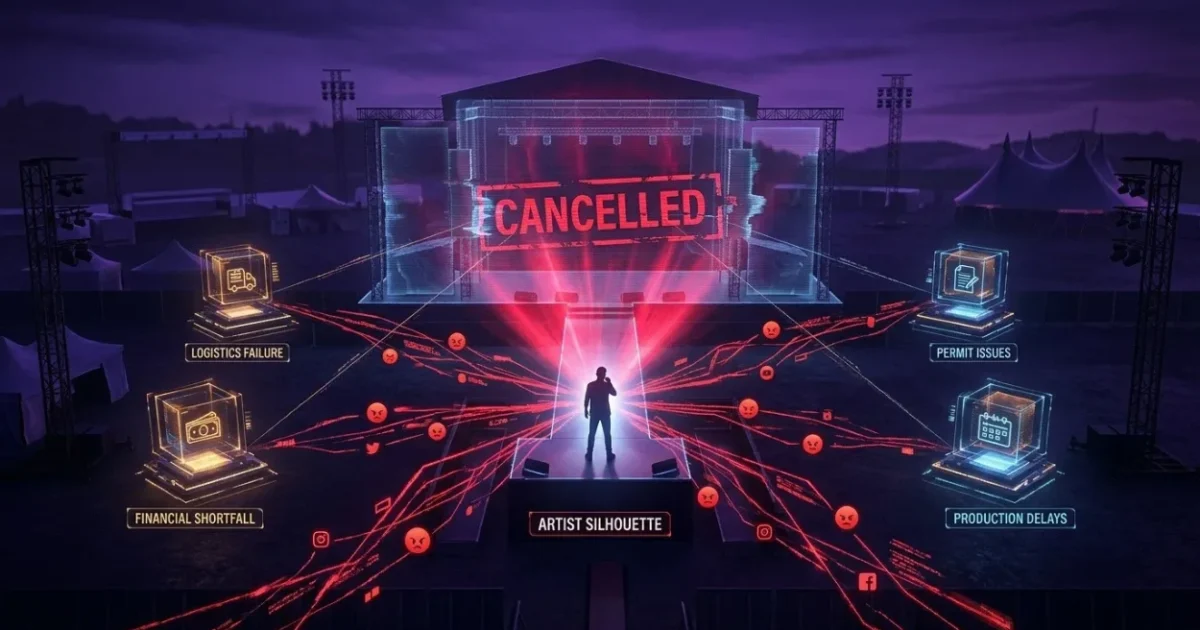
Festival cancellations can become associated with an artist because public information often connects the performer’s name with the cancelled event before responsibility is clearly established. Reputation management is the structured understanding of how information about an artist is created, indexed, ranked and interpreted across digital platforms.
Why do festival cancellations become associated with an artist?
Festival cancellations become associated with an artist when published information places the artist’s name alongside the cancellation event. Search engines index statements from festivals, artists, promoters, media outlets, ticketing platforms and social networks, creating a connected information environment around the event. When multiple pages repeat the artist’s name in connection with a cancellation, that association becomes part of the entity’s searchable context. The association does not establish responsibility by itself because search systems organise information based on relevance, prominence and available signals rather than independently determining factual liability. Reputation signals therefore depend on the content, source and context surrounding the cancellation.
The first indexed reports often have disproportionate visibility because early coverage can attract links, engagement and subsequent references. Later publications frequently build on existing reporting, reinforcing the connection between the artist and the cancelled event. Search engines evaluate these relationships through content relevance, authority and textual context rather than through a single definitive reputation judgement. This explains why an artist’s name can remain connected to a cancellation even when later information provides additional context.
How does search visibility shape perceptions of festival cancellations?
Search visibility shapes perception by determining which information appears when users investigate the artist or cancelled festival. A search engine results page contains a mixture of official announcements, news reports, social posts, reviews, event listings and other indexed material. The position and prominence of these sources influence which version of an event users encounter first. Reputation signals therefore emerge from the visible information environment rather than from one isolated article.
Search behaviour also creates different results for different queries. A search for an artist’s name can produce biography pages and music coverage, while a query combining the artist with a festival cancellation can prioritise news reports or event-specific discussions. This query-level difference is important because entity perception is influenced by the relationship between the searched entity and the surrounding terms. A cancellation that occupies only a small part of an artist’s overall digital footprint can become more prominent when users repeatedly search for the event.
What role does content indexing play in festival cancellation reputation?
Content indexing determines whether information about a festival cancellation becomes available for retrieval through search engines. Indexing is the process through which search engines discover, process and store web content so that relevant pages can appear in search results. Once a cancellation announcement, article or social page is indexed, its information becomes part of the searchable environment associated with the event and potentially the artist. The indexed content does not automatically represent a verified conclusion about what happened.
The structure of the indexed content also affects relevance. A page repeatedly mentioning an artist, festival, cancellation and alleged reason creates a stronger textual relationship between those entities than a page that merely lists the artist in an event archive. Search engines use signals from page content, links, structure and other contextual information to evaluate relevance. This means that wording surrounding a cancellation can influence how closely the event becomes associated with the artist in search.
Indexing also explains why corrections do not always erase earlier associations immediately. A later clarification becomes another piece of indexed information rather than automatically replacing every previous page. Search engines continue evaluating the available corpus of content, meaning older reports can remain discoverable alongside newer explanations. Understanding content indexing therefore provides a clearer explanation of why reputation-related search results often contain information from different stages of an event.
How do search engines evaluate information about a cancelled festival?
Search engines evaluate indexed information through relevance, authority, content quality, links, freshness and other ranking signals rather than assigning a simple factual verdict to the event. An official festival announcement can carry strong contextual relevance because it originates from an entity directly connected to the event. A recognised news publication can also provide substantial authority when reporting on the cancellation. Social media posts, fan discussions and secondary commentary contribute additional information but operate within different authority and reliability contexts.
SERP evaluation therefore involves the interaction of multiple sources. When official statements, media reports and social commentary describe the same cancellation differently, users encounter a mixed information environment. Search systems determine which pages appear prominently according to ranking signals, while users interpret the visible material according to their own understanding of source credibility and context. Reputation signals emerge from this interaction between indexed information and human interpretation.
Freshness also affects the information environment surrounding an active cancellation. Recent announcements can receive increased visibility when users search for developing events, while older pages retain relevance when they continue to answer the query effectively. The resulting SERP can therefore change as new statements, reports and explanations enter the index.
Can press coverage create a stronger reputation association than the original announcement?
Press coverage can strengthen an association when multiple authoritative pages repeat the same connection between an artist and a festival cancellation. A single announcement establishes an initial information relationship, while subsequent reporting can expand that relationship across additional domains. Each indexed reference provides another source containing related entities and terminology. This creates a broader searchable footprint around the cancellation.
The effect depends on how the reporting is written. A headline stating that an artist cancelled an appearance creates a different semantic relationship from a report stating that a festival was cancelled and the artist was one of the scheduled performers. The distinction between these formulations affects the contextual interpretation available to search users. Accurate attribution therefore matters because wording can influence how responsibility is perceived without changing the underlying event.
Authority also affects visibility. A report from an established publication with strong topical relevance can receive greater search prominence than an isolated discussion forum. When authoritative sources repeat a particular framing, that framing becomes more visible within searches connected to the event. This demonstrates why content authority forms an important part of online credibility and reputation analysis.
How do reviews and social media affect an artist’s cancellation reputation?
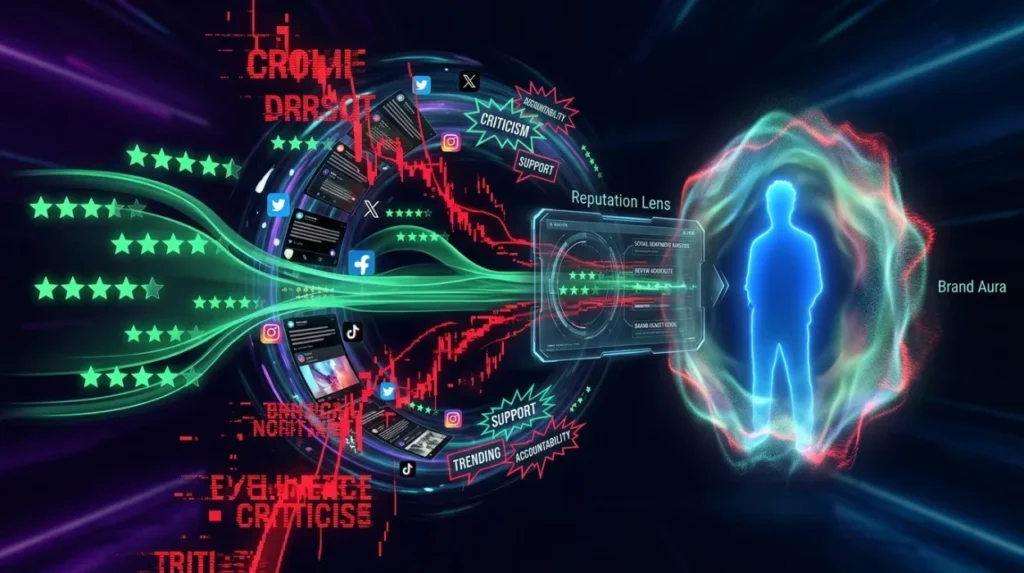
Reviews and social media introduce user-generated reputation signals that can influence how an artist is discussed after a cancellation. Users frequently respond to event disruptions through comments, reviews, posts and discussion threads, creating additional indexed material around the artist and festival. These sources reflect individual interpretations rather than necessarily providing verified information about the reason for cancellation. Search visibility can nevertheless make these interpretations discoverable to future audiences.
Sentiment analysis provides another layer of interpretation. Platforms and search systems can process language indicating dissatisfaction, approval, blame or uncertainty, although sentiment signals do not independently establish factual responsibility. A large volume of negative commentary can therefore indicate public reaction without proving that the artist caused the cancellation. Reputation analysis requires separating sentiment from verified event information.
The permanence and visibility of user-generated content also vary by platform. Some posts receive temporary attention and disappear from prominent search positions, while discussion pages and review content can remain accessible for longer periods. The resulting digital footprint depends on indexing, engagement, links, platform structure and the continued relevance of the content to search queries.
Why does entity perception matter when an artist is linked to a cancellation?
Entity perception refers to how a person, organisation or other identifiable entity is represented through the information connected to it across digital systems. For an artist, entity perception develops through music publications, profiles, interviews, event pages, reviews, social platforms and other sources. A festival cancellation becomes one component of this broader information network when the artist’s name is repeatedly associated with the event. The significance of that association depends on its prominence relative to the rest of the artist’s digital footprint.
Search engines do not maintain a single public reputation score for an artist. Instead, they organise and rank information that helps satisfy particular queries. An artist therefore has different search-result environments depending on whether a user searches for music, performances, reviews, festival appearances or cancellation-related terms. Entity perception emerges from the collection of these query-specific information environments.
This distinction prevents a cancellation from being treated as an automatic definition of an artist’s entire online identity. A search result can establish relevance to one event without becoming representative of every aspect of the entity. Analysing reputation therefore requires examining the breadth, authority and persistence of associated content rather than focusing on one result in isolation.
How can an artist’s name remain connected to a cancellation after clarification?
An artist’s name can remain connected to a cancellation because previously indexed content continues to exist after new information becomes available. A clarification adds another source to the search ecosystem but does not automatically remove earlier articles, cached references, discussion pages or archived event information. Search engines continue evaluating the available pages according to relevance and authority. Consequently, a later explanation can coexist with earlier reporting rather than replacing it.
The timing of content publication also creates a chronological information structure. Initial reports often document the event as it was understood at the time, while subsequent statements provide additional information. Search users can therefore encounter different stages of the story depending on the query and ranking position. Reputation signals are influenced by this cumulative content environment.
For an artist concerned with protecting your name when a festival cancels, understanding this mechanism is important because the searchable association can persist independently of the event’s original duration. The issue is not simply whether the cancellation happened, but how information about it remains indexed, connected and presented through search results. This makes search perception analysis relevant to understanding the long-term digital footprint of a cancellation.
What determines whether a festival cancellation affects an artist’s digital footprint?
The effect depends on the volume, authority, prominence, duration and framing of content connecting the artist to the cancellation. A cancellation reported only through a temporary event page has a different digital footprint from one covered extensively by authoritative publications and discussed across social platforms. Search visibility also changes the practical significance of each reference. Highly visible content is more likely to become part of the information encountered during relevant searches.
The digital footprint also includes content that is not directly about the cancellation but becomes associated with it through links and references. An interview, artist profile or event archive can connect to cancellation coverage and reinforce the broader entity network. Search engines use these relationships to understand topical relevance and retrieve information for related queries. Reputation signals therefore develop across interconnected sources rather than inside individual pages alone.
Persistence is another defining factor. Content that remains indexed and relevant for a long period has greater potential to continue appearing in future searches. Content that loses relevance or visibility has a reduced presence in the search environment. Digital reputation is consequently dynamic, with content prominence changing as new information enters the ecosystem.
How do trust and authority signals influence interpretation of cancellation stories?
Trust and authority signals influence which sources users regard as credible when interpreting a festival cancellation. Official statements provide direct information from organisations or individuals connected to the event, while established media publications provide independently produced reporting. Industry publications, event platforms and verified professional profiles can add further context. Each source contributes a different type of evidence to the overall information environment.
Authority does not mean that every statement from a prominent source is automatically correct. It indicates that the source has characteristics that can make its content more prominent or credible within a particular context. Users still evaluate consistency between sources, supporting evidence and the clarity of attribution. Reputation analysis therefore separates source authority from factual certainty.
For artists, this distinction is important because a highly visible claim can influence perception even when later information provides additional context. A balanced search environment contains enough authoritative information for users to compare claims rather than relying on one prominent interpretation. The structure of that information affects how entity credibility is understood.
Dive Deeper With Our Expert Guides:
How Past Label Disputes Resurface During a Comeback
Why Fan Wars Distort a Musician’s Online Sentiment
What does a festival cancellation reveal about online reputation systems?
A festival cancellation demonstrates how online reputation develops through connected information rather than through a single statement or ranking. The event creates an initial set of documents, which can then generate news coverage, social commentary, reviews, updates and secondary references. Search engines index these materials and evaluate their relevance for different queries. Users interpret the resulting SERPs according to source authority, wording, recency and available context.
The key reputation signals include the sources discussing the event, the language used to describe the artist’s involvement, the prominence of related pages and the persistence of indexed content. These factors explain why an artist can become associated with a cancellation even when responsibility remains disputed or unclear. Search visibility amplifies information relationships by placing connected content in front of users investigating the artist.
Understanding this system also clarifies the difference between reputation and factual responsibility. Search engines organise information; they do not independently determine who caused an event. Online reputation therefore reflects the searchable representation created by indexed content, ranking dynamics, source authority and user interpretation.
How should festival cancellation information be understood within an artist’s digital footprint?
Festival cancellation information is best understood as one reputation signal within a wider digital footprint rather than as a complete representation of the artist. The digital footprint includes professional profiles, music coverage, interviews, event listings, reviews, social content and third-party publications. A cancellation becomes more significant when it occupies prominent positions across relevant searches or becomes repeatedly connected with the artist. Its actual influence depends on the strength and persistence of those associations.
The search ecosystem continually changes as new information is published and existing pages are updated. Search rankings also change as algorithms reassess relevance, authority and other signals. This means that the relationship between an artist and a cancelled festival remains part of a dynamic information environment rather than a fixed reputation record. Understanding these mechanisms provides a more accurate basis for interpreting search visibility.
Ultimately, festival cancellations become reputation issues when event information, attribution and search visibility combine to create a persistent association between the artist and the cancelled event. Reputation management in this context is the study of how that association forms, how content becomes indexed and how users encounter the resulting information. Analysing SERP evaluation, authority signals, sentiment and entity perception provides a structured way to understand the relationship between public information and digital reputation without assuming that search visibility itself establishes responsibility.
Why do festival cancellations get blamed on the artist?
Festival cancellations can become associated with an artist when news reports, event pages and social posts repeatedly connect the artist’s name with the cancelled event. This association reflects available reputation signals and search visibility, but it does not automatically establish responsibility.
Can a festival cancellation affect an artist’s online reputation?
Yes, a cancellation can affect an artist’s digital footprint when negative coverage, reviews or social commentary becomes prominent in search results. The impact depends on the authority, visibility, persistence and context of the indexed content.
How does Google rank festival cancellation stories about artists?
Search engines evaluate factors such as relevance, authority, content quality, links and freshness when ranking cancellation-related pages. These ranking signals determine which information appears prominently when users search for an artist and the cancelled festival.
Can negative festival cancellation stories remain in search results?
Negative cancellation stories can remain visible when the original pages continue to be indexed, relevant and authoritative. Later statements or corrections add new information but do not automatically remove earlier coverage from search results.
How can artists protect their online reputation after a festival cancellation?
Artists can monitor branded search results, review the accuracy and context of cancellation coverage, and ensure authoritative information is clearly represented online. A structured reputation management for musicians approach focuses on understanding search visibility, reputation signals and the wider digital footprint.