
Fan wars distort a musician’s online sentiment because coordinated or highly active fan discussions can increase the volume, repetition, and visibility of polarised content around an artist. Reputation management is the process of analysing and influencing the information environment associated with a person or entity, while online reputation refers to how that information is represented and interpreted across digital platforms and search ecosystems.
How does a fan war affect a musician’s online reputation?
A fan war affects online reputation by increasing the concentration of conflicting sentiment around a musician’s name, work, relationships, or public activity. Online reputation is not formed from a single opinion; it emerges from an information environment containing articles, reviews, social posts, discussions, videos, comments, and other indexed references. When fan communities repeatedly publish opposing claims, search engines encounter a larger volume of semantically related content. This creates additional reputation signals associated with the musician’s entity. The resulting search environment can therefore contain a stronger association between the musician and the dispute itself.
The effect is particularly relevant when fan activity produces content that remains publicly accessible and indexable. Search engines evaluate pages according to relevance, authority, content characteristics, links, engagement-related signals, and other ranking systems rather than determining whether a particular fan’s interpretation is correct. A highly repeated topic can consequently become more visible without representing a balanced assessment of the artist. Search visibility then becomes partly shaped by the structure and distribution of available information.
What is online sentiment in search ecosystems?
Online sentiment is the observable direction of attitudes expressed about a person, organisation, product, or topic across digital content. Sentiment analysis classifies language and other signals into categories such as positive, negative, or neutral, although search engines do not reduce reputation evaluation to a simple sentiment score. For musicians, sentiment can appear through reviews, editorial coverage, social commentary, forum discussions, video titles, and user-generated content. The semantic context surrounding the artist’s name determines which associations become connected to the entity. Sentiment therefore operates as one component of a broader digital reputation system.
Why do fan wars create distorted sentiment signals?
Fan wars create distorted sentiment signals because highly motivated participants produce disproportionate amounts of content compared with ordinary audiences. A dispute can generate repeated posts, replies, reposts, quotations, reaction videos, and discussion threads around the same subject. Each piece of content adds another occurrence of terms and entities associated with the musician. Search systems process these pages individually while also interpreting relationships between concepts, topics, and entities. The resulting information environment can give a narrow dispute greater semantic prominence than its actual relevance to the musician’s wider career.
How does content volume influence perception?
Content volume influences perception by increasing the amount of searchable material associated with a particular topic. A musician with extensive positive, negative, and neutral coverage can still encounter a concentrated cluster of negative discussion if fan conflict generates repeated references to the same controversy. Search users encounter the pages selected by ranking systems rather than the complete universe of online commentary. This creates an information-selection effect in which visible content represents only a subset of available information. The subset can influence entity perception even when it does not represent the complete sentiment landscape.
How do search engines interpret fan-war content?
Search engines interpret fan-war content through relevance, content quality, authority, links, freshness, user queries, and other ranking signals rather than treating fan activity as a direct measure of public opinion. A page discussing a musician in connection with a fan dispute becomes part of the searchable corpus when it is accessible and indexed. Its ranking then depends on the characteristics of that page and its relationship to the query. Repeated discussion does not automatically make every page authoritative, but widespread references can increase the amount of material competing for relevant searches. SERP evaluation therefore determines which parts of the dispute become visible to search users.
What role does content indexing play?
Content indexing determines whether a publicly available page enters a search engine’s searchable database. An indexed article, forum thread, social page, or video can appear for queries connected to its content, entities, and terminology. If fan-war discussions remain indexed, they become part of the information environment surrounding the musician. Indexing therefore establishes the foundation for subsequent search visibility. Content that is not indexed has less direct influence on traditional organic search results, although it can still exist and circulate through other digital channels.
Can repeated fan-war discussions change search results?
Repeated fan-war discussions can change the composition of search results when the associated content gains sufficient relevance, authority, freshness, or other ranking signals. Search results are query-dependent, so a dispute becomes particularly visible when users search for the musician alongside terms connected with the conflict. New pages and discussions can enter the competitive search environment while older pages change position over time. This creates a dynamic SERP landscape rather than a fixed reputation profile. The musician’s search perception therefore reflects the interaction between published content and ranking systems.
How does search intent affect visibility?
Search intent affects visibility because search engines attempt to return information that satisfies the meaning behind a query. A user searching for a musician’s latest release receives a different result set from a user searching for a dispute involving that musician. Fan-war content becomes more relevant when queries contain terms associated with the conflict. Entity perception therefore varies across query categories rather than existing as one universal search result. Reputation analysis needs to distinguish branded searches, issue-related searches, informational queries, and navigational queries to understand the actual search environment.
Why does polarised content attract greater attention online?
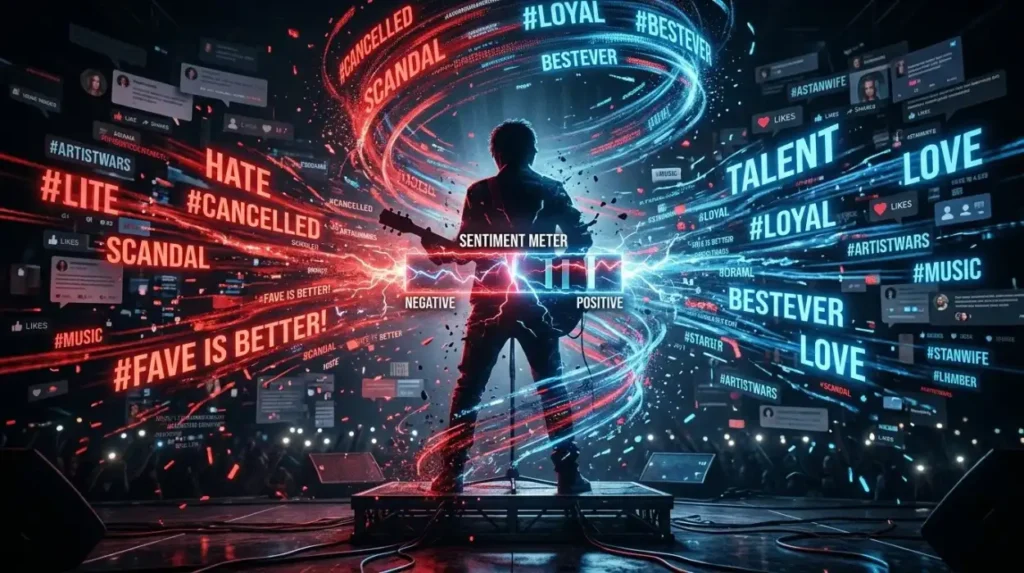
Polarised content attracts attention because disagreement creates strong topical relationships between people, claims, events, and entities. Fan wars frequently involve opposing interpretations, competing narratives, and repeated responses, which produce dense semantic connections around the musician’s name. These connections can extend across social platforms, forums, news coverage, commentary videos, and other publishing environments. The resulting digital footprint contains a concentrated cluster of related terminology. Search perception is influenced by which parts of this cluster become prominent for relevant queries.
What is a digital footprint in reputation analysis?
A digital footprint is the collection of publicly accessible information associated with an individual or entity across digital environments. For a musician, it can include official releases, interviews, biographies, reviews, social profiles, press coverage, fan discussions, public comments, videos, and third-party references. Each source contributes information to the wider entity landscape, although individual sources have different levels of authority and relevance. Fan-war content therefore represents one category within a much larger digital footprint. Analysing that footprint requires separating authoritative information from repetitive or low-context commentary.
How do reviews contribute to a musician’s online sentiment?
Reviews contribute to online sentiment by expressing evaluations of music, performances, releases, or professional activity through published text and rating systems. Review signals can appear on editorial websites, music platforms, event pages, social networks, and other digital properties. Their interpretation depends on context, source authority, recency, relevance, and the relationship between the review and the musician’s entity. Fan disputes can complicate this environment when supporters or critics publish reviews primarily as responses to an ongoing conflict. Search perception then contains both substantive evaluation and dispute-driven commentary.
Are fan comments the same as reputation signals?
Fan comments are reputation signals in the broad sense that they contribute publicly available information about how an entity is discussed, but they do not carry identical evidential value. A professional review, verified interview, established publication, and anonymous comment differ in authorship, context, authority, and editorial control. Search engines also evaluate pages and sources through ranking systems rather than assigning a universal credibility score to every statement. Reputation analysis therefore requires source differentiation. Treating every comment as equivalent to independent editorial evidence produces an inaccurate interpretation of the musician’s online sentiment.
Dive Deeper With Our Expert Guides:
How Autotune and Lip-Sync Accusations Follow Singers Online
Why Sample-Clearance Disputes Become Reputation Stories
How do authority and trust signals affect a musician’s search reputation?
Authority and trust signals affect search reputation by influencing how information sources are evaluated within search systems and by users. Established publications, authoritative websites, recognised profiles, and well-supported factual pages generally provide stronger contextual information than isolated anonymous posts. Search engines assess pages through complex systems that incorporate relevance and quality-related signals rather than relying on one authority measurement. Users also apply their own credibility judgements when comparing search results. The interaction between algorithmic ranking and human evaluation shapes entity perception.
Why does source context matter?
Source context matters because the same statement carries different informational meaning depending on where, why, and how it is published. A documented interview represents a different type of evidence from an anonymous forum comment, while an editorial review differs from a fan-created reaction video. Context allows search users and information systems to distinguish factual reporting, opinion, commentary, speculation, and promotional material. This distinction becomes important during fan wars because emotionally polarised discussions frequently mix these content types. Accurate reputation analysis therefore evaluates the source and context alongside the sentiment expressed.
How can fan wars influence entity perception?
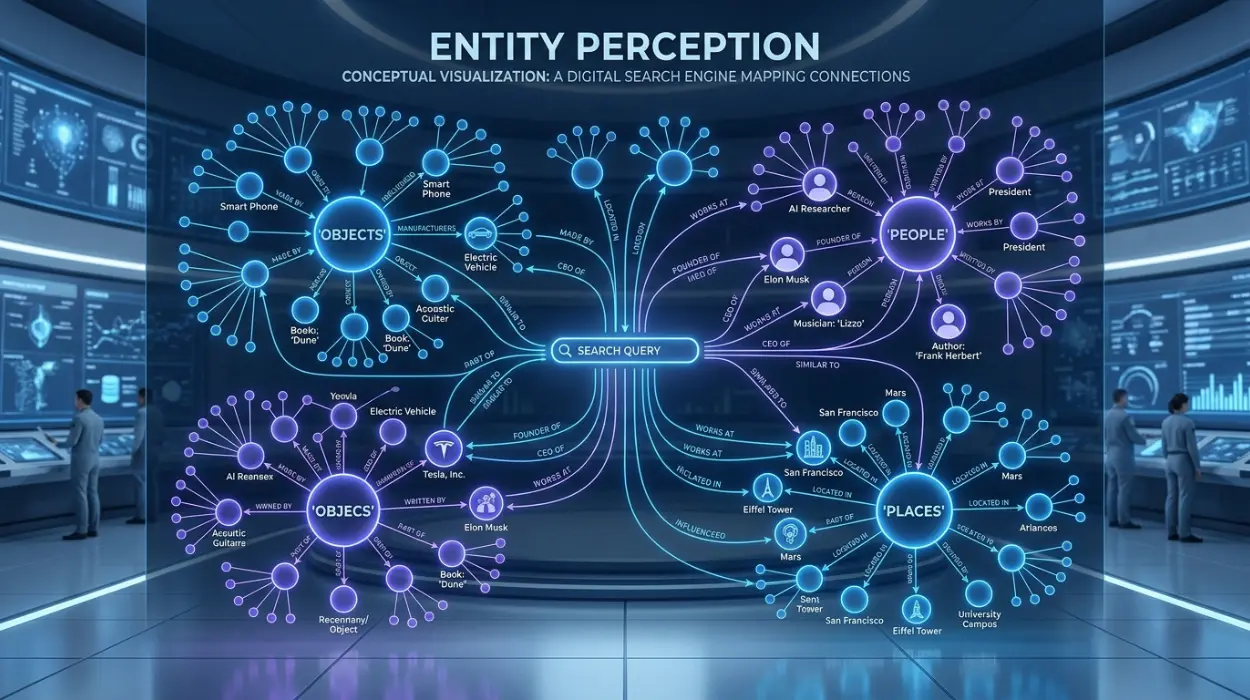
Fan wars influence entity perception by associating a musician’s name with recurring topics, people, claims, and controversies. An entity is a distinct person, organisation, place, or concept recognised across information systems, while entity perception refers to how that entity is represented through connected information. Repeated associations can strengthen the semantic relationship between a musician and a particular dispute. Search users then encounter those associations when relevant queries retrieve pages containing the connected entities. Entity perception is therefore influenced by the structure of information surrounding the musician, not simply by the musician’s own published statements.
What is the relationship between sentiment and entity associations?
Sentiment and entity associations operate together but represent different concepts. Sentiment describes the expressed attitude within content, while entity associations describe the subjects and concepts connected to a named person or organisation. A fan-war article can contain negative sentiment while also connecting the musician to specific rivals, disputes, allegations, releases, or communities. Repeated content can reinforce those connections across the digital footprint. Search perception consequently reflects both the emotional direction of discussion and the subjects repeatedly associated with the musician.
Why is fan-war sentiment not a complete measure of public opinion?
Fan-war sentiment is not a complete measure of public opinion because online participation is uneven and platform-specific. Highly active communities produce a greater volume of visible commentary than less active audiences, while platform algorithms determine which posts receive additional exposure. Search engines then apply another layer of selection when generating results for specific queries. The visible online conversation therefore represents a constructed information environment rather than a statistically representative survey. Reputation analysis needs to distinguish observable digital sentiment from measured population opinion.
How should search sentiment be interpreted?
Search sentiment is best interpreted as evidence about the information environment surrounding an entity rather than as a definitive measurement of what the entire audience believes. Analysts can examine the frequency, context, source type, ranking position, topical relationships, and sentiment of indexed content. They can then identify whether negative or positive associations are concentrated within specific platforms, queries, or content types. This approach separates search visibility from assumptions about public opinion. It also provides a clearer framework for understanding how fan activity affects digital reputation.
How can fan wars create long-term reputation effects?
Fan wars can create longer-term reputation effects when dispute-related content remains indexed, repeatedly referenced, or connected to persistent digital properties. A social post can disappear from immediate attention while related articles, forum discussions, videos, or archived pages continue appearing for relevant searches. Fresh content can also revive older disputes by linking them to new events or renewed fan activity. Content persistence therefore matters alongside initial publication volume. A temporary dispute can acquire a longer search lifespan when its associated information remains accessible and connected to the musician’s entity.
What makes a reputation signal persistent?
A reputation signal becomes persistent when the information supporting it remains accessible, indexed, relevant, and connected to recurring search behaviour or authoritative sources. Persistent pages can continue competing for rankings after the original dispute loses social attention. Links, references, updates, and new discussions can also reconnect older content with current queries. This creates continuity between historical and contemporary search results. Reputation analysis therefore considers both current sentiment and the longevity of the underlying information.
What does fan-war distortion reveal about online reputation systems?
Fan-war distortion demonstrates that online reputation is shaped by the interaction between publishing behaviour, content indexing, ranking systems, source authority, entity relationships, and user search behaviour. A musician’s online sentiment does not exist as a single measurable value stored by search engines. Instead, search ecosystems assemble results from a changing collection of documents and digital references. Fan activity can alter that information environment by increasing the volume and concentration of specific narratives. Understanding those mechanisms provides a more accurate interpretation of search reputation and digital credibility.
Why does understanding fan-war distortion matter?
Fan wars distort a musician’s online sentiment by concentrating discussion, strengthening repeated entity associations, and increasing the amount of searchable content connected with a dispute. Search engines evaluate the resulting pages through ranking and indexing systems, while users interpret the information through their own assessments of relevance and credibility. Reviews, social commentary, editorial coverage, authority signals, and persistent digital references all contribute to the broader reputation environment. How to Calm Fan Wars That Distort Your Public Sentiment represents the next consideration point for understanding how this type of reputation problem is analysed. The central principle remains that search sentiment is an information-system outcome, not a complete measurement of public opinion.
How do fan wars affect a musician’s online reputation?
Fan wars increase the volume of polarised content associated with a musician’s name, which can influence search visibility and entity perception. Repeated posts, comments, reviews and discussions can create a stronger association between the musician and the dispute.
Can fan wars change what appears when you search for a musician?
Yes. When fan-war content is indexed and gains relevance or other ranking signals, it can appear for searches connected to the musician and the dispute. This can alter the composition of search engine results pages (SERPs) without representing the musician’s overall public reputation.
Does negative fan content affect a musician’s Google search results?
Indexed negative content can affect search results when its pages are relevant to queries involving the musician. Search visibility depends on factors such as relevance, authority, content quality and ranking signals rather than sentiment alone.
Is online sentiment a reliable measure of what people think about a musician?
Online sentiment is not a complete measure of public opinion because highly active fan communities can produce disproportionate amounts of content. Reputation analysis distinguishes searchable sentiment from representative audience research and considers source, context, authority and content distribution.
How can fan-war content become a lasting reputation signal?
Fan-war content can become a lasting reputation signal when it remains publicly accessible, indexed, repeatedly referenced or connected to relevant entities and search queries. Persistent articles, forum discussions, videos and social references can continue influencing the musician’s digital footprint after the original dispute loses attention.