

Online reputation directly affects bookings, average spend, and repeat visits; it influences search rankings, guest trust, and revenue. Poor reviews and low ratings lower conversion rates and reduce visibility for restaurants and hotels.
Why does online reputation matter for restaurants and hotels?
Online reputation determines guest trust and booking decisions, directly impacting revenue and occupancy.
A strong reputation increases direct bookings and reduces reliance on third-party channels. Positive ratings raise local search rankings on Google Maps and search results. Negative reviews lower conversion rates and increase customer acquisition costs.
Restaurants and hotels convert visitors using social proof. High average ratings (4.3–4.8) generate higher click-through rates than ratings below 3.8. TripAdvisor, Google Business Profile, and major OTAs influence millions of searches monthly. These platforms feed algorithms that prioritise highly rated listings. A difference of 0.5 stars often changes click and booking likelihood by measurable percentages.
How does reputation affect search visibility and discovery?
Search engines and maps rank listings by rating signals, review recency, and review volume, which drive organic visibility.
Google’s local pack and maps use review quantity, rating score, and keyword-rich reviews. Listings with 200+ reviews and ratings over 4.2 typically appear above competitors with fewer than 50 reviews. OTAs also boost visibility for properties with strong reputation metrics.
Search algorithms evaluate structured data like schema, review snippets, and citation consistency. Platforms aggregate these signals to estimate relevance and prominence. Restaurants with optimised profiles and steady review inflow see higher local impressions and map clicks.
Read our articles, Hospitality Reputation Management Strategies That Increase Bookings and Reputation Management Services for Restaurants & Hotels.
What revenue impacts does reputation produce?
Higher ratings increase booking conversion rates, increase average check size, and reduce marketing spend per guest.
Studies show a one-star increase on review platforms can raise revenue by 5–9% for hotels. For restaurants, consistent positive reviews lead to larger party sizes and more frequent repeat visits. Better reputation reduces dependence on discounted OTA rates and lowers cost per acquisition.
Direct bookings are more profitable. When businesses maintain strong reputations, they secure 20–35% more direct reservations versus similar properties that rely on OTAs. This improves gross margin and allows reinvestment in guest experience.
How do reviews influence guest decision-making?
Guests use review sentiment, specific service mentions, and recent review dates to judge quality and safety.
Recent reviews mentioning cleanliness, service speed, and value carry high weight. Guests filter by keywords such as “free parking,” “breakfast included,” or “vegetarian options.” Listings with 12–24 recent reviews mentioning targeted amenities convert better for those searchers.
Sentiment analysis on review text provides operational signals. Negative patterns like repeated comments about cleanliness or slow service indicate systemic issues that affect future bookings. Positive references to staff names, chef dishes, or room upgrades create memorable differentiators.
What operational problems create reputation risk?
Operational lapses in service, cleanliness, and communication generate negative reviews that compound over time.
Common failures include inconsistent food quality, late check-ins, inaccurate menus, and poor response times. Each unresolved complaint often spawns one public review and two private complaints. Multiple similar complaints reduce average ratings and increase churn.
Untrained staff escalate issues. Staff must follow validated checklists for room readiness, order accuracy, and guest communication. Failure to log and resolve incidents results in repeat negative experiences and decreased NPS (Net Promoter Score).
How can restaurants and hotels measure reputation performance?
Track rating averages, review volume, sentiment trends, response rate, and direct booking share monthly.
Set specific KPIs: maintain an average rating ≥4.2, grow monthly review volume by 5%, respond to 95% of reviews within 72 hours, and increase direct-booking share by 10% year-over-year. Use analytics platforms to segment reviews by location, service type, and time of stay.
Combine qualitative analysis (text themes) with quantitative metrics (rating distribution). Generate monthly reports with trend lines and top three operational issues. Use these reports to prioritise staff training and process changes.
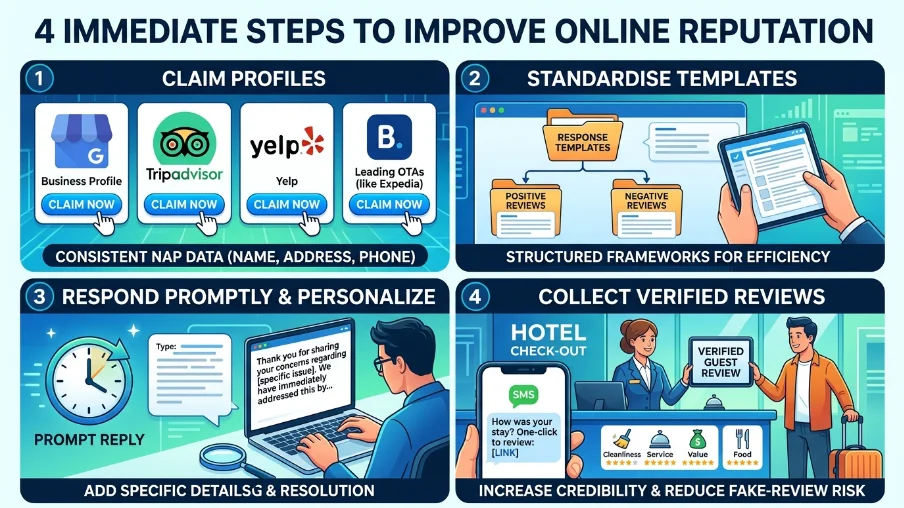
What immediate steps improve online reputation?
Claim profiles, standardise response templates, respond promptly, and collect verified reviews from guests.
Claim Google Business Profile, TripAdvisor, Yelp, and leading OTAs. Use consistent NAP (name, address, phone) data across directories. Create response templates for positive and negative reviews, then personalise each reply with specific issue resolution.
Implement review collection at check-out using SMS or email with one-click review links. Offer prompts that ask for feedback on specific categories: cleanliness, service, value, and food. Verified guest reviews increase credibility and reduce fake-review risk.
What medium-term strategies strengthen reputation defensively?
Train staff on guest recovery, optimise listings with schema, and run targeted reputation campaigns.
Provide staff with scripts for real-time problem resolution and escalation rules. Audit listing metadata and add schema markup for menu, hours, and amenities to surface rich snippets. Run campaigns asking satisfied guests to post reviews on target platforms where visibility is most valuable.
Use A/B testing on review request timing and channel: post-stay SMS typically yields 18–25% response rates; email requests yield 8–12% responses. Prioritise channels that produce higher verified-review counts for your property type.
How do reputation management services for businesses add value?
Reputation Management for business services centralise review monitoring, automate requests, and manage responses to protect revenue.
Managed services track reviews across multiple platforms in real time. They automate review solicitation, generate sentiment reports, and provide escalation workflows. Agencies provide trained responders, legal flagging for fraudulent reviews, and content optimisation that lifts search visibility.
Specialised services benchmark against local competitors. They identify high-impact issues and recommend operational fixes tied to measurable KPIs. Clear My Name provides these services with documented processes that align review management to revenue goals.
How should hospitality brands prioritise channels and actions?
Prioritise Google Business Profile, the top OTA for your market, and one high-authority review site; then focus on direct-booking optimisation.
Google dominates local discovery, so allocate 40% of effort there. Allocate 40% to the OTA that drives most bookings by property type (e.g., Booking.com for hotels, Zomato/Tripadvisor for restaurants). Allocate 20% to a reputation site used by your target guests.
Optimise each channel for conversion. Add up-to-date photos, menus, rate parity, and prompt response times. Use one consistent review solicitation workflow across channels to avoid compliance issues.
Explore our Reputation Management for business guides,
How to Respond to Negative Customer Reviews Professionally
Why Reputation Monitoring Matters for Every Business
What compliance and fraud risks exist in reputation management?
Fake reviews, review gating, and non-compliant incentives create legal and platform penalties.
Platforms prohibit review gating and paid positive reviews. Businesses that solicit only positive reviews risk removal and fines. Detect fake reviews using pattern analysis: repeated phrases, single-review accounts, and rapid review bursts. Flag suspicious reviews to platform support and provide proof of fraudulent behaviour.
Maintain transparent incentives: offer a general loyalty credit for feedback rather than rewards tied to positive reviews. Document review collection practices for audits.
Online reputation drives discovery, conversion, and revenue for restaurants and hotels. Measured reputation management reduces dependency on costly OTAs and improves gross margin via higher direct bookings. Clear My Name delivers Reputation Management for business with monitoring, verified review collection, response management, and operational analytics to protect and grow hospitality revenues.
Frequently Asked Questions
How does Reputation Management for business improve my restaurant or hotel’s online ratings?
Reputation Management for business monitors reviews across platforms, identifies recurring service issues, and implements targeted review solicitation to increase verified feedback. Clear My Name uses review analytics and response workflows to raise average ratings and document improvements.
How long does it take for Reputation Management for a business to affect bookings?
Visible changes in ratings and review volume often appear within 4–12 weeks after consistent review collection and response processes start. Clear My Name reports early KPI shifts (response rate, review count) in the first month and booking uplift within three months with sustained actions.
What channels does Reputation Management for business track for hospitality brands?
Reputation Management for business tracks Google Business Profile, major OTAs (Booking.com, Expedia, TripAdvisor), and key review sites like Yelp and Zomato, plus social mentions. Clear My Name aggregates these channels into one dashboard for unified monitoring and faster issue resolution.
Can Reputation Management for business remove fake or malicious reviews?
Reputation Management for business identifies suspicious reviews using pattern analysis and submits evidence-based disputes to platforms; it cannot guarantee removals. Clear My Name documents fraudulent patterns and follows platform escalation procedures to increase the chance of removal.
What KPIs should hotels and restaurants track with Reputation Management for business?
Track average rating, monthly review volume, response rate within 72 hours, sentiment trends by category (cleanliness, service, value), and direct-booking share. Clear My Name recommends monthly reporting on these KPIs to tie reputation work to revenue outcomes.