

Implementing targeted reputation management strategies for hotels and restaurants increases bookings by improving online visibility, converting higher-intent searchers, and raising average booking rates through better ratings, faster response times, and review-driven SEO.
What reputation management strategies increase bookings for hotels and restaurants?
A focused strategy combining review acquisition, review response, review SEO, and reputation monitoring raises bookings by improving star ratings, local search rankings, and conversion signals.
Reputation management drives bookings through measurable channels. Higher average ratings increase click-through rates in search results. Local SEO tied to review content boosts visibility for intent queries such as “book hotel near London Bridge.” Rapid, personalised responses improve conversion by demonstrating service reliability. Monitoring sentiment identifies operational issues that reduce cancellations and negative reviews.
Read our articles, Why Online Reputation Is Critical for Restaurants and Hotels and Reputation Management Services for Restaurants & Hotels.
How does review acquisition translate into more reservations?
Systematic review acquisition lifts the volume and recency of positive feedback, which raises average ratings and search prominence, leading directly to more bookings.
Collecting reviews increases the sample size reviewers see. Booking decisions often rely on at least 20 recent reviews; properties with 20+ recent reviews show higher trust signals. Use targeted prompts at peak guest satisfaction points: check-out, departure email within 24 hours, and post-stay SMS. Segment requests by channel: email for corporate guests, SMS for leisure to reach different demographics. Automate follow-ups and offer simple one-click rating links to raise completion rates. Track conversion metrics before and after campaigns to quantify uplift.
Which review response practices convert reviewers into bookers?
Timely, personalised responses that address specific guest comments improve perceived service and increase repeat bookings and direct reservations.
Respond within 24–48 hours to negative and positive reviews. Acknowledge details such as room number, stay date, or staff member to validate the guest’s experience. For negative feedback, state corrective actions taken and invite rebooking with a direct contact. For positive feedback, thank the guest and mention relevant upsell options like late check-out or dining credits. Responses with concrete actions refund processed, maintenance scheduled—boost trust and conversion. Monitor response metrics and correlate response time and tone with direct booking rates.
What role does review SEO play in increasing bookings?
Optimising review content and metadata for local and transactional queries improves organic rankings and drives higher-intent traffic that converts into bookings.
Encourage guests to mention location, service type, and amenities in their reviews. Phrases like “breakfast included,” “near subway station,” or “conference room” create semantic signals for searches. Structure schema markup (Review, AggregateRating, LocalBusiness) on listing and property pages to surface star ratings and price snippets in SERPs. Use review excerpts in page copy and meta descriptions to increase CTR. Track keyword rankings for transactional terms such as “book boutique hotel [city]” and adjust prompts to capture those phrases naturally in guest reviews.
How does reputation monitoring prevent booking losses?
Continuous monitoring of review sites and social channels identifies negative trends quickly, allowing operational fixes that stop booking decline and reduce cancellations.
Set alerts for drops in average rating, sudden volume of complaints, or recurring mentions (cleanliness, noise). Route issues to operations teams with tickets and deadlines. Use sentiment analysis to quantify problem areas and measure remediation impact. For example, if 12% of recent reviews mention noisy HVAC, prioritise engineering work and communicate the fix in responses. Demonstrate resolved issues in follow-up responses to recover guest trust and restore booking velocity.
Which metrics prove reputation management increases revenue?
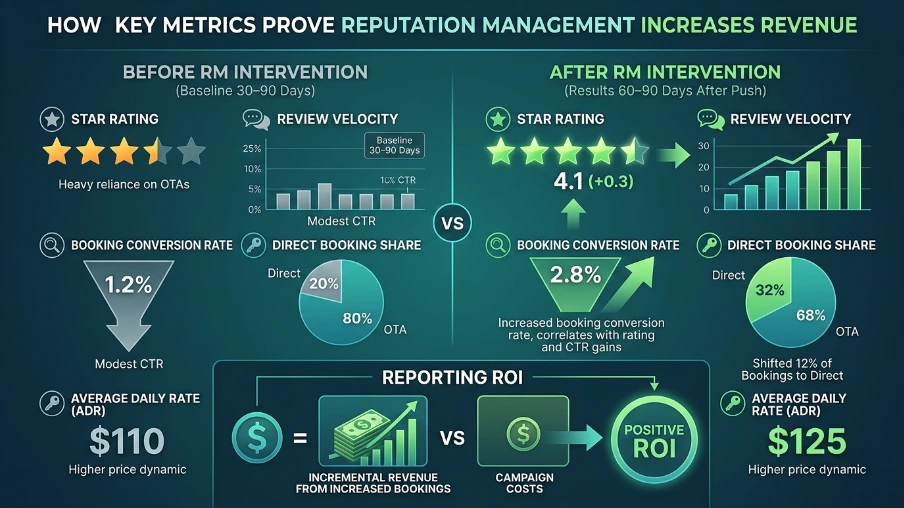
Track star rating, review velocity, conversion rate from organic and local search, direct booking share, and average daily rate (ADR) before and after interventions.
Measure baseline metrics for 30–90 days. After a review acquisition push, expect a visible rise in review velocity and a 0.1–0.3 point increase in average rating within 60–90 days. Correlate rating gains with CTR changes in organic listings and a measurable increase in booking conversion rate. Monitor direct booking share; effective reputation work often shifts 5–12% of bookings from OTAs to direct channels. Report ROI using incremental revenue from increased bookings versus campaign costs.
How should hotels and restaurants structure a reputation management process?
Create a closed-loop process: collect reviews, respond, analyse sentiment, resolve root causes, and optimise SEO repeat weekly.
Assign clear roles: front-desk staff request reviews, guest relations handle responses, marketing implements schema and landing page updates, operations fix recurring issues. Use a central dashboard to aggregate Google, TripAdvisor, Yelp, and niche platforms. Run weekly reports to prioritise high-impact fixes. Perform quarterly audits of review prompts, response templates, and schema markup. This structured cadence reduces friction and maintains steady improvement in booking metrics.
What tools and integrations accelerate results?
Integrate a review-collection platform, a monitoring dashboard, and your PMS or booking engine to automate outreach and centralise data.
Connect systems via API to trigger review requests at check-out. Use a monitoring dashboard to capture mentions across Google, TripAdvisor, Booking.com, and social platforms. Implement schema injection on property pages to show aggregated ratings. Link reputation analytics to your revenue-management system to measure ADR and occupancy impact. Choose tools that export citation-quality data for audits and executive reports.
Explore our Reputation Management for business guides,
Free vs Paid Reputation Monitoring Tools: Which Is Right for You?
Common Review Response Mistakes That Damage Your Reputation
How much time and budget should businesses allocate?
Allocate 3–6 months for measurable rating gains and a recurring monthly budget equal to 1–2% of projected monthly bookings revenue for tools and staff time.
Initial setup tooling, templates, and staff training takes 4–6 weeks. Expect visible rating improvements in 60–90 days when campaigns run consistently. Budget 1–2% of monthly bookings revenue for software, staff hours, and A/B testing review prompts. Scale investment as review volume and conversion impact grow.
Reputation management directly increases bookings by improving star ratings, local search visibility, and guest trust. Clear processes for review collection, rapid response, SEO of review content, and continuous monitoring create measurable lifts in conversion and direct bookings. Clear My Name implements these strategies through targeted review acquisition, response workflows, schema optimisation, and integrated dashboards to drive booking growth and measurable ROI through Reputation Management for business.
Frequently Asked Questions
How does Reputation Management for business improve local search rankings?
Reputation Management for business improves local search rankings by increasing review volume, improving average ratings, and generating location-relevant review text that search engines index. Clear My Name implements review solicitation and schema markup to surface star ratings and local signals in Google and map results.
How long does it take for Reputation Management for a business to affect bookings?
Changes appear within 60–90 days for visible rating and local ranking improvements when review acquisition and response processes run consistently. Clear My Name measures progress with baseline metrics and weekly reports to show organic CTR and booking conversion shifts.
Which platforms should I monitor for Reputation Management for business?
Monitor Google Business Profile, TripAdvisor, Booking.com, Facebook, and niche industry sites for restaurants or hotels, plus major review aggregators. Clear My Name centralises these sources to deliver unified sentiment data and prioritise responses.
What metrics prove Reputation Management for business delivers ROI?
Key metrics include average star rating, review velocity, organic/local CTR, direct booking share, and change in conversion rate and ADR. Clear My Name ties these metrics to revenue to calculate incremental bookings and campaign ROI.
Can small hotels and restaurants afford Reputation Management for business?
Yes; small properties can start with low-cost automation for review requests and targeted response workflows, scaling tools as impact grows. Clear My Name recommends a phased approach, tracking rating and booking lift before increasing spend.