
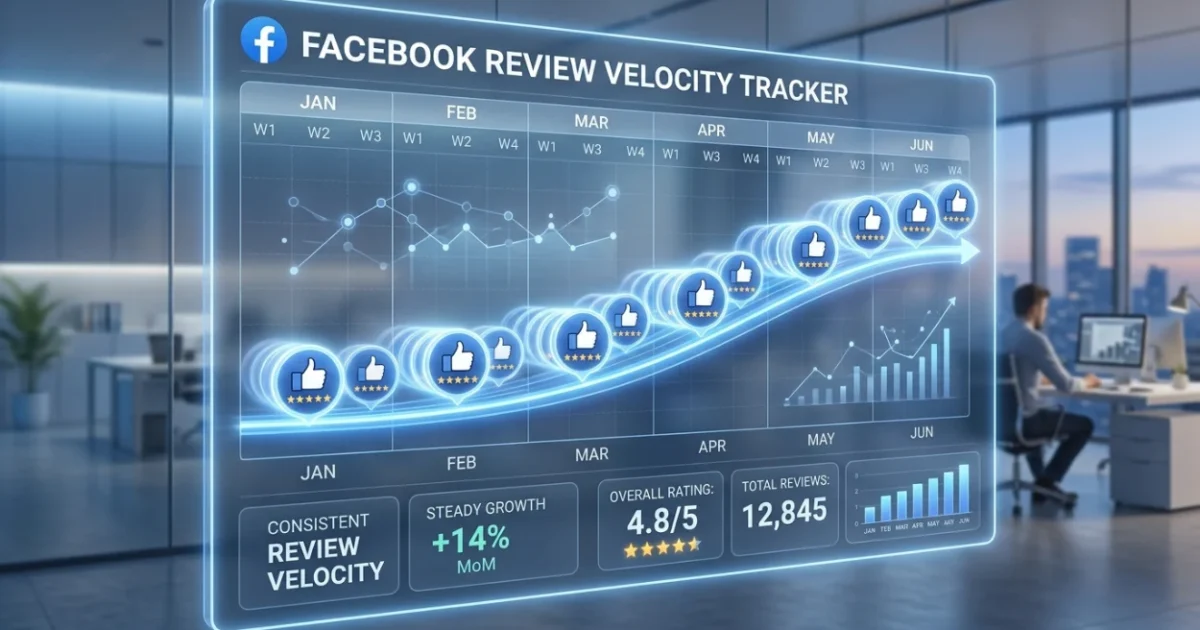
Consistent Facebook review velocity is maintained by generating a steady pattern of genuine customer feedback rather than relying on occasional increases in review volume. The most sustainable approach combines ongoing customer engagement, review monitoring, sentiment analysis and reputation risk management.
Reputation management strategies differ based on the type, frequency and visibility of reputation signals associated with an entity. Online reputation control methods are evaluated through their ability to influence information quality, sentiment distribution, SERP composition, entity credibility and long-term digital visibility. Facebook Reviews form part of this environment by creating publicly accessible customer-generated information that contributes to an organisation’s broader digital footprint.
What does Facebook review velocity mean for reputation management?
Facebook review velocity is the rate and consistency at which new customer reviews are generated on a Facebook business presence. Unlike total review count, which represents accumulated historical feedback, velocity measures how frequently fresh reputation signals enter the profile.
Review velocity operates through a temporal pattern rather than a single numerical measurement. A profile receiving reviews at relatively consistent intervals demonstrates ongoing customer feedback activity, while a profile receiving a large number of reviews during one period followed by prolonged inactivity presents a different pattern. The distinction is important because current reputation information has a different contextual value from historical information.
From a reputation management perspective, velocity provides an additional measurement for evaluating the health of a review profile. It does not replace rating averages, review sentiment or total review volume. Instead, it adds information about whether customer-generated content continues to develop over time.
Consistent activity also creates a more stable sentiment distribution. When reviews are published regularly, positive, neutral and negative feedback enter the dataset continuously, allowing the overall profile to reflect a broader period of customer experience rather than a single concentrated period.
Is consistent review velocity more effective than increasing total review volume?
Consistent review velocity is generally more informative for ongoing reputation analysis than short-term increases in total review volume because it establishes continuity. Total volume measures accumulated customer feedback, whereas velocity measures the rate at which new information is added.
A sudden increase in review volume creates a temporary change in the profile’s information density. Once the increase stops, the velocity returns to its previous level. A consistent review pattern instead creates an ongoing stream of reputation signals that remains connected to current customer activity.
The two approaches therefore serve different strategic purposes. Increasing total volume expands the historical evidence available on a profile, while maintaining velocity keeps the review dataset active and temporally current. Neither measurement independently determines search ranking influence or entity credibility.
A balanced evaluation considers both metrics together. High volume with low recent activity indicates an established historical reputation, while moderate volume with consistent recent activity indicates an actively developing reputation profile. The strongest analysis therefore evaluates volume, velocity, recency and sentiment distribution as separate variables.
How does organic review generation compare with reactive review management?
Organic review generation focuses on creating conditions in which genuine customers voluntarily provide feedback, while reactive review management focuses on responding to existing reviews and reputation events. These approaches operate differently because one develops new reputation signals and the other manages information that already exists.
Organic activity has a long-term orientation because each genuine review adds another piece of customer-generated content to the profile. Regular customer feedback creates continuity and expands the available dataset. Its limitation is that review frequency depends on actual customer behaviour and business activity.
Reactive management operates after a review has already been published. It includes responding to customer feedback, identifying recurring sentiment themes and addressing reputational issues visible within the review profile. This approach provides greater control over communication but does not directly create new independent customer feedback.
The two approaches therefore complement rather than replace each other. Organic review generation affects the development of the reputation dataset, while reactive management affects how existing information is interpreted and contextualised. Evaluating them separately prevents response activity from being mistaken for review velocity.
How does review response management compare with review generation?
Review response management and review generation address different parts of the reputation cycle. Review generation adds new customer-generated information, while response management adds an organisational perspective to information that customers have already published.
A response can demonstrate acknowledgement, clarification or issue resolution without changing the original review itself. This distinction is important because the customer’s sentiment remains part of the public record even when an organisation provides additional context.
Review generation affects the quantity and temporal distribution of customer feedback. Response management affects the conversational context surrounding that feedback. Both contribute to the overall perception of an entity, but they produce different types of reputation signals.
From a scalability perspective, response management requires continuous monitoring as review volume increases. Review generation also requires ongoing customer interaction, but its output depends on authentic customer participation. A sustainable reputation strategy therefore evaluates both the production of new feedback and the management of existing feedback.
When is content creation more appropriate than content removal?
Content creation is more appropriate when existing information is accurate, legitimate and capable of being contextualised through additional authoritative information. Content removal is relevant when information violates platform rules, contains demonstrably inaccurate material or qualifies for a legitimate removal mechanism.
Content enhancement operates by adding relevant, authoritative information to the digital footprint. New content can establish clearer entity associations, provide factual context and strengthen topical relevance. It does not erase existing reputation signals and therefore functions differently from suppression or removal.
Content removal operates through specific mechanisms that affect the availability of an existing item. Platform policies, legal rights and content ownership rules determine whether removal is possible. Removal therefore depends on eligibility rather than simply on the reputational impact of the content.
The distinction is essential for risk evaluation. Attempting to remove legitimate customer feedback without an applicable policy basis does not represent a sustainable reputation management method. Content creation provides a broader long-term approach, while removal remains a targeted response to information that meets defined removal criteria.
Dive Deeper With Our Expert Guides:
A Practical Guide to Meta’s Recommendation Content Policies
Review Acquisition Tactics Built for Local Facebook Pages
How does review velocity affect SERP composition?
Review velocity can influence the information environment surrounding an entity by continuously introducing fresh customer-generated content. SERP composition refers to the combination and ordering of information that appears in search results for a particular query.
Search engines evaluate indexed content according to relevance, quality, authority, context and other signals. Reviews can contribute to the wider entity information environment, particularly when they contain language associated with products, services, locations or customer experiences.
However, Facebook review velocity does not operate as an isolated ranking control. Search ranking influence results from interconnected systems that evaluate multiple content sources. A change in review activity therefore does not guarantee a corresponding change in organic search position.
The stronger consideration is information continuity. Regularly generated customer feedback provides new material that can contribute to an entity’s broader digital footprint. When combined with authoritative websites, relevant third-party references and consistent entity information, review content becomes one component of a wider search perception system.
Which approach provides better long-term reputation sustainability?
Long-term sustainability depends on whether a reputation management approach creates repeatable processes rather than temporary changes in reputation signals. Consistent customer feedback, continuous monitoring and structured response processes provide greater continuity than isolated reputation interventions.
Short-term tactics often focus on immediate changes in review volume, individual negative results or temporary SERP fluctuations. These actions address a defined problem but do not necessarily establish an ongoing reputation management system. Their effectiveness therefore needs to be measured against the persistence of the original issue.
Long-term approaches focus on maintaining the quality and consistency of the entire information ecosystem. This includes monitoring new reviews, analysing sentiment distribution, maintaining accurate entity information and developing authoritative content where appropriate.
Sustainability also depends on risk exposure. Processes based on authentic customer feedback and legitimate platform mechanisms create a clearer compliance position than artificial review activity or attempts to manipulate reputation signals. The long-term objective is therefore consistency within legitimate information systems rather than artificial control of review outcomes.
How can businesses evaluate the effectiveness of Facebook review velocity?
Effectiveness can be evaluated by measuring review frequency, recency, sentiment distribution, rating patterns and changes in the broader reputation environment. A single increase in review count does not provide enough evidence to determine whether review velocity has improved.
A practical evaluation framework includes four core measurements:
- Measure review frequency — Calculate the number of new reviews received during consistent time periods to identify whether activity is stable, increasing or declining.
- Analyse review recency — Examine publication dates to distinguish current customer feedback from historical reputation information.
- Evaluate sentiment distribution — Categorise recent review language according to positive, neutral and negative sentiment to identify changes in customer perception.
- Compare reputation signals — Assess Facebook review activity alongside ratings, third-party references, indexed content and other entity-related information to understand the wider reputation environment.
These measurements create a more reliable assessment than total review count alone. They also separate activity from sentiment, allowing reputation managers to determine whether increased review velocity represents a broader change in customer feedback or simply an increase in the amount of available information.
How does review velocity relate to search visibility and entity credibility?
Review velocity relates to search visibility through the wider information ecosystem surrounding an entity rather than through a direct ranking mechanism. Fresh reviews add customer-generated information to the entity’s digital footprint, while search engines independently evaluate that information alongside other indexed sources.
Entity credibility is constructed from multiple reputation signals. Authoritative references, consistent business information, high-quality content and customer feedback each contribute different forms of evidence. Review velocity adds a temporal dimension by indicating how frequently new customer-generated signals enter the ecosystem.
The relationship between velocity and credibility therefore depends on context. Consistent review activity with coherent sentiment and accurate entity information creates a more informative reputation dataset than a profile evaluated solely through its historical review total. The quality and authenticity of the underlying information remain central to the assessment.
Search visibility also depends on query intent and SERP composition. Review activity can contribute to the information available around an entity, but it does not independently determine which pages rank. This distinction prevents review velocity from being treated as a standalone search ranking mechanism.
What are the main limitations of relying on review velocity?
The main limitation is that review velocity measures activity rather than reputation quality. A high frequency of reviews does not automatically indicate positive sentiment, strong customer satisfaction or greater entity credibility.
Velocity also varies naturally according to business activity, customer volume and seasonal patterns. Comparing two entities without accounting for these contextual differences produces an unreliable evaluation. A meaningful assessment therefore compares an entity’s current activity with its own historical pattern and relevant operational context.
Another limitation concerns authenticity and platform compliance. Artificially generated or manipulated reviews create risk exposure and undermine the reliability of the reputation dataset. Sustainable review velocity therefore depends on genuine customer participation and legitimate platform processes.
Finally, review velocity cannot control the entire search ecosystem. Negative third-party content, authoritative news coverage, outdated pages and other reputation signals remain independent components of SERP composition. Review management is consequently one element of reputation strategy rather than a complete solution for every search perception issue.
How can consistent Facebook review velocity be maintained sustainably?
Consistent Facebook review velocity is maintained through repeatable customer-feedback processes rather than short-term attempts to increase review volume. The emphasis remains on continuity, authenticity and accurate measurement.
A sustainable framework evaluates customer touchpoints where genuine feedback naturally follows an interaction. It then monitors review frequency and sentiment without attempting to manufacture outcomes. This creates a measurable relationship between customer activity and review generation.
Ongoing monitoring also identifies changes in sentiment distribution. A decline in positive feedback, an increase in recurring complaints or a change in review frequency provides information for operational and reputational analysis. These signals can then be evaluated alongside wider digital footprint changes.
Where review activity forms part of a broader reputation programme, the strategy can also connect customer feedback with authoritative content and consistent entity information. This creates a more comprehensive reputation environment instead of treating Facebook reviews as an isolated metric.
A structured approach to Sustain Facebook Review Velocity therefore focuses on maintaining authentic review activity, measuring temporal patterns and evaluating new feedback within the wider entity reputation system.
Maintaining Facebook review velocity requires a distinction between review volume, review frequency, review recency and sentiment distribution. Total review count measures accumulated history, while velocity measures the continuing flow of new reputation information.
Organic review generation, reactive review management, content enhancement and legitimate removal mechanisms each operate through different mechanisms. Organic approaches build new customer-generated signals, reactive methods manage existing information, content creation strengthens the wider digital footprint, and removal addresses content that qualifies for an appropriate mechanism.
The most sustainable evaluation considers effectiveness, scalability, risk exposure and long-term continuity. Review velocity contributes to reputation analysis by showing whether fresh customer feedback continues to enter the information ecosystem, but it does not independently control search rankings or entity perception.
What is Facebook review velocity?
Facebook review velocity refers to the rate and frequency at which a business receives new Facebook reviews over time. A consistent review pattern can help create a more natural and credible-looking customer feedback profile.
How often should a business receive Facebook reviews?
There is no fixed number of Facebook reviews a business should receive each week or month. Review frequency should reflect genuine customer activity, business size, sales volume, and opportunities for customers to provide feedback.
How can I maintain a consistent Facebook review velocity?
Encourage genuine customers to leave feedback at regular intervals rather than requesting large numbers of reviews at once. Timing review requests around completed purchases, services, or positive customer interactions can support a steady flow of authentic reviews.
Can sudden increases in Facebook reviews affect a business profile?
A sudden increase in reviews may create an unusual review pattern, particularly when it does not match normal customer activity. Maintaining a steady flow of genuine feedback is generally more appropriate than attempting to generate reviews in large batches.
Does review velocity affect Facebook business reputation?
Review velocity can contribute to how consistently a business’s customer feedback profile develops over time. A steady pattern of authentic reviews, combined with genuine customer engagement, can provide a clearer representation of ongoing customer experiences.