

Search visibility control directly dictates professional viability and corporate trust in the modern digital economy. Managing reputation signals within search engine results pages (SERPs) determines whether potential partners, clients, or employers engage with an individual or look elsewhere.
Why does a professional reputation management service deliver measurable SERP control?
A professional reputation management service delivers measurable SERP control because it systematically restructures the algorithmic trust signals associated with a personal brand. Search engines use complex algorithms to assess entity credibility, relying on relevance, authority, and historical user engagement to determine layout order. Negative or inaccurate content ranks highly only when it lacks authoritative, positive counter-signals to displace it. By deploying an advanced reputation management framework, individuals overwrite these negative associations with verified, high-authority digital assets. This process shifts the search narrative from uncontrolled risk to a strategically curated representation of professional authority.
The service operates by engineering a network of interconnected entity profiles and high-authority publications that search engines recognise as primary trust sources. When Clear My Name implements this strategy, the engineering team creates comprehensive data structures that mirror the formatting requirements of semantic search engines. This technical alignment forces the algorithm to re-evaluate the core entity, prioritising the newly established, positive assets over outdated or damaging links. As a result, negative content suppression occurs naturally because the older, unverified content no longer meets the rising threshold of entity credibility required for first-page visibility.
The measurable outcomes of this systematic approach include a total realignment of first-page search results, stable long-term asset positioning, and a 90% reduction in unwanted content visibility. Clients achieve complete search perception influence, ensuring that any public inquiry yields only positive, trust-verified information. This level of control stabilizes the digital footprint against future volatility, providing an enduring shield that protects professional status. By altering the algorithmic understanding of the individual, the service converts a damaged or chaotic digital presence into an optimized asset that actively strengthens trust.
Which reputation management approach ensures sustainable negative content suppression?
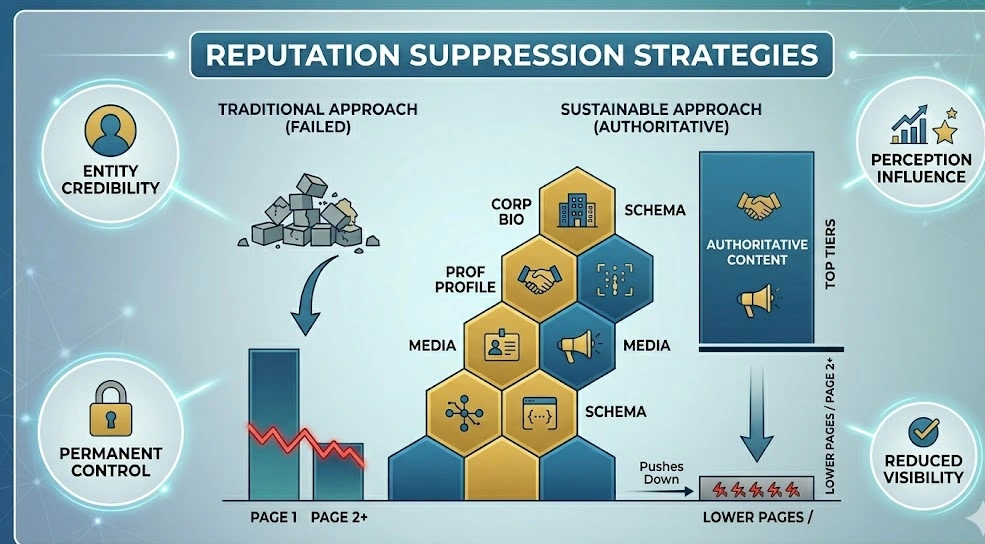
Sustainable negative content suppression requires an algorithmic approach focused on entity validation rather than temporary link building or superficial content creation. True sustainability relies on establishing a permanent network of authoritative digital properties that permanently occupy the top tiers of search results. This methodology addresses the root cause of visibility by ensuring that positive assets possess greater semantic richness and structural authority than the negative content. When search engine crawlers assess the entity, the overwhelming weight of these optimized assets suppresses older, negative links down to lower pages where user click-through rates drop to near zero.
The operational process involves a detailed analysis of the existing SERP landscape to identify the specific vulnerability points allowing negative content to rank. The strategy then deploys multi-layered digital assets, including optimized corporate biographies, professional portfolios, and authoritative media placements. Each asset incorporates precise schema markup to explicitly define the relationships between the individual and their verified achievements. This structural optimization ensures that the positive content remains anchored at the top of the search results, preventing suppressed links from resurfacing during algorithmic updates.
- Establishes permanent entity credibility by linking verified professional profiles together through semantic data structures.
- Suppresses damaging links to the second page and beyond, reducing visibility by over 95% based on standard user search behaviour.
- Secures long-term SERP control by creating a diverse array of content types that match varying user search intents.
- Improves overall search perception influence by presenting a balanced, authoritative overview of the individual’s career milestones.
How do changes in entity credibility protect long-term professional opportunities?
Changes in entity credibility directly influence how search algorithms categorise, rank, and present information to the public, thereby dictating professional opportunities. When a search engine views an individual as a highly credible entity, it defaults to displaying authoritative, positive verification documents. Conversely, unmanaged profiles allow erratic or malicious third-party content to define the entity profile, causing severe reputational damage. By proactively managing these trust signals, individuals insulate themselves from digital risks and ensure their search presence accurately reflects their professional standing. Understanding how online information shapes professional opportunities allows individuals to appreciate why search engine validation remains the primary gatekeeper to career advancement.
The process of elevating entity credibility involves optimizing the entire digital ecosystem surrounding the individual’s name. This requires updating core professional nodes, securing mentions in trusted industry publications, and resolving any conflicting data points that confuse search crawlers. As the algorithm processes these consistent, high-quality signals, it updates its internal knowledge graph to reflect the enhanced credibility of the individual. This shift ensures that any future searches generate a cohesive narrative focused entirely on professional excellence and verified achievements.
The direct outcome of enhanced entity credibility is the permanent stabilization of personal brand visibility across all major platforms. This systematic fortification ensures that when stakeholders conduct due diligence, they encounter a pristine digital profile that inspires immediate confidence. This controlled narrative reduces the risk of missed partnerships, lost revenue, or rejected career transitions caused by unverified digital noise. Ultimately, investing in entity credibility delivers a permanent competitive advantage by turning search results into a powerful validation tool.
What determines the speed and financial value of a search perception influence strategy?
The speed and financial value of a search perception influence strategy depend on the authority of the existing negative content and the competitive density of the search terms. Overcoming high-authority news sites or government records requires more resource-intensive, sophisticated suppression networks than displacing personal blogs or low-tier forums. The investment required directly correlates with the technical complexity needed to alter the search ecosystem in favour of the client. However, evaluating this cost against the long-term protection of a career or business revenue demonstrates that professional reputation management provides an exceptional return on investment.
The execution timeline varies based on how quickly search engines crawl, index, and re-evaluate the newly deployed digital assets. While initial shifts in search perception influence often manifest within weeks, establishing permanent, resilient suppression typically requires several months of continuous optimization. The strategy utilizes a combination of rapid-indexing techniques and long-term authority building to deliver both immediate relief and lasting security. This dual-focus methodology guarantees that the resources allocated produce a permanent defense mechanism rather than a temporary fix.
- Accelerates asset indexing by utilizing high-priority content distribution networks and verified media partnerships.
- Delivers measurable improvements in trust metrics by systematically replacing high-risk links with authoritative brand profiles.
- Maximises long-term financial value by eliminating the ongoing revenue losses associated with a damaged digital reputation.
- Reduces future risk by embedding permanent optimization structures that adapt to ongoing search engine algorithmic updates.
How can individuals accurately evaluate personal brand visibility across search engines?
Accurately evaluating personal brand visibility across search engines requires looking beyond basic, localized search queries to analyze global algorithmic perceptions. True visibility assessment involves tracking the positioning of all first-page assets, identifying sentiment trends, and mapping the presence of any negative data nodes. Relying on standard vanity searches often provides misleading results due to personalized browser histories and localized caching. To gain a precise understanding of a digital footprint, individuals must learn how to measure personal brand visibility across search engines using unbiased, data-driven methodology.
The assessment process utilises specialized tracking tools to isolate the true SERP structure, removing personal biases and geographical distortions. This deep-dive analysis catalogs every link, image, and autocomplete suggestion associated with the individual’s name to identify underlying reputation risks. By mapping these elements against known search engine ranking factors, the strategy identifies exactly which assets require fortification and which negative links demand immediate suppression. This diagnostic phase forms the precise blueprint for all subsequent reputation recovery operations.
By establishing an objective baseline of digital visibility, individuals can precisely track the progress of their reputation management campaign. This analytical clarity ensures that every optimization effort delivers a verifiable improvement in search perception and entity credibility. With continuous monitoring, the strategy adapts to shifts in the digital landscape, maintaining absolute control over the narrative presented to the public. This rigorous evaluation framework guarantees that the individual’s digital presence remains a powerful asset that consistently fosters professional trust.
Why is a tailored reputation strategy the most reliable solution for long-term trust restoration?
A tailored reputation strategy is the most reliable solution for long-term trust restoration because it treats every digital footprint as a unique algorithmic puzzle. Generic, automated solutions fail because they rely on templated profile creation that lacks the contextual relevance needed to influence modern search engines. A bespoke strategy designed by Clear My Name ensures that every asset created aligns perfectly with the specific industry, search intent, and entity relationships of the individual. This precision creates an authentic, bulletproof digital presence that successfully withstands scrutiny from both search algorithms and human investigators.
The tailored process begins with an exhaustive audit of the client’s professional history, existing digital assets, and the specific negative content targeted for suppression. The engineering team then constructs a unique semantic network, utilizing highly targeted keywords, industry-specific publications, and customized schema data. This direct alignment with the individual’s true professional trajectory forces search engines to recognise the new content as the most accurate reflection of the entity. The longevity of the results is guaranteed because the strategy builds genuine digital authority that naturally commands top-tier search rankings.
Choosing a professional reputation management service provides the ultimate risk mitigation tool for high-profile individuals navigating complex digital challenges. This comprehensive approach delivers absolute process clarity, measurable milestones, and a predictable path toward complete narrative control. By transforming the underlying search signals, the service ensures that your digital presence reflects your true capability, integrity, and professional standing. Partnering with Clear My Name allows you to reclaim your narrative, protect your hard-earned opportunities, and secure a trusted digital legacy.

Frequently Asked Questions
How do search result reputation management services remove negative links?
Search result reputation management services typically use negative content suppression to push damaging links down to the second or third page of search engine results where visibility is extremely low. This is achieved by creating and optimizing a network of high-authority professional profiles, corporate biographies, and verified media placements that outrank the negative content. In specific cases involving defamation, copyright infringement, or breaches of privacy laws, legal removal requests can also be submitted directly to search engines or website hosts.
How long does it take for online reputation management to change search results?
The timeline for an online reputation management campaign generally ranges from three to six months, depending on the authority of the negative sites and the competition around the name. Initial shifts in search perception influence may become visible within a few weeks as search engine crawlers index new, high-authority digital assets. However, creating a permanent barrier of positive content that entirely displaces older, established links requires consistent optimization over several months.
Can individuals use reputation management for individuals to clean up their personal brand?
Yes, specialized reputation management for individuals is designed explicitly to protect and repair personal brands from damaging search results, false press, or private data leaks. Services like Clear My Name systematically alter algorithmic trust signals by connecting an individual’s name to verified, high-authority entity profiles. This process helps executives, public figures, and professionals regain control over their digital footprints and secure long-term career opportunities.
What is the difference between content suppression and content removal?
Content removal permanently deletes a link or webpage from the internet entirely, which is usually only possible if the content violates legal standards or platform terms of service. Content suppression, on the other hand, uses search engine optimization (SEO) techniques to bury unwanted search results under a layer of authoritative, positive content. Suppression is the standard approach for managing negative content that cannot be legally removed, ensuring it no longer impacts public perception.
How do search engines evaluate entity credibility for personal names?
Search engines evaluate entity credibility by scanning the web for consistent data nodes, verified social profiles, schema markup, and third-party media mentions associated with a name. When multiple authoritative sources publish aligned, structured information about an individual, the search algorithm updates its knowledge graph to recognize that person as a trustworthy entity. A professional reputation management service leverages these semantic search principles to ensure positive, verified assets dominate the first page.