

Reputation metrics define how a business is perceived across search ecosystems and digital information environments. These metrics influence search visibility, entity perception, credibility evaluation, and long-term business growth.
Reputation management is the process of monitoring, analysing, and understanding reputation signals that shape public perception. Online reputation refers to the collection of indexed information, reviews, mentions, content assets, and trust indicators that search engines evaluate when determining credibility.
What are reputation metrics and why do they matter for business growth?
Reputation metrics are measurable indicators that evaluate trust, credibility, authority, and perception within digital ecosystems. These metrics provide data about how an entity is interpreted by search engines, users, review platforms, and information retrieval systems.
Search engines rely on reputation signals to understand whether an entity demonstrates expertise, trustworthiness, and relevance. Content indexing systems collect information from multiple sources and connect those signals to an entity profile. Reputation metrics help explain how perception is formed rather than simply describing popularity.
Business growth is linked to reputation because search visibility influences discovery. When credibility signals remain consistent across indexed sources, search engines gain stronger confidence in entity understanding. This process affects rankings, click behaviour, and perception during SERP evaluation.
How does review volume function as a reputation metric?
Review volume is the total quantity of user-generated reviews associated with an entity across digital platforms. It acts as a measurable reputation signal that demonstrates the scale of public feedback available for evaluation.
Search ecosystems analyse review volume as part of entity assessment. A larger review dataset provides more information for sentiment interpretation and trust calculations. Algorithms evaluate review frequency alongside review quantity to understand information freshness.
Review volume influences perception because users interpret larger datasets as stronger evidence. During SERP evaluation, extensive review activity creates additional context around products, services, organisations, and brands. This contributes to credibility assessment within search environments.
Why is review sentiment a key indicator of reputation?
Review sentiment is the aggregated emotional and evaluative direction expressed within user feedback. It measures whether indexed opinions are positive, neutral, or negative.
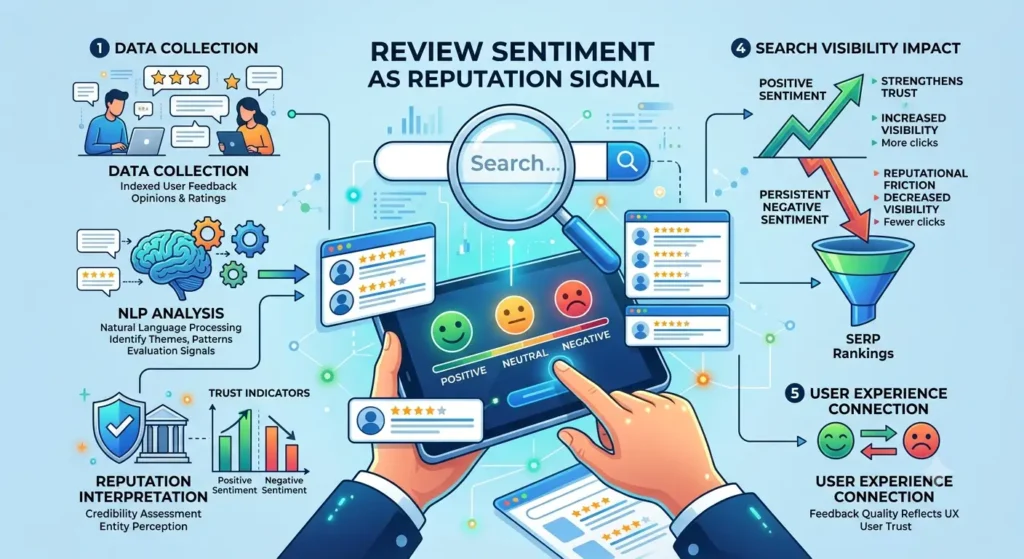
Search engines use natural language processing to analyse sentiment patterns. Content indexing systems identify recurring themes, opinions, and evaluation signals across reviews. These patterns contribute to reputation interpretation and entity perception.
Sentiment affects search visibility because credibility is partly derived from feedback quality. Consistently positive sentiment strengthens trust indicators, while persistent negative sentiment introduces reputational friction. Search ecosystems interpret sentiment as a behavioural reputation signal connected to user experience.
How does search visibility measure reputation strength?
Search visibility refers to the prominence of an entity across search engine results pages. It measures how frequently and how prominently an entity appears for relevant queries.
Search engines rank information according to relevance, authority, and trust signals. When an entity consistently appears across high-value search queries, visibility becomes a measurable representation of reputation strength. Visibility demonstrates recognition within the information retrieval process.
Strong search visibility increases exposure to users seeking information. Search ecosystems often associate visibility with authority because indexed content repeatedly satisfies search intent. This relationship connects reputation development with discoverability.
What is branded search demand and what does it reveal?
Branded search demand is the volume of searches containing a specific entity name. It reflects recognition, awareness, and information-seeking behaviour connected to that entity.
Search demand acts as a reputation metric because it indicates public interest. When users actively search for an organisation, they contribute behavioural data that demonstrates entity relevance. Search engines interpret this activity as a recognition signal.
Branded search demand affects perception because repeated search activity reinforces entity prominence. Search ecosystems evaluate these patterns when analysing relevance and popularity. The metric helps explain how awareness contributes to reputation formation.
How does content sentiment influence entity perception?
Content sentiment refers to the overall evaluative tone contained within indexed articles, reviews, discussions, and informational resources. It extends beyond review platforms and includes broader content ecosystems.
Search engines analyse sentiment through semantic interpretation models. Algorithms identify language patterns associated with trust, credibility, satisfaction, criticism, and authority. These signals contribute to entity understanding.
Entity perception develops through accumulated content signals. Positive content sentiment supports trust formation, while negative sentiment alters interpretation. Search ecosystems continuously evaluate indexed information to maintain updated entity profiles.
Why is authority score associated with reputation evaluation?
Authority score is a measurement used to evaluate perceived credibility and influence across digital environments. It reflects the strength of content relationships, references, citations, and trust signals.
Authority emerges through information validation. Search engines analyse content quality, citation networks, topical expertise, and consistency across sources. These factors help define whether an entity demonstrates recognised authority.
Authority affects search visibility because ranking systems prioritise trustworthy information. Strong authority signals support higher confidence during SERP evaluation. This relationship links credibility measurement to reputation assessment.
How do brand mentions contribute to online credibility?
Brand mentions are references to an entity across websites, articles, reviews, forums, and digital publications. They function as reputation signals because they indicate recognition within information networks.
Search ecosystems analyse both linked and unlinked mentions. Algorithms evaluate contextual relevance, sentiment, source quality, and topical alignment. Mention patterns help search engines understand entity relationships.
Online credibility increases when references originate from authoritative and relevant sources. Consistent mentions reinforce entity recognition and contribute to reputation stability. This process supports broader search ecosystem understanding.
What role does sentiment consistency play in reputation management?
Sentiment consistency measures the stability of evaluative signals across digital channels. It analyses whether perception remains aligned across reviews, content, discussions, and indexed information sources.
Search engines evaluate consistency because conflicting information complicates entity interpretation. Stable sentiment patterns create clearer understanding within content indexing systems. Consistency reduces ambiguity during reputation evaluation.
Entity perception benefits from coherent information structures. When positive or negative sentiment remains consistent across sources, algorithms identify stronger confidence signals. This improves reputation clarity within search ecosystems.
How does digital footprint size affect reputation?
Digital footprint refers to the total collection of indexed information associated with an entity. It includes websites, reviews, articles, profiles, citations, media assets, and references.
A larger digital footprint increases informational coverage. Search engines gain access to more data points for reputation assessment. Expanded coverage strengthens entity understanding because algorithms can verify information across multiple sources.
Digital footprint size influences perception through visibility and information availability. Comprehensive indexed coverage creates stronger contextual understanding. Search ecosystems rely on this information density when evaluating trust and relevance.
Why are engagement signals connected to credibility?

Engagement signals refer to measurable interactions with digital content. These interactions include clicks, comments, shares, discussions, and user participation behaviours.
Search ecosystems analyse engagement because it reflects audience response to information. High engagement often indicates content relevance and informational value. Algorithms evaluate behavioural patterns alongside traditional ranking factors.
Credibility is reinforced when engagement aligns with quality content. Consistent interaction demonstrates that users find information useful and relevant. This contributes additional context during reputation evaluation.
How does knowledge panel accuracy influence reputation perception?
Knowledge panel accuracy refers to the consistency and correctness of structured entity information displayed within search environments. Accurate information supports reliable entity identification.
Search engines build knowledge representations using structured and unstructured data. These systems connect attributes, relationships, and factual information to an entity profile. Accuracy determines whether search engines maintain confidence in those associations.
Dive Deeper With Our Expert Guides:
Why Reputation Is Becoming a Key Competitive Advantage
15 Business Reputation Trends Affecting UK Companies This Year
Reputation perception benefits from accurate knowledge representation because users receive consistent information. Search ecosystems use entity verification processes to strengthen trust and improve information reliability.
What is reputation trend analysis and why is it important?
Reputation trend analysis is the process of evaluating changes in reputation signals over time. It examines sentiment movement, visibility shifts, review developments, and credibility indicators.
Search ecosystems are dynamic information environments. Entity perception changes as new content enters indexing systems and older content loses prominence. Trend analysis explains how reputation evolves rather than providing a static measurement.
A structured approach helps define:
How to Build a Reputation Improvement Strategy by analysing metric movement, identifying signal patterns, and evaluating perception changes across search ecosystems. Trend analysis transforms isolated reputation metrics into a coherent understanding of digital trust development.
Reputation metrics provide measurable indicators of how search ecosystems evaluate trust, authority, credibility, and relevance. Review sentiment, search visibility, digital footprint size, authority signals, engagement patterns, and entity accuracy each contribute to reputation formation.
Search engines interpret reputation through interconnected information signals rather than isolated data points. Content indexing, sentiment evaluation, SERP analysis, and entity recognition systems collectively define online credibility. Understanding these twelve reputation metrics explains how digital perception develops and how reputation influences long-term business growth within search environments.
Answers to Key Questions
What is reputation management for business?
Reputation management for business is the process of monitoring, analysing, and improving how a company is perceived online. It focuses on search results, customer reviews, media mentions, and other reputation signals that influence trust and credibility.
Why is online reputation important for a business?
Online reputation affects how customers, partners, and stakeholders evaluate a business before making decisions. Positive search visibility and credible online information help strengthen digital trust and brand perception.
How do customer reviews impact business reputation?
Customer reviews contribute directly to online reputation by influencing public perception and search engine evaluation. Review sentiment, review volume, and review quality are important reputation signals used across digital platforms.
What factors influence a company’s online reputation?
Key factors include search engine results, customer reviews, media coverage, social mentions, content quality, and digital footprint. Together, these elements shape entity perception and online credibility.