
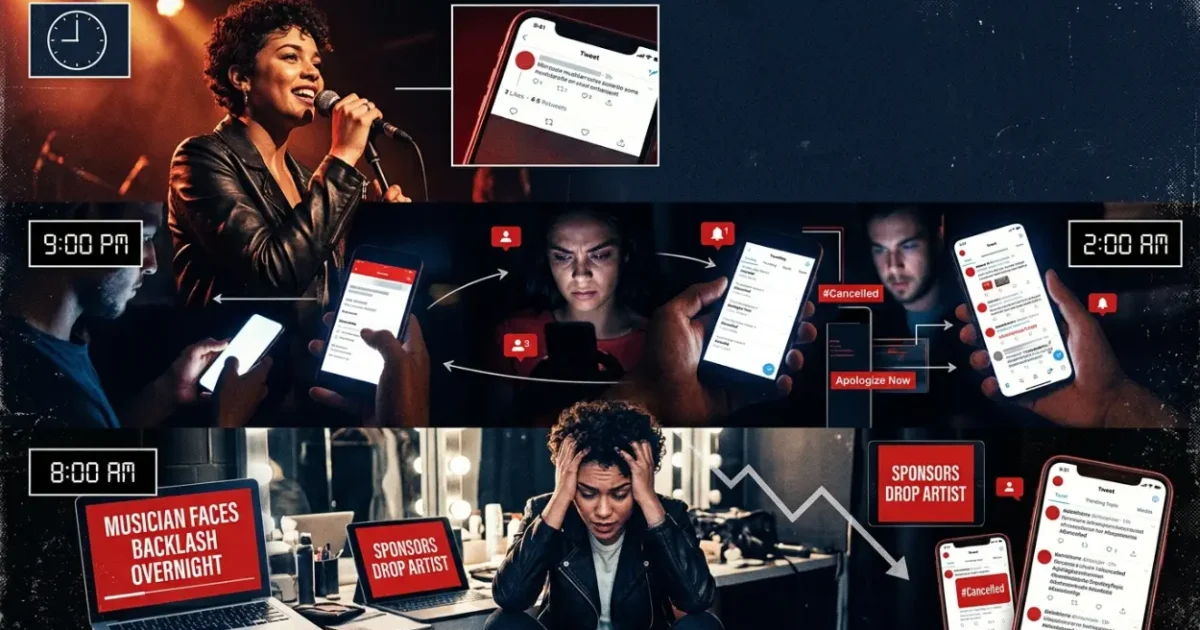
Cancel campaigns can damage a musician’s online reputation rapidly by concentrating negative content across social platforms, search results and public discussions. Reputation management is the process of monitoring and influencing how an individual or entity is represented across digital environments.
Online reputation refers to the collection of information, opinions, reviews, discussions and published content associated with a person across the internet. For musicians, this digital footprint includes social profiles, interviews, streaming platforms, news coverage, reviews and search results. When a controversy begins, these information sources interact to shape entity perception. Search visibility then determines which parts of that reputation users encounter first.
What is a cancel campaign in an online reputation system?
A cancel campaign is a coordinated pattern of public criticism intended to reduce support for a person, organisation or public figure. It operates through repeated discussions, reposted claims, commentary, social posts and references across interconnected digital platforms. The campaign itself does not represent a single ranking mechanism because search engines independently evaluate and organise available content. However, increased publication and engagement create additional information that enters the musician’s digital footprint.
The reputation impact depends on the type, quantity, credibility and persistence of published information. A single social post has a different information footprint from an allegation discussed across news websites, forums and public social accounts. Search engines crawl and index eligible content according to their own systems, while users interpret the resulting information through context and perceived authority. The combination creates an environment where search perception can change rapidly without every individual piece of content receiving equal visibility.
A cancel campaign therefore functions as an information-distribution event within a wider reputation system. Its influence comes from the interaction between publication, indexing, engagement, content relevance and user behaviour. Understanding these mechanisms separates reputation analysis from assumptions about public opinion alone.
Why can cancel campaigns affect musicians so quickly?
Cancel campaigns can affect musicians quickly because musicians maintain highly visible digital identities across multiple platforms. Their names frequently function as strong search entities connecting music releases, performances, interviews, social profiles and media coverage. When a controversy introduces new content associated with the same entity, search engines receive additional information about that entity. Users searching the musician’s name can then encounter a different mixture of content from the material previously associated with the artist.
Speed also results from the low barriers to digital publication. Social platforms allow commentary to spread before longer-form content receives formal editorial review. Repeated references can create multiple URLs, posts and discussions around the same topic. These sources remain distinct even when they repeat substantially similar claims. The resulting digital footprint becomes more complex as additional content is indexed.
This does not mean that rapid publication automatically produces permanent search-ranking changes. Search engines evaluate content independently using numerous signals. However, rapid content creation increases the quantity of information available for crawling, indexing and evaluation. Reputation analysis therefore focuses on how the information ecosystem changes rather than treating social activity as a direct ranking command.
How do search engines interpret cancel campaign content?
Search engines interpret cancel campaign content through ranking and retrieval systems that evaluate relevance, quality, authority and other signals. They do not assign a universal “reputation score” that determines whether a musician is trusted. Instead, search systems organise individual pages and pieces of content in response to specific queries. The musician’s name acts as an entity-related query that can retrieve content from different sources.
Content ranking dynamics determine which pages become more visible when users search for the musician. A recent article, social profile or discussion can enter the competitive environment for branded queries if it is indexed and considered relevant. Existing authoritative pages continue to compete for visibility. The resulting SERP composition therefore reflects the interaction between newly published information and previously established content.
Search evaluation also distinguishes between the existence of content and its ranking position. A page being indexed does not guarantee prominent visibility. Similarly, a large amount of discussion does not automatically place every related page at the top of search results. This distinction is essential when analysing the search impact of cancel campaigns.
What reputation signals increase during a cancel campaign?
The primary reputation signals that increase during a cancel campaign are content volume, topical association, sentiment, references and discussion frequency. These signals exist across different platforms and do not function as one combined algorithmic score. Instead, they contribute to the information environment surrounding an entity. Increased references to the same musician and topic can strengthen the association between the entity and the subject within the visible digital footprint.
Sentiment is another important component of reputation analysis. Sentiment refers to the positive, negative or neutral orientation expressed within content. Search engines can process language and context, but sentiment interpretation is not equivalent to assigning a simple positive or negative reputation rating. Different pages can contain different perspectives about the same event.
Authority also affects how information is perceived. A detailed publication from an established source carries a different contextual signal from an anonymous social post. Users similarly evaluate information according to source familiarity, evidence, recency and consistency. Entity credibility therefore depends on the broader information environment rather than a single reputation signal.
How does content indexing influence a musician’s digital reputation?

Content indexing determines whether eligible online material becomes available for retrieval within a search engine’s index. When new content relating to a musician is crawled and indexed, it enters the pool of information that can potentially appear for relevant queries. Indexing therefore represents an important stage between publication and search visibility. It does not guarantee high ranking or prominent SERP placement.
A cancel campaign can produce a rapid increase in potentially relevant content. Articles, public posts, videos, interviews and discussions each create separate information objects. Their indexing status can differ according to technical accessibility, platform restrictions, duplication and search-engine evaluation. Consequently, the visible reputation landscape depends on which content is actually available for retrieval.
Content indexing also explains why deleting or editing one social post does not automatically remove every reference to the same subject. Information can exist across independent sources. Search perception therefore requires analysis of the complete digital footprint rather than focusing on a single publication.
How does social media activity affect search perception during a cancel campaign?
Social media activity affects search perception by generating publicly accessible information, discussions and references associated with a musician. Social platforms can become important sources of reputation signals because users publish reactions, commentary and links at high frequency. Some of this material remains confined to the platform, while other content becomes discoverable through search engines. The distinction depends on platform architecture, accessibility and indexing.
High engagement can also increase the visibility of a discussion within its original platform. However, social engagement does not translate into an identical ranking effect in general search results. Search engines use their own retrieval and ranking systems. Therefore, social popularity and SERP prominence represent related but separate forms of visibility.
For reputation analysis, the important factor is the relationship between platform activity and the wider information ecosystem. Social discussion can lead to additional articles, commentary and references, increasing the amount of content associated with the entity. This creates a broader reputation footprint for search systems and users to evaluate.
Dive Deeper With Our Expert Guides:
Why a Single Bad Concert Review Spreads Across Fan Forums
How Old Lyrics and Tweets Resurface to Haunt Artists
How does negative sentiment influence a musician’s online credibility?
Negative sentiment influences online credibility by changing the type of information users encounter when researching the musician. Sentiment is interpreted within context, meaning criticism, factual reporting, opinion and unverified commentary represent different information categories. A reputation analysis therefore evaluates the source, context and distribution of negative content rather than simply counting negative mentions.
A concentration of negative content around branded searches can alter the perceived balance of information. Users often examine multiple results before forming an assessment, making SERP composition relevant to online credibility. If negative material occupies prominent positions, it receives greater exposure during the research process. If authoritative neutral or positive material remains visible, users encounter a broader representation of the entity.
The effect is therefore connected to visibility rather than sentiment alone. A negative statement with limited reach has a different reputation impact from highly visible content appearing repeatedly across prominent sources. Measuring search visibility provides a more precise method for evaluating reputation changes.
Why do repeated claims create stronger reputation associations?
Repeated claims can create stronger associations because the same topic becomes connected to the musician across multiple pieces of content. Search systems recognise relationships between entities, topics and language through information processing mechanisms. Users also notice recurring references when similar subjects appear across multiple results. Repetition therefore increases the prominence of an association within the digital information environment.
However, repetition does not independently establish factual accuracy. Multiple pages can reproduce the same original claim without providing independent evidence. A reputation analysis must therefore distinguish between content quantity and source independence. Treating every repeated reference as separate confirmation creates an inaccurate assessment of credibility.
This distinction is especially important during rapidly developing controversies. Early claims can spread before comprehensive information becomes available. Subsequent content can repeat those claims while adding little new evidence. Evaluating source provenance, publication context and content relationships provides a more accurate understanding of the reputation signal.
What can musicians monitor when a cancel campaign begins?
Musicians can monitor the structure and movement of their digital reputation rather than focusing exclusively on individual comments. Monitoring identifies changes in search visibility, content indexing, sentiment distribution and entity associations. It also provides a basis for distinguishing temporary discussion from persistent reputation changes.
- Track branded search results to identify changes in SERP composition and the appearance of newly indexed content.
- Analyse content sources to distinguish authoritative reporting, commentary, duplicated claims and independent publications.
- Monitor sentiment distribution to identify whether negative, neutral or positive content is becoming more prominent.
- Evaluate entity associations to determine which topics increasingly appear alongside the musician’s name.
- Record content changes over time to separate short-lived discussion from persistent search visibility patterns.
These measurements provide a structured view of reputation development. They also prevent individual social posts from being treated as complete evidence of the musician’s online reputation. The objective is to understand how information is distributed, interpreted and retrieved across the wider ecosystem.
How can musicians assess rapid reputation changes without overreacting?
Musicians can assess rapid reputation changes by separating immediate online activity from measurable changes in the broader search environment. Social discussion often develops faster than search indexing and ranking changes. Treating every viral post as a permanent reputation shift creates an inaccurate assessment. A structured review examines search results, indexed content, source authority and sentiment distribution together.
A useful assessment begins with the musician’s existing digital baseline. Established profiles, official websites, music platforms and historical coverage provide context for evaluating new content. Comparing the current SERP composition with that baseline identifies whether the information environment has materially changed. This approach prioritises observable search behaviour over assumptions about public reaction.
The assessment also benefits from monitoring over consistent periods. A rapid increase in mentions can decline quickly, while some content remains searchable for longer periods. Measuring persistence provides stronger evidence than relying on a single snapshot. Reputation analysis therefore combines speed of detection with disciplined interpretation.
What role does a rapid-response reputation strategy play?
A rapid-response reputation strategy focuses on identifying and analysing reputation changes before they become established within the wider digital footprint. The objective is not to control every online conversation. Instead, it is to establish visibility over new content, assess its significance and understand how it interacts with existing reputation signals.
The strategy becomes more effective when it distinguishes between content types. A social comment, news article, review, interview and official statement each operate differently within the information ecosystem. Their authority, indexability, persistence and audience differ. Classifying these sources enables more precise reputation analysis.
For musicians seeking a deeper understanding of this approach, rapid-response plans for musicians facing cancel campaigns provide a useful consideration-stage framework for evaluating response timing, monitoring and reputation-risk controls. The focus remains on understanding how information develops rather than assuming every criticism produces an identical search impact.
How sustainable is reputation recovery after a cancel campaign?
Sustainable reputation recovery depends on the long-term composition of the musician’s digital footprint rather than a temporary reduction in discussion. Search engines continuously discover and evaluate content, while older indexed pages can remain available for future queries. Reputation therefore functions as an evolving information system rather than a fixed status.
A sustainable digital reputation contains accurate, authoritative and current information about the entity. Official content, credible publications, professional profiles and relevant third-party references contribute to the information environment. Their continued availability provides users with broader contextual evidence when evaluating the musician.
Long-term analysis also requires monitoring new content and changing search behaviour. Reputation signals can shift as new events, publications and discussions emerge. Maintaining awareness of the digital footprint therefore supports a more accurate understanding of entity perception over time.
How do cancel campaigns reshape musician reputation online?
Cancel campaigns reshape musician reputation by rapidly increasing the amount of information associated with an entity across social platforms, publications and search ecosystems. Their impact depends on content indexing, source authority, sentiment distribution, repetition, search visibility and the resulting SERP composition.
The key distinction is between online activity and measurable search perception. Not every post becomes indexed, not every indexed page ranks prominently, and not every repeated claim represents independent evidence. A reliable reputation analysis therefore evaluates the complete digital footprint and identifies how individual reputation signals interact.
For musicians, understanding these systems provides a clearer framework for assessing digital credibility during periods of intense online discussion. Monitoring content creation, indexing, ranking dynamics and entity associations creates an evidence-based view of reputation change. The result is a more precise understanding of how information influences perception across modern search ecosystems.
How do cancel campaigns affect a musician’s online reputation?
Cancel campaigns can rapidly increase negative content, social discussions and search references associated with a musician. This can alter SERP composition and influence how users perceive the musician’s digital credibility.
Can a cancel campaign affect a musician’s Google search results?
A cancel campaign can introduce new content that competes for visibility in branded search results. The impact depends on factors such as content relevance, indexing, source authority and ranking signals.
How quickly can negative content appear in search results?
Negative content can become searchable quickly when it is publicly accessible and indexed by search engines. Search visibility depends on crawling, indexing, relevance and the authority of the publishing source.
What reputation signals matter during a cancel campaign?
Key reputation signals include content volume, source authority, sentiment distribution, search visibility and recurring entity associations. These signals help shape the information environment users encounter when researching a musician.
How can musicians monitor their reputation during a cancel campaign?
Musicians can monitor branded search results, newly indexed content, sentiment patterns and references linking their name to specific topics. Tracking these signals over time helps distinguish temporary online activity from persistent reputation changes.