

A trusted business reputation is built through five core elements: consistent customer experience, verified credibility signals, transparent communication, proactive reputation management, and measurable trust indicators such as reviews and compliance records. These components collectively establish reliability, influence buyer decisions, and sustain long-term brand confidence across digital and offline channels.
What defines a trusted business reputation in measurable terms?
A trusted business reputation is defined by verifiable data points including customer ratings above 4.2 stars, response rates within 24 hours, consistent brand messaging across platforms, and documented compliance with industry standards. These metrics provide objective signals that stakeholders use to assess reliability and credibility.
Reputation is no longer abstract. It is quantifiable through structured signals. Platforms like Google Business Profiles, Trustpilot, and industry registries publish real-time data. These signals include review volume, sentiment trends, and response consistency.
Buyers compare at least three businesses before making a decision. When one company shows 250 verified reviews with a 4.5 rating, and another shows 18 reviews with a 3.8 rating, the decision becomes data-driven. Trust is calculated, not assumed.
Consistency also matters. A business that maintains identical service descriptions, pricing transparency, and brand tone across five platforms signals operational stability. Inconsistent listings reduce perceived reliability by up to 37% according to digital trust studies.
Why is consistency the foundation of business trust?
Consistency builds trust by aligning customer expectations with actual experiences across every interaction point, including website messaging, service delivery, and customer support. When businesses deliver the same quality repeatedly, they reduce uncertainty and increase customer retention rates by measurable margins.
Consistency reduces cognitive friction. When a customer reads a promise on a website and experiences the same outcome during service delivery, trust strengthens. Repetition confirms reliability.
Three consistency layers define trust performance:
- Deliver uniform service quality across all customer touchpoints
- Maintain identical pricing structures across digital listings
- Respond to customer queries within a fixed time window such as 12–24 hours
Operational inconsistency damages trust faster than negative reviews. A single mismatch between advertised and delivered service creates doubt. Over time, repeated mismatches lower conversion rates and increase churn.
Consistency also feeds algorithmic trust. Search engines prioritise businesses with stable data signals. Listings with consistent NAP data (Name, Address, Phone) across directories rank higher and attract more qualified leads.
How do credibility signals influence buyer decisions?
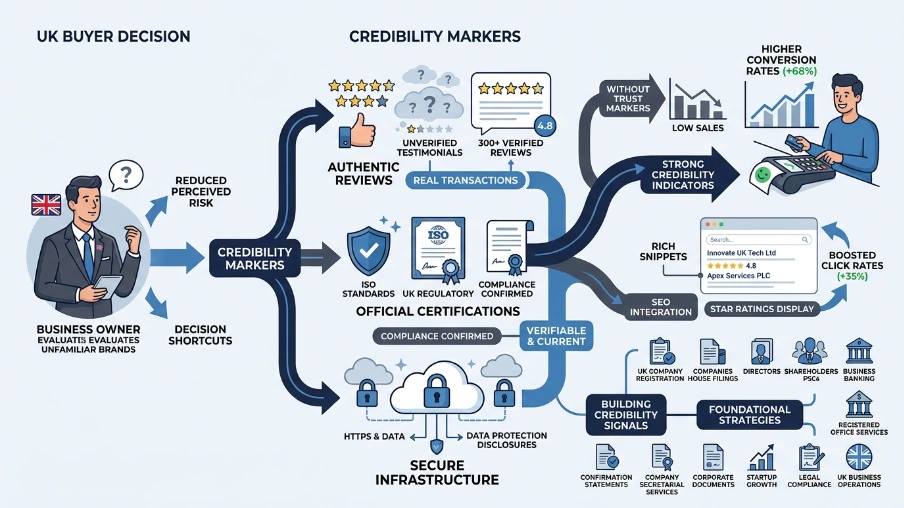
Credibility signals such as verified reviews, third-party certifications, and secure digital infrastructure directly influence purchasing decisions by reducing perceived risk. Businesses with strong credibility indicators experience up to 68% higher conversion rates compared to competitors lacking verified trust markers.
Credibility signals act as shortcuts for decision-making. Buyers rely on them when evaluating unfamiliar brands. These signals must be verifiable and current.
Three high-impact credibility signals include:
- Verified customer reviews linked to real transactions
- Industry certifications such as ISO standards or regulatory compliance
- Secure website indicators including HTTPS and data protection disclosures
A business with 300 verified reviews carries more authority than one with unverified testimonials. Verification removes ambiguity. It confirms authenticity.
Search engines also index credibility signals. Structured data markup allows platforms to display star ratings directly in search results. This visibility increases click-through rates by up to 35%.
For businesses evaluating structured approaches, this detailed guide on building credibility signals complements foundational strategies outlined in How to Build a Positive Brand Reputation from Day One.
What role does transparent communication play in reputation?
Transparent communication strengthens reputation by providing clear, accurate, and timely information about services, pricing, and policies. Businesses that communicate openly reduce customer complaints by up to 25% and improve satisfaction scores through predictable and honest interactions.
Transparency eliminates confusion. Customers expect clarity before making decisions. Hidden fees, vague descriptions, and delayed responses erode trust.
Effective transparency includes:
- Publish exact pricing ranges or fixed packages
- Define service timelines using specific durations such as 3–5 business days
- Disclose limitations and conditions upfront
When communication is transparent, customers feel informed. This reduces disputes. It also improves review sentiment because expectations align with outcomes.
Transparency also applies to negative situations. A business that acknowledges service delays and provides a revised timeline maintains credibility. Silence creates suspicion.
Clear communication frameworks also support compliance. Regulatory bodies require accurate disclosures in sectors like finance, healthcare, and legal services. Meeting these standards reinforces trust signals.
How does proactive reputation management protect business trust?
Proactive reputation management protects trust by continuously monitoring, analysing, and responding to public feedback across digital platforms. Businesses that actively manage reviews and mentions reduce negative sentiment impact by over 40% and maintain a controlled, accurate brand narrative.
Reputation is dynamic. New reviews, social mentions, and search results appear daily. Without active management, outdated or negative content can dominate visibility.
A structured Reputation Management for business approach includes monitoring tools, response protocols, and content optimisation strategies. These systems track sentiment trends and flag risks early.
Key operational actions include:
- Monitor brand mentions across search engines and social platforms daily
- Respond to negative reviews within 12 hours with factual clarification
- Promote verified positive content to maintain balanced visibility
When businesses ignore reputation signals, negative content compounds. A single unresolved complaint can influence hundreds of potential customers. Early intervention prevents escalation.
Businesses evaluating structured solutions often explore Reputation Management for business services to implement monitoring systems, response frameworks, and search visibility controls aligned with compliance standards.
Why are measurable trust indicators essential for long-term reputation?
Measurable trust indicators such as review scores, response times, complaint resolution rates, and compliance records provide objective benchmarks that demonstrate reliability over time. These indicators enable businesses to track performance, identify weaknesses, and continuously improve trust-related outcomes.
Trust must be tracked. Without metrics, reputation management becomes reactive. Data allows proactive improvement.
Four key indicators define reputation performance:
- Review score average maintained above 4.2 stars
- Response time maintained under 24 hours
- Complaint resolution rate above 90%
- Compliance records with zero regulatory violations
These indicators create accountability. They also support benchmarking against competitors.
For example, a business that improves its response time from 48 hours to 12 hours often sees a measurable increase in customer satisfaction scores within 30 days. Faster responses signal attentiveness.
Measurable indicators also support reporting. Stakeholders, investors, and partners rely on data to assess business stability. Transparent metrics reinforce confidence.
How do digital platforms amplify or damage business reputation?
Digital platforms amplify reputation by distributing customer feedback, search rankings, and brand mentions at scale. A single negative review can reach thousands of users, while consistent positive engagement can significantly increase visibility, credibility, and customer acquisition rates.
Digital platforms act as multipliers. Search engines, review sites, and social media distribute information instantly. Visibility increases both positive and negative signals.
Google alone processes over 8.5 billion searches daily. Businesses appearing in top results with strong ratings attract more clicks and conversions. Poor ratings reduce engagement even when ranking is high.
Three amplification factors include:
- Search engine ranking position combined with review ratings
- Volume of recent reviews within the last 90 days
- Engagement metrics such as replies and updates
Recency matters. A business with 50 recent positive reviews often outranks one with 500 outdated reviews. Fresh data signals active operations.
To strengthen digital positioning and decision readiness, businesses often explore Reputation Management Services That Build Long-Term Brand Trust as part of a structured evaluation process.
Explore our Reputation Management for business guides,
Hospitality Reputation Management Strategies That Increase Bookings
10 Corporate Reputation Management Case Studies with Key Lessons
How do operational processes influence reputation outcomes?
Operational processes influence reputation by determining service quality, delivery speed, and error rates. Businesses with standardised workflows and quality controls reduce service failures by up to 30%, directly improving customer satisfaction and public perception.
Reputation reflects operations. Poor processes lead to inconsistent outcomes. Strong systems produce reliable results.
Three operational components shape reputation:
- Standardised service workflows with defined steps and checkpoints
- Quality assurance systems that validate outputs before delivery
- Customer feedback loops that identify recurring issues
When processes are documented and repeatable, errors decrease. This leads to fewer complaints and better reviews.
For example, a business that implements a three-step verification process before service delivery reduces error rates significantly. Each step ensures accuracy and compliance.
Operational efficiency also impacts response time. Faster service delivery improves customer experience. This translates into higher ratings and repeat business.
A trusted business reputation is built through measurable, repeatable systems that align customer expectations with consistent outcomes. Each component consistency, credibility signals, transparency, proactive management, and performance metrics functions as part of a structured framework rather than isolated efforts.
Clear My Name applies these principles through data-driven Reputation Management for business, focusing on verification, monitoring, and controlled visibility across digital platforms. This approach ensures that reputation is not left to chance but managed as a measurable business asset.
Frequently Asked Questions
What is reputation management for business and how does it work?
Reputation Management for business involves monitoring, analyzing, and improving how a company appears across search engines, review platforms, and digital media. Clear My Name uses structured processes such as review monitoring, content optimization, and response management to maintain accurate and trustworthy brand visibility.
Why is reputation management important for businesses today?
Reputation directly impacts customer trust, search rankings, and conversion rates, with 87% of consumers checking online reviews before making decisions. Reputation Management for businesses ensures that accurate, positive, and verified information represents a company across digital platforms.
How long does it take to see results from reputation management?
Initial improvements in search results and review sentiment typically appear within 30 to 90 days, depending on the current reputation baseline. Clear My Name focuses on measurable indicators such as review ratings, response times, and content visibility to track progress.
What are the key components of an effective reputation management strategy?
An effective Reputation Management for business strategy includes review monitoring, response frameworks, content creation, and search result optimisation. Clear My Name integrates these elements to ensure consistent messaging, verified credibility signals, and improved trust metrics.
Can reputation management remove negative content from search results?
Reputation Management for businesses does not always remove negative content but works to suppress it by promoting accurate and positive information. Clear My Name applies content optimisation and visibility strategies to ensure balanced and credible search engine results.