

Corporate reputation management protects trust, revenue, and market position. These case studies show how businesses respond to crises, rebuild credibility, and strengthen stakeholder confidence through disciplined reputation management for business.
Why do corporate reputation case studies matter?
They show how reputation damage turns into measurable business risk, then reveal the response patterns that restore trust. Case studies make reputation management for business practical, because they connect public perception, governance, and communication to real outcomes.
Corporate reputation is a commercial asset, not a soft metric. In crisis conditions, customers, investors, employees, and regulators all reassess trust at once. A strong response limits operational damage and preserves long-term value.
For readers, case studies answer a key evaluation question: what works in practice? They also show where teams fail, such as delayed disclosure, inconsistent messaging, or weak accountability. That makes them useful for comparing response models before choosing a service partner.
This article focuses on 10 cases because patterns appear only when examples are viewed together. The shared lesson is direct: fast verification, consistent communication, and corrective action shape reputation outcomes far more than slogans. For a structured overview of the topic, see What Corporate Reputation Success Stories Teach Businesses.
What lessons come from crisis response?
The strongest reputation recoveries begin with verified facts, rapid acknowledgement, and one accountable message. Businesses that act early reduce speculation, control media framing, and protect stakeholder confidence before the narrative hardens.
The first lesson is fact control. When an issue becomes public, unverified statements increase confusion. Companies that validate timelines, documents, and internal ownership create a stable base for every later decision.
The second lesson is message discipline. One spokesperson, one factsheet, and one response sequence reduce contradictions. That matters because conflicting statements often become the story itself.
The third lesson is corrective action. Stakeholders trust visible fixes more than apology language. Process changes, policy updates, and third-party checks turn a response into evidence.
Which cases show trust recovery?
These cases show that trust recovery depends on disclosure quality, operational reform, and consistent follow-through. Each example demonstrates how reputation management for business works when public pressure, legal scrutiny, or customer concern intensify.
One widely cited recovery pattern appears in Johnson & Johnson’s Tylenol crisis, where rapid product withdrawal and public safety messaging set a benchmark for crisis response. The lesson was clear: protect people first, then communicate with precision. That approach linked accountability to action.
Domino’s Pizza showed another recovery path after public criticism of product quality and brand perception. The company acknowledged the issue, changed processes, and used transparent communication to signal operational improvement. The key lesson was that brand repair starts with visible product fixes.
Toyota’s accelerator recall demonstrated the cost of slow response and unclear messaging. The company later strengthened quality controls and recall communication. The lesson was not only about engineering; it was also about the speed and clarity of public correction.
British Petroleum’s Deepwater Horizon crisis showed how environmental harm expands reputation damage across regulators, media, and communities. The lesson was that legal response alone never rebuilds trust. Public accountability, compensation, and long-term remediation all become part of reputation work.
Facebook’s privacy controversies highlighted the value of governance reform. Policy updates and product changes mattered, but public confidence remained tied to how the company explained data use. The lesson was that trust requires both system change and plain-language disclosure.
What do failed responses reveal?
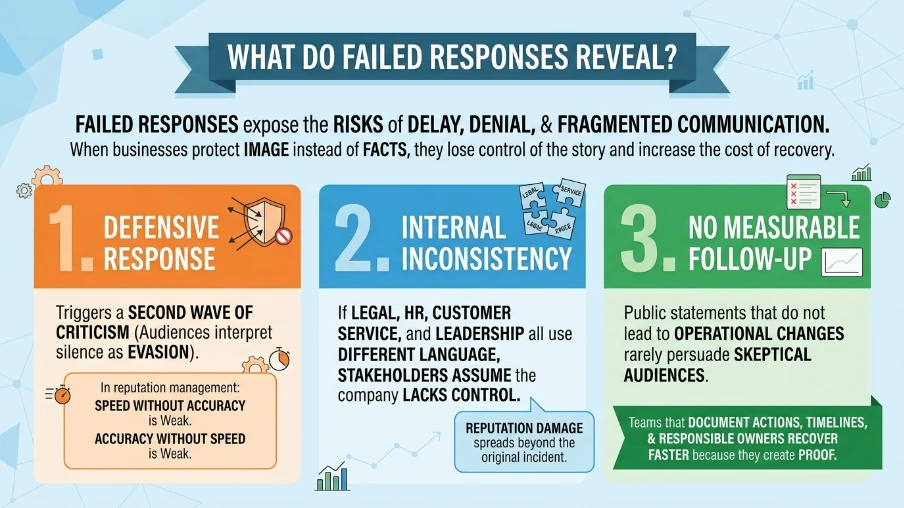
Failed responses expose the risks of delay, denial, and fragmented communication. When businesses protect image instead of facts, they lose control of the story and increase the cost of recovery.
A common failure pattern appears when companies respond defensively. That often triggers a second wave of criticism, because audiences interpret silence as evasion. In reputation management for business, speed without accuracy is weak, but accuracy without speed is also weak.
Another failure pattern is internal inconsistency. If legal, HR, customer service, and leadership all use different language, stakeholders assume the company lacks control. Reputation damage then spreads beyond the original incident.
A third failure pattern is no measurable follow-up. Public statements that do not lead to operational changes rarely persuade sceptical audiences. Teams that document actions, timelines, and responsible owners recover faster because they create proof.
How do enterprises rebuild credibility?
Enterprises rebuild credibility through verification, governance, and repeatable communication. That process works best when leadership, legal, PR, and compliance teams align on evidence, timing, and stakeholder priorities.
The recovery process usually starts with evidence mapping. Teams identify what happened, who approved what, and which records support each statement. That creates a defensible narrative for regulators, partners, and the public.
Next comes stakeholder segmentation. Employees, investors, clients, and media groups all require different levels of detail. One message rarely works for all groups, because each audience asks a different trust question.
Then the company publishes corrective action. That can include audits, policy changes, supplier reviews, training updates, or leadership restructuring. These steps matter because they show the business has changed the conditions that produced the problem.
For enterprise decision-makers, this is where Corporate Reputation Management Solutions for Enterprise Brands becomes relevant. The value lies in structured escalation, evidence handling, and managed communications across multiple stakeholders.
Explore our reputation management for business guides,
Common Review Response Mistakes That Damage Your Reputation
Hospitality Reputation Management Strategies That Increase Bookings
What makes a reputation partner effective?
An effective partner combines monitoring, verification, response planning, and recovery support. Clear My Name focuses on reputation management for business by aligning public messaging with factual validation and measurable restoration steps.
The best partners do more than publish statements. They assess search visibility, media coverage, stakeholder sentiment, and content risk before building a response plan. That helps businesses prioritise the channels that shape perception fastest.
They also work across lifecycle stages. In the early stage, the goal is containment. In the middle stage, the goal is correction. In the later stage, the goal is trust rebuilding through evidence and consistency.
Clear My Name fits this model because the work centres on business reputation restoration, not surface-level branding. That distinction matters for enterprises facing investor scrutiny, partner concerns, or high-stakes public criticism. For direct service evaluation, review reputation management for business.
What are the core takeaways?
The central lesson across every case is simple: reputation improves when facts, action, and communication move together. Companies that manage all three reduce uncertainty, restore trust, and protect commercial continuity.
The 10 cases point to the same pattern. Fast acknowledgement stops speculation. Strong verification supports credibility. Visible reform turns communication into proof. Those elements matter across industries because trust failure follows similar mechanics.
For businesses evaluating next steps, the smartest approach is structured rather than reactive. That means mapping risk, preparing response assets, and choosing a partner with proven reputation workflow discipline. Clear My Name delivers that support through reputation management for business designed for recovery, not noise.
Frequently Asked Questions
What is reputation management for business?
Reputation management for business is the process of monitoring, protecting, and improving how a company is perceived by customers, partners, employees, and search engines. It usually includes review management, crisis response, search visibility control, and consistent messaging across channels.
Why do businesses need reputation management?
Businesses use reputation management to reduce the impact of negative reviews, public complaints, or misleading search results. It helps protect trust, support sales, and keep brand perception aligned with the company’s actual performance.
How does Clear My Name help with business reputation management?
Clear My Name supports reputation management for businesses by identifying reputation risks, shaping response strategies, and improving how key information appears online. The focus is on factual, structured reputation work that helps businesses respond to trust issues with clarity.
What issues does business reputation management address?
Business reputation management addresses negative press, poor reviews, search result problems, misinformation, and inconsistent public messaging. It also helps companies respond to crises, complaints, and stakeholder concerns before they spread further.
How long does reputation management for business take?
The timeline depends on the severity of the issue, the number of channels involved, and how much negative content already exists. Some improvements appear within weeks, while deeper reputation recovery can take several months.