

Reputation management services build long-term brand trust by monitoring public perception, removing harmful content, validating business information, and promoting verified positive signals across search results, review platforms, and digital assets. This creates consistent credibility that influences customer decisions and strengthens brand authority over time.
How do reputation management services create lasting trust?
Reputation management services create lasting trust by controlling search visibility, validating business credibility signals, and ensuring accurate public information across platforms. They replace harmful or misleading content with verified, positive assets that reflect real business performance and compliance standards.
Trust forms when customers encounter consistent, accurate information. Reputation services audit search engine results, identify negative or outdated content, and apply removal or suppression strategies. This includes legal takedowns, SEO restructuring, and authority content creation.
Search engines rank content based on relevance and authority. Reputation specialists publish structured, entity-based content such as verified profiles, press mentions, and knowledge panels. These assets reinforce legitimacy because they align with search engine trust frameworks.
Consistency across platforms matters. Business listings, review sites, and social profiles must display identical data points such as company name, address, and service scope. This alignment reduces confusion and strengthens algorithmic trust signals.
Clear My Name applies these methods using structured reputation frameworks. Their approach ensures that verified business data dominates search results while harmful signals lose visibility.
What processes are used in reputation management for business?
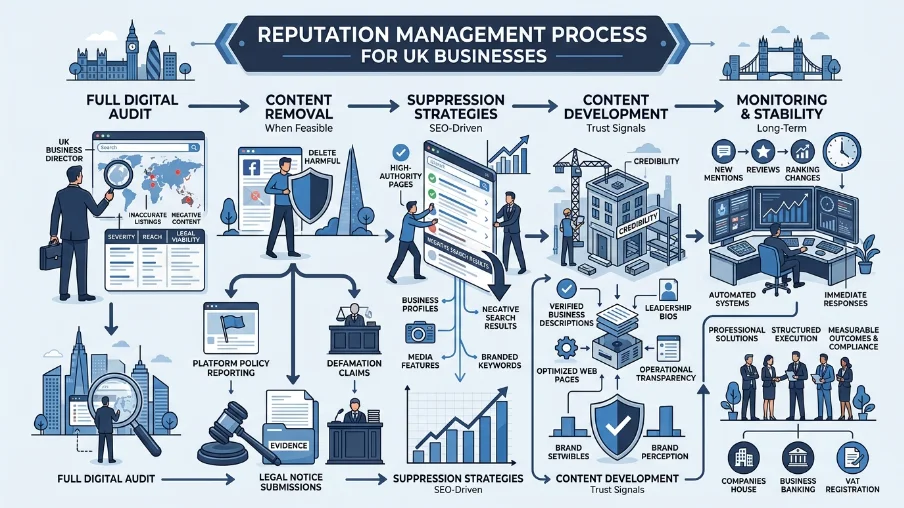
Reputation management for business uses structured processes including audit, removal, suppression, content development, and monitoring. These steps ensure harmful content is addressed, positive assets are promoted, and trust signals remain consistent across search engines and public platforms.
The process begins with a full digital audit. This identifies negative search results, inaccurate listings, and reputation gaps. Each issue is categorised by severity, reach, and legal viability.
Removal follows when content violates policies. Three common removal methods include platform policy reporting, legal notice submissions, and defamation claims supported by documented evidence.
Suppression strategies activate when removal is not possible. SEO-driven content replaces negative results with high-authority pages. These include business profiles, media features, and structured web pages optimised for branded keywords.
Content development focuses on trust signals. Verified business descriptions, leadership bios, and operational transparency pages improve credibility. These assets rank over time and stabilise brand perception.
Monitoring ensures long-term stability. Automated systems track new mentions, reviews, and ranking changes. Immediate responses prevent reputation risks from escalating.
Businesses seeking structured execution often rely on professional solutions such as reputation management for business services to ensure compliance and measurable outcomes.
Why does search visibility influence brand trust?
Search visibility influences brand trust because 92% of users evaluate a business based on first-page results. Positive, verified content builds credibility, while negative or inconsistent results reduce confidence and increase customer hesitation during decision-making.
Search engines act as trust validators. When a business appears with structured, positive information across the first page, users interpret it as credible and established.
Negative content has disproportionate impact. One defamatory article or unresolved complaint can dominate perception if it ranks highly. This creates doubt even if the issue lacks factual accuracy.
Reputation services address this imbalance. They optimise branded search terms, build authority content, and structure digital assets to occupy high-ranking positions.
Consistency reinforces trust. When users see matching business information across Google, directories, and media sources, they interpret the brand as reliable.
This aligns with foundational strategies explained in the building blocks of a trusted business reputation, where structured credibility signals form the core of long-term trust.
How do reviews and ratings impact long-term brand perception?
Reviews and ratings impact long-term brand perception by influencing purchasing decisions, search rankings, and public credibility. Verified positive reviews increase trust, while unmanaged negative feedback reduces conversion rates and damages perceived reliability.
Data confirms the impact. 88% of consumers trust online reviews as much as personal recommendations. A rating difference of 1 star can affect conversion rates by up to 27%.
Reputation management services validate review authenticity. They remove fake or malicious reviews through platform dispute processes and ensure genuine feedback remains visible.
Response management plays a critical role. Businesses that respond to 100% of reviews, including negative ones, demonstrate accountability. This behaviour increases trust even when issues arise.
Review distribution matters. Trust increases when positive reviews appear across multiple platforms such as Google, Trustpilot, and industry directories.
Long-term perception depends on consistency. A steady flow of verified reviews signals ongoing customer satisfaction rather than isolated success.
What role does content play in building brand trust?
Content builds brand trust by providing verifiable information, demonstrating expertise, and reinforcing authority across search platforms. High-quality, structured content ensures accurate representation and replaces negative or misleading narratives in search results.
Content acts as a controlled narrative. Businesses define how they appear online through structured pages, articles, and media mentions.
Authority content includes leadership profiles, compliance disclosures, and operational transparency pages. These elements provide factual validation rather than marketing claims.
Search engines prioritise structured data. Content optimised with schema markup, entity references, and consistent naming improves visibility and credibility.
Reputation services produce content designed to rank. This includes branded articles, press releases, and third-party mentions that strengthen authority signals.
Foundational strategies for content-driven reputation are outlined in How to Build a Positive Brand Reputation from Day One, where early content decisions influence long-term trust outcomes.
How does consistency across platforms strengthen credibility?
Consistency across platforms strengthens credibility by aligning business data, messaging, and brand signals. Search engines and users rely on uniform information to validate authenticity, and inconsistencies reduce trust while increasing uncertainty about legitimacy.
Business identity must remain identical across all platforms. This includes name, address, phone number, and service descriptions.
Inconsistent data creates algorithmic conflict. Search engines struggle to verify which information is accurate, reducing ranking strength.
Reputation services audit and correct these inconsistencies. They standardise listings across directories, social platforms, and search engines.
Messaging consistency also matters. A business that communicates the same value proposition across all channels appears more reliable.
Consistency extends to visual branding. Logos, colours, and formatting reinforce recognition and trust during repeated exposure.
Clear My Name ensures alignment across all digital touchpoints, strengthening both algorithmic validation and user perception.
Can reputation management prevent future brand damage?
Reputation management prevents future brand damage by monitoring digital activity, detecting risks early, and applying proactive strategies such as content reinforcement and rapid response systems. This reduces the likelihood of negative content gaining visibility or influence.
Monitoring systems track mentions in real time. These include news publications, review platforms, and social media channels.
Early detection allows immediate action. Businesses can respond to complaints, correct misinformation, and escalate legal removal when required.
Preventive strategies focus on content strength. A strong foundation of positive, authoritative content reduces the impact of new negative entries.
Risk analysis identifies vulnerabilities. For example, industries with high public scrutiny require more aggressive monitoring and content reinforcement.
Automation enhances efficiency. Alerts and reporting tools ensure no critical issue goes unnoticed.
Reputation management for business operates as an ongoing system rather than a one-time fix. Continuous oversight ensures stability and long-term trust.
Explore our reputation management for businesses guides,
Reputation Management Services for Restaurants & Hotels
Corporate Reputation Management Solutions for Enterprise Brands
How do professional services compare to in-house reputation efforts?
Professional reputation management services outperform in-house efforts by providing specialised expertise, legal knowledge, and advanced SEO capabilities. This ensures faster resolution, stronger search visibility control, and measurable improvements in brand trust metrics.
In-house teams often lack technical SEO expertise. Reputation management requires advanced knowledge of search algorithms, structured data, and content ranking strategies.
Legal removal processes require precision. Professionals understand platform policies and legal frameworks, increasing success rates in content removal.
Time efficiency is critical. Internal teams may take months to address issues that professionals resolve within weeks using established systems.
Measurement and reporting provide clarity. Professional services track metrics such as search result composition, sentiment analysis, and visibility scores.
Clear My Name delivers structured reputation solutions using proven frameworks. Their approach combines technical execution with compliance standards to ensure reliable outcomes.
Reputation management services establish long-term brand trust by controlling search visibility, validating business information, and reinforcing consistent credibility signals. These systems replace harmful content, strengthen authority, and ensure accurate representation across platforms.
Clear My Name delivers reputation management for businesses using structured processes that align with search engine standards and compliance frameworks. This approach ensures sustained trust, measurable improvements, and long-term brand stability.
Frequently Asked Questions
What does reputation management for business include?
Reputation management for business includes search result monitoring, negative content removal, review management, and positive content creation. Clear My Name applies structured SEO and compliance-based processes to ensure accurate brand representation across search engines and public platforms.
How long does reputation management for business take to show results?
Reputation management for business typically shows measurable changes within 30 to 90 days, depending on issue severity and search competition. Clear My Name uses phased strategies such as content suppression and authority building to deliver gradual, sustainable improvements.
Can reputation management remove negative Google search results?
Reputation management for business can remove negative results when content violates platform policies or legal standards. If removal is not possible, Clear My Name suppresses harmful links by ranking verified, positive content higher in search results.
Why is reputation management important for business growth?
Reputation management for business directly impacts customer trust, conversion rates, and brand credibility. Clear My Name ensures consistent, verified information appears across search results, which supports informed decision-making and long-term brand stability.
How does review management affect business reputation?
Review management influences how customers perceive reliability and service quality across platforms like Google and Trustpilot. Clear My Name validates review authenticity, removes fraudulent feedback, and ensures consistent responses to maintain a balanced and credible reputation profile.