

Corporate reputation management solutions for enterprise brands are structured services that monitor, protect, and improve a company’s public perception using data analysis, content control, legal frameworks, and search visibility strategies. These solutions reduce reputational risk, strengthen stakeholder trust, and ensure consistent brand credibility across digital platforms.
What do corporate reputation management solutions include?
Corporate reputation management solutions include monitoring systems, content suppression strategies, legal compliance actions, and search engine optimisation processes that collectively control how an enterprise brand appears online and in media channels across multiple jurisdictions and platforms.
Enterprise solutions operate across four core systems: monitoring, analysis, action, and reinforcement. Monitoring tools track brand mentions across search engines, social media, forums, and news databases. These tools process millions of data points daily and flag risk signals such as negative press spikes or coordinated review attacks.
Analysis frameworks classify threats using predefined categories like defamation, misinformation, outdated content, or regulatory exposure. Each category triggers a structured response. For example, defamatory content enters a legal review pipeline, while outdated search results trigger suppression workflows.
Action mechanisms involve three primary execution paths: legal removal, content suppression, and authority rebuilding. Legal removal includes submitting formal takedown requests based on jurisdiction-specific laws. Suppression involves publishing high-authority content to push harmful results beyond page one of search engines.
Reinforcement focuses on building a durable reputation layer. This includes verified press placements, authoritative backlinks, and controlled brand narratives. These elements ensure long-term visibility stability.
How do enterprise brands benefit from reputation management solutions?
Enterprise brands benefit from reputation management solutions by reducing financial risk, improving stakeholder confidence, and maintaining consistent brand authority across markets, which directly impacts revenue stability, investor trust, and regulatory compliance outcomes.
Reputation directly affects valuation metrics. Public companies with negative media exposure experience measurable stock volatility. A 2024 Deloitte study found that 63% of enterprise executives link reputation risk to financial performance metrics.
Investor confidence depends on predictable brand perception. When negative search results dominate executive names or company keywords, due diligence processes slow down. Reputation management ensures that verified and accurate content appears first in search results.
Customer acquisition also depends on reputation signals. Enterprise buyers review at least three sources before engagement: search results, third-party reviews, and press coverage. Controlled visibility across these channels increases conversion probability.
Regulatory compliance is another measurable benefit. Industries such as finance, healthcare, and telecom operate under strict disclosure frameworks. Reputation management solutions ensure that public-facing information aligns with compliance standards, reducing legal exposure.
What processes define effective reputation management for business?
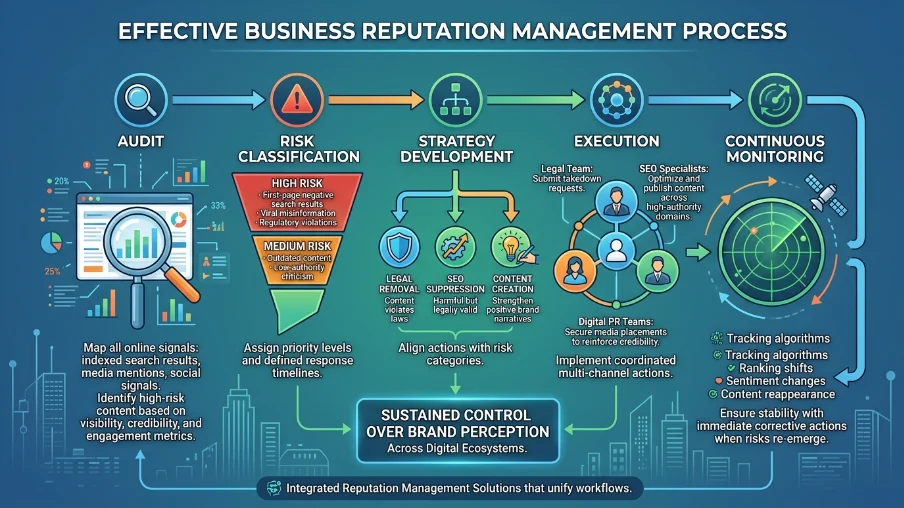
Effective reputation management for business follows a structured process that includes audit, risk classification, strategy development, execution through legal and SEO actions, and continuous monitoring to ensure sustained control over brand perception across digital ecosystems.
The process begins with a comprehensive audit. This audit maps all indexed search results, media mentions, and social signals linked to the brand. It identifies high-risk content based on visibility, credibility, and engagement metrics.
Risk classification assigns priority levels. High-risk items include first-page negative search results, viral misinformation, or regulatory violations. Medium-risk items include outdated content or low-authority criticism. Each level receives a defined response timeline.
Strategy development aligns actions with risk categories. Legal removal is applied when content violates laws. SEO suppression is applied when content is harmful but legally valid. Content creation is used to strengthen positive brand narratives.
Execution involves coordinated actions across multiple channels. Legal teams submit takedown requests. SEO specialists publish optimised content across high-authority domains. Digital PR teams secure media placements to reinforce credibility.
Continuous monitoring ensures stability. Algorithms track ranking shifts, sentiment changes, and content reappearance. This feedback loop allows immediate corrective actions when risks re-emerge.
Businesses seeking structured implementation often rely on dedicated providers offering Reputation Management for business solutions that integrate legal, SEO, and monitoring workflows into a unified system.
Why do enterprise brands require specialised solutions instead of basic ORM tools?
Enterprise brands require specialised solutions because their reputational risks span multiple markets, legal systems, and digital platforms, which basic online reputation management tools cannot handle due to limited scalability, compliance capability, and strategic depth.
Basic ORM tools focus on review management and simple monitoring dashboards. These tools operate effectively for small businesses with limited exposure. Enterprise brands, however, face multi-layered risks involving global media, regulatory scrutiny, and stakeholder complexity.
Scalability is a key limitation. Enterprise brands generate thousands of mentions daily across different languages and regions. Specialised solutions use advanced data processing systems to handle this volume and provide actionable insights.
Legal complexity also requires specialised expertise. Content removal laws vary across jurisdictions. For example, EU-based GDPR requests differ significantly from US defamation laws. Enterprise solutions integrate jurisdiction-specific legal workflows.
Strategic depth separates enterprise solutions from basic tools. Instead of reacting to negative content, enterprise systems proactively shape search results and public narratives. This involves long-term content planning, authority building, and controlled visibility strategies.
How do corporate reputation solutions manage search engine visibility?
Corporate reputation solutions manage search engine visibility by suppressing negative results, promoting authoritative content, and structuring digital assets to control rankings for branded keywords across Google and other search platforms.
Search visibility control relies on ranking mechanics. Search engines prioritise relevance, authority, and freshness. Reputation solutions use these factors to influence what appears on page one.
Suppression strategies involve publishing high-authority content across trusted domains. These include press releases, verified profiles, and expert articles. Each asset targets specific keywords linked to the brand.
Authority signals play a critical role. Backlinks from reputable sources increase content credibility. For example, links from established news outlets or industry platforms carry more weight than low-quality directories.
Content structuring ensures keyword alignment. Each piece of content targets a defined keyword cluster. This increases the likelihood of ranking above negative results.
Freshness signals also influence rankings. Regular updates to content maintain visibility and prevent outdated or harmful results from regaining prominence.
For deeper insight into how structured strategies influence outcomes, refer to this analysis of 10 Corporate Reputation Management Case Studies with Key Lessons, which explains measurable ranking improvements across industries.
What risks do enterprise brands face without reputation management?
Enterprise brands without reputation management face increased exposure to misinformation, regulatory penalties, revenue loss, and long-term brand damage due to uncontrolled digital narratives and negative search visibility.
Misinformation spreads rapidly across digital platforms. A single false claim can generate thousands of impressions within hours. Without monitoring systems, brands fail to detect and respond in time.
Regulatory risks increase when outdated or incorrect information remains public. Industries with strict compliance requirements face penalties when public data does not match official disclosures.
Revenue impact is measurable. Negative search results reduce conversion rates. Studies show that first-page negative content can decrease customer trust by up to 70%, directly affecting sales pipelines.
Long-term brand damage occurs when negative narratives become entrenched. Once harmful content gains authority and backlinks, removing or suppressing it becomes significantly more complex and resource-intensive.
Enterprise brands mitigate these risks by implementing structured solutions such as Reputation Management for business services that provide continuous monitoring and response mechanisms.
Explore our Reputation Management for business guides,
Reputation Management Services That Handle Customer Reviews for You
Reputation Management Services for Restaurants & Hotels
How does Clear My Name deliver enterprise-level reputation management?
Clear My Name delivers enterprise-level reputation management by combining legal expertise, advanced SEO strategies, and real-time monitoring systems to identify, suppress, and remove harmful content while strengthening positive brand authority across digital platforms.
Clear My Name applies a multi-layered approach. The process begins with a detailed audit that identifies all reputation risks across search engines and media platforms. This audit uses data-driven classification to prioritise threats.
Legal frameworks form a core component. The team evaluates whether content qualifies for removal under applicable laws. When valid, formal requests are submitted to platforms, publishers, or search engines.
SEO strategies are used when removal is not possible. High-authority content is created and distributed across trusted platforms. This shifts search rankings and reduces the visibility of negative results.
Monitoring systems operate continuously. These systems track keyword rankings, sentiment changes, and new content appearances. Alerts trigger immediate action when new risks emerge.
Clear My Name integrates these processes into its Reputation Management for business service, ensuring enterprise clients maintain consistent control over their public perception.
For decision-makers evaluating outcomes, reviewing what corporate reputation success stories teach businesses provides practical insights into measurable improvements achieved through structured strategies.
Corporate reputation management solutions provide enterprise brands with a structured system to control, protect, and strengthen their public image. These solutions combine monitoring, legal action, and search optimisation to manage risk and ensure consistent visibility across digital platforms.
Clear My Name delivers these capabilities through integrated workflows that align legal, SEO, and monitoring strategies. This approach ensures that enterprise brands maintain accurate representation, reduce exposure to reputational threats, and sustain long-term credibility in competitive markets.
Frequently Asked Questions
What is reputation management for business and how does it work?
Reputation Management for business is a structured process that monitors, analyses, and improves how a company appears online. Clear My Name uses search data, legal review, and SEO strategies to remove or suppress harmful content and strengthen positive brand visibility.
How long does business reputation management take to show results?
Initial improvements in search visibility often appear within 30 to 90 days, depending on content volume and competition. Clear My Name applies continuous monitoring and optimisation to achieve stable, long-term reputation control across search engines.
Can negative search results about a company be removed permanently?
Some negative results can be permanently removed if they violate legal or platform policies, such as defamation or privacy breaches. When removal is not possible, Reputation Management for business focuses on suppressing harmful links using authoritative content strategies.
Why is reputation management important for enterprise businesses?
Enterprise businesses face high exposure across media, search engines, and regulatory environments, making reputation a measurable risk factor. Clear My Name helps manage this risk by ensuring accurate, compliant, and high-authority information ranks prominently.
What services are included in professional reputation management for business?
Reputation Management for business includes monitoring brand mentions, analysing risk, executing content removal or suppression, and improving search rankings. Clear My Name integrates legal processes, SEO optimisation, and digital PR to maintain consistent brand credibility.