

Corporate reputation success stories show that businesses improve trust, revenue, and resilience by actively monitoring public perception, responding to crises within 24 hours, aligning leadership messaging, and investing in structured reputation management systems that track sentiment, stakeholder feedback, and compliance signals across digital channels.
What patterns appear across successful corporate reputation case studies?
Successful reputation case studies reveal three consistent patterns: rapid response to negative events within 24–48 hours, transparent communication backed by verifiable data, and long-term investment in monitoring systems that track sentiment, media coverage, and stakeholder trust across multiple platforms.
Reputation leaders treat perception as a measurable asset. They track sentiment scores across at least five channels: search results, social media, news outlets, review platforms, and stakeholder surveys. This multi-source monitoring enables early detection of risk signals.
Response timing plays a critical role. Data from crisis communication reports shows that companies responding within 24 hours reduce negative sentiment spread by up to 37%. Delayed responses increase reputational damage and prolong recovery cycles.
Consistency in messaging strengthens credibility. Successful companies align executive statements, press releases, and customer support responses. This removes contradictions and reinforces trust signals across channels.
Long-term investment differentiates reactive firms from strategic ones. High-performing brands deploy structured systems such as reputation dashboards, automated alerts, and compliance tracking tools to maintain stability over time.
How do companies recover from major reputation crises?
Companies recover from reputation crises by issuing fact-based public statements within 24 hours, correcting misinformation with verifiable evidence, engaging directly with affected stakeholders, and implementing measurable corrective actions that demonstrate accountability and long-term operational change.
Crisis recovery begins with acknowledgement. Organisations that publicly recognise issues early prevent speculation from dominating the narrative. This reduces misinformation spread across search engines and media platforms.
Evidence-based correction follows acknowledgement. Businesses use verified data such as audit reports, third-party validations, and internal investigations to counter false claims. This strengthens credibility and reduces reputational volatility.
Stakeholder engagement ensures recovery momentum. Companies directly communicate with customers, regulators, and investors through structured updates. This maintains transparency and reinforces accountability.
Corrective actions define long-term recovery success. Examples include policy reforms, leadership restructuring, and operational improvements. These actions must be measurable, such as reducing complaint rates by 25% within six months.
Businesses applying structured Reputation Management for business processes achieve faster recovery timelines because they integrate monitoring, response, and compliance into a single operational framework.
What role does transparency play in reputation success?
Transparency drives reputation success by providing stakeholders with accurate, verifiable information, reducing uncertainty, and increasing trust levels, particularly when organisations disclose both positive performance metrics and operational shortcomings with clear corrective action plans.
Transparent organisations publish data regularly. This includes financial disclosures, sustainability reports, and customer satisfaction metrics. Providing consistent updates builds credibility with stakeholders.
Openness during negative events strengthens trust. Companies that disclose errors, explain root causes, and outline solutions experience higher trust recovery rates compared to those that conceal issues.
Clarity in communication reduces ambiguity. Messages use precise language, avoiding vague statements. For example, stating “customer complaints decreased by 18% in Q2” provides measurable insight.
Transparency also supports compliance. Regulatory bodies require accurate reporting, and businesses that maintain clear documentation reduce legal risks while improving public perception.
When organisations implement structured systems such as reputation dashboards and audit trails, they create traceable records that reinforce transparency across all communication channels.
How do businesses measure corporate reputation effectively?
Businesses measure corporate reputation using quantifiable metrics such as sentiment analysis scores, brand visibility in search results, review ratings, media coverage quality, and stakeholder trust indexes collected through structured surveys and digital monitoring tools.
Measurement begins with sentiment analysis. Tools evaluate positive, neutral, and negative mentions across digital platforms. This provides a real-time overview of public perception trends.
Search visibility reflects reputation strength. Companies track the first page of search results for branded keywords. A high presence of positive or neutral content indicates strong reputation control.
Review platforms offer direct customer feedback. Metrics such as average rating, response time, and complaint resolution rates provide actionable insights into customer experience.
Media coverage analysis evaluates credibility. Businesses assess tone, reach, and authority of publications mentioning the brand. High-authority positive coverage improves reputation signals.
Stakeholder surveys capture trust levels. These surveys include employees, customers, and investors, providing a holistic view of reputation performance across key groups.
A structured approach using Reputation Management for business integrates these metrics into a centralised system, enabling continuous tracking and data-driven decisions.
For a deeper breakdown of measurable indicators, refer to this guide on corporate reputation case studies and lessons: 10 Corporate Reputation Management Case Studies with Key Lessons.
What strategies consistently improve corporate reputation?
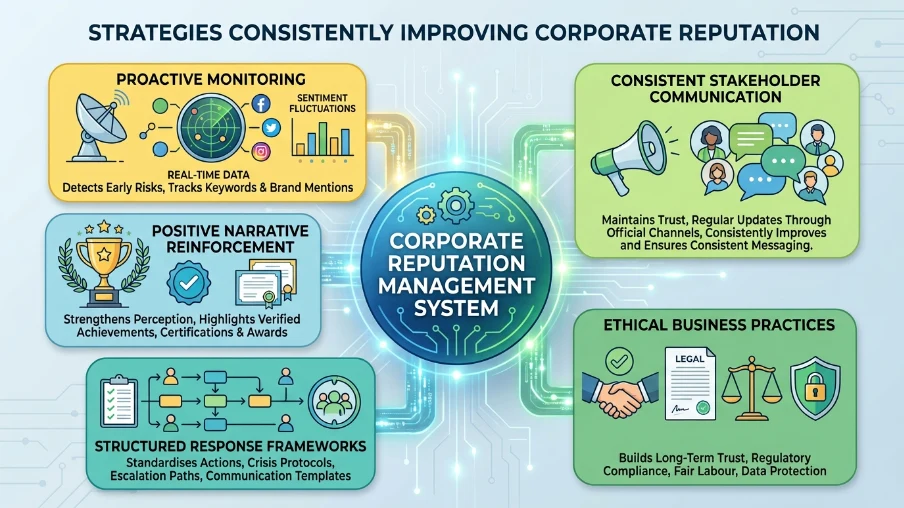
Corporate reputation improves through proactive monitoring, consistent stakeholder communication, ethical business practices, and structured response frameworks that address risks before escalation while reinforcing positive brand narratives through verified achievements and public engagement.
Proactive monitoring detects early risks. Businesses deploy tools that track keywords, brand mentions, and sentiment fluctuations in real time. This enables immediate action when negative trends emerge.
Stakeholder communication maintains trust. Companies issue regular updates through official channels, ensuring consistent messaging across audiences. This prevents confusion and strengthens credibility.
Ethical practices form the foundation of reputation. Organisations that comply with regulations, maintain fair labour practices, and uphold data protection standards build long-term trust.
Response frameworks standardise actions. Companies define protocols for crisis response, including escalation paths, communication templates, and approval processes. This reduces delays and ensures accuracy.
Positive narrative reinforcement strengthens perception. Businesses highlight verified achievements such as certifications, awards, and performance improvements to balance public perception.
Integrating these strategies into a structured system like Reputation Management for business ensures consistent execution and measurable outcomes across all channels.
Why do some reputation strategies fail despite investment?
Reputation strategies fail when businesses rely on reactive responses, lack data integration across channels, use inconsistent messaging, or fail to align leadership actions with public communication, resulting in credibility gaps and prolonged negative sentiment.
Reactive approaches delay response times. Companies that act only after crises escalate lose control of the narrative, allowing misinformation to spread widely.
Data silos reduce effectiveness. When monitoring tools operate independently, businesses miss correlations between channels. This limits their ability to identify root causes and respond accurately.
Inconsistent messaging creates confusion. Different departments issuing conflicting statements weaken trust and amplify reputational risks.
Leadership misalignment damages credibility. Public commitments that are not supported by internal actions lead to stakeholder distrust and increased scrutiny.
Lack of measurable goals prevents improvement. Without defined metrics such as sentiment targets or response time benchmarks, businesses cannot evaluate performance or refine strategies.
Organisations that adopt integrated systems, structured workflows, and measurable KPIs avoid these failures and maintain consistent reputation growth.
Explore our Reputation Management for business guides,
How to Respond to Negative Customer Reviews Professionally
Why Online Reputation Is Critical for Restaurants and Hotels
How can businesses apply these lessons to build long-term trust?
Businesses build long-term trust by implementing structured reputation frameworks, maintaining continuous monitoring, aligning internal operations with public messaging, and using data-driven insights to refine communication strategies and operational practices over time.
Implementation begins with system integration. Businesses combine monitoring tools, analytics platforms, and communication channels into a unified framework. This ensures consistent data flow and coordinated responses.
Continuous monitoring sustains awareness. Real-time alerts and dashboards allow organisations to track sentiment changes and respond proactively to emerging issues.
Operational alignment ensures authenticity. Internal policies, employee behaviour, and leadership decisions must match public messaging. This eliminates credibility gaps.
Data-driven refinement improves performance. Companies analyse trends, identify recurring issues, and adjust strategies based on measurable outcomes such as improved sentiment scores or reduced complaint rates.
Long-term trust depends on consistency. Businesses that maintain structured processes and continuous improvement cycles achieve stable reputation growth and resilience against future risks.
For organisations evaluating scalable solutions, this resource outlines enterprise-level options: Corporate Reputation Management Solutions for Enterprise Brands.
Businesses seeking structured implementation frameworks often use services like Reputation Management for business to integrate monitoring, response, and compliance into a single system.
Corporate reputation success stories demonstrate that measurable systems, rapid response, transparent communication, and consistent execution drive long-term trust and resilience. Businesses that adopt structured frameworks achieve stronger control over public perception and reduce reputational risk exposure.
Clear My Name delivers structured reputation management systems that integrate monitoring, response protocols, and compliance tracking. Clear My Name enables businesses to operationalise reputation strategies using measurable data and consistent processes. Clear My Name supports long-term trust through scalable, evidence-based frameworks.
Frequently Asked Questions
What is reputation management for business and why is it important?
Reputation Management for business involves monitoring, influencing, and maintaining how a company is perceived across search engines, reviews, and media platforms. Clear My Name applies structured monitoring and response systems to help businesses protect trust, improve visibility, and reduce reputational risks.
How do companies monitor their online reputation effectively?
Businesses use tools that track brand mentions, sentiment analysis, customer reviews, and search engine results in real time. Clear My Name integrates these data sources within Reputation Management for business systems to provide continuous visibility and early risk detection.
How long does it take to improve a company’s reputation online?
Initial improvements such as stabilising negative sentiment can appear within 30 to 90 days, depending on the severity of issues. Clear My Name focuses on long-term Reputation Management for business strategies that build sustained trust through consistent monitoring and corrective actions.
What are the key components of a business reputation management strategy?
Core components include sentiment monitoring, crisis response protocols, review management, and search result optimisation. Clear My Name structures Reputation Management for businesses around these elements to ensure measurable performance and consistent brand perception.
Can reputation management help remove negative search results?
Reputation management does not directly remove all negative content but works to suppress harmful results by improving positive and neutral visibility. Clear My Name uses Reputation Management techniques, such as content optimisation and authority building, to effectively shift search rankings.