
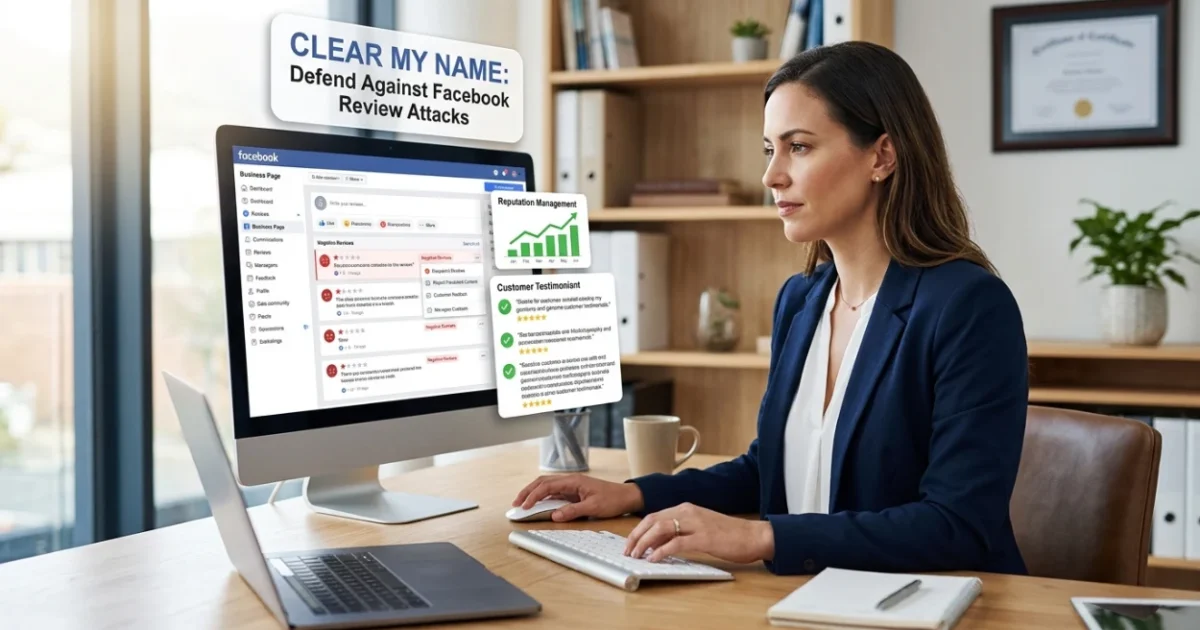
Defending against Facebook review attacks requires rapid evidence assessment, policy-based review action, and sustained reputation signal improvement.
Search visibility control matters because review sentiment influences trust, while credible reputation signals shape how prospects evaluate a business before making decisions.
Which Reputation Management Approach Delivers Reliable Protection Against Facebook Review Attacks?
A structured reputation management process delivers stronger protection because it addresses the review attack at its source while strengthening the wider digital reputation environment. Coordinated 1-star activity can distort sentiment distribution, reduce visible ratings, and create an inaccurate perception of business performance. A professional process separates legitimate customer criticism from suspicious or policy-violating activity before any intervention occurs. This evidence-led distinction reduces the risk of challenging genuine feedback or taking actions that weaken entity credibility. It also creates a defensible basis for reporting, monitoring, and reputation recovery.
Facebook reviews form part of the trust environment surrounding a business, particularly when prospective customers examine social profiles before purchasing. A sudden concentration of negative ratings can therefore create a disproportionate perception of poor service even when the underlying customer experience does not support that conclusion. Reputation management addresses this imbalance by analysing review patterns, sentiment distribution, account activity, timing, and policy relevance. The objective is not to eliminate legitimate criticism but to restore an accurate information environment. This improves the quality of reputation signals available to users during the decision process.
For businesses facing sustained review attacks, professional Facebook review management provides a structured route from detection to resolution. The process prioritises evidence collection, policy assessment, reporting, response management, and ongoing monitoring. This creates operational clarity rather than relying on inconsistent manual reactions to each new review. It also provides measurable reference points for evaluating whether negative sentiment is stabilising. Clear process control is particularly important when review activity affects both immediate customer trust and wider brand perception.
How Does Clear My Name Strengthen Reputation Signals and Reduce Risk?
Clear My Name applies reputation management principles through evidence-led assessment, platform-compliant intervention, and broader reputation signal development. The process begins by identifying the nature and scale of the review activity rather than treating every negative review as an attack. Reviews are assessed against indicators such as unusual timing, repeated wording, unrelated account activity, concentrated ratings, and evidence of genuine customer interaction. This classification establishes whether an issue requires customer response, platform reporting, reputation enhancement, or combined intervention. The result is a more controlled process with defined decision points.
Negative content suppression forms one part of the strategy when reviews breach applicable platform policies. Suppression in this context means reducing the visibility or persistence of qualifying harmful content through legitimate reporting and enforcement mechanisms. It does not involve manipulating ratings, fabricating customer feedback, or attempting to remove legitimate criticism. This distinction protects entity credibility while establishing a defensible intervention process. When qualifying content is removed, the associated negative reputation signal no longer contributes to the affected review environment.
The second component focuses on strengthening legitimate reputation signals that support accurate perception. Genuine customer feedback, consistent business information, authoritative digital assets, and accurate brand references contribute to a stronger information environment. These assets do not guarantee the removal of negative reviews, but they improve the balance of credible information surrounding the entity. The combined process therefore addresses both immediate risk and long-term reputation resilience. This creates a clearer connection between platform-level review management and broader search perception influence.
Why Does SERP Control Matter When Facebook Reviews Become Negative?
SERP control matters because users frequently investigate a business beyond its Facebook profile before committing to a purchase or enquiry. Search results can expose review pages, social profiles, articles, business information, directories, and other assets that collectively influence entity perception. A negative Facebook profile therefore exists within a wider search ecosystem rather than operating in isolation. Reputation management evaluates this ecosystem to determine whether negative review activity has broader visibility consequences. The objective is to maintain an accurate and credible search environment around the business.
Search engines do not simply treat every Facebook review as a direct ranking factor. Instead, indexed social content can contribute to the information available around an entity, while user behaviour and search activity influence how prospects discover and interpret reputation-related content. Search ranking influence therefore depends on relevance, authority, content quality, query intent, and the relationship between an asset and the entity. Reputation management does not guarantee a specific ranking position. It improves control over the quality, consistency, and visibility of information that forms part of the search landscape.
This makes SERP control a risk-management function rather than a promise of manipulating rankings. A professional strategy identifies negative assets, evaluates their visibility, strengthens credible alternatives, and monitors changes in search composition. Search visibility control for review attacks therefore supports a broader objective: ensuring that prospects encounter accurate and proportionate information when researching the business. This approach connects Facebook review management with wider digital trust optimisation. It also provides measurable indicators beyond the Facebook star rating itself.
Which Process Provides the Fastest and Safest Response to Review Attacks?
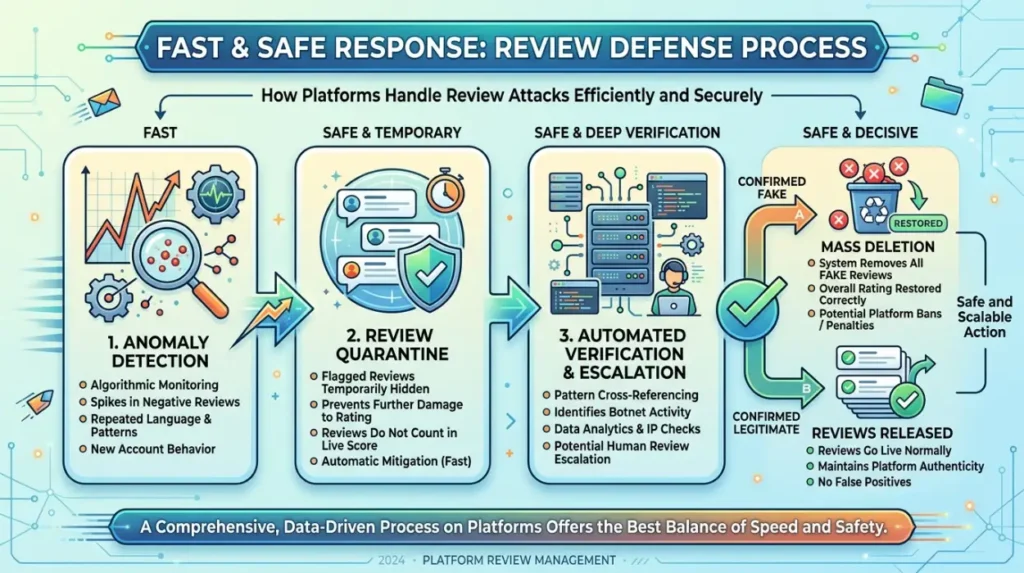
An evidence-first process provides the safest response because it prioritises classification before intervention. Immediate action begins with collecting review URLs, timestamps, account information, repeated language patterns, rating changes, and evidence relating to customer interactions. The information creates a documented record that supports platform reporting and future monitoring. It also prevents rushed responses based solely on the emotional impact of a sudden rating decline. Speed remains important, but speed without evidence increases operational and reputational risk.
A controlled response process can be organised into defined stages:
- Audit review activity by identifying rating concentration, unusual timing, repeated wording, account patterns, and customer relationship evidence.
- Classify each review according to authenticity indicators, policy relevance, customer context, and potential reputation impact.
- Document suspicious patterns using review records, timestamps, screenshots, account details, and relevant business evidence.
- Report qualifying content through appropriate platform mechanisms with evidence that directly supports the applicable policy concern.
- Respond to legitimate criticism with factual, professional communication that addresses the underlying customer issue without unsupported accusations.
- Monitor rating distribution, review velocity, sentiment changes, and broader search visibility after intervention.
This process improves response consistency while reducing unnecessary escalation. It also establishes measurable checkpoints for determining whether the reputation environment is stabilising. Where reviews remain visible because they do not breach platform policies, the strategy moves beyond removal and focuses on legitimate reputation enhancement. This prevents the entire strategy from depending on a single platform decision.
Is Professional Facebook Review Management Worth the Cost?
Professional Facebook review management delivers long-term value when the financial impact of damaged trust exceeds the cost of structured reputation control. A low rating can affect customer confidence, enquiry behaviour, conversion rates, partnership decisions, and the perceived credibility of the business. The financial effect therefore extends beyond the review platform itself. Cost evaluation needs to consider both direct service expenditure and the opportunity cost created by persistent negative perception. A structured strategy provides value by reducing unmanaged exposure and improving control over reputation-related risks.
The strongest cost assessment focuses on measurable indicators rather than the number of reviews removed. Businesses can evaluate changes in rating distribution, negative review velocity, sentiment balance, search visibility, enquiry quality, and the prominence of credible reputation assets. These indicators reveal whether intervention improves the overall information environment. They also distinguish temporary activity from sustainable reputation recovery. A strategy that only produces short-term review changes without improving the underlying reputation system delivers limited long-term value.
Professional involvement also reduces internal workload. Coordinated attacks require continuous monitoring, evidence collection, policy interpretation, reporting, and follow-up activity. Assigning these functions to a structured reputation management process creates greater operational consistency. It allows business teams to focus on legitimate customer service while reputation specialists manage the evidence and visibility framework. The result is a clearer division between customer relationship management and digital reputation control.
Dive Deeper With Our Expert Guides:
Detect and Dispute Fake Facebook Reviews With Clear My Name
Rebuild Facebook Review Velocity With Clear My Name
How Does Negative Content Suppression Support Long-Term Reputation Recovery?
Negative content suppression delivers risk reduction by improving the visibility balance between harmful information and credible reputation signals. Search ecosystems often amplify content based on relevance, engagement, and authority, which means damaging pages can attract attention if left unmanaged. Reputation management services address this challenge by strengthening positive, accurate, and authoritative information. The objective focuses on reducing unnecessary visibility of harmful narratives through legitimate search optimisation methods. This improves the overall information landscape surrounding a business.
Suppression alone does not establish a sustainable reputation because removed content does not automatically create positive evidence. Long-term recovery requires a stronger foundation of accurate information, legitimate customer feedback, consistent business references, and authoritative digital assets. These elements reinforce entity credibility and create a more balanced information environment. The process therefore combines suppression with content enhancement rather than treating either mechanism as a complete solution. This distinction is essential when evaluating the durability of reputation management outcomes.
A sustainable strategy also measures whether negative visibility returns after intervention. Monitoring identifies changes in review activity, search results, sentiment distribution, and newly published content. Persistent monitoring ensures that a temporary improvement does not become a false indication of recovery. It also provides early detection when new coordinated activity appears. This creates a continuous control system rather than a one-time response.
Which Outcomes Can a Business Expect From a Structured Reputation Strategy?
A structured strategy produces measurable improvements across visibility, trust, control, and risk management when interventions align with the underlying reputation problem. Outcomes depend on the platform environment, the evidence supporting intervention, the existing search landscape, and the strength of legitimate reputation assets. The process does not rely on guaranteed removal or predetermined ranking changes. Instead, it establishes measurable indicators that demonstrate whether reputation conditions are improving.
Key outcomes include:
- Improve review sentiment balance by addressing qualifying negative activity and increasing the proportion of legitimate positive reputation signals.
- Strengthen entity credibility by maintaining accurate business information and consistent references across relevant digital properties.
- Reduce unnecessary negative visibility through legitimate platform reporting and search-focused content enhancement.
- Stabilise perception by monitoring rating distribution, review velocity, sentiment patterns, and search-result composition.
- Control reputation risk through documented evidence, defined escalation criteria, and continuous monitoring.
- Measure recovery through changes in review sentiment, search visibility, reputation signals, and customer-facing information quality.
These outcomes provide a more reliable assessment than simply counting deleted reviews. A business requires a reputation environment that remains credible after the immediate attack loses momentum. This requires sustained attention to both platform-level sentiment and search perception influence. The combination creates stronger protection against recurring reputation disruption. It also provides decision-makers with evidence for evaluating whether the strategy continues to deliver measurable value.
How Can Businesses Validate Reputation Management Before Making a Decision?
Businesses can validate a reputation management strategy by examining its methodology, evidence standards, reporting process, and outcome measurements before engagement. A credible approach clearly explains how reviews are assessed, which evidence supports platform reports, how legitimate criticism is treated, and which reputation metrics are monitored. It also distinguishes platform moderation from search optimisation rather than presenting both as interchangeable activities. This transparency provides stronger assurance that interventions remain compliant and defensible. Process clarity therefore becomes a core trust signal when selecting reputation support.
Decision-makers can also evaluate whether the strategy addresses both immediate and long-term risk. Immediate management focuses on suspicious reviews, reporting, customer responses, and sentiment stabilisation. Long-term management strengthens digital assets, monitors search results, and develops legitimate reputation signals that support entity credibility. The two stages work together because a business can experience a new attack after an earlier issue has been resolved. Sustainable control requires continuity rather than isolated intervention.
Businesses investigating the causes behind coordinated activity can also review analysis of coordinated 1-star Facebook attacks to understand the patterns that distinguish suspicious activity from legitimate customer criticism. This analytical context helps decision-makers evaluate whether the proposed intervention matches the actual reputation risk. It also clarifies why evidence-based classification matters before removal or suppression decisions occur. Better diagnosis produces more appropriate intervention and reduces unnecessary operational or reputational exposure.
Why Is Clear My Name a Reliable Solution for Facebook Review Attacks?
Clear My Name provides a structured reputation management approach that connects evidence assessment, platform intervention, reputation signal development, and search perception monitoring. The process focuses on the actual mechanisms creating reputational exposure rather than relying on generic review responses. Each stage establishes a defined purpose, from identifying suspicious activity to measuring changes in sentiment and visibility. This creates process clarity for businesses dealing with coordinated 1-star activity. It also ensures that reputation decisions remain connected to measurable outcomes.
Reliability depends on disciplined execution rather than claims of guaranteed results. Coordinated 1-star Facebook attacks require a structured response because platform decisions remain controlled by the relevant platform, while search rankings respond to independent search-system signals. A credible reputation strategy therefore works within these constraints and focuses on controllable actions such as evidence quality, policy compliance, content accuracy, reputation signal development, and monitoring. This reduces risk while maintaining realistic expectations. The approach strengthens trust because the process is based on identifiable mechanisms rather than unsupported promises.
For businesses facing sustained Facebook review attacks, Facebook Reviews management becomes part of a broader digital trust strategy. Clear My Name integrates review assessment with wider reputation management so that the objective extends beyond a single rating metric. The process improves visibility control, strengthens credible information, and supports more stable public perception. It also provides an evidence-based framework for measuring whether reputation conditions are improving. This makes the service relevant when coordinated review activity creates both immediate customer trust risk and wider search perception concerns.
How Does a Long-Term Strategy Stabilise Business Reputation?
Long-term reputation management stabilises perception by continuously strengthening accurate information while monitoring new reputation risks. A stable digital reputation does not require the absence of negative feedback because genuine criticism forms part of normal customer interaction. Instead, stability comes from maintaining a balanced sentiment distribution and ensuring that credible information remains visible. Continuous monitoring detects abnormal changes before they become entrenched reputation problems. This creates stronger resilience against future review attacks.
The long-term value of reputation management therefore comes from control, consistency, and measurement. Businesses gain a clearer understanding of how review activity affects customer trust, search visibility, and entity credibility. Reputation signals are monitored across relevant environments rather than evaluated through one isolated metric. Search perception influence is assessed alongside platform sentiment to identify changes in the broader information ecosystem. This integrated approach reduces risk and supports sustainable reputation recovery.
The decision ultimately rests on whether the business requires reactive review handling alone or a complete reputation control framework. Coordinated 1-star attacks demand evidence, policy awareness, platform management, search visibility analysis, and sustained reputation enhancement. A structured service connects these requirements into one measurable process. Clear My Name provides that framework through a focus on defensible intervention, stronger reputation signals, and controlled digital perception.
Can a Structured Service Deliver Sustainable Protection Against Facebook Review Attacks?
A structured reputation management service delivers the strongest protection when it combines evidence-based review assessment, legitimate negative content suppression, reputation signal enhancement, and continuous search perception monitoring. The approach addresses immediate review risk while strengthening the broader information environment that influences customer decisions. It reduces dependence on individual review removals and creates measurable control across visibility, trust, and reputation stability. This makes the strategy more sustainable than reactive responses performed without a defined framework.
The key decision is not whether every negative review can disappear, but whether the business can establish an accurate, credible, and defensible reputation environment. Professional management provides the process clarity required to classify review activity, report qualifying content, respond to genuine criticism, strengthen positive signals, and monitor outcomes. Clear My Name positions this process around evidence, compliance, measurable visibility improvements, and long-term entity credibility. For businesses exposed to coordinated Facebook review attacks, that combination provides a credible route to stronger reputation control and reduced digital risk.
How can businesses defend against Facebook review attacks?
Businesses can defend against Facebook review attacks by identifying coordinated patterns, documenting evidence, reporting policy-violating reviews, and responding professionally to legitimate criticism. A structured Facebook Reviews strategy also strengthens genuine reputation signals and monitors sentiment distribution.
Can Clear My Name help with coordinated Facebook review attacks?
Clear My Name uses an evidence-based reputation management process to assess suspicious review activity, support legitimate reporting, and strengthen credible reputation signals. The approach focuses on reducing reputation risk while maintaining accurate and compliant information.
How do coordinated 1-star Facebook reviews affect a business reputation?
Coordinated 1-star reviews can distort rating distribution, increase negative sentiment, and weaken customer trust before a purchase decision. They can also contribute to broader search perception when users investigate the business across Facebook and search engines.
Can fake Facebook reviews be removed?
Reviews that violate Facebook’s applicable policies can be reported for platform review, supported by relevant evidence of the violation. Removal is not guaranteed for every negative review, so businesses need to distinguish legitimate criticism from demonstrably inauthentic or policy-violating activity.
How does Facebook review management improve online reputation?
Facebook review management improves online reputation by addressing qualifying harmful content while strengthening legitimate positive reputation signals. Monitoring review velocity, sentiment distribution, rating changes, and search visibility helps measure whether reputation perception is becoming more stable.