
Bankruptcy filings are public records that can influence how a debt lawyer is represented and interpreted across search results. Reputation management is the process of analysing, monitoring, and influencing the information that shapes an entity’s perceived credibility across digital environments.
What Does Online Reputation Mean for a Debt Lawyer?
Online reputation refers to the collection of information, signals, associations, and interpretations connected to a lawyer or law firm across digital search ecosystems. It includes public records, professional profiles, legal directories, reviews, published articles, regulatory information, social media references, and other indexed content. Search engines process these sources as separate documents while users interpret them as parts of a broader professional identity. Entity perception therefore develops through the relationship between individual pages, recurring facts, source authority, and the context surrounding the lawyer’s name. A debt lawyer’s online reputation is consequently influenced by both the existence of information and the way that information appears within search visibility.
Why Do Bankruptcy Filings Become Relevant to a Lawyer’s Search Reputation?

Bankruptcy filings become relevant because public records create independently published information associated with identifiable individuals and legal entities. A bankruptcy record typically contains structured factual information connected to a court proceeding, creating a document that can enter public databases, legal indexes, news archives, and specialised record systems. When information from these sources becomes indexed, search engines associate textual references with the relevant entity. This process does not automatically establish a negative professional judgement, but it introduces a reputation signal that users can encounter during SERP evaluation. The perceived significance of the filing therefore depends on its context, source authority, prominence, freshness, and relationship to other information about the lawyer.
Dive Deeper With Our Expert Guides:
What Real Estate Attorneys Should Know About Zillow-Era Client Research
How Tax Lawyers Lose Clients to Weak Online Credibility
How Do Public Records Influence Search Engine Entity Perception?
Public records influence entity perception through information association, indexing, and source-level evaluation. Search engines analyse textual relationships between names, organisations, locations, legal subjects, and documents to understand which entities a page describes. A bankruptcy filing containing a lawyer’s name therefore contributes information to the broader entity representation when the record is indexed and connected to that individual. Authority signals also influence how the information is evaluated because established legal, governmental, and institutional sources carry identifiable contextual characteristics. Search systems use these relationships to construct relevance and ranking signals rather than treating every document as an isolated reference.
How Does Content Indexing Affect the Visibility of Bankruptcy Information?
Content indexing determines whether information contained within a public record becomes available for retrieval through search queries. Indexing refers to the process through which search engines discover, process, and store information from accessible web documents for potential inclusion in search results. A bankruptcy-related document that enters an index becomes part of the searchable information environment surrounding the associated entity. Its visibility then depends on factors including query relevance, source authority, content structure, competition, and search demand. Content indexing therefore creates the technical connection between a public record and the possibility of that record appearing when someone searches for a debt lawyer’s name.
How Do Search Results Interpret Public-Record Information?
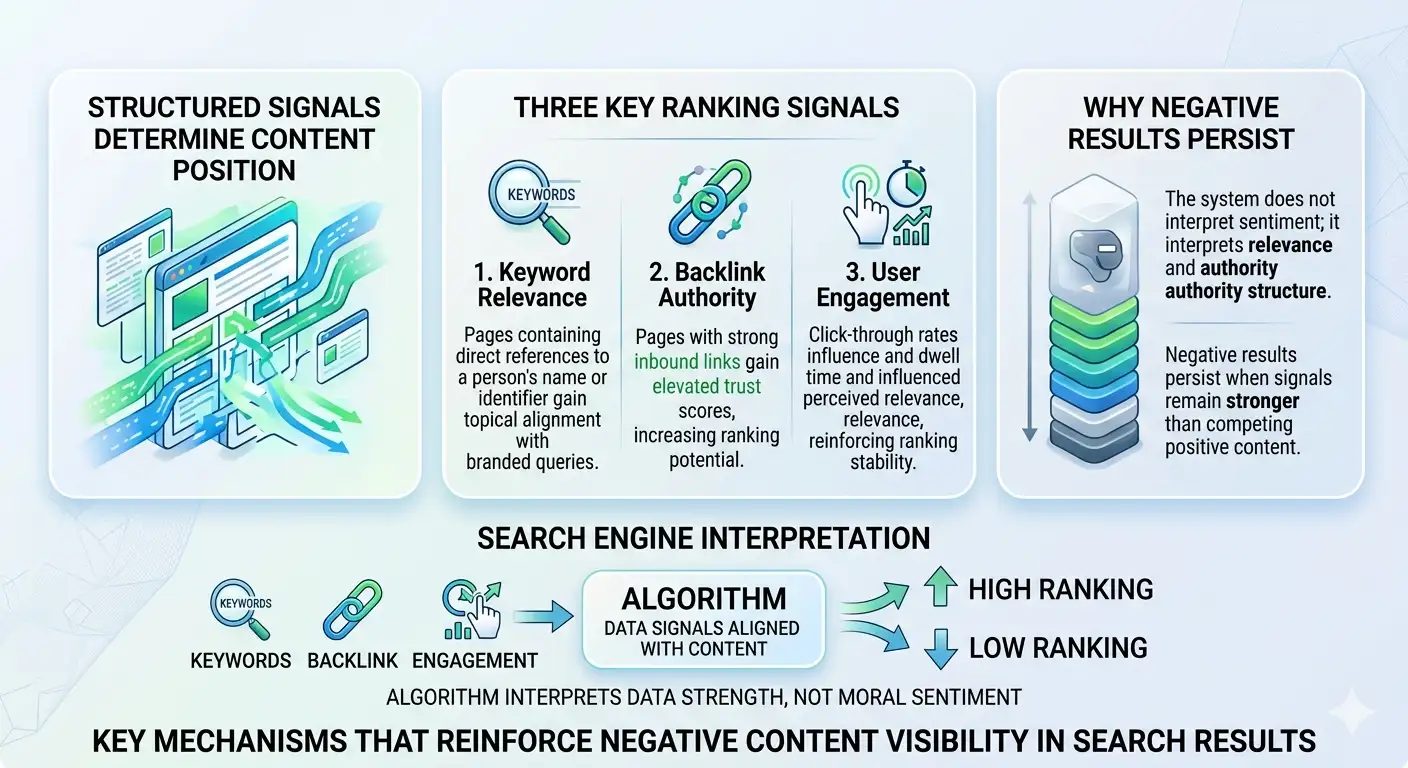
Search results interpret public-record information through relevance, authority, context, and relationships between entities and documents. A search engine evaluates whether a document satisfies the intent behind a query and determines how strongly its content corresponds with the searched entity. The ranking process does not represent a simple judgement of whether information is positive or negative. Instead, SERP evaluation considers the relationship between the query, document content, source characteristics, and other ranking signals. A bankruptcy filing therefore competes with professional biographies, law firm pages, legal publications, reviews, interviews, directories, and other authoritative references within the same search environment.
How Do Reviews Interact With Public-Record Reputation Signals?
Reviews provide a different type of reputation signal because they communicate user-generated assessments rather than court-record information. Review systems contain sentiment, language patterns, ratings, reviewer context, and recurring themes that search engines and users interpret differently from structured public records. Positive or negative sentiment contributes contextual information about perceived service quality, professionalism, responsiveness, and client experience. Public records instead provide documentary information associated with legal or administrative events. When both content types appear within search results, users evaluate them as components of the same entity landscape even though their underlying information structures differ.
Why Do Authority and Trust Signals Matter in Bankruptcy-Related Search Results?
Authority and trust signals matter because search ecosystems distinguish between sources according to their reliability, relevance, reputation, and contextual relationship to a subject. Government databases, courts, established legal publications, recognised professional organisations, and authoritative directories possess different source characteristics from anonymous websites or low-quality content platforms. These differences influence how information participates in content ranking dynamics. A factual bankruptcy record therefore does not carry the same search characteristics as an unsupported allegation published on an unrelated website. Understanding source authority separates the existence of information from the credibility and visibility assigned to that information within search results.
How Does Search Visibility Shape a Debt Lawyer’s Professional Image?
Search visibility shapes professional image because users frequently encounter search results before reviewing deeper information about a lawyer. The first page of a branded search creates an information environment containing professional credentials, publications, reviews, directory profiles, public records, and other references. Users interpret these sources through relevance, prominence, consistency, and perceived authority. A prominent bankruptcy-related result can therefore become part of the initial entity perception even when other professional information provides broader context. Search visibility does not create the underlying event; it determines how easily that information enters the user’s evaluation process.
How Does Context Change the Meaning of a Bankruptcy Filing?

Context changes the interpretation of a bankruptcy filing by distinguishing the factual event from assumptions about professional competence. A public record establishes that a documented proceeding exists, while surrounding information determines how users understand its relevance to the lawyer’s professional identity. The same record can appear alongside authoritative professional information, explanatory material, legal credentials, and unrelated personal references. Search engines organise these documents according to relevance and ranking signals, while users construct meaning from the visible collection of results. Context therefore functions as a critical reputation signal because isolated information rarely represents the full semantic structure of an entity.
What Role Does Digital Footprint Analysis Play in Understanding a Lawyer’s Reputation?
Digital footprint analysis is the systematic examination of online information associated with an identifiable person, organisation, or professional entity. It identifies where information originates, how it is indexed, which entities it references, and how prominently it appears within search results. For a debt lawyer, the footprint can include professional websites, legal directories, reviews, court-related records, publications, interviews, social profiles, and third-party references. Analysing this footprint reveals the distribution of reputation signals across different sources and content types. It also demonstrates whether search visibility reflects professional expertise, public-record information, review sentiment, or a combination of these elements.
How Can Public-Record Visibility Be Analysed Without Changing the Underlying Record?
Public-record visibility can be analysed by examining indexing status, ranking position, source authority, query relevance, and the surrounding search-result ecosystem. The underlying public record remains a factual source, while analysis focuses on how that source is presented and discovered through search. Researchers can compare branded searches, related legal queries, directory references, professional pages, and public-record results to identify patterns in entity visibility. This process distinguishes factual documentation from interpretation and separates source-level authority from user-generated commentary. Managing Public-Record Visibility for Bankruptcy and Debt Lawyers therefore represents a search-analysis concept centred on understanding how public information enters and operates within the wider reputation system.
How Does SERP Evaluation Connect Public Records With Professional Credibility?
SERP evaluation connects public records with professional credibility through the information users encounter when assessing an entity. Search engines rank documents according to relevance and other ranking mechanisms, while users compare visible sources to form an overall understanding of the lawyer. Professional credentials, authoritative publications, reviews, legal directories, and public records each provide different reputation signals. Their combined visibility creates an information landscape that influences how the entity is interpreted. Professional credibility therefore exists within a wider digital information structure rather than within a single search result or isolated document.
What Does Bankruptcy-Related Search Visibility Reveal About Online Credibility?
Bankruptcy-related search visibility reveals how factual public information interacts with broader signals of online credibility. Online credibility refers to the perceived reliability and professional trustworthiness derived from the quality, consistency, authority, and context of available information. A public bankruptcy record forms one factual component of that information environment, while professional sources provide additional evidence about expertise and identity. Search engines organise these sources through content indexing and ranking systems rather than assigning a single reputation score to the lawyer. The resulting SERP therefore reflects an interaction between documented information, source authority, entity relationships, and user search intent.
How Do Bankruptcy Filings Shape a Debt Lawyer’s Digital Reputation?
Bankruptcy filings shape a debt lawyer’s digital reputation primarily through their visibility, indexing, context, and relationship with other entity-level information. A public record provides factual information, while search engines determine how that information participates in search visibility through ranking and relevance systems. Reviews contribute sentiment signals, professional publications contribute authority signals, and legal directories contribute structured identity information. Users interpret these sources collectively when evaluating online credibility and professional identity. Understanding these mechanisms explains why reputation analysis focuses not only on what information exists, but also on how information is indexed, ranked, connected, and interpreted across search ecosystems.
How do bankruptcy filings affect a debt lawyer’s online reputation?
Bankruptcy filings can become reputation signals when public records are indexed and appear in search results for a lawyer’s name. Their impact depends on visibility, source authority, context, and the presence of other professional information.
Are bankruptcy filings public records in the UK?
Bankruptcy information can be available through public insolvency records and related official sources in the UK. When such information is indexed online, it can become part of a lawyer’s digital footprint and influence search visibility.
Can a bankruptcy record appear in Google search results?
Yes, public bankruptcy information can appear in search results when the relevant source is accessible and indexed by search engines. Ranking depends on factors such as relevance, authority, content indexing, and the search query.
Do public records affect a lawyer’s professional credibility online?
Public records can influence online credibility because users often assess multiple information sources when researching a lawyer. Search visibility, professional profiles, reviews, authoritative publications, and public records collectively contribute to entity perception.
How can lawyers analyse bankruptcy-related search visibility?
Lawyers can analyse branded search results, indexed public records, ranking positions, source authority, reviews, and professional references to understand their digital footprint. This identifies how public-record information interacts with broader reputation signals across search ecosystems.