

Responding to coordinated 1-star Facebook attacks requires distinguishing legitimate customer criticism from organised review activity and assessing the evidence behind each rating. Effective response strategies focus on review authenticity, policy compliance, sentiment distribution, reputation signals, and the resulting effect on public perception.
Reputation management strategies differ based on whether the objective involves addressing individual reviews, challenging coordinated activity, strengthening positive reputation signals, or improving the broader information environment. Online reputation control methods are evaluated through their effectiveness, scalability, risk exposure, sustainability, and influence on trust signals across search and social platforms.
How Does Coordinated Review Activity Differ From Genuine Negative Feedback?
Coordinated review activity is a pattern of reviews that displays behavioural or contextual characteristics inconsistent with independent customer experiences. Genuine negative feedback normally relates to a specific interaction, transaction, product, or service issue, while coordinated activity often presents repeated language, unusual timing, unrelated accounts, or concentrated rating behaviour. The distinction matters because each pattern requires a different response mechanism. Treating authentic criticism as manipulation creates unnecessary risk and can weaken entity credibility. Treating organised activity as ordinary dissatisfaction also leaves potentially damaging reputation signals unexamined.
A coordinated attack operates by creating an abnormal concentration of negative sentiment around a business entity within a short period. Facebook’s review environment then reflects a lower average rating and a greater proportion of negative sentiment, regardless of whether every contribution represents a genuine customer experience. This changes sentiment distribution at the platform level and can influence how prospective customers interpret the business. The resulting perception does not depend exclusively on individual review quality because rating volume, recency, and overall distribution also contribute to the visible reputation profile.
Which Response Approach Is More Effective: Review Removal or Reputation Enhancement?
Review removal focuses on challenging content that violates platform rules, while reputation enhancement focuses on strengthening legitimate positive information around the entity. Removal operates through policy-based reporting and evidence demonstrating that specific reviews contain prohibited or inauthentic activity. Enhancement operates by increasing the presence of genuine positive reputation signals through legitimate customer feedback, accurate business information, authoritative content, and consistent digital identity signals. These approaches address different mechanisms and therefore produce different outcomes.
Removal has greater relevance when identifiable policy violations provide a defensible basis for action. Its limitation is dependency on platform enforcement because content remains visible when it does not breach applicable rules. Reputation enhancement has greater sustainability because it does not depend on removing every negative contribution. Its limitation is that additional positive signals do not automatically neutralise coordinated activity when the underlying negative rating concentration remains prominent.
The distinction between content suppression and content enhancement is therefore important. Content suppression targets the visibility or persistence of problematic material through legitimate platform processes, whereas content enhancement strengthens competing reputation signals without attempting to manipulate platform systems. Suppression can produce a direct change when disputed content is removed. Enhancement produces a broader change in sentiment distribution and information balance over time.
Is a Reactive Response Better Than an Organic Reputation Strategy?
Reactive responses provide greater immediate relevance when a coordinated attack is actively affecting the visible review profile. A reactive approach operates by identifying suspicious reviews, documenting patterns, responding to legitimate criticism, and reporting content that breaches platform policies. Its primary strength is speed because the strategy directly addresses an emerging reputation event. Its limitation is that repeated attacks create repeated intervention requirements, increasing operational workload and risk exposure. Reactive management therefore performs best when paired with a broader reputation framework.
Organic reputation management operates by continuously developing authentic reputation signals before a significant negative event occurs. This includes encouraging legitimate customer feedback, maintaining consistent business information, publishing accurate content, and ensuring that the organisation’s digital footprint communicates a coherent identity. The mechanism is cumulative rather than event-driven. A stronger baseline of positive sentiment distribution provides greater resilience when isolated negative content appears. Organic activity therefore improves sustainability, although it does not eliminate the need for reactive assessment when policy violations or unusual review patterns emerge.
The two approaches differ primarily in timing and purpose. Reactive management responds to an identifiable reputation disturbance, while organic management builds a stronger reputation environment that reduces dependence on individual interventions. Search ranking influence also operates differently because organic authority and relevance signals accumulate across digital assets, whereas a review response primarily affects the specific platform environment. Combining both approaches creates a more comprehensive assessment framework without treating every negative review as an adversarial event.
How Do Content Creation and Content Removal Compare in Reputation Control?
Content creation strengthens the information ecosystem surrounding an entity, while content removal attempts to reduce the visibility or existence of specific problematic material. Content creation operates through relevance, authority, consistency, and usefulness, giving search engines additional information from which to interpret the entity. Content removal operates through legitimate legal, platform, or policy mechanisms when the underlying material qualifies for removal. These mechanisms therefore address different parts of the reputation problem.
The effectiveness of content creation depends on whether the new material provides meaningful reputation signals rather than repetitive promotional pages. Accurate corporate information, expert commentary, authoritative profiles, and genuine customer experiences provide stronger contextual signals than low-quality content produced solely to influence rankings. Search engines evaluate information according to factors including relevance, quality, authority, and user interaction patterns. Consequently, content enhancement does not function as a simple replacement mechanism for negative pages.
Content removal has a narrower but potentially more direct effect. When an offending review violates platform rules and is successfully removed, the associated negative signal disappears from the relevant review environment. However, removal does not automatically repair the remaining sentiment distribution or establish stronger entity credibility. A business with a damaged review profile therefore requires analysis beyond individual content decisions. Comparing both methods demonstrates that removal addresses specific harmful assets, while enhancement addresses the wider information environment.
How Does Organic Search Differ From Facebook-Based Reputation Management?
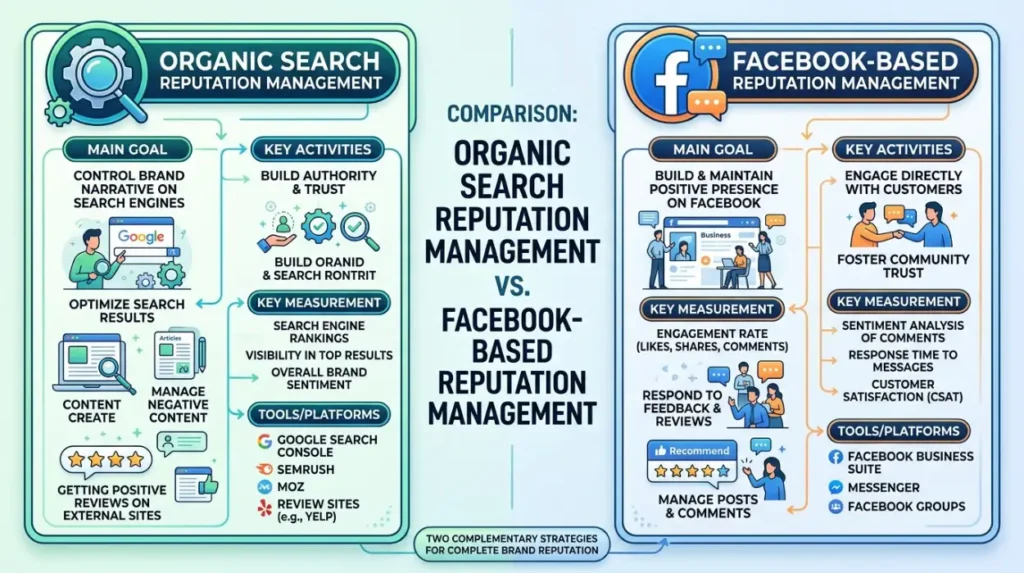
Facebook-based reputation management operates primarily within a social platform where ratings, recommendations, review text, engagement, and account behaviour contribute to visible sentiment. Organic search management operates across search results where webpages, profiles, news content, business information, and other indexed assets shape the SERP composition. The two environments overlap because users frequently move from social reviews to search engines when evaluating an organisation. Reputation signals therefore travel across channels through user behaviour and information discovery.
Search engines do not simply reproduce Facebook’s rating system as a direct ranking factor for every query. Instead, Facebook content can form part of the wider information environment associated with an entity when it is accessible, relevant, indexed, or referenced elsewhere. Search ranking influence therefore depends on the relationship between the content, the entity, the query, and the search ecosystem. A negative Facebook discussion can contribute to perception even when it does not directly determine organic rankings. This distinction prevents overestimating the technical ranking effect of individual social reviews.
The practical difference concerns SERP composition versus platform sentiment. Facebook management focuses on the distribution and legitimacy of reviews within the platform, while search-focused management analyses which assets appear when users investigate the entity through Google or other search engines. Strong reputation control evaluates both environments because users form perceptions across multiple information sources. A coordinated review attack can therefore require platform-level assessment even when the principal business concern involves broader search visibility.
Which Strategy Provides Greater Scalability and Sustainability?
A structured reputation framework provides greater scalability than repeatedly addressing individual reviews without a defined evaluation system. Scalability is the ability to apply consistent detection, classification, evidence collection, response, and monitoring processes as review volume increases. A framework can classify reviews according to legitimacy, policy compliance, relevance, sentiment, and potential risk. This reduces the dependence on ad hoc decisions for each new review. It also creates a consistent record of patterns that become more informative over time.
Short-term interventions provide faster control over individual reputation events, but their sustainability depends on recurring manual assessment and platform-specific decisions. Long-term reputation development requires continuous monitoring of sentiment distribution, review velocity, entity references, search results, and the quality of supporting information. The longer-term approach strengthens resilience because it treats reputation as an information system rather than a collection of isolated reviews. Its effectiveness is measured through stability in reputation signals rather than the disappearance of every negative statement.
A scalable evaluation process can be assessed through four mechanisms:
- Classify reviews by authenticity indicators, policy relevance, timing, language patterns, and customer relationship evidence.
- Document coordinated patterns through timestamps, account characteristics, repeated wording, rating concentration, and supporting records.
- Compare sentiment distribution before and after intervention to measure whether negative activity represents an isolated event or sustained deterioration.
- Monitor SERP composition and platform-level reputation signals to identify whether perception changes persist beyond the initial response period.
How Should Effectiveness Be Measured Across Reputation Management Approaches?
Effectiveness is measured through changes in reputation signals rather than through removal volume alone. A high number of reported reviews does not demonstrate successful reputation control if the underlying rating distribution remains unstable. Measurement therefore requires baseline data covering review volume, rating averages, sentiment distribution, review velocity, and the visibility of relevant search assets. Comparing these indicators over defined periods provides a more reliable assessment of strategic impact.
Search perception influence also requires separate measurement from platform outcomes. A review profile can improve while negative search results remain visible, or search visibility can stabilise while a platform rating continues to decline. These outcomes represent different information environments. Evaluating them together reveals whether the strategy addresses the complete reputation ecosystem or only one channel.
Risk exposure also forms part of effectiveness. Aggressive attempts to suppress legitimate criticism create policy, legal, and credibility risks that can outweigh short-term visibility improvements. A defensible approach distinguishes legitimate criticism from demonstrably coordinated or policy-violating activity. This distinction protects entity credibility while maintaining a clear basis for intervention. Sustainable reputation management therefore prioritises evidence, proportionality, platform compliance, and measurable changes in information quality.
Dive Deeper With Our Expert Guides:
How to Detect and Dispute Fake Facebook Recommendations
How to Rebuild Review Velocity on a Stagnant Facebook Page
What Is the Most Balanced Approach to Coordinated 1-Star Facebook Attacks?
The most balanced approach combines evidence-based review assessment, legitimate removal mechanisms, responsive communication, organic reputation development, and broader search perception monitoring. No single mechanism controls every part of the reputation environment because Facebook reviews, search results, third-party content, and business information operate through different systems. Removal addresses qualifying content, enhancement strengthens legitimate reputation signals, and monitoring measures changes in sentiment and visibility. This combination provides a clearer distinction between immediate incident response and long-term reputation resilience.
The strategic priority is to evaluate the source and mechanism of reputational damage before selecting an intervention. Coordinated review activity requires evidence-based classification rather than blanket rejection of negative feedback. Legitimate criticism remains part of the information environment and requires an appropriate response, while policy-violating or demonstrably inauthentic content requires a different evaluation path. The resulting strategy reduces unnecessary risk while maintaining accurate and credible information around the entity.
In this context, Facebook Review Attacks represents a specific reputation risk that requires analysis across platform activity, sentiment distribution, reputation signals, and broader search perception. The appropriate response depends on the evidence, the platform rules involved, the scale of the activity, and the relationship between social review visibility and wider SERP composition.
Which Reputation Management Approach Provides the Strongest Long-Term Control?
Coordinated 1-star Facebook attacks require a distinction between content removal, content enhancement, reactive intervention, and organic reputation development. Removal provides a direct mechanism for qualifying policy violations, while enhancement strengthens legitimate reputation signals without depending on the removal of criticism. Reactive management addresses immediate reputation disturbances, whereas organic strategies build resilience through sustained information quality and positive sentiment distribution. Search-focused analysis adds another layer by evaluating how social reputation interacts with SERP composition and entity credibility.
The strongest evaluation framework therefore measures effectiveness, scalability, sustainability, and risk exposure across both platform and search environments. Reputation management is not defined by eliminating every negative statement; it is defined by maintaining an accurate, credible, and balanced information environment while responding proportionately to demonstrable manipulation or policy violations. This approach provides a clearer basis for assessing search ranking influence, sentiment distribution, and long-term perception without confusing platform moderation with broader reputation control.
What should I do if my Facebook business page receives coordinated 1-star reviews?
First, assess whether the reviews show patterns such as unusual timing, repeated wording, unrelated accounts, or concentrated rating activity. Document the evidence and report reviews that violate Facebook’s review policies rather than treating all negative feedback as inauthentic.
Can coordinated 1-star Facebook reviews be removed?
Reviews can be reported when they breach applicable Facebook policies, including content that is demonstrably inauthentic or otherwise prohibited. Removal depends on platform review and the evidence provided, so legitimate criticism does not automatically qualify for removal.
How can I respond to fake Facebook reviews without damaging my reputation?
Respond factually to legitimate criticism while avoiding accusations that cannot be supported with evidence. For suspected coordinated activity, use documented patterns and appropriate reporting channels to protect entity credibility and reduce unnecessary risk.
Does responding to negative Facebook reviews improve online reputation?
A clear and factual response can strengthen trust signals by demonstrating transparency and addressing genuine customer concerns. However, responses alone do not remove coordinated negative sentiment, so review monitoring and broader reputation management remain relevant.
How can businesses recover from a Facebook review attack?
Recovery involves assessing review authenticity, reporting qualifying content, monitoring sentiment distribution, and developing genuine positive reputation signals. A long-term approach also evaluates search visibility and SERP composition to determine whether the negative activity affects broader online perception.