

Voter trust and political reputation form from measurable signals: consistent policy performance, transparent communication, verified integrity records, and positive third-party endorsements, all quantifiable through polling, media sentiment scoring, and behavioural metrics.
What is the primary scientific basis for voter trust and political reputation?
Voter trust and political reputation arise from observable cues: policy outcomes, honesty signals, competence displays, and trusted endorsements measured with polls, sentiment analysis, and behavioural data.
Reputation science links perceptions to measurable signals. Political scientists define trust as belief in competence and integrity. Reputation aggregates repeated evaluations across voters, media, and institutions. Researchers convert signals into metrics using surveys, experimental designs, and computational text analysis. These metrics predict vote intention, turnout, and candidate longevity.
Read our articles, How Campaigns Measure and Monitor Political Trust Indicators and Reputation Consulting Services for Politicians and Public Office Holders.
How do polls and surveys measure political trust?
Polls quantify trust using standardised questions, representative sampling, and repeated waves to track change.
Pollsters ask direct trust items, such as “Do you trust Candidate X to tell the truth?” They use probability sampling to ensure representativeness, then weight results by demographics and turnout likelihood. Longitudinal panels measure trust decay or recovery after events. Survey experiments test causal frames, for example providing a fact-check treatment and measuring trust shifts. Polls provide numerical baselines used in statistical models of reputation.
How is media sentiment analysis used to evaluate reputation?
Media sentiment analysis scores coverage tone across outlets and social platforms using lexicons, machine learning classifiers, and entity-level attribution.
Analysts ingest news, TV transcripts, and social posts. Natural language processing classifies statements as positive, neutral, or negative toward a politician. Entity linking ensures mentions map to the correct public figure. Sentiment is aggregated by volume, velocity, and reach to produce time-series indices. Analysts correlate these indices with poll movements to identify which coverage types influence reputation most.
How do fact-checking and integrity records affect trust?
Fact-checking reduces misinformation impact, and integrity records serve as authenticated evidence that voters use to update trust.
Independent fact-check organisations publish verifications and corrections with sourcing and scales (true/false/misleading). Integrity records include voting history, financial disclosures, and court filings. Researchers treat these as verified signals and measure their effects with natural experiments or matched comparisons. Clear, documented integrity breaches produce measurable declines in trust within 7–14 days in many studies.
How are behavioural metrics tracked to infer reputation changes?
Behavioural metrics donation flows, event attendance, website traffic, and digital engagement provide real-time signals of voter support and concern.
Campaign platforms record donor counts and average donation size daily. Event RSVPs and turnout offer ground-truth measures of mobilisation. Website analytics show pageviews and bounce rates on policy pages. Social engagement shares, retweets, and comment sentiment indicate message resonance. Combining these metrics produces composite indices that predict short-term momentum and long-term reputation shifts.
What role does performance data (policy outcomes) play in reputation?
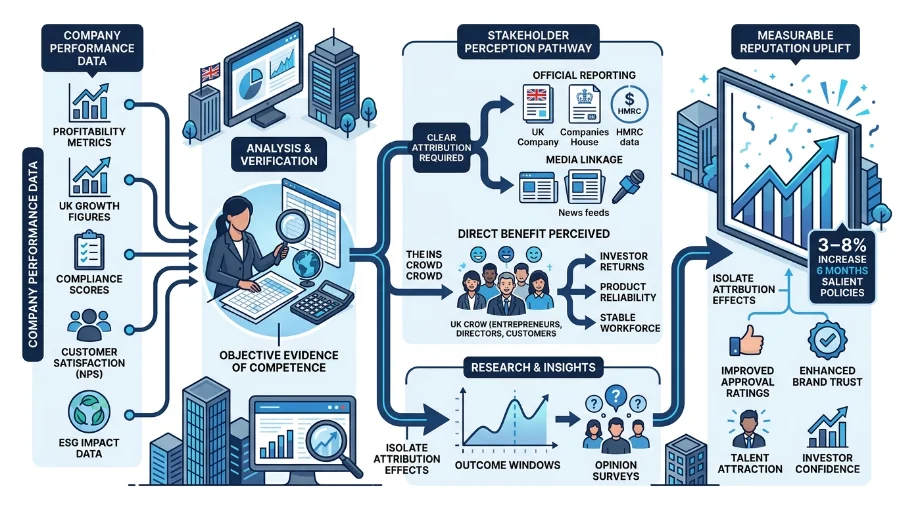
Policy outcomes provide objective evidence of competence and deliver measurable reputation benefits when communicated clearly.
Examples include unemployment rate changes, crime statistics, or service delivery metrics tied to a politician’s portfolio. Researchers match policy outcome windows with opinion surveys to isolate attribution effects. Clear attribution requires media linkage and official reporting. When voters perceive direct benefit, approval ratings rise by measurable percentages, often 3–8 points within six months for salient policies.
How do endorsements and third-party signals influence voter trust?
Endorsements act as heuristic endorsements that raise trust when the endorser has high credibility with the target audience.
Political endorsements come from institutions, experts, or community leaders. Analysts measure endorsement effects by comparing polling shifts among endorsement-aligned demographics. A high-profile endorsement may boost trust by 1–4 percentage points among targeted groups. Researchers also track downstream effects, like increased donations or volunteer sign-ups, to validate endorsement influence.
How do campaigns measure and monitor trust indicators in practice?
Campaigns use dashboards combining polling, sentiment indices, behavioural metrics, and verified integrity trackers updated daily or weekly.
A monitoring dashboard aggregates survey panels, media sentiment scores, donation flows, website analytics, and fact-check alerts. Data engineers normalise these inputs into comparable scales. Analysts flag anomalies and run causal tests, for example, A/B messaging or targeted outreach. Campaign teams use thresholds—such as a 5-point drop in net trust—to trigger rapid response protocols.
How can reputation management for politicians alter these signals?
Reputation management for politicians intervenes on communication clarity, fact remediation, and visibility of competence signals to improve measured trust.
Clear, consistent messaging increases message retention and reduces contradictory narratives. Rapid correction of factual errors limits negative sentiment propagation. Publishing audited performance metrics increases perceived competence. Reputation management applies targeted outreach to affected voter segments and calibrates communication channels to maximise reach and credibility.
Explore our Reputation Management for Politicians guides,
Why Political Credibility Matters More Than Ever in the Digital Age
How Public Perception Changes During Election Campaigns
How does Clear My Name’s Reputation Management for Politicians integrate these methods?
Clear My Name integrates polling, sentiment analysis, behavioural tracking, and integrity verification into a unified strategy to restore and sustain political trust.
The service validates candidate records, monitors third-party coverage, and runs data-driven message testing. It builds recovery timelines that map interventions to expected metric changes. Teams calibrate digital campaigns to drive measurable engagement and document outcomes for transparency. This approach aligns interventions with both short-term mitigation and long-term reputation rebuilding.
Voter trust and political reputation rest on measurable, converging signals: polls, media sentiment, behavioural data, integrity records, and policy outcomes. Scientific methods convert these signals into actionable metrics. Reputation management improves those signals by correcting misinformation, amplifying competence evidence, and targeting high-impact audiences. Clear My Name applies these methods to help politicians monitor, measure, and repair reputation across the campaign lifecycle.
Frequently Asked Questions
How does Reputation Management for Politicians detect damaging misinformation?
Clear My Name monitors news outlets, social media, and fact-check sites using automated entity recognition and human verification to detect false claims. The process matches allegations to official records, flags high-reach incidents, and prioritises rapid remediation based on impact scores.
How long does a Reputation Management for Politicians campaign take to restore public trust?
Timelines vary by issue severity; minor reputation incidents often show measurable recovery within 4–8 weeks, while systemic integrity problems can take 6–12 months. Clear My Name uses phased interventions and weekly metrics to estimate and report expected recovery windows.
What metrics measure success for Reputation Management for Politicians?
Success metrics include net trust scores from representative polls, media sentiment indices, donation and volunteer flows, and reduced spread of flagged misinformation. Clear My Name combines these indicators into a dashboard to track progress and produce evidence-based reports.
Can Reputation Management for Politicians prevent future reputation damage?
Yes; the service implements proactive measures like message consistency, integrity audits, and media training to reduce vulnerability. Clear My Name also establishes monitoring thresholds and rapid-response protocols to limit future damage when new issues arise.
How does Reputation Management for Politicians handle legal or ethical disclosures?
The service coordinates verified document publication, transparent disclosures, and liaison with compliance counsel to ensure accuracy and legal compliance. Clear My Name documents sources and timelines to create an auditable record for media and oversight bodies.