

B2B-ready Facebook Reviews strengthen the reputation signals procurement teams assess during supplier research and vendor verification.
Clear review context, credible customer feedback and controlled search visibility improve how a business entity is evaluated across digital channels.
Why Are Facebook Reviews Important for B2B Vendor Decisions?
Facebook Reviews function as publicly accessible reputation signals that contribute to a business’s digital credibility. Procurement teams increasingly assess online information alongside formal supplier documentation, company websites and professional profiles when evaluating potential vendors. Review content adds a customer-facing layer to this assessment because it reflects experiences attributed to people outside the business itself. The relevance of these signals increases when review content appears prominently for branded searches or supplier-related research. A structured Facebook Reviews profile therefore forms part of the wider information environment surrounding a business entity.
The value of Facebook Reviews comes from their relationship with other information rather than from individual ratings alone. Search users interpret review volume, sentiment, recency, response behaviour and recurring themes as connected indicators of business credibility. Positive sentiment provides supportive context, while unresolved negative themes introduce additional evaluation points during vendor research. Search engines also process publicly available review-related information as part of broader content and entity understanding. This makes Facebook Reviews relevant to both human decision-making and search perception.
The relationship between Facebook Reviews and procurement research is particularly important because B2B decisions involve perceived risk. A procurement professional evaluating a supplier wants evidence that the business delivers consistently, communicates professionally and maintains a credible market presence. Reviews cannot independently establish these characteristics, but they contribute supporting or conflicting information to the evaluation process. Consistency between Facebook Reviews, website information and other authoritative sources creates a more coherent entity profile. Contradictions across these sources increase information uncertainty and weaken confidence in the overall search environment.
Businesses that understand this relationship gain a clearer basis for evaluating their online reputation. Facebook Reviews in B2B vendor vetting provides the analytical foundation for identifying which review signals influence procurement perception. This assessment focuses on visibility, relevance, sentiment and consistency rather than treating every review as an isolated ranking factor. The objective is to understand how customer-generated content contributes to the total reputation profile. That distinction creates a more accurate framework for B2B reputation control. Facebook Reviews in B2B vendor vetting therefore connects customer-generated feedback with the broader reputation signals that procurement teams assess during supplier research.
Which Facebook Review Signals Matter Most During Procurement Checks?
The strongest Facebook Review signals are relevance, authenticity, sentiment consistency, recency and response quality. These characteristics help procurement teams interpret whether review content provides useful evidence about a supplier. A review that discusses service delivery, communication or product reliability carries greater procurement relevance than an unrelated comment. Recurring themes also carry greater analytical significance than an isolated statement because repetition establishes a stronger pattern within the available information. Review assessment therefore depends on content context rather than numerical ratings alone.
Sentiment distribution provides another important measurement. A profile containing predominantly positive feedback presents a different information environment from one containing persistent negative themes. Procurement evaluation also considers how the business responds to criticism because responses demonstrate communication standards and information governance. Clear, factual responses create additional context around disputed or incomplete feedback. The resulting reputation signal becomes a combination of customer-generated content and the organisation’s documented response.
Recency also affects interpretation because B2B buyers need information that reflects current operating conditions. Older reviews provide historical context, while recent reviews indicate how the business currently performs from the customer perspective. A balanced review profile therefore contains information that remains relevant to present-day supplier evaluation. Search visibility adds another dimension because highly visible reviews have greater exposure during branded and business-related searches. The interaction between content relevance and visibility determines how strongly a review contributes to perceived entity credibility.
How Does Facebook Review Optimisation Improve Search Perception?
Facebook Review optimisation improves search perception by strengthening the consistency and clarity of information associated with the business entity. The process does not depend on artificially manipulating sentiment or generating fabricated feedback. Instead, it focuses on accurate information, legitimate customer feedback, appropriate responses and stronger alignment between the review profile and the wider digital footprint. This creates a more coherent information structure for users researching the company. Improved coherence supports stronger entity understanding across the search ecosystem.
Search perception influence operates through the total composition of visible information. When users search for a business, they encounter a collection of pages, profiles, reviews, directories and other sources rather than a single reputation signal. Facebook Reviews form one component of this SERP environment. Their prominence, sentiment and topical relevance affect the information users encounter during research. Preparing Facebook Reviews for B2B procurement checks therefore involves evaluating how the review profile interacts with other visible sources rather than analysing Facebook independently.
A reliable optimisation process also separates legitimate review management from inappropriate content manipulation. Genuine reviews represent customer-generated information and require appropriate handling based on accuracy, platform rules and relevance. Unsupported removal attempts, fabricated responses or artificial review generation introduce credibility and compliance risks. Effective reputation management instead establishes a documented framework for assessing review content and responding through legitimate mechanisms. This approach strengthens the reliability of the wider reputation system.
Should Businesses Prioritise Review Responses or Negative Content Suppression?
Review response management provides the stronger first-line mechanism when negative content remains legitimate and platform-compliant. A professional response adds factual context, demonstrates accountability and gives future readers additional information when evaluating the original complaint. Negative content suppression addresses a different situation because it focuses on reducing the visibility of content through legitimate search optimisation or platform-based removal mechanisms where appropriate. The two approaches therefore solve different information problems. Selecting between them requires assessment of the content’s accuracy, platform status, search visibility and reputational impact.
Negative content that violates platform policies presents a distinct intervention category. False, fraudulent, impersonating or otherwise policy-infringing material requires evidence-based assessment before a removal request is pursued. Legitimate criticism does not become removable simply because it creates reputational discomfort. Treating all negative feedback as suppression material creates unnecessary risk and undermines the credibility of the reputation strategy. A structured approach therefore separates factual criticism, disputed information, policy violations and demonstrably false claims.
For businesses preparing for B2B procurement checks, this distinction has measurable value. Responses address the interpretation of visible criticism, while legitimate removal processes address content that qualifies for intervention. Content enhancement then supports the wider information environment by increasing the visibility of accurate and authoritative business information. These mechanisms operate together rather than competing as identical solutions. The appropriate combination depends on the composition of the existing SERP and the underlying source quality.
How Can a Reputation Management Service Strengthen B2B Review Credibility?
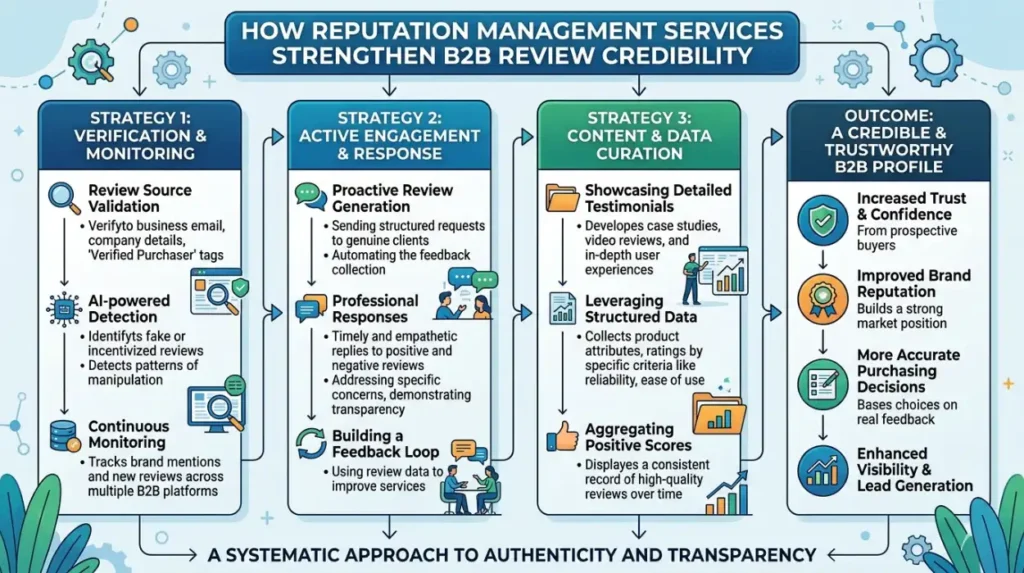
A professional reputation management service strengthens B2B review credibility through structured assessment, content analysis, reputation monitoring and search visibility control. Clear My Name applies this framework by treating Facebook Reviews as part of the wider entity reputation rather than as an isolated social profile. The process begins with identifying visible reputation signals and assessing their relevance to the business entity. Review content, sentiment patterns, search positioning and competing information then form part of the evaluation. This creates a defined basis for deciding which reputation factors require attention.
A structured process also improves consistency across the digital footprint. Business names, descriptions, service information and customer-facing statements need factual alignment across relevant online sources. Inconsistent information creates ambiguity during procurement research and reduces the clarity of entity identification. Accurate information strengthens the connection between the business, its services and its customer-generated feedback. This supports a more stable search perception when procurement teams investigate the company through multiple channels.
Process clarity is also important for risk reduction. Every review-related action requires a defined reason, evidence and expected outcome. Platform policies, content ownership, factual accuracy and search visibility all influence the appropriate response. A professional framework documents these factors before intervention rather than applying identical treatment to every negative review. This reduces unnecessary escalation and keeps reputation activity aligned with legitimate information management.
What Outcomes Can B2B-Ready Facebook Reviews Deliver?
B2B-ready Facebook Reviews deliver value by improving the clarity, consistency and credibility of information available during supplier research. The objective is not to create an artificially perfect review profile. The objective is to establish a reputation environment where legitimate customer feedback, accurate business information and professional responses provide useful evidence to prospective buyers.
A structured reputation process can deliver measurable outcomes across three areas:
- Improve visibility control by monitoring branded searches and identifying review content that occupies prominent SERP positions.
- Strengthen trust signals by maintaining accurate business information and ensuring legitimate customer feedback receives appropriate contextual responses.
- Reduce reputation risk by identifying policy-violating, inaccurate or misleading content and applying evidence-based intervention where valid.
- Stabilise entity perception by aligning Facebook information with authoritative website, directory and professional business data.
- Measure reputation change by tracking sentiment distribution, search visibility and recurring review themes over defined monitoring periods.
These outcomes work together because B2B procurement decisions rarely depend on one piece of information. A supplier’s reputation is evaluated through an interconnected information environment. Stronger consistency between reviews and authoritative sources reduces ambiguity during research. Improved visibility control also limits the dominance of isolated or misleading information within the search landscape. The result is a more coherent representation of the business entity.
Dive Deeper With Our Expert Guides:
Defend Against Facebook Review Attacks With Clear My Name
Detect and Dispute Fake Facebook Reviews With Clear My Name
How Quickly Can Facebook Review Reputation Improve?
Reputation improvement operates progressively because search visibility, content indexing and user perception respond to changes within an information ecosystem rather than through a single immediate action. Platform responses, search engine processing and the publication of accurate information follow different timelines. Removal decisions also depend on the platform and the evidence submitted. Consequently, speed is measured through defined stages rather than a single promised timeframe.
The initial stage focuses on identifying the existing reputation environment. This includes reviewing Facebook Reviews, search results, business profiles, negative themes and competing information. The next stage establishes which issues require response, correction, removal requests or content enhancement. Monitoring then measures changes in visibility, sentiment distribution and search composition. This staged process creates greater accountability than relying on an immediate change in search results.
Clear My Name places process structure around this timeline by connecting assessment, intervention and monitoring. The emphasis remains on measurable reputation signals rather than unsupported claims of instant results. This approach provides a more reliable basis for evaluating progress because each intervention has a defined purpose. B2B reputation management therefore becomes an ongoing information-control process rather than a one-time review adjustment.
Is Facebook Review Management Worth the Long-Term Investment for B2B Businesses?
Facebook Review management provides long-term value when it forms part of a broader reputation governance system. B2B procurement research continues to rely on publicly available information, which means reputation signals remain relevant after an individual review has been addressed. A one-time response does not establish long-term control over future content, search visibility or sentiment distribution. Ongoing monitoring provides the mechanism for identifying changes before they become dominant reputation signals. Sustainability therefore depends on continuous information accuracy and structured review management.
The cost-versus-value assessment also requires consideration of reputational risk. A supplier that loses credibility during procurement evaluation can face additional scrutiny, delayed decisions or reduced confidence from prospective commercial partners. These outcomes are difficult to attribute to one review because procurement perception results from a wider information set. Reputation management creates value by reducing information inconsistency and improving the quality of visible reputation signals. The commercial value therefore extends beyond the Facebook profile itself.
Long-term sustainability also depends on maintaining factual integrity. Artificial review generation, misleading responses and unsupported claims undermine entity credibility and introduce additional risk. Legitimate customer feedback, accurate business information and transparent responses create a more durable reputation foundation. Professional Facebook Reviews management therefore focuses on information quality, visibility control and consistent reputation governance. This produces a stronger basis for continued B2B vendor evaluation.
Why Is Clear My Name a Reliable Choice for B2B Facebook Review Management?
Clear My Name provides a structured approach to Facebook Reviews by connecting review assessment with broader search perception and entity credibility. The process treats reputation as an information system rather than a collection of isolated comments. Review visibility, sentiment distribution, content relevance and business information consistency form the basis of the evaluation. This structure creates clearer decision points for intervention and monitoring. It also ensures reputation activity remains connected to the wider search environment.
The strongest advantage of a structured approach is process transparency. Each reputation issue requires identification, classification, evidence assessment and an appropriate response mechanism. This prevents legitimate criticism from being treated as removable content while creating a defined route for addressing inaccurate or policy-violating material. Content enhancement then strengthens authoritative information that supports the business entity. Together, these mechanisms improve search perception without relying on exaggerated claims.
For businesses facing B2B procurement scrutiny, reputation control ultimately depends on the quality of information available to decision-makers. Clear My Name integrates Facebook Reviews into that wider reputation framework, supporting stronger visibility control and more coherent entity representation. The emphasis remains on evidence, legitimate intervention and measurable reputation signals. This establishes a practical foundation for improving trust and reducing avoidable reputation risk.
How Can Businesses Maintain B2B-Ready Facebook Reviews Over Time?
Maintaining B2B-ready Facebook Reviews requires continuous monitoring, accurate information management and consistent response standards. Review profiles change as new customers publish feedback and existing content gains or loses visibility. Search engines also update their understanding of entities and content relationships over time. These changes make ongoing monitoring essential for sustainable SERP control. A reputation strategy therefore remains active after the initial optimisation phase.
Businesses can maintain control by monitoring branded searches, reviewing new customer feedback, checking business information and assessing emerging sentiment patterns. They can also evaluate whether new content creates contradictions with authoritative company information. This monitoring identifies reputation changes before they become established search signals. Consistent documentation then provides a record of actions and outcomes. The process creates continuity between reputation management and broader digital trust governance.
The result is a reputation environment that remains aligned with current business information and procurement expectations. Accurate customer feedback remains visible, legitimate criticism receives appropriate context and qualifying problematic content receives evidence-based assessment. Search perception influence then develops through cumulative information quality rather than isolated interventions. This provides the strongest foundation for sustained entity credibility in B2B markets.
What Makes Facebook Reviews B2B-Ready?
B2B-ready Facebook Reviews depend on credible customer feedback, accurate business information, professional responses and controlled search visibility. Procurement teams evaluate suppliers through interconnected reputation signals, making consistency across the digital footprint an important component of entity credibility. Effective management therefore combines review analysis, legitimate intervention, content enhancement and ongoing monitoring.
The decision is not simply whether a business has positive or negative reviews. The more important question is whether the available information provides a coherent, accurate and trustworthy representation of the entity. Clear My Name approaches Facebook Reviews through this wider search perception framework, connecting visibility control with reputation governance and risk reduction. A structured process delivers clearer measurement, stronger information consistency and sustainable reputation control without relying on exaggerated outcomes.
How can Facebook Reviews help with B2B procurement checks?
Facebook Reviews provide customer-generated reputation signals that procurement teams can consider when evaluating a supplier’s credibility. Review sentiment, relevance, recency and response quality contribute to the wider online reputation profile.
What makes Facebook Reviews B2B-ready?
B2B-ready Facebook Reviews present relevant, authentic and consistently managed customer feedback alongside accurate business information. Clear review context and professional responses help procurement teams evaluate the business more effectively.
Do Facebook Reviews affect B2B vendor credibility?
Facebook Reviews can influence perceived vendor credibility because they provide publicly accessible evidence about customer experiences. Consistent positive sentiment and professional review responses strengthen the overall reputation signals associated with a business.
How should businesses manage negative Facebook Reviews before procurement checks?
Businesses can assess whether negative reviews are accurate, policy-compliant and relevant before deciding on an appropriate response. Legitimate criticism can receive a professional response, while content that violates platform rules can be assessed for legitimate removal.
Can Clear My Name help businesses manage Facebook Reviews for B2B buyers?
Clear My Name provides Facebook Reviews management focused on review visibility, reputation signals, content assessment and online credibility. The approach connects review management with broader search perception and B2B vendor evaluation.